From Surf Wiki (app.surf) — the open knowledge base
Electronic gear-shifting system
Method of changing gears on a bicycle

Method of changing gears on a bicycle
An electronic gear-shifting system is a method of changing gears on a bicycle, which enables riders to shift with electronic switches instead of using conventional control levers and mechanical cables. The switches are connected by wire or wirelessly to a battery pack and to a small electric motor that drives the derailleur, switching the chain from cog to cog. An electronic system can switch gears faster and, because the system does not use Bowden cables and can calibrate itself, it may require less maintenance.
History


In 1990, the Japanese bike component manufacturer SunTour introduced the Browning Electronic AccuShift Transmission (SunTour BEAST) - a triple crankset/chainset system for mountain bikes in which one quarter of the circle is hinged along a radius. During shifting, this segment is pushed sideways by a relay operated mechanism like a railroad switch and picks up the chain that is currently running on the next cog.
In 1992 the French manufacturer Mavic introduced their first electronically controlled gear shift mechanism called Zap at the 1992 Tour de France. It was a prototype, but it achieved neither technical success nor commercial application. A development of this was used by Chris Boardman to win the opening time trial (prologue) of the 1997 Tour de France.
In 1994 Sachs introduced the Speedtronic.[[File:Deragliatore elettronico.jpg|thumb|upright|Mavic Mektronic rear derailleur]]In 1999 Mavic introduced the Mektronic, its second electronic shift system, which suffered from reliability issues and was subsequently discontinued.
In 2001 Shimano introduced a set of trekking components called Di2 (Digital Integrated Intelligence), which included electronic shifting and automatic adaption of front and rear derailleur to riding speed.
During the 2000s both Shimano and Campagnolo (2005) experimented with electronic shifting in professional cycle races.
The first commercially successful electronic gear shift system for road bicycles was introduced by Shimano in 2009, the Di2. Three professional teams used the Di2 in the 2009 Tour of California: Columbia High Road, Garmin Slipstream, and Rabobank; and several teams and riders, including George Hincapie, used it during the 2009 Tour de France
Also in 2009 Giant released a bicycle equipped with the Shimano Di2 and Trek began providing a battery mount and Di2-specific cable routing and stops on its Madone frames.
In 2015 SRAM announced its wireless electronic groupset called, SRAM RED eTap. The group was released in Spring of 2016 and is available on complete bikes and through aftermarket SRAM component dealers.
A wireless system that can be retrofitted onto any bicycle was announced in 2016. The front and rear derailleurs remain in place, while a wireless gear-change controller is added to the handlebar, with configuration of the system via an iOS/Android app, and customization can be added to the button controllers via the Bluetooth app.
Implementation


As of 2009, one system was commercially available from a major parts manufacturer: Shimano's Di2 (Dura-Ace 7970) for road bicycles. While the traditional method of gear shifting uses mechanical control levers that pull and release Bowden cables and spring-loaded derailleurs, Di2 is controlled by electronic switches located either in the integrated shift levers and/or at the end of time trial bars. The switches send signals through a wiring harness to a battery pack, placed near the bottom bracket. The rechargeable lithium-ion battery pack supplies power to the derailleur motors, which move the derailleurs via worm gears. Shimano estimates that their 7.4-volt battery pack can last up to 1000 km per charge. The system also has an LED light to warn when it needs a charge.
The rear derailleur has shift times similar to mechanical systems and a break-away system to protect it in case of a crash. The front derailleur, however, switches gears almost 30% faster than Dura-Ace’s mechanical counterpart. On traditional bikes, the front derailleur is problematic because the chain can be under tension and has to make a large vertical jump between chainrings. The electronic system's controlled motion overcomes these problems. The Di2 can also trim the front derailleur to eliminate chain rub and calibrate itself to adjust for wear and tear. Finally, the entire 7970 groupset weighs approximately 113 g less than the 7800 it replaces but 68 g more than the new 7900.
In 2011 Shimano introduced the Ultegra Di2 electronic gear change set, a cheaper version of the electronic Dura-Ace system. This set seemed to provide an electronic option within reach of a wider audience.
Campagnolo introduced their first system of electronic shifting, EPS, in the same year. By 2012 Campagnolo had three electronic shifting groupsets available. Cyclists began to see a growing range of electronic alternatives to traditional mechanical shifting for derailleur gears.
File:Shimano Di2 9070 Back EN.jpg|Parts of a wired system - rear File:Shimano Di2 9070 Front EN.jpg|Parts of a wired system - front
Wireless shifting
.jpg)
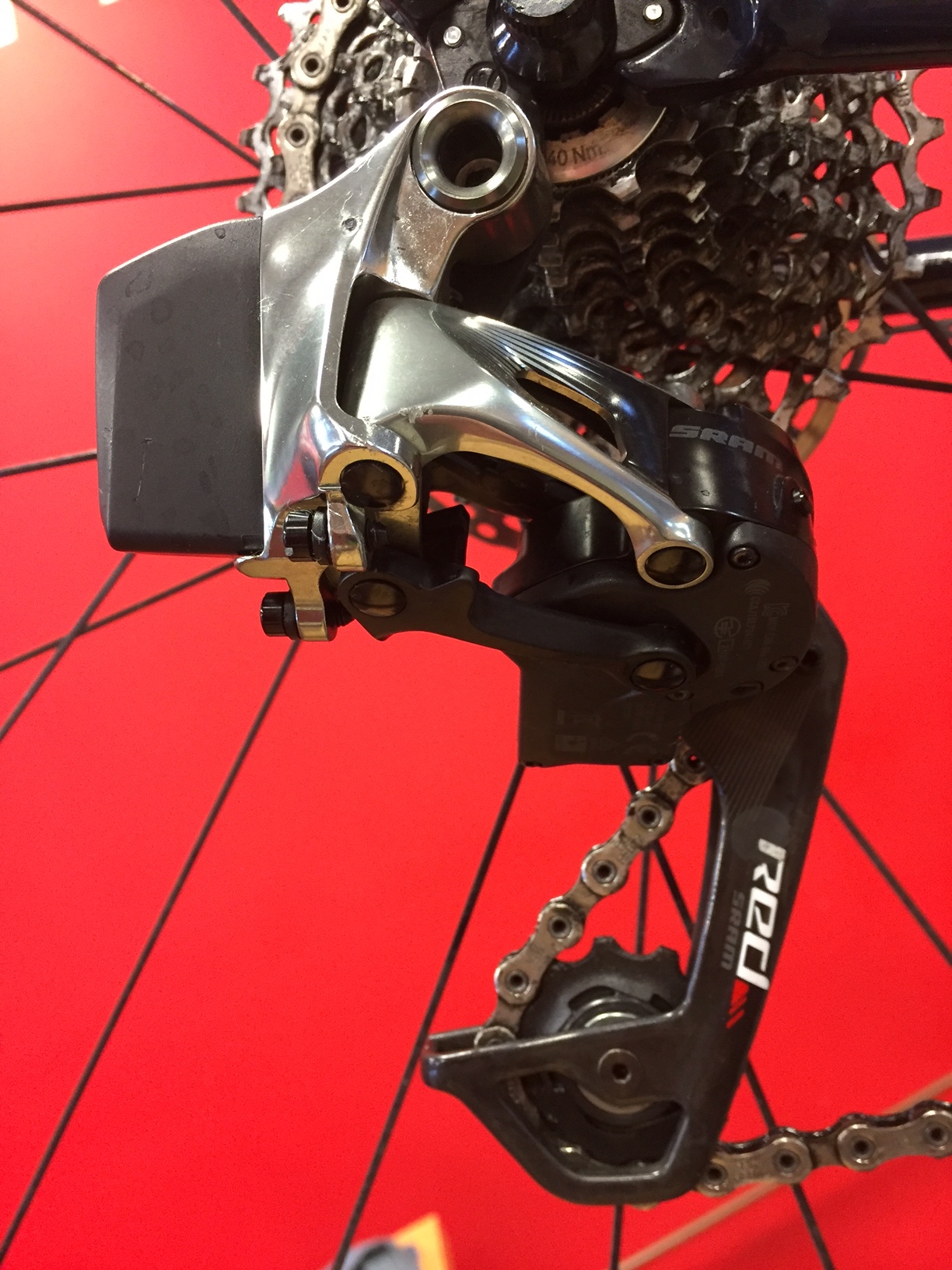

In August 2015 SRAM Corporation announced its wireless shifting system, eTap. The system had been extensively developed and secretly tested over several years from initial design to a stage win in the 2015 Tour de France. The front and rear derailleurs use direct-mount batteries and communicate wirelessly with the shifters through a proprietary wireless protocol developed by SRAM called, Airea (pronounced: area). A set of small satellite shifter buttons, called Blips, can be connected to the shift levers or aero shift module (BlipBox) and placed anywhere along the handlebars as part of the system. A maximum of four Blips can be used per bike. The company also took the opportunity to introduce a new shifting convention with this system. The right lever shifts the rear derailleur outboard, the left lever shifts the rear derailleur inboard, and pressing both levers together shifts the front derailleur. SRAM made the groupset available for purchase on complete bikes and as aftermarket components sold through dealers from Spring 2016. Eventually, extension of the system is expected to the company's lower group sets, such as SRAM Force. In May 2016 the company announced a hydraulic disc brake version of its wireless road group called SRAM RED eTap HRD. The new brakes make use of a hydraulic lever design with both lever reach adjustment and lever contact point adjustment, a first for road disc brakes.
Advantages and disadvantages
An electronic system can have several advantages over a comparable mechanical system:
- eliminate the need for the rider to switch hand positions in order to shift
- allow for an accurate and effortless shift, even in difficult circumstances, such as if the rider has cold hands or is completely exhausted
- shifting performance is not affected by contaminated, stretched, or worn Bowden cables
- automatic trim function can eliminate chain rub
- shifts can be timed to occur at a particular point in the cassette or chainring rotation, making best and smoothest use of ramps and cutouts in the sprocket teeth
- the front and rear shift pattern on a bike with multiple chainrings can be programmed to make best use of the gear progression, avoid duplicate ratios and relieve the rider of the need to decide what combination of front and rear sprockets to employ
- the smoothness of electronics can reduce the shock on drivetrain components
An electronic system may have some disadvantages when compared to a mechanical system:
-
There is currently no option for manual override when the battery is exhausted. This could pose a problem for riders, depending on the type of terrain on which they are riding. However, SRAM's RED eTap groupset's interchangeable derailleur batteries makes it possible to manually switch batteries between the two derailleurs in order to place the battery with remaining charge onto the derailleur the user intends to shift.
-
Reliability issues have caused previous electronic systems to be withdrawn from the market. As of recently, all electronic group sets are fully waterproof. External connectors are completely waterproof, but internal connectors (internal routing for wired systems) need to be shrink wrapped with shrink tubing to be waterproof.
-
Cost: The system is expensive compared to lower end mechanical derailleur systems. (The Shimano Dura Ace Di2 system costs in excess of $2500 in May, 2010).
-
Weight: Electronic groupsets are typically heavier than their mechanical counterparts.
References
References
- Best, Paul. (2009-04-08). "Shimano's Dura-Ace Di2 electronic shifting to give road racers a time advantage". Gizmag.
- Michael Sweatman. (September 2025). "Browning".
- "SRAM History".
- Lennard Zinn. (September 2025). "Campagnolo's Magic Lives on in Vicenza".
- David Arthur. (9 July 2009). "Pro riders on Shimano Dura-Ace Di2". RoadCyclingUK.
- "TSR Advanced SL LTD". [[Giant Manufacturing]].
- "Madone 6 Series". [[Trek Bicycle Corporation]].
- "When is SRAM RED eTap available? – SRAM Road Electronic Groupset FAQ".
- "Where is SRAM RED eTap available? – SRAM Road Electronic Groupset FAQ".
- Ben Coxworth. (December 7, 2016). "The 10 best cycling innovations of 2016". New Atlas.
- Tyler Benedict. (November 2, 2016). "X-Shifter's universal wireless shifting kit goes live". Bike Rumor.
- Crowe, Paul. "Electronic Shift By Wire on Bicycle". The Kneeslider.
- James Huang. (Aug 2009). "Shimano Dura-Ace Di2 transmission". BikeRadar.com.
- Hagerman, Eric. (2008-07-31). "Shimano Shuns Cables for Full Electronic Shifting".
- Cole, Matthew. (2008-08-01). "Shimano unveils Dura-Ace Di2 electronic groupset". BikeRadar.com.
- Richard Tyler. (Jun 20, 2011). "Shimano Ultegra Di2 – First look". BikeRadar.com.
- Stephen Farrand. (Oct 25, 2010). "Campagnolo show off new electronic gear system". BikeRadar.com.
- Robin Wilmott. (Jul 17, 2012). "Campagnolo Athena EPS 11-speed launched". BikeRadar.com.
- Ben Coxworth. (December 18, 2012). "Tiso unveils wireless electronic gear-shifting for road bikes". GizMag.
- Warren Rossiter. (August 26, 2015). "SRAM Red eTap ushers in wireless shifting era". BikeRadar.
- Phillips, Matt. (9 Feb 2010). "The Shift to Electric". [[Bicycling Magazine]].
- Ian Austen. (February 13, 2009). "Cycling Enters the Electronic Age With a New Gear-Shifting System". [[The New York Times]].
- "SRAM Road Electronic Groupset FAQ Batteries Batteries". [[SRAM Corporation]].
- "The Competitive Cyclist".
- "SRAM Road Electronic Groupset FAQ Batteries Batteries". [[SRAM Corporation]].
This article was imported from Wikipedia and is available under the Creative Commons Attribution-ShareAlike 4.0 License. Content has been adapted to SurfDoc format. Original contributors can be found on the article history page.
Ask Mako anything about Electronic gear-shifting system — get instant answers, deeper analysis, and related topics.
Research with MakoFree with your Surf account
Create a free account to save articles, ask Mako questions, and organize your research.
Sign up freeThis content may have been generated or modified by AI. CloudSurf Software LLC is not responsible for the accuracy, completeness, or reliability of AI-generated content. Always verify important information from primary sources.
Report