From Surf Wiki (app.surf) — the open knowledge base
Electronic cigarette
Device that vaporizes a liquid nicotine solution for inhalation
_(retouched).jpg)
Device that vaporizes a liquid nicotine solution for inhalation
.png)
An electronic cigarette (e-cigarette) or vape{{Efn|Also known as an e-cig, vaporizer, vape pen, hookah pen, e-pipe, nic stick, razz or, formally, electronic nicotine delivery system (ENDS). often called "vaping".
The atomizer is a heating element that vaporizes a liquid solution called e-liquid that cools into an aerosol of tiny droplets, vapor and air. The vapor mainly comprises propylene glycol and/or glycerin, usually with nicotine and flavoring. Its exact composition varies, and depends on matters such as user behavior.{{Efn|A 2014 review found "In addition to the uniqueness of the liquid compositions in each brand, inconsistency of both the device performance properties and the data collection methodologies used by researchers contribute to the observed variation in constituent levels and to the range of particle size distributions among products." and most kinds are reusable.
Vaping is less harmful than smoking, but still has health risks. Vaping affects asthma. Limited evidence indicates that e-cigarettes are less addictive than smoking, with slower nicotine absorption rates.
E-cigarettes containing nicotine are more effective than nicotine replacement therapy (NRT) for smoking cessation, but have not been tested as rigorously as nicotine replacement therapy products.
Description
Main article: Construction of electronic cigarettes

An electronic cigarette consists of an atomizer, a power source such as a battery, and a container for e-liquid such as a cartridge or tank.
E-cigarettes have evolved over time, and the different designs are classified in generations. First-generation e-cigarettes tend to look like traditional cigarettes and are called "cigalikes". Second-generation devices are larger and look less like traditional cigarettes. Third-generation devices include mechanical mods and variable voltage devices. There are also pod mod devices that use protonated nicotine, rather than free-base nicotine found in earlier generations,
E-liquid
The mixture used in vapor products such as e-cigarettes is called e-liquid. E-liquid formulations vary widely. The flavorings may be natural, artificial, or organic. There are many e-liquid manufacturers, and more than 15,000 flavors.
Many countries regulate what e-liquids can contain. In the US, there are Food and Drug Administration (FDA) compulsory manufacturing standards and American E-liquid Manufacturing Standards Association (AEMSA) recommended manufacturing standards. European Union standards are published in the EU Tobacco Products Directive.
Coils
Vaping cannabis usually involves higher temperatures than nicotine.
Use
Popularity

Since entering the market around 2003, e-cigarette use has risen rapidly. In 2011 there were about 7 million adult e-cigarette users globally, increasing to 68 million in 2020 compared with 1.1 billion cigarette smokers. There was a further rise to 82 million e-cigarette users in 2021. This increase has been attributed to targeted marketing, and ecigs being cheaper and safer than combustible cigarettes. E-cigarette use is highest in China, the US, and Europe, with China having the most users.
Motivation
.jpg)
There are varied reasons for e-cigarette use. Most users are trying to quit smoking, but a large proportion of use is recreational or as an attempt to get around smoke-free laws. and some because vaping is safer than smoking. The wide choice of flavors and lower price compared to cigarettes are also important factors.
Other motivations include reduced odor and fewer stains. E-cigarettes also appeal to technophiles who enjoy customizing their devices.
Gateway theory
The gateway hypothesis is the idea that using less harmful drugs can lead to more harmful ones. Evidence shows that many users who begin by vaping will go on to also smoke traditional cigarettes. People with mental illnesses, who as a group are more susceptible to nicotine addiction, are at particularly high risk of dual use.
However, an association between vaping and subsequent smoking does not necessarily imply a causal gateway effect. Instead, people may have underlying characteristics that predispose them to both activities. There is a genetic association between smoking, vaping, gambling, promiscuity and other risk-taking behaviors. Young people with poor executive functioning use e-cigarettes, cigarettes, and alcohol at higher rates than their peers. E-cigarette users are also more likely to use both cannabis and unprescribed Adderall or Ritalin. Longitudinal studies of e-cigarettes and smoking have been criticized for failing to adequately control for these and other confounding factors.
Smoking rates have continually declined as e-cigarettes have grown in popularity, especially among young people, suggesting that there is little evidence for a gateway effect at the population level. This observation has been criticized, however, for ignoring the effect of anti-smoking interventions.
Young adult and teenage users
Worldwide, increasing numbers of young people are vaping. With access to e-cigarettes, young people's tobacco use has dropped by about 75%.
Most young e-cigarette users have never smoked, but there is a substantial minority who both vape and smoke. Many young people who would not smoke are vaping. Young people who smoke tobacco or marijuana, or who drink alcohol, are much more likely to vape. Among young people who have tried vaping, most used a flavored product the first time.
Vaping correlates with smoking among young people, even in those who would otherwise be unlikely to smoke. A 2015 study found minors had little resistance to buying e-cigarettes online. As a result, self-reporting may be lower in surveys.
More recent studies show a trend of an increasing proportion of young people who use e-cigarettes. In 2018, 20% of high school students were using e-cigarettes. In 2020, however, this number increased to 50% of high school students reported to have used e-cigarettes. Similarly, in Canada, there has been trend showing 29% of young people reporting to have used e-cigarettes in 2017, increasing to 37% in 2018.
Health effects
History
It is commonly stated that the modern e-cigarette was patented in 2003 by Chinese pharmacist Hon Lik, but tobacco companies had been developing nicotine aerosol generation devices since as early as 1963.
Early prototypes and barriers to entry: 1920s–1990s
In 1927, Joseph Robinson applied for a patent for an electronic vaporizer to be used with medicinal compounds. The patent was approved in 1930 but the device was never marketed. In 1930, the United States Patent and Trademark Office reported a patent stating, "for holding medicinal compounds which are electrically or otherwise heated to produce vapors for inhalation." In 1934 and 1936, further similar patents were applied for.
The earliest e-cigarette can be traced to American Herbert A. Gilbert. In 1963, Gilbert applied for a patent for "a smokeless non-tobacco cigarette" that involved "replacing burning tobacco and paper with heated, moist, flavored air". Gilbert's invention was ahead of its time. However, it received little attention and was never commercialized because smoking was still fashionable at that time. Gilbert said in 2013 that today's electric cigarettes follow the basic design set forth in his original patent.
The Favor cigarette, introduced in 1986 by public company Advanced Tobacco Products, was another early noncombustible product promoted as an alternative nicotine-based tobacco product. Favor was a "plastic, smoke-free product shaped and colored like a conventional cigarette that contained a filter paper soaked with liquid nicotine so users could draw a small dose by inhaling. There was no electricity, combustion, or smoke; it delivered only nicotine."
Favor cigarettes were sold in California and several Southwestern states, marketed as "an alternative to smokers, and only to smokers, to use where smoking is unacceptable or prohibited." In 1987, the FDA exercised jurisdiction over products analogous to E-Cigarettes. Advanced Tobacco Products never challenged the Warning Letter and ceased all distribution of Favor. Ray's wife Brenda Coffee coined the term vaping. Philip Morris' division NuMark, launched in 2013 the MarkTen e-cigarette that Philip Morris had been working on since 1990.
Modern electronic cigarette: 2000s
Despite these earlier efforts, Hon Lik, a Chinese pharmacist and inventor, who worked as a research pharmacist for a company producing ginseng products, is frequently credited with the invention of the modern e-cigarette. This design creates a smoke-like vapor.

Hon Lik registered a patent for the modern e-cigarette design in 2003. The e-cigarette was first introduced to the Chinese domestic market in 2004. The company that Hon worked for, Golden Dragon Holdings, registered an international patent in November 2007. The company changed its name to Ruyan (如烟, literally "like smoke"
Many e-cigarette makers copied his designs illegally, so Hon didn't receive all of the financial reward for his invention. In 2009 his company successfully sued a competitor in China, and after getting a US patent in 2012, they launched patent infringement lawsuits against multiple US companies. In 2013 his company sold its e-vapor business to Imperial Brands for 75 million USD. As of 2014, most e-cigarettes used a battery-powered heating element rather than the earlier ultrasonic technology design.
Initially, their performance did not meet the expectations of users. This is a mechanism that integrates the heating coil into the liquid chamber. and the design is now widely adopted by most "cigalike" brands. This device generated a lot of interest, as it let the user to vape for hours at one time. Other enthusiasts built their own mods to improve functionality or aesthetics. When pictures of mods appeared at online vaping forums many people wanted them, so some mod makers produced more for sale.
These mods led to demand for customizable e-cigarettes, prompting manufacturers to produce devices with interchangeable components that could be selected by the user. In 2009, Joyetech developed the eGo series which offered the power of the screwdriver model and a user-activated switch to a wide market. The clearomizer was invented in 2009. Originating from the cartomizer design, it contained the wicking material, an e-liquid chamber, and an atomizer coil within a single clear component. The clearomizer allows the user to monitor the liquid level in the device. Soon after the clearomizer reached the market, replaceable atomizer coils and variable voltage batteries were introduced. Clearomizers and eGo batteries became the best-selling customizable e-cigarette components in early 2012. From the mid-2010s onward, the vaping industry saw rapid innovation, with devices becoming more compact, powerful, and specialized. Pod-based systems such as Juul popularized nicotine salt e-liquids, offering a stronger and smoother nicotine delivery. At the same time, vaping technology expanded beyond nicotine use. Many modern vaporizers are now designed to heat cannabis oils, distillates, or dry herbs, reflecting a broader shift in consumer preferences. These “cannabis vaporizers” operate similarly to e-cigarettes but are engineered for cannabis consumption rather than nicotine-based e-liquids. The growing legal cannabis market has further influenced vape technology, with industry sources such as Smokeland discussing different vape cartridge types, their effects, and user preferences.
International growth: 2010s
The market for electronic cigarettes rose rapidly during the early 2010s and it started gaining attention in mainstream media. In the United States, some of the most notable start-ups in the market were blu eCigs, NJOY, V2 Cigs, and Logic, as of 2013. International tobacco companies dismissed e-cigarettes as a fad at first. However, recognizing the development of a potential new market sector that could render traditional tobacco products obsolete, they began to produce and market their own brands of e-cigarettes and acquire existing e-cigarette companies. The large tobacco companies bought some of the established e-cigarette companies. blu eCigs, a prominent US e-cigarette manufacturer, was acquired by Lorillard Inc. for $135 million in April 2012. Japan Tobacco invested in Ploom. British American Tobacco was the first tobacco business to sell e-cigarettes in the UK and launched the e-cigarette Vype in July 2013. Imperial Tobacco's Fontem Ventures acquired the intellectual property owned by Hon Lik through Dragonite International Limited for $US 75 million in 2013 and launched Puritane in partnership with Boots UK. On 1 October 2013 Lorillard Inc. acquired another e-cigarette company, this time the UK based company SKYCIG. SKY was rebranded as blu.[[File:All e-cigarettes vs. Juul.jpg|thumb|Various e-cigarettes from 2018. From left to right: Phix, Juno, Von Erl, [[Juul]]]] On 3 February 2014, Altria Group, Inc. acquired popular e-cigarette brand Green Smoke{{Efn|Altria no longer sells e-cigarettes. for $110 million. The deal was finalized in April 2014 for $110 million with $20 million in incentive payments. Altria also markets its own e-cigarette, the MarkTen, while Reynolds American has entered the sector with its Vuse product. On 30 April 2015, Japan Tobacco bought the US Logic e-cigarette brand. On 15 July 2014, Lorillard sold blu to Imperial Tobacco as part of a deal for $7.1 billion.
Following these changes, the main players in the e-cigarette market (at least in the US) were as follows (as of end 2015):
| Company | Brand(s) |
|---|---|
| Reynolds American, Inc. | Vuse |
| Fontem (Imperial Brands) | Blu |
| Japan Tobacco International | Logic |
| Altria Group | MarkTen, Green Smoke |
| CB Distributors | 21st Century Smoke |
| Njoy, Inc. | NJOY |
| Ballantyne Brands, Inc. | Mistic, NEO |
| VMR Products | V2, Vapor Couture |
| Nicotek | Metro |
| FIN Branding Group | FIN |
Despite the acquisitions by big tobacco companies, some independent e-cigarette companies had more success, most notably Juul Labs, as of 2018.
, 95% of e-cigarettes were made in China. Despite international growth of e-cigarettes during the 2010s, not all regions around the world have yet embraced it as much. In 2018, Indonesia became only one of the first in Asia or the Global South to recognise e-cigarettes as a genuine alternative to smoking tobacco.
Established: 2020s
In the United States between 2020 and 2022, the number of e-cigarettes sold had climbed to 22.7 million units. Elf Bar/EBDESIGN, Vuse, JUUL, NJOY and Breeze Smoke were recognized as the five most popular brands as of December 2022. The surge was driven by non-tobacco flavors such as menthol (for prefilled cartridges) and fruit and candy (for disposables), according to the CDC's health economist Fatma Romeh Ali.
In the UK, where most vaping uses refillable sets and e-liquid, there is now support from the National Health Service, and other medical bodies now embrace the use of e-cigarettes as a viable way to quit smoking. This has contributed to record numbers of people vaping, with estimated 3.6 million in 2019, 3.2 million in 2020, rising to 3.6 million in 2021. Current vapers being 2.2 million as of 2024.
Society and culture


Consumers have shown passionate support for e-cigarettes that other nicotine replacement products did not receive. They have a mass appeal that could challenge combustible tobacco's market position.
By 2013, a subculture had emerged calling itself "the vaping community". Members often see e-cigarettes as a safer alternative to smoking, and some view it as a hobby. The online forum E-Cig-Reviews.com was one of the first major communities. There are also groups on Facebook and Reddit. Online forums based around modding have grown in the vaping community.
Vapers embrace activities associated with e-cigarettes and sometimes evangelise for them. E-cigarette companies have a substantial online presence, and there are many individual vapers who blog and tweet about e-cigarette related products.
Contempt for Big Tobacco is part of vaping culture. A 2014 review stated that tobacco and e-cigarette companies interact with consumers for their policy agenda. Tobacco companies have worked with organizations conceived to promote e-cigarette use, and these organizations have worked to hamper legislation intended at restricting e-cigarette use.
.jpg)
Large gatherings of vapers, called vape meets, take place around the US. Some vape shops have a vape bar where patrons can test out different e-liquids and socialize. The Electronic Cigarette Convention in North America which started in 2013, is an annual show where companies and consumers meet up.
A subclass of vapers configure their atomizers to produce large amounts of vapor by using low-resistance heating coils. This practice is called "cloud-chasing". By using a coil with very low resistance, the batteries are stressed to a potentially unsafe extent. As vaping comes under increased scrutiny, some members of the vaping community have voiced their concerns about cloud-chasing, stating the practice gives vapers a bad reputation when doing it in public. The Oxford Dictionaries' word of the year for 2014 was "vape".
Regulation
Main article: Regulation of electronic cigarettes, List of vaping bans in the United States

Regulation of e-cigarettes varies across countries and states, ranging from no regulation to banning them entirely. For instance, e-cigarettes containing nicotine are illegal in Japan, forcing the market to use heated tobacco products for cigarette alternatives. Others have introduced strict restrictions and some have licensed devices as medicines such as in the UK. , around two thirds of major nations have regulated e-cigarettes in some way.
Because of the potential relationship with tobacco laws and medical drug policies, e-cigarette legislation is being debated in many countries. The companies that make e-cigarettes have been pushing for laws that support their interests. In 2016 the US Department of Transportation banned the use of e-cigarettes on commercial flights. In 2018, the Royal College of Physicians asked that a balance is found in regulations over e-cigarettes that ensure product safety while encouraging smokers to use them instead of tobacco, as well as keep an eye on any effects contrary to the control agencies for tobacco.
The legal status of e-cigarettes is currently pending in many countries. and India have banned e-cigarettes. In June 2025, Pakistan banned e-cigarettes in the province of Punjab, though the decision was reversed the next month. Canada-wide in 2014, they were technically illegal to sell, as no nicotine-containing e-cigarettes are not regulated by Health Canada, but this is generally unenforced and they are commonly available for sale Canada-wide. In 2016, Health Canada announced plans to regulate vaping products. In the US and the UK, the use and sale to adults of e-cigarettes are legal. The revised EU Tobacco Products Directive came into effect in May 2016, providing stricter regulations for e-cigarettes. It limits e-cigarette advertising in print, on television and radio, along with reducing the level of nicotine in liquids and reducing the flavors used. It does not ban vaping in public places. It requires the purchaser for e-cigarettes to be at least 18 and does not permit buying them for anyone less than 18 years of age. The updated Tobacco Products Directive has been disputed by tobacco lobbyists whose businesses could be impacted by these revisions.
The US FDA regulates e-cigarettes, e-liquid and all related products. It evaluates ingredients, product features and health risks, as well their appeal to minors and non-users. and their sale in all-ages vending machines is not permitted in the US.
In 2016, the US FDA used its authority under the Family Smoking Prevention and Tobacco Control Act to deem e-cigarette devices and e-liquids to be tobacco products, which meant it intended to regulate the marketing, labelling, and manufacture of devices and liquids; vape shops that mix e-liquids or make or modify devices were considered manufacturing sites that needed to register with US FDA and comply with good manufacturing practice regulation. E-cigarette and tobacco companies recruited lobbyists in an effort to prevent the US FDA from evaluating e-cigarette products or banning existing products already on the market.
In February 2014, the European Parliament passed regulations requiring standardization and quality control for liquids and vaporizers, disclosure of ingredients in liquids, and child-proofing and tamper-proofing for liquid packaging. In April 2014 the US FDA published proposed regulations for e-cigarettes. In the US some states tax e-cigarettes as tobacco products, and some state and regional governments have broadened their indoor smoking bans to include e-cigarettes. , 12 US states and 615 localities had prohibited the use of e-cigarettes in venues in which traditional cigarette smoking was prohibited.
In November 2020, the New Zealand government passed a vaping regulation that requires vape stores to register as specialist vape retailers before they can sell e-cigarettes, the wider range of flavoured e-liquids, and other related vaping products. Vaping products are required to be notified by the government before they can be sold to ensure that the products are following safety requirements and ingredients in liquids do not contain prohibited substances.
E-cigarettes containing nicotine have been listed as drug delivery devices in a number of countries, and the marketing of such products has been restricted or put on hold until safety and efficacy clinical trials are conclusive. Since they do not contain tobacco, television advertising in the US is not restricted. Some countries have regulated e-cigarettes as a medical product even though they have not approved them as a smoking cessation aid. A 2014 review stated the emerging phenomenon of e-cigarettes has raised concerns in the health community, governments, and the general public and recommended that e-cigarettes should be regulated to protect consumers. It added, "heavy regulation by restricting access to e-cigarettes would just encourage continuing use of much unhealthier tobacco smoking." A 2014 review said regulation of the e-cigarette should be considered on the basis of reported adverse health effects.
Criticism of vaping bans
Vaping is much safer than smoking, and critics of vaping bans say that they incentivize people to return to smoking. Additionally, San Francisco's chief economist, Ted Egan, when discussing the San Francisco vaping ban said that the city's ban on e-cigarette sales would increase smoking as vapers switch to combustible cigarettes. Critics of smoking bans stress the absurdity of criminalizing the sale of a safer alternative to tobacco while tobacco continues to be legal. Prominent proponents of smoking bans are not in favor of criminalizing tobacco either, but rather allowing consumers to have the choice to choose whatever products they desire.
In 2022, after two years of review, the Food and Drug Administration (FDA) denied Juul's application to keep its tobacco and menthol flavored vaping products on the market. Critics of this denial note that research published in Nicotine and Tobacco Research found that smokers who transitioned to Juuls in North America were significantly more likely to switch to vaping than those in the United Kingdom who only had access to lower-strength nicotine products. They also note that vaping does not contain many of the components that make smoking dangerous such as the combustion process and certain chemicals that are present in cigarettes that are not present in vape products.
Product liability
Multiple reports from the U.S. Fire Administration conclude that electronic cigarettes have been combusting and injuring people and surrounding areas. The composition of a cigarette is the cause of this, as the cartridges that are meant to contain the liquid mixture are in such close proximity to the battery. A research report by the U.S. Fire Administration supports this, stating that, "Unlike mobile phones, some e-cigarette lithium-ion batteries within e-cigarettes offer no protection to stop the coil overheating".
In 2015, the U.S. Fire Administration noted in their report that electronic cigarettes are not created by Big Tobacco or other tobacco companies, but by independent factories that have little quality control.Because of this low quality control when made, electronic cigarettes have led to incidents in which people are hurt, or in which the surrounding area is damaged.
Marketing
Main article: Electronic cigarette and e-cigarette liquid marketing
They are marketed to people as being safer than traditional cigarettes. They are also marketed to non-smokers. There are growing concerns that e-cigarette advertising campaigns unjustifiably focus on young adults, adolescents, and women. Large tobacco companies have greatly increased their marketing efforts. Some companies may use e-cigarette advertising to advocate smoking, deliberately, or inadvertently, is an area of concern. A 2014 review said, "the e-cigarette companies have been rapidly expanding using aggressive marketing messages similar to those used to promote cigarettes in the 1950s and 1960s."
E-cigarette companies are using methods that were once used by the tobacco industry to persuade young people to start using cigarettes. E-cigarettes are promoted to a certain extent to forge a vaping culture that entices non-smokers. Themes in e-cigarette marketing, including sexual content and customer satisfaction, are parallel to themes and techniques that are appealing to young people and young adults in traditional cigarette advertising and promotion. A 2017 review found "The tobacco industry sees a future where ENDS accompany and perpetuate, rather than supplant, tobacco use, especially targeting the youth." E-cigarettes and nicotine are regularly promoted as safe and even healthy in the media and on brand websites, which is an area of concern.
While advertising of tobacco products is banned in most countries, television and radio e-cigarette advertising in several countries may be indirectly encouraging traditional cigarette use. As cigarette companies have acquired the largest e-cigarette brands, they currently benefit from a dual market of smokers and e-cigarette users while simultaneously presenting themselves as agents of harm reduction.
In the US, six large e-cigarette businesses spent $59.3 million on promoting e-cigarettes in 2013. In the US and Canada, over $2 million is spent yearly on promoting e-cigarettes online. E-cigarette websites often made unscientific health statements in 2012. The ease to get past the age verification system at e-cigarette company websites allows underage individuals to access and be exposed to marketing. Around half of e-cigarette company websites have a minimum age notice that prohibited underage individuals from entering.
Celebrity endorsements are used to encourage e-cigarette use. Opponents of the tobacco industry state that the Blu advertisement, in a context of longstanding prohibition of tobacco advertising on television, seems to have resorted to advertising tactics that got former generations of people in the US addicted to traditional cigarettes.

Since at least 2007, e-cigarettes have been heavily promoted across media outlets globally. They are promoted on YouTube by movies with sexual material and music icons, who encourage minors to "take their freedom back." Tobacco companies intensely market e-cigarettes to young people, with industry strategies including cartoon characters and candy flavors. Fruit flavored e-liquid is the most commonly marketed e-liquid flavor on social media.
E-cigarette companies commonly promote that their products contain only water, nicotine, glycerin, propylene glycol, and flavoring but this assertion is misleading as researchers have found differing amounts of heavy metals in the vapor, including chromium, nickel, tin, silver, cadmium, mercury, and aluminum. The widespread assertion that e-cigarettes emit "only water vapor" is not true because the evidence demonstrates e-cigarette vapor contains possibly harmful chemicals such as nicotine, carbonyls, metals, and volatile organic compounds, in addition to particulate matter.
Many e-cigarette companies market their products as a smoking cessation aid without evidence of effectiveness. E-cigarette marketing has been found to make unsubstantiated health statements (e.g., that they help one quit smoking) including statements about improving psychiatric symptoms, which may be particularly appealing to smokers with mental illness. Some e-cigarette companies state that their products are green without supporting evidence which may be purely to increase their sales.
Economics
The number of e-cigarettes sold increased every year from 2003 to 2014. Worldwide e-cigarette sales in 2014 were around US$7 billion. Worldwide e-cigarette sales in 2019 were about $19.3 billion. E-cigarette sales could exceed traditional cigarette sales by 2023. Approximately 30–50% of total e-cigarettes sales are handled on the internet. Established tobacco companies have a significant share of the e-cigarette market.
, 95% of e-cigarette devices were made in China, mainly in Shenzhen. Chinese companies' market share of e-liquid is low. In 2014, online and offline sales started to increase.
Large tobacco retailers are leading the cigalike market. "We saw the market's sudden recognition that the cigarette industry seems to be in serious trouble, disrupted by the rise of vaping," ''Mad Money'''s Jim Cramer stated April 2018. In 2019, a vaping industry organization released a report stating that a possible US ban on e-cigarettes flavors can potentially effect greater than 150,000 jobs around the US.
The leading seller in the e-cigarette market in the US is the Juul e-cigarette, which was introduced in June 2015. On 17 July 2018 Reynolds announced it will debut in August 2018 a pod mod type device similar Juul. The popularity of the Juul pod system has led to a flood of other pod devices hitting the market.
In Canada, e-cigarettes had an estimated value of 140 million CAD in 2015. There are numerous e-cigarette retail shops in Canada. A 2014 audit of retailers in four Canadian cities found that 94% of grocery stores, convenience stores, and tobacconist shops which sold e-cigarettes sold nicotine-free varieties only, while all vape shops stocked at least one nicotine-containing product.
By 2015, the e-cigarette market had only reached a twentieth of the size of the tobacco market in the UK. In the UK in 2015 the "most prominent brands of cigalikes" were owned by tobacco companies, however, with the exception of one model, all the tank types came from "non-tobacco industry companies". Yet some tobacco industry products, while using prefilled cartridges, resemble tank models.
France's e-cigarette market was estimated by Groupe Xerfi to be €130 million in 2015. In December 2015, there were 2,400 vape shops in France, 400 fewer than in March of the same year. Industry organization Fivape said the reduction was due to consolidation, not to reduced demand.
In Vietnam, the e-cigarette market is growing rapidly, with the use rate increasing 18 times from 2015 to 2020. The use rate of e-cigarettes in adolescents aged 13–15 is 3.5%, up 1.6% from 2019. According to estimates by the World Health Organization (WHO), the global economic losses caused by tobacco each year are $1.4 trillion. Economic losses caused by tobacco are estimated to account for 1% of GDP. The Vietnamese government is making efforts to control the e-cigarette market. However, here are still many challenges to be addressed, such as consumer's lack of understanding of the harm of e-cigarettes, unclear legal regulations, and fierce competition from imported e-cigarette products.
Environmental impact
Main article: Environmental impact of electronic cigarettes
![A discarded e-cigarette next to a traditional cigarette in a car park]]{{Update section](https://upload.wikimedia.org/wikipedia/commons/7/7b/Tobacco_product_waste.jpg)
Compared to traditional cigarettes, reusable e-cigarettes do not create waste and potential litter from every use in the form of discarded cigarette butts. though once discarded they undergo biodegradation and photodegradation.
E-cigarettes that are not reusable contribute to the problem of electronic waste, which can create a hazard for people and other organisms. If improperly disposed of, they can release heavy metals, nicotine, and other chemicals from batteries and unused e-liquid.
Councils in England and Wales are pushing for a 2024 ban on single-use vapes due to environmental and health risks, as 1.3 million are thrown away weekly. Recycling challenges, waste issues, and fire hazards are cited. Concerns about youth vaping are also raised. The UK Vaping Industry Association defends disposables as quitting aids and warns of potential black market products if banned. Although some brands have begun recycling services for their e-cigarette cartridges and batteries, the prevalence of recycling is unknown.
Related technologies
Other devices to deliver inhaled nicotine have been developed.
British American Tobacco, through their subsidiary Nicoventures, licensed a nicotine delivery system based on existing asthma inhaler technology from UK-based healthcare company Kind Consumer. In September 2014 a product based on this named Voke obtained approval from the United Kingdom's Medicines and Healthcare Products Regulatory Agency.
In 2011, Philip Morris International bought the rights to a nicotine pyruvate technology developed by Jed Rose at Duke University. The technology is based on the chemical reaction between pyruvic acid and nicotine, which produces an inhalable nicotine pyruvate vapor. Philip Morris Products S.A. created a different kind e-cigarette named P3L. The device is supplied with a cartridge that contains nicotine and lactic acid in different cavities. When turned on and heated, the nicotine salt called nicotine lactate forms an aerosol.
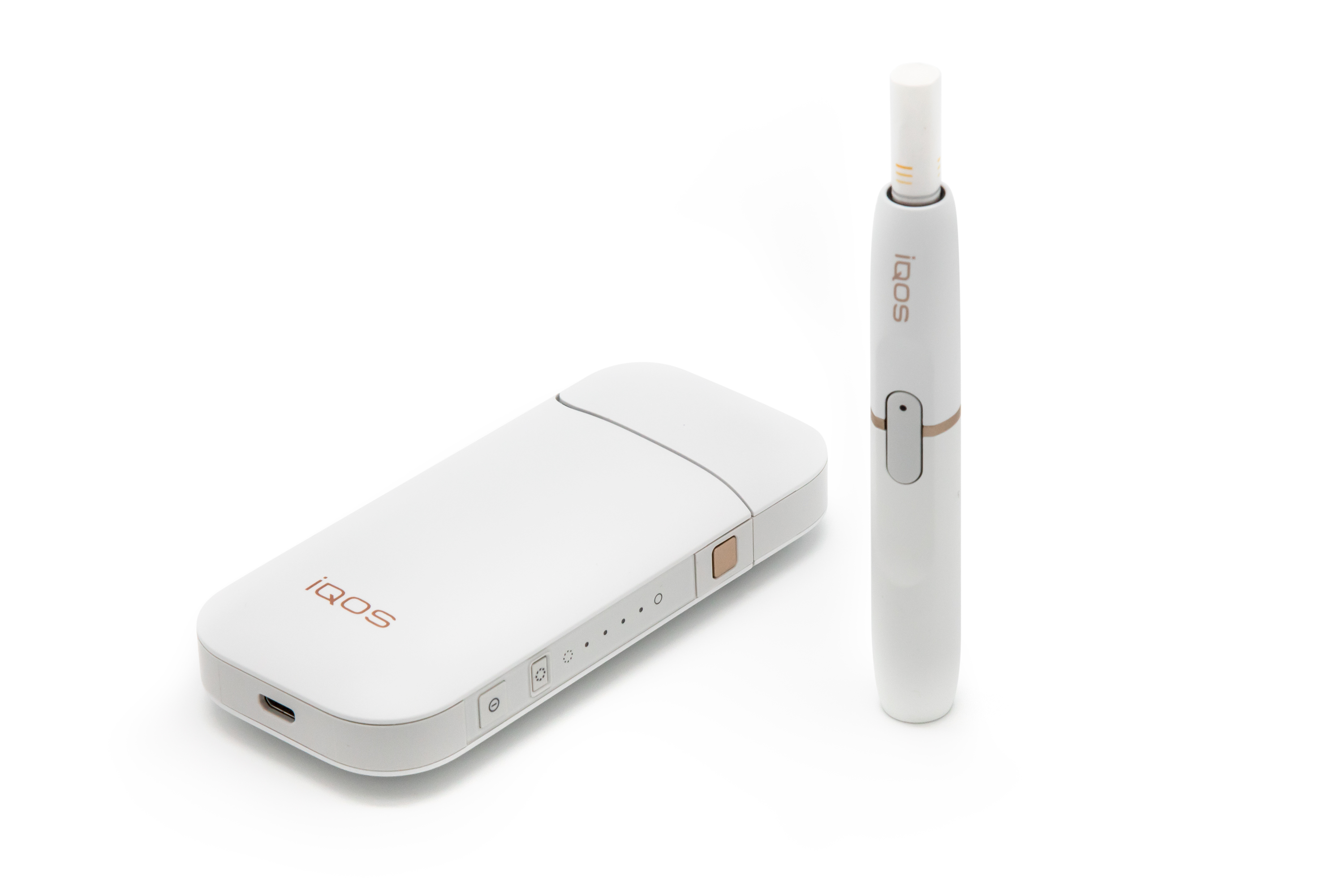
The IQOS is a heated tobacco product marketed by Philip Morris International. It heats tobacco at a lower temperature than traditional cigarettes. The tobacco sticks reach a temperature up to 350 °C. It sold first in Japan since November 2014. In December 2016, the United Tobacco Vapor Group's (UTVG) stated that they have been given a patent for their vaporizing component system.
Pax Labs has developed vaporizers that heats the leaves of tobacco to deliver nicotine in a vapor. In June 2015, they introduced Juul, a type of e-cigarette which delivers 10 times as much nicotine as other e-cigarettes, equivalent to an actual cigarette puff. Juul was spun off from Pax Labs in June 2017 and is now available by the independent company Juul Labs. The eTron 3T from Vapor Tobacco Manufacturing, launched in December 2014, The e-liquid contains organic tobacco, organic glycerin, and water.
In December 2013, Japan Tobacco launched Ploom in Japan. In January 2016, they launched Ploom TECH that produces a vapor from a heated liquid that moves through a capsule of granulated tobacco leaves. In 2016, British American Tobacco (BAT) released its own version of the heat but not burn technology called glo in Japan and Switzerland. It uses tobacco sticks rather than nicotine liquid, and does not directly heat or burn tobacco. Heated tobacco products were first introduced in 1988, but were not a commercial success.
BLOW started selling e-hookahs, an electronic version of the hookah in 2014. The handle of each hose for the e-hookah contains a heating element and a liquid, which produces vapor. Gopal Bhatnagar, based in Toronto, Canada, invented a 3D printed adapter to turn a traditional hookah into an e-hookah. It is used instead of the ceramic bowl that contains shisha tobacco.
Vaping of drugs other than nicotine
Some vape pens, generally not referred to as "e-cigarettes", contain cannabis derivatives instead of nicotine and tobacco derivatives. Some cannabis pens, known as "dab pens", contain cannabis extracted using butane as solvent ("butane hash oil"). Other vaporizers contain e-liquid made with pure THC, and they generally resemble conventional e-cigarettes. A 2020 study shows that one third of teenagers engaged in conventional, tobacco vaping also engage in THC vaping.
KanaVape is an e-cigarette containing cannabidiol (CBD) and no THC. Several companies including Canada's Eagle Energy Vapor are selling caffeine-based e-cigarettes instead of containing nicotine. Some e-cigarettes marketed as being "nicotine-free" have been found to instead contain the nicotine analogue 6-methylnicotine, which is more potent and may be more addictive than nicotine itself.
More broadly, vape pens and e-liquids have become increasingly widely used as a delivery mechanism for a wide variety of illicit and designer drugs. These can include stimulants such as methamphetamine and cocaine, opioids such as fentanyl analogs and nitazenes, a wide variety of synthetic cannabinoids as well as semi-synthetic cannabinoids derived from THC, sedatives including benzodiazepines like etizolam as well as etomidate and methaqualone, psychedelics such as NBOMe substituted phenethylamine derivatives, dissociatives such as ketamine, and assorted other compounds.
Notes
References
Bibliography
References
- (2014). "Chemical evaluation of electronic cigarettes". [[Tobacco Control (journal).
- (2015). "Electronic cigarettes-a narrative review for clinicians". The American Journal of Medicine.
- (14 February 2020). "Vaporizers, E-Cigarettes, and other Electronic Nicotine Delivery Systems (ENDS)". United States Food and Drug Administration.
- (2014). "Electronic Cigarettes". Journal of Addiction Medicine.
- (December 2020). "Tracing the composition of single e-cigarette aerosol droplets in situ by laser-trapping and Raman scattering". Scientific Reports.
- (2013). "Electronic nicotine delivery system (electronic cigarette) awareness, use, reactions and beliefs: a systematic review". Tobacco Control.
- (November 2017). "Key issues surrounding the health impacts of electronic nicotine delivery systems (ENDS) and other sources of nicotine". CA: A Cancer Journal for Clinicians.
- (2024-03-01). "Comparative systematic review on the safety of e-cigarettes and conventional cigarettes". Food and Chemical Toxicology.
- (September 2021). "Balancing Consideration of the Risks and Benefits of E-Cigarettes". American Journal of Public Health.
- (2022-09-02). "Association between e-cigarette use and asthma: a systematic review and meta-analysis". Journal of Asthma.
- (18 May 2018). "Public Health Consequences of E-Cigarettes". National Academies Press (US).
- (2022). "Nicotine vaping in England: an evidence update including health risks and perceptions, September 2022. A report commissioned by the Office for Health Improvement and Disparities.". Uk.gov.
- (2025-01-29). "Electronic cigarettes for smoking cessation". The Cochrane Database of Systematic Reviews.
- (September 2023). ""Effect of unguided e-cigarette provision on uptake, use, and smoking cessation among adults who smoke in the USA: a naturalistic, randomised, controlled clinical trial."". eClinicalMedicine.
- (2023). "What's in an E-Cigarette?". American Lung Association.
- (2014). "Nicotine absorption from electronic cigarette use: Comparison between first and new-generation devices". Scientific Reports.
- (14 October 2014). "Electronic Cigarettes: A Policy Statement From the American Heart Association". Circulation.
- Hayden McRobbie. (2014). "Electronic cigarettes". National Centre for Smoking Cessation and Training.
- Konstantinos Farsalinos. (2015). "Electronic cigarette evolution from the first to fourth generation and beyond". Global Forum on Nicotine.
- (8 April 2019). "FDA To Investigate Whether Vaping Causes Seizures". The Fix.
- (2018). "Adolescents' Use of "Pod Mod" E-Cigarettes — Urgent Concerns". New England Journal of Medicine.
- (2017). "E-smoking: Emerging public health problem?". International Journal of Occupational Medicine and Environmental Health.
- (2015). "Nicotine and the Developing Human". American Journal of Preventive Medicine.
- (August 2014). "The electronic cigarette. Official statement of the Spanish Society of Pneumology and Thoracic Surgery (SEPAR) on the efficacy, safety and regulation of electronic cigarettes". Archivos de Bronconeumologia.
- (2013). "Electronic Cigarettes: A Short Review". Respiration.
- (5 June 2015). "America's First Certified Organic E-Cigarette Vaping Liquid Is Here". Modern Farmer.
- John Reid Blackwell. (7 June 2015). "Avail Vapor offers glimpse into the 'art and science' of e-liquids". Richmond Times-Dispatch.
- (2020). "Imaging Findings of Vaping-Associated Lung Injury". American Journal of Roentgenology.
- (12 August 2016). "Manufacturing". United States Food and Drug Administration.
- (4 September 2015). "E-Liquid Manufacturing Standards". American E-Liquid Manufacturing Standards Association (AEMSA).
- (2014). "The Chemical Components of Electronic Cigarette Cartridges and Refill Fluids: Review of Analytical Methods". Nicotine & Tobacco Research.
- "Toxic metal, leached from e-cigarette coil, permanently scars woman's lung".
- (2017). "E-cigarettes and Urologic Health: A Collaborative Review of Toxicology, Epidemiology, and Potential Risks". European Urology.
- (2014). "Electronic Cigarettes. A Position Statement of the Forum of International Respiratory Societies". American Journal of Respiratory and Critical Care Medicine.
- Shapiro, Harry. (2020). "Burning Issues: The Global State of Tobacco Harm Reduction".
- "82 million vapers worldwide in 2021: the GSTHR estimate".
- (2016). "Tobacco Use Disorders". Child and Adolescent Psychiatric Clinics of North America.
- (2017). "Graphical review: The redox dark side of e-cigarettes; exposure to oxidants and public health concerns". Redox Biology.
- (11 June 2018). "Lung cancer deaths on the rise in two thirds of European countries". VoxEurop/The European Data Journalism Network (EDJNet).
- (2014). "Electronic cigarettes: patterns of use, health effects, use in smoking cessation and regulatory issues". Tobacco Induced Diseases.
- (22 September 2015). "Behavioral and Pharmacotherapy Interventions for Tobacco Smoking Cessation in Adults, Including Pregnant Women: U.S. Preventive Services Task Force Recommendation Statement.". Annals of Internal Medicine.
- (2023-06-01). "An examination of quitting smoking as a reason for vaping by the type of nicotine vaping device used most often among adults who smoke and vape: Findings from the Canada, England and the United States 2020 ITC Smoking and Vaping Survey". Preventive Medicine Reports.
- (2024-11-12). "Boredom, relaxation and experimentation are among top reasons teens vape".
- (21 March 2016). "The perceived effects of electronic cigarettes on health by adult users: A state of the science systematic literature review.". Journal of the American Association of Nurse Practitioners.
- (2016). "Cigarette Smoking and Electronic Cigarettes Use: A Meta-Analysis". International Journal of Environmental Research and Public Health.
- (2017). "Electronic cigarettes and mental illness: Reviewing the evidence for help and harm among those with psychiatric and substance use disorders". The American Journal on Addictions.
- (2018). "Measuring perceptions related to e-cigarettes: Important principles and next steps to enhance study validity". Addictive Behaviors.
- Peter N Lee. (2015). "Appropriate and inappropriate methods for investigating the "gateway" hypothesis, with a review of the evidence linking prior snus use to later cigarette smoking". Harm Reduction Journal.
- (2021). "E-cigarette use and combustible tobacco cigarette smoking uptake among non-smokers, including relapse in former smokers: umbrella review, systematic review and meta-analysis". BMJ Open.
- (2014). "Electronic Cigarettes in North America: History, Use, and Implications for Smoking Cessation". Circulation.
- (2021). "Association between electronic nicotine delivery systems and electronic non-nicotine delivery systems with initiation of tobacco use in individuals aged < 20 years. A systematic review and meta-analysis". PLOS ONE.
- (2017). "Practical guidelines on e-cigarettes for practitioners and others health professionals. A French 2016 expert's statement". Revue des Maladies Respiratoires.
- (2016). "Electronic Cigarettes for Curbing the Tobacco-Induced Burden of Noncommunicable Diseases: Evidence Revisited with Emphasis on Challenges in Sub-Saharan Africa". Pulmonary Medicine.
- Etter, Jean-François. (2017-06-19). "Gateway effects and electronic cigarettes: Gateway effects and e-cigarettes". Addiction.
- (2021-03-18). "The "gateway" effect of e-cigarettes may be explained by a genetic liability to risk-taking". PLOS Medicine.
- (2017-05-01). "Adolescents and e-cigarettes: Objects of concern may appear larger than they are". Drug and Alcohol Dependence.
- (2021-03-18). "Association of genetic liability to smoking initiation with e-cigarette use in young adults: A cohort study". PLOS Medicine.
- (2015-03-01). "Parent, peer, and executive function relationships to early adolescent e-cigarette use: A substance use pathway?". Addictive Behaviors.
- (2021-01-01). "Electronic Cigarettes Associated With Incident and Polysubstance Use Among Youth". Journal of Adolescent Health.
- (2020-09-04). "Gateway or common liability? A systematic review and meta-analysis of studies of adolescent e-cigarette use and future smoking initiation". Addiction.
- Phillips, Carl V.. (2015-05-21). "Gateway Effects: Why the Cited Evidence Does Not Support Their Existence for Low-Risk Tobacco Products (and What Evidence Would)". International Journal of Environmental Research and Public Health.
- (2021-01-01). "Is e-cigarette use in non-smoking young adults associated with later smoking? A systematic review and meta-analysis". Tobacco Control.
- (2019-04-17). "The Gateway Effect of E-cigarettes: Reflections on Main Criticisms". Nicotine & Tobacco Research.
- (2020). "The Vaping Epidemic in Adolescents". [[Missouri Medicine]].
- (2016). "Vaping as a Catalyst for Smoking? An Initial Model on the Initiation of Electronic Cigarette Use and the Transition to Tobacco Smoking Among Adolescents". Nicotine & Tobacco Research.
- (2018). "Prevalence of electronic nicotine delivery systems (ENDS) use among youth globally: a systematic review and meta-analysis of country level data". Australian and New Zealand Journal of Public Health.
- (1 November 2019). "Examining the relationship of vaping to smoking initiation among US youth and young adults: a reality check". Tobacco Control.
- (7 October 2019). "Epidemic of youth nicotine addiction? What does the National Youth Tobacco Survey reveal about high school e-cigarette use in the USA? (Preprint)". Qeios.
- (1 March 2020). "Have e-cigarettes renormalised or displaced youth smoking? Results of a segmented regression analysis of repeated cross sectional survey data in England, Scotland and Wales". Tobacco Control.
- (17 December 2019). "Historical NYTS Data and Documentation". Centers for Disease Control and Prevention.
- (2016). "Electronic Cigarettes Use and Intention to Cigarette Smoking among Never-Smoking Adolescents and Young Adults: A Meta-Analysis". International Journal of Environmental Research and Public Health.
- (13 May 2014). "E-cigarettes: a scientific review.". Circulation.
- (2017). "E-cigs ... Are They Cool? Talking to Teens About E-Cigarettes". Clinical Pediatrics.
- (January 2018). "E-Cigarettes: Use, Effects on Smoking, Risks, and Policy Implications". Annual Review of Public Health.
- (2019). "Association Between Electronic Cigarette Use and Marijuana Use Among Adolescents and Young Adults". JAMA Pediatrics.
- U.S. Department of Health and Human Services. (2016). "E-Cigarette Use Among Youth and Young Adults. A Report of the Surgeon General". U.S. Department of Health and Human Services, Centers for Disease Control and Prevention, National Center for Chronic Disease Prevention and Health Promotion, Office on Smoking and Health.
- (2018). "A systematic review of consumer preference for e-cigarette attributes: Flavor, nicotine strength, and type". PLOS ONE.
- (2018). "Is vaping a gateway to smoking: a review of the longitudinal studies". International Journal of Adolescent Medicine and Health.
- (July 2025}} Teenagers may not admit to using e-cigarettes, but use, for instance, a hookah pen.{{cite journal). "Electronic Cigarettes: Vulnerability of Youth". Pediatric Allergy, Immunology, and Pulmonology.
- (December 2022). "E-cigarettes and youth: an unresolved Public Health concern". Italian Journal of Pediatrics.
- (April 2022). "Prevalence of E-Cigarette Use and Its Associated Factors Among Youths Aged 12 to 16 Years in 68 Countries and Territories: Global Youth Tobacco Survey, 2012‒2019". American Journal of Public Health.
- (2016). "Philip Morris research on precursors to the modern e-cigarette since 1990". Tobacco Control.
- Prashant Sharma. (6 November 2015). "A Modern Device with an Illustrious History". TechPluto.
- (2016). "A Historical Timeline of Electronic Cigarettes". The Consumer Advocates for Smoke-free Alternatives Association.
- (16 November 2016). "Analytical Assessment of e-Cigarettes: From Contents to Chemical and Particle Exposure Profiles". Elsevier Science.
- Noah Charney. (7 December 2014). "America's vaping revolution: How suspicious should we really be of the e-cigarette craze?". [[Salon (website).
- (17 August 1965). "US Patent 3200819. Smokeless non-tobacco cigarette".
- P.H.. (17 March 2014). "A case of the vapers". [[Economist Group]].
- Julie Beck. (13 June 2014). "Schrödinger's Cigarette: Is Electronic Safer?". The Atlantic.
- (25 April 2009). "The Push to Ban E-Cigarettes: Where's the Proof?". TimeLine.
- Mary Bellis. (2015). "Who Invented Electronic Cigarettes?". About.com.
- (24 August 2011). "Electronic Cigarette Sales on the Rise". [[WalesOnline]].
- MCGonegal, Matthew. (November 2019). ""Can I rip your Juul?"". University of Oregon.
- (27 May 1986). "Company sniffs profits from a smokeless cigarette". [[Chicago Tribune]].
- (11 May 2009). "FDA's Brief in Opposition to Motion for Preliminary Injunction". Food and Drug Administration.
- (October–November 2018). "Spotlight on Tobacco {{!}} Future Developments in the Regulation of Electronic Nicotine Delivery Systems: Potential Over-the-Counter Pathway". Food and Drug Law Institute.
- Coffee, Brenda. (22 December 2018). "A deadly addicting lie". 1010ParkPlace.
- Barbara Demick. (25 April 2009). "A high-tech approach to getting a nicotine fix". Los Angeles Times.
- (10 July 2013). "I was sure that the electronic cigarette would be welcomed with open arms". Sciences et Avenir.
- (30 October 2021). "Vape nation: how did Britain end up so hooked on e‑cigarettes?". [[The Times]].
- (27 February 2009). "E-cigarettes attracting attention — and scrutiny". [[NBCNews.com]].
- Tom Hancock. (4 October 2013). "Chinese e-cigarette inventor fights for royalties". [[The Japan Times]].
- (22 November 2007). "Electronic Atomization Cigarette".
- Tom Hancock. (1 October 2013). "China's e-cigarette inventor fights for financial rewards". Fox News Channel.
- "Ruyan Press release: Ruyan Asserts Patent Rights to E-cigarette in Key China Court Ruling".
- (July 2012). "Ruyan Patent Litigation as Reason to Consider Patent Protection". Troutman Sanders Tobacco Law.
- Mike K. (9 June 2015). "What Does The Future Hold For Vaping Technology?". Steve K's Vaping World.
- Annabel Denham. (10 June 2013). "Brothers who took a punt on a new market". CityAM.
- "Smokeland".
- (Feb 2014). "Electronic Cigarettes. Potential Harms and Benefits". Annals of the American Thoracic Society.
- (2012-02-01). "The emerging phenomenon of electronic cigarettes". Expert Review of Respiratory Medicine.
- Robehmed, Natalie. (September 17, 2013). "E-cigarette Sales Surpass $1 Billion As Big Tobacco Moves In".
- (2019). ""Think it. Mix it. Vape it.": A Content Analysis on E-cigarette Radio Advertisements". Substance Use & Misuse.
- (27 May 2015). "Big Tobacco fights back: how the cigarette kings bought the vaping industry". Newsweek.
- (28 September 2013). "Kodak moment". The Economist.
- Mike Esterl. (3 February 2014). "Altria Expands in E-Cigarettes With Green Smoke". The Wall Street Journal.
- (2016). "Ethical considerations of e-cigarette use for tobacco harm reduction". Respiratory Research.
- Brian Montopoli. (11 June 2013). "Tobacco companies bet on electronic cigarettes". CBS News.
- Daniel Nasaw. (5 December 2012). "Electronic cigarettes challenge anti-smoking efforts". BBC News.
- Sanchez Manning. (29 July 2013). "British American Tobacco enters electronic cigarette market in Britain with the 'Vype'". The Independent.
- (2 September 2013). "Imperial Tobacco Agrees to Acquire Dragonite's E-Cigarette Unit". [[Bloomberg News]].
- (1 October 2013). "Lorillard acquires British e-cig maker for $48.6M". [[Triad Business Journal]].
- (27 March 2014). "Lorillard to Rebrand SKYCIG as blu eCigs". Convenience Store News.
- Crook, Jordan. (20 December 2018). "Juul Labs gets $12.8 billion investment from Marlboro Maker Altria Group". [[TechCrunch]].
- (2015). "The Electronic Cigarette: The Good, the Bad, and the Ugly". The Journal of Allergy and Clinical Immunology: In Practice.
- (5 February 2014). "RPT-Fitch: Altria Green Smoke Buy Highlights Industry e-Cig Interest". Reuters.
- (9 January 2016). "Altria Bolsters E-Cigarette Business With $110M Buy of Green Smoke". FOXBusiness.
- Gideon Spanier. (26 June 2014). "Philip Morris buys e-cigarette maker Nicocigs as it warns of falling profits". The Independent.
- (30 April 2015). "Japan Tobacco's Global Ambitions Lead to Logic Acquisition". Convenience Store News.
- (15 July 2014). "Feeling blu? E-cig company spun off in major tobacco deal". [[CNBC]].
- (January 5, 2016). "Nielsen: Tobacco "All Channel" Data Through 12/26".
- Journal, Richard Craver Winston-Salem. (2018-07-17). "Reynolds Vapor prepares national launch of new e-cig rival to Juul".
- Chowdhery, Samrat. (2024-11-22). "Will Indonesia, a Key Tobacco Control Outlier, Keep Vaping Legal?".
- (June 22, 2023). "U.S. E-cigarette Sales Climbed during 2020-2022".
- (24 November 2021). "Using e-cigarettes to stop smoking".
- (ASH), Action on Smoking and Health. (June 2021). "Use of e-cigarettes (vapes) among adults in Great Britain. 2021". Use of E-cigarettes (Vapes) Among Adults in Great Britain. 2021.
- (2024-08-11). "Number of UK adults who vape reaches record level, report finds". The Guardian.
- (15 May 2014). "Electronic cigarettes – A report commissioned by Public Health England". Public Health England.
- (13 May 2013). "Inside the world of vapers, the subculture that might save smokers' lives". [[Digital Trends]].
- (26 August 2013). "The Feed: The subculture around e-cigarettes". [[SBS World News]].
- (31 July 2014). "Electronic cigarettes: review of use, content, safety, effects on smokers and potential for harm and benefit". Addiction.
- (2013). "Perceived efficacy of e-cigarettes versus nicotine replacement therapy among successful e-cigarette users: a qualitative approach". Addiction Science & Clinical Practice.
- Michael Grothaus. (1 October 2014). "Trading addictions: the inside story of the e-cig modding scene". Engadget.
- (25 January 2014). "Pimp My Vape: The Rise of E-Cigarette Hackers". Mashable.
- Molly Osberg. (25 February 2014). "CVape life: welcome to the weird world of e-cig evangelists". [[The Verge]].
- (2014). "E-cigarettes: an up to date review and discussion of the controversy". W V Med J.
- (2014). "Electronic cigarettes: peering through the smokescreen". Postgraduate Medical Journal.
- Tom Gara. (14 April 2014). "Are E-Cigarettes Losing Ground in the Vapor Market?". The Wall Street Journal.
- (8 October 2014). "The Right to Vape". The Atlantic.
- (17 April 2014). "E-cigarettes: no smoke without fear". FT Magazine.
- (February 2014). "Electronic cigarettes. Potential harms and benefits.". Annals of the American Thoracic Society.
- Gavin Haynes. (22 April 2015). "Daft vapers: the competitive world of e-cigarette smoking". The Guardian.
- Mike Esterl. (29 May 2014). "'Vaporizers' Are the New Draw in E-Cigarettes". The Wall Street Journal.
- Staff. (13 February 2014). "Generation V E-Cigarettes and Vape Bar aims to convert smokers to e-cigarettes". [[Daily Nebraskan]].
- Neil Nisperos. (4 September 2014). "Vaping convention coming to Ontario Convention Center Friday". [[Inland Valley Daily Bulletin]].
- Mary Plass. (29 January 2014). "The Cloud Chasers". Vape News Magazine.
- Dominique Mosbergen. (5 August 2014). "This Man Is An Athlete In The Sport Of 'Cloud Chasing'". HuffPost.
- Sean Cooper. (23 May 2014). "What you need to know about vaporizers". Engadget.
- Victoria Bekiempis. (1 April 2015). "Veteran E-Cigarette Users Fret 'Cloud Chasers' Give Them a Bad Name". [[Newsweek]].
- (19 November 2014). "'Vape' Is Oxford Dictionaries' Word Of The Year". HuffPost.
- (May 2011). "Electronic nicotine delivery systems: a research agenda". Tobacco Control.
- (2018). "Heat-not-burn tobacco product use in Japan: its prevalence, predictors and perceived symptoms from exposure to secondhand heat-not-burn tobacco aerosol". Tobacco Control.
- "Tobacco: preventing uptake, promoting quitting and treating dependence Draft for consultation, November 2024".
- Barnaby Page. (5 March 2015). "World's law-makers favour basing e-cig rules on tobacco". Tamarind Media Limited.
- (2016). "Review of electronic cigarettes as tobacco cigarette substitutes: their potential human health impact". Journal of Environmental Science and Health, Part C.
- (2016). "The importance of product definitions in US e-cigarette laws and regulations". Tobacco Control.
- (2 March 2016). "U.S. Department of Transportation Explicitly Bans the Use of Electronic Cigarettes on Commercial Flights". [[United States Department of Transportation]].
- (1 February 2018). "What the RCP thinks about tobacco". Royal College of Physicians.
- (18 September 2019). "India bans e-cigarette sales and says there's an 'epidemic' of kids vaping". The Verge.
- (2025-07-14). "Vape Ban Reversed in Punjab, Pakistan – PTVA".
- (29 September 2014). "Public health officers tackle hazy issue of e-cigarettes". [[The Globe and Mail]].
- (22 November 2016). "Vaping, e-cigarettes to be regulated by Health Canada". [[CBC News]].
- (2015). "A review of the current geographic distribution of and debate surrounding electronic cigarette clean air regulations in the United States". Health & Place.
- (26 January 2014). "E-cigarettes to be stubbed out for under-18s". [[BBC News]].
- (4 May 2016). "European court: Tougher rules on electronic cigarettes". [[Business Insider]].
- Francesca Washtell. (5 May 2016). "EU Tobacco Products Directive chokes off the UK's e-cigarette and vaping market". City A.M..
- (2017). "Electronic cigarettes and indoor air quality: a review of studies using human volunteers". Reviews on Environmental Health.
- Ashitha Nagesh. (10 July 2013). "Anger over tobacco lobbyists as Europe nears new rules on e-cigarettes". [[Euronews]].
- (17 August 2017). "FDA's New Regulations for E-Cigarettes, Cigars, and All Other Tobacco Products". United States Food and Drug Administration.
- (23 August 2017). "Summary of Federal Rules for Tobacco Retailers". United States Food and Drug Administration.
- (2 May 2017). "The Facts on the FDA's New Tobacco Rule". United States Food and Drug Administration.
- (10 May 2016). "Deeming Tobacco Products To Be Subject to the Federal Food, Drug, and Cosmetic Act, as Amended by the Family Smoking Prevention and Tobacco Control Act; Restrictions on the Sale and Distribution of Tobacco Products and Required Warning Statements for Tobacco Products". United States Food and Drug Administration.
- Eric Lipton. (2 September 2016). "A Lobbyist Wrote the Bill. Will the Tobacco Industry Win Its E-Cigarette Fight?". The New York Times.
- (26 February 2014). "Questions & Answers: New rules for tobacco products". European Commission.
- (25 April 2014). "Deeming Tobacco Products To Be Subject to the Federal Food, Drug, and Cosmetic Act, as Amended by the Family Smoking Prevention and Tobacco Control Act; Regulations on the Sale and Distribution of Tobacco Products and Required Warning Statements for Tobacco Products". United States Food and Drug Administration.
- Sabrina Tavernise. (24 April 2014). "F.D.A. Will Propose New Regulations for E-Cigarettes". The New York Times.
- (2015). "Electronic Nicotine Delivery Systems: Executive Summary of a Policy Position Paper From the American College of Physicians". Annals of Internal Medicine.
- (3 March 2017). "Alternative Nicotine Products – Electronic Cigarettes". [[National Conference of State Legislatures]].
- "Vaping Law FAQ - Vaping Regulations Explained {{!}} Shosha NZ".
- (2013). "E-Cigarettes and Cardiovascular Risk: Beyond Science and Mysticism". Seminars in Thrombosis and Hemostasis.
- (2015). "Does Vaping in E-Cigarette Advertisements Affect Tobacco Smoking Urge, Intentions, and Perceptions in Daily, Intermittent, and Former Smokers?". Health Communication.
- (2014). "Carbonyl Compounds Generated from Electronic Cigarettes". International Journal of Environmental Research and Public Health.
- (March 2014). "Achieving appropriate regulations for electronic cigarettes.". Therapeutic Advances in Chronic Disease.
- (6 May 2022). "California Is Forcing Smokers To Buy More Dangerous Products".
- (August 2015). "Vaping 95% less harmful than smoking".
- (15 July 2019). "San Francisco's Top Economist Confirms Vape Ban Means More Smoking".
- (22 June 2022). "FDA to Order Juul E-Cigarettes Off U.S. Market". Wall Street Journal.
- (18 May 2021). "Differences in Switching Away From Smoking Among Adult Smokers Using JUUL Products in Regions With Different Maximum Nicotine Concentrations: North America and the United Kingdom". Nicotine & Tobacco Research.
- "Electronic Cigarette Fires and Explosions in the United States 2009-2016".
- "E-Cigarette Fire Risks and Reported Incidents".
- (2015). "Electronic cigarettes: the new face of nicotine delivery and addiction". Journal of Thoracic Disease.
- (September 2014). "Heart and Stroke Foundation: E-cigarettes in Canada". Heart and Stroke Foundation.
- (June 2016). "E-cigarettes: How "safe" are they?". J Fam Pract.
- (2014). "Position Statement Electronic Cigarettes". Cancer Council Australia; National Heart Foundation of Australia.
- (2017). "Getting real with the upcoming challenge of electronic nicotine delivery systems: The way forward for the South-East Asia region". Indian Journal of Public Health.
- (2016). "E-cigarettes and smoking cessation in real-world and clinical settings: a systematic review and meta-analysis". The Lancet Respiratory Medicine.
- (2015). "E-Cigarette use among children and young people: the need for regulation". Expert Rev Respir Med.
- (2017). "The messages presented in online electronic cigarette promotions and discussions: a scoping review protocol". BMJ Open.
- (2014). ""Smoking revolution": a content analysis of electronic cigarette retail websites". Am J Prev Med.
- (5 January 2016). "E-cigarette Ads and Youth". Centers for Disease Control and Prevention.
- (2016). "Electronic cigarettes in the media.". Proc (Bayl Univ Med Cent)..
- (31 October 2014). "Handbook of Research on Global Business Opportunities". IGI Global.
- (2015). "E-cigarettes and Lung Health". American Lung Association.
- (2015). "Myths and Facts About E-cigarettes". American Lung Association.
- (22 January 2016). "Impact of Flavor on Electronic Cigarette Marketing in Social Media". Springer.
- (2015). "A Practitioner's Guide to Electronic Cigarettes in the Adolescent Population". Journal of Adolescent Health.
- (2015). "Particulate Matter from Electronic Cigarettes and Conventional Cigarettes: a Systematic Review and Observational Study". Current Environmental Health Reports.
- (February 2014). "Non-Cigarette Tobacco and the Lung". Clinical Reviews in Allergy & Immunology.
- (2017). "Do E-cigarettes induce weight changes and increase cardiometabolic risk? A signal for the future". Obesity Reviews.
- Peter Evans. (20 February 2015). "E-Cigarette Makers Face Rise of Counterfeits". The Wall Street Journal.
- (15 September 2019). "Vaping: How popular are e-cigarettes? - Spending on e-cigarettes is growing". BBC News.
- (2017). "Pulmonary Toxicity of E-cigarettes". American Journal of Physiology. Lung Cellular and Molecular Physiology.
- (2014). "Are E-cigarettes a safe and good alternative to cigarette smoking?". Annals of the New York Academy of Sciences.
- Meera Senthilingam. (23 March 2015). "E-cigarettes: Helping smokers quit, or fueling a new addiction?". CNN.
- (2019). "Electronic Cigarettes and Youth in the United States: A Call to Action (at the Local, National and Global Levels)". Children.
- (25 May 2014). ""Vaping" a slow burner in China, world's maker of e-cigarettes". Reuters.
- (1 September 2015). "Chinese E-cigarette Makers Shift to Domestic Markets". Tobacco Asia.
- (13 December 2014). "China's E-Cigarette Boom". The New York Times.
- (30 May 2015). "The e-cigarette is taking off in nation that invented it". Shanghai Daily.
- (2017). "Innovative approaches to support smoking cessation for individuals with mental illness and co-occurring substance use disorders". Expert Review of Respiratory Medicine.
- Gurdus, Elizabeth. (23 April 2018). "Cramer: Vaping is decimating the cigarette industry—and it could get even worse". CNBC.
- (22 November 2019). "Ban on flavored vapes could lead to loss of 150,000 jobs, $8.4 billion sales hit: report". Reuters.
- (27 August 2018). "Did Juul Lure Teenagers and Get 'Customers for Life'?". The New York Times.
- Kimberly Suiters. (31 January 2018). "Are your kids juuling at school? 7 On Your Side investigates". [[WJLA-TV]].
- (25 August 2018). "Juul expands e-cig market share gap with Reynolds' Vuse". Winston-Salem Journal.
- (8 August 2018). "JUUL copycats are flooding the e-cigarette market". Truth Initiative.
- (4 July 2015). "'Wild West' for e-cigarette use in Canada, critic says". Toronto Sun.
- Aedan Helmer. (6 April 2014). "E-cig retailers stand up to Health Canada". [[Ottawa Sun]].
- (9 October 2015). "Retail availability and marketing of electronic cigarettes in Canada". Canadian Journal of Public Health.
- (2017). "Tobacco industry strategies undermine government tax policy: evidence from commercial data". Tobacco Control.
- (7 February 2016). "Cigarettes électroniques. Le marché de la vape en deux cartes". Le Télégramme.
- "Thuốc lá điện tử, nung nóng độc hại, vì sao có sức hút lớn với giới trẻ Việt Nam? - Tin tổng hợp - Cổng thông tin Bộ Y tế".
- Võ, Thu. "5 năm, tỷ lệ hút thuốc lá điện tử ở cả nam và nữ tại Việt Nam tăng 18 lần".
- "Tỷ lệ dùng thuốc lá điện tử ở nhóm 13-15 tuổi là 3,5%".
- Lê, Nga. "Học sinh 13-15 tuổi hút thuốc lá điện tử tăng".
- VnExpress. "Học sinh 13-15 tuổi hút thuốc lá điện tử tăng".
- (2023-11-14). "Tổn thất kinh tế toàn cầu do thuốc lá gây ra mỗi năm là 1.400 tỷ USD".
- "Đề xuất cấm lưu hành thuốc lá điện tử tại Việt Nam".
- (2023-11-23). "Gần 97% bệnh nhân ung thư phổi có hút thuốc lá".
- Phương, Thảo. "Sớm "chốt" giải pháp kiểm soát thuốc lá điện tử".
- (2023-10-24). "Vapor Store".
- (2023-10-31). "Ưu tiên hỗ trợ Việt Nam thực hiện các mục tiêu của Chiến lược Quốc gia về phòng chống tác hại thuốc lá".
- Theo, TTXVN. (2015-05-29). "Kiểm soát thuốc lá tại Việt Nam: Vẫn nhiều thách thức".
- (2023-10-26). "Cần sớm quản lý đồng thời thuốc lá điện tử và thuốc lá làm nóng".
- (11 April 2012). "Cigarettes vs. e-Cigarettes: Which Is Less Environmentally Harmful?". [[National Geographic (magazine).
- (2014). "E-cigarettes—prevention, pulmonary health, and addiction". Dtsch Ärztebl Int.
- (2019). "Notes from the Field: Environmental Contamination from E-cigarette, Cigarette, Cigar, and Cannabis Products at 12 High Schools — San Francisco Bay Area, 2018–2019". MMWR Morb Mortal Wkly Rep.
- Davey, James. (2023-07-15). "UK councils call for ban on disposable vapes by 2024". Reuters.
- (2014). "Research gaps related to the environmental impacts of electronic cigarettes". Tobacco Control.
- (2015). "E-Cigarettes: A Review of New Trends in Cannabis Use". International Journal of Environmental Research and Public Health.
- (7 June 2011). "BAT unit to market nicotine inhaler". Tobacco Journal International.
- Mark Odell. (12 September 2014). "British American Tobacco nicotine inhaler wins regulatory approval". Financial Times.
- Michael Felberbaum. (26 May 2011). "Philip Morris Int'l buys rights to nicotine system". [[The Boston Globe]].
- (27 February 2010). "New smoking cessation therapy proves promising".
- (29 March 2016). "Big Tobacco Is Starting To Cash In On Vaping". HuffPost.
- (2018). "Heat or Burn? Impacts of Intrauterine Tobacco Smoke and E-Cigarette Vapor Exposure on the Offspring's Health Outcome". Toxics.
- Michael Felberbaum. (26 June 2014). "Philip Morris Int'l to sell Marlboro Heatsticks". Salon Media Group.
- (2016). "Awareness and use of electronic cigarettes and heat-not-burn tobacco products in Japan". Addiction.
- (2 December 2016). "New Vaporizing Technology, qmos, set to Revolutionize Vaping and E-Cigarette Industries". [[Yahoo! Finance]].
- Brad Stone. (21 November 2013). "Ploom's E-Cigarettes and Vaporizers Use Real Tobacco". [[Bloomberg Businessweek]].
- Melissa Vonder Haar. (11 March 2015). "PAX Labs CEO Teases 'Fundamentally Different' E-Cigarette". CSP Magazine.
- Will Yakowicz. (10 June 2015). "This Silicon Valley Company Just Raised $47 Million to Smoke Cigarette Makers". [[Inc. (magazine).
- (8 February 2018). "PAX Labs brings on Bharat Vasan as new CEO". [[TechCrunch]].
- (9 July 2013). "US8479747B2 - Method for preparing tobacco extract for electronic smoking devices".
- (16 December 2014). "Certified organic e-liquids being launched by VTM". Tobacco Reporter.
- Tuinstra, Taco. (26 January 2016). "JT announces launch of next-generation Ploom". Tobacco Reporter.
- Rossel, Stefanie. (1 July 2016). "Blending nature and technology". Tobacco Reporter.
- Chambers, Sam. (3 February 2017). "Japan Tobacco Sees No Quick Fix for Heat-Not-Burn Shortage". Bloomberg News.
- (22 March 2017). "BAT finds strong Japan demand for its Glo smokeless tobacco device". The Japan Times.
- (26 April 2017). "British American Says 2017 Trading in Line With Expectations". The New York Times.
- (30 May 2017). "British American Tobacco will expand sales of its "glo" tobacco-heating device to Tokyo and Osaka from July". Reuters.
- ANI. (6 March 2016). "Now, 'safer' e-cigarette with tobacco flavour, less harmful smoke". [[Penske Media Corporation]].
- (24 August 2016). "Heat-not-burn tobacco products are about to reach their boiling point.". Tobacco Control.
- Candice Nguyen. (1 February 2014). "'E-Hookah' Debuts in San Diego Amid Critics". NBCUniversal.
- Susie Ochs. (20 February 2014). "Blow Hookah: No fire, no charcoal, just vapor and lasers". [[PC World]].
- Debra Thimmesch. (7 October 2014). "Canadian Doctor Promotes a 3D Printed Adapter for Converting Hookahs to E-Hookahs". 3DPrint.com.
- (20 May 2014). "3DPI.TV – 3D Printed e-Hookah Adapter Could Help Smokers". 3DPI.TV.
- (June 2020). "Cannabis vaping: Understanding the health risks of a rapidly emerging trend". Paediatrics & Child Health.
- Gaspard Glanz. (17 December 2014). "France's First Cannabis E-Cigarette Is Completely Legal". Vice.
- Alexandra Ma. (11 August 2015). "This Is What It's Like To Vape Caffeine". HuffPost.
- Vanhee C, Dill M, Canfyn M, Tuenter E, Barhdadi S. (Aug 2025). "The Emergence of a Novel Synthetic Nicotine Analog 6-Methyl Nicotine (6-MN) in Proclaimed Tobacco- and Nicotine-Free Pouches Available in Europe". Drug Test Anal.
- Jenkins C, Kelso C, Morgan J. (Sep 2024). "6-Methylnicotine: a new nicotine alternative identified in e-cigarette liquids sold in Australia". Med J Aust.
- (2016). "Drug Vaping: From the Dangers of Misuse to New Therapeutic Devices". Toxics.
- (2018). "E-cigarettes—An unintended illicit drug delivery system". Drug and Alcohol Dependence.
- (2019). "The Analysis of Aerosolized Methamphetamine from E-cigarettes Using High Resolution Mass Spectrometry and Gas Chromatography Mass Spectrometry". Journal of Analytical Toxicology.
- (2021). "The cocaine-e-cigarette – A theoretical concept of a harm reduction device for current users of smokable cocaine forms". Drug Science, Policy and Law.
- (2022). "Newly emerging synthetic cannabinoids and novel modes of use of benzodiazepines in prisons: An update from the Scottish Prisons Non-Judicial Seizures Drug Monitoring Project". Toxicologie Analytique et Clinique.
- (2023). "Vaping Opioids: Should We be Worried?". American Journal of Health Promotion.
- (2024). "Detection in seized samples, analytical characterization, and in vitro metabolism of the newly emerged 5-bromo-indazole-3-carboxamide synthetic cannabinoid receptor agonists". Drug Testing and Analysis.
- (2024). "Electronic cigarettes are a tool to vape illicit drugs". Discover Public Health.
- (2025). "Commentary on Craft ''et al'' .: Drug contaminants and substitutions in illicit vapes represent a major health risk". Addiction.
- (2025). "Adolescent Cannabis Vaping Trends (2021–2023): Delta-9-Tetrahydrocannabinol, Cannabidiol, and Synthetic Cannabinoids". American Journal of Preventive Medicine.
- "News: April 2025 – Increasing range of drugs and new psychoactive substances found in vaping products".
This article was imported from Wikipedia and is available under the Creative Commons Attribution-ShareAlike 4.0 License. Content has been adapted to SurfDoc format. Original contributors can be found on the article history page.
Ask Mako anything about Electronic cigarette — get instant answers, deeper analysis, and related topics.
Research with MakoFree with your Surf account
Create a free account to save articles, ask Mako questions, and organize your research.
Sign up freeThis content may have been generated or modified by AI. CloudSurf Software LLC is not responsible for the accuracy, completeness, or reliability of AI-generated content. Always verify important information from primary sources.
Report