From Surf Wiki (app.surf) — the open knowledge base
Electric multiple unit
Electric train with no locomotive

Electric train with no locomotive

An electric multiple unit or EMU is a multiple-unit train consisting of self-propelled carriages using electricity as the motive power. An EMU requires no separate locomotive, as electric traction motors are incorporated within one or a number of the carriages. An EMU is usually formed of two or more semi-permanently coupled carriages. However, electrically powered single-unit railcars are also generally classed as EMUs. The vast majority of EMUs are passenger trains but versions also exist for carrying mail.
EMUs are popular on intercity, commuter, and suburban rail networks around the world due to their fast acceleration and pollution-free operation, and are used on most rapid-transit systems. Being quieter than diesel multiple units (DMUs) and locomotive-hauled trains, EMUs can operate later at night and more frequently without disturbing nearby residents. In addition, tunnel design for EMU trains is simpler as no provision is needed for exhausting fumes, although retrofitting existing limited-clearance tunnels to accommodate the extra equipment needed to transmit electric power to the train can be difficult.
History


Multiple unit train control was first used in the 1890s.
The Liverpool Overhead Railway opened in 1893 with two-car electric multiple units, controllers in cabs at both ends directly controlling the traction current to motors on both cars.
The multiple unit traction control system was developed by Frank Sprague and first applied and tested on the South Side Elevated Railroad (now part of the Chicago 'L') in 1897. In 1895, derived from his company's invention and production of direct current elevator control systems, Frank Sprague invented a multiple unit controller for electric train operation. This accelerated the construction of electric traction railways and trolley systems worldwide. Each car of the train has its own traction motors: by means of motor control relays in each car energized by train-line wires from the front car all of the traction motors in the train are controlled in unison.
As technology improved with more compact and reliable electrical systems becoming available, EMUs became more common and supplanted locomotive hauled stock on many networks. This process was accelerated on crowded networks with frequent trains, as the operational advantages in using EMUs outweighed the initial cost.
Types
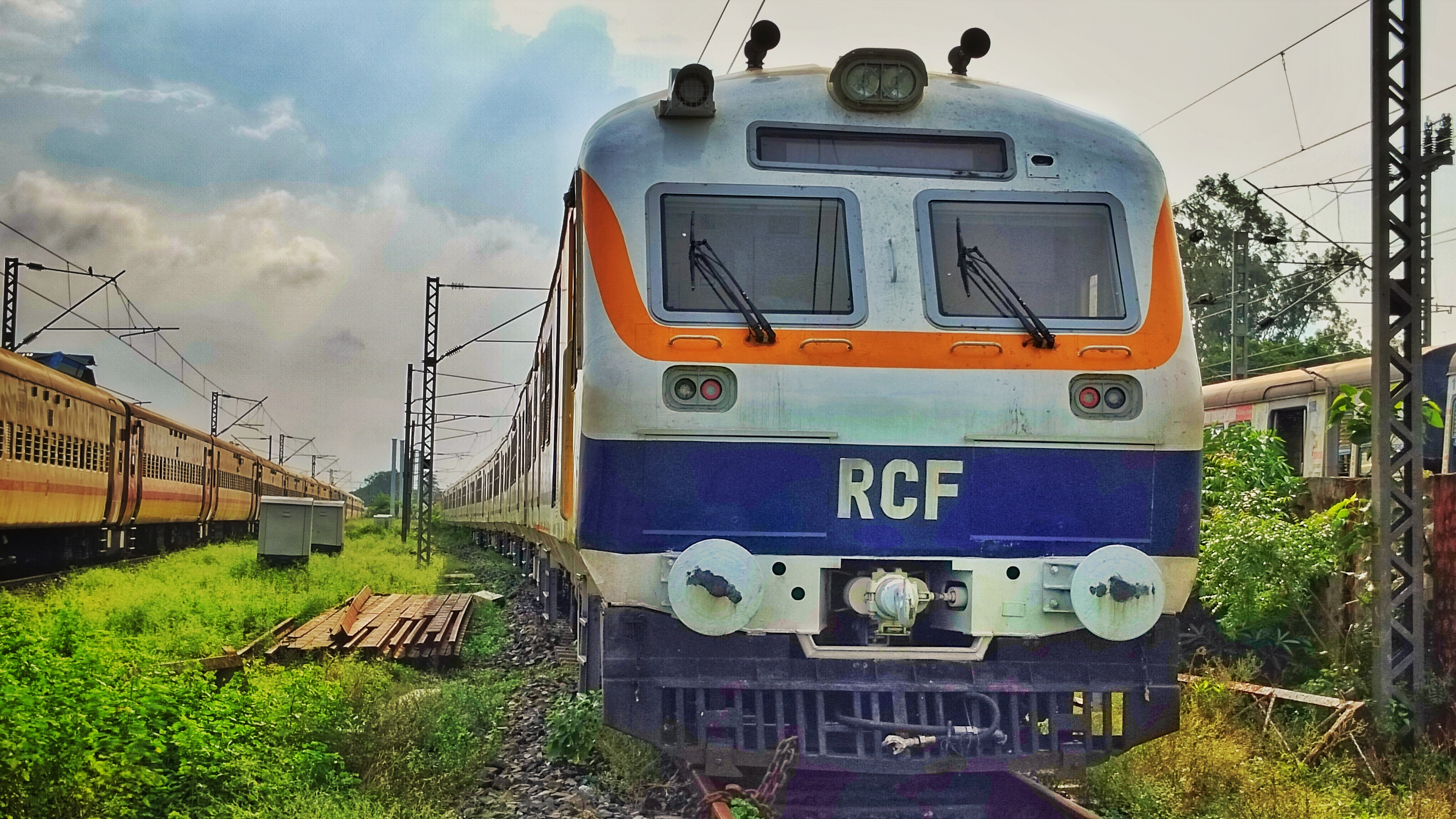

The cars that form a complete EMU set can usually be separated by function into four types: power car, motor car, driving car, and trailer car. Each car can have more than one function, such as a motor-driving car or power-driving car.
- A power car carries the necessary equipment to draw power from the electrified infrastructure, such as pickup shoes for third rail systems and pantographs for overhead systems, and transformers.
- Motor cars carry the traction motors to move the train, and are often combined with the power car to avoid high-voltage inter-car connections.
- Driving cars are similar to a cab car, containing a driver's cab for controlling the train. An EMU will usually have two driving cars at its outer ends. These can have gangway connections to provide more operational flexibility, along with convenience for passengers.
- Trailer cars are any cars (sometimes semi-permanently coupled) that carry little or no traction or power related equipment, and are similar to passenger cars in a locomotive-hauled train.

On third rail systems, the outer vehicles usually carry the pick up shoes with the motor vehicles receiving the current via intra-unit connections. This helps to avoid 'gapping' events where the unit is not in contact with the third rail and needs rescuing. For modern EMUs that operate on AC overhead systems, the traction motors have often moved from the power car to separate motor cars. The power car retains the transformer and sends the required energy via connectors to the motor cars. This helps to distribute weight along the length of the EMU and reduces the maximum axle load and track access/maintenance costs. This is not a consideration with DC powered sets as no transformer is required and any other conversion equipment is lighter.
The majority of EMUs are set up as twin/"married pair" units or longer sets. In addition to the traction motors, the ancillary equipment (air compressor and tanks, batteries and charging equipment, traction power and control equipment, etc.) are shared between the cars in the set. Since no car can operate independently, such sets are only split at maintenance facilities. For longer length EMUs (8+ cars) the unit will often have duplicate power, traction & braking systems in two halves of the set, providing redundancy for increased weight and cost.
Advantages of married pair or longer sets include weight and cost savings over single-unit cars (due to reducing the ancillary equipment required per set) while allowing multiple cars to be powered, unlike a motor-trailer combination. Each EMU has only two control cabs, located at the outer ends of the set. This saves space and expense over a cab at both ends of each car and provides more capacity. Disadvantages include a loss of operational flexibility, as trains must be multiples of a set length, and a failure on a single car could force removing the entire set from service.
In rare circumstances EMUs can operate like locomotives, hauling push-pull sets of trailer coaches. The BR Class 432 was an example of this, hauling TC trailer units on services on the South West Main Line.
As high-speed trains

.jpg)
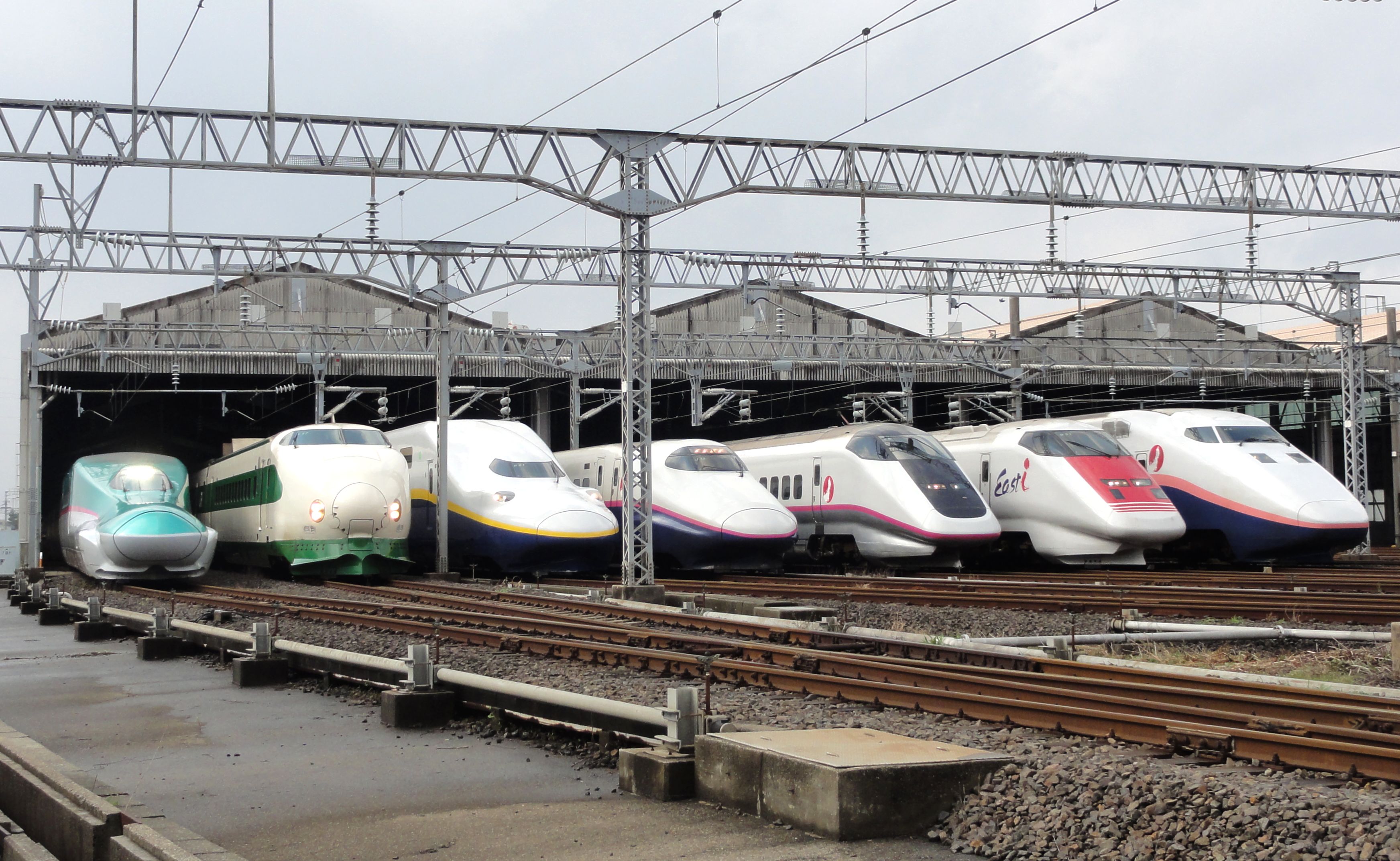
Some of the more famous electric multiple units in the world are high-speed trains, including the:
- 1964 - Shinkansen - Bullet train
- 1969 - Budd Metroliner - The retired New York–Washington Metroliner service, first operated by the Pennsylvania Railroad and later by Amtrak
- 1978 - British Rail Class 370 - APT-P
- 1988 - Fiat FS Class ETR 450 - Pendolino
- 2000 - Siemens Velaro - ICE 3
- 2007 - British Rail Class 395 / Hitachi A-train - Javelin.
- 2007 - China Railway CRH2 / E2 Series Shinkansen
- 2008 - China Railway CRH1 / Bombardier Regina
- 2008 - FS Class ETR 600
- 2015 - Frecciarossa 1000 / Alstom (Bombardier Transportation) Zefiro
- 2024 - KTX-Cheongryong
Fuel cell development
EMUs powered by fuel cells are under development. If successful, this would avoid the need for an overhead line or third rail. An example is Alstom’s hydrogen-powered Coradia iLint. The term hydrail has been coined for hydrogen-powered rail vehicles.
Battery electric multiple unit
Main article: Battery electric multiple unit

Many battery electric multiple units are in operation around the world, with the take up being strong. Many are bi-modal taking energy from onboard battery banks and line pickups such as overhead wires or third rail. In most cases the batteries are charged via the electric pickup when operating on electric mode.
Comparison with locomotives
EMUs, when compared with electric locomotives, offer:
- Higher acceleration, since there are more motors sharing the same load, more motors allows for a higher total motor power output
- Braking, including eddy current, rheostatic and/or regenerative braking, on multiple axles at once, greatly reducing wear on brake parts (as the wear can be distributed among more brakes) and allowing for faster braking (lower/reduced braking distances)
- Reduced axle loads, since the need for a heavy locomotive is eliminated; this in turn allows for simpler and cheaper structures that use less material (like bridges and viaducts) and lower structure maintenance costs
- Reduced ground vibrations, due to the above
- Lower adhesion coefficients for driving (powered) axles, due to lower weight on these axles; weight is not concentrated on a locomotive
- A higher degree of redundancy – performance is only minimally affected following the failure of a single motor or brake
- Higher seating capacity, since there is no locomotive; all cars can contain seats. Electric locomotives, when compared to EMUs, offer:
- Less electrical equipment per train resulting in lower train manufacturing and maintenance costs
- Allows for lower noise and vibration in passenger cars, since there are no motors or gearboxes on the bogies below the cars
- Greater flexibility in use, can haul freight and passenger services
References
References
- N. K. De. (2004). "Electric Drives". PHI Learning Pvt. Ltd..
- "Liverpool Overhead Railway motor coach number 3, 1892". [[National Museums Liverpool]].
- Frank Sprague. (18 January 1902). "Mr Sprague answers Mr Westinghouse". [[The New York Times]].
- (24 October 2017). "What you need to know about Alstom's hydrogen-powered Coradia iLint – Global Rail News".
- Hata, Hiroshi. "What Drives Electric Multiple Units?".
This article was imported from Wikipedia and is available under the Creative Commons Attribution-ShareAlike 4.0 License. Content has been adapted to SurfDoc format. Original contributors can be found on the article history page.
Ask Mako anything about Electric multiple unit — get instant answers, deeper analysis, and related topics.
Research with MakoFree with your Surf account
Create a free account to save articles, ask Mako questions, and organize your research.
Sign up freeThis content may have been generated or modified by AI. CloudSurf Software LLC is not responsible for the accuracy, completeness, or reliability of AI-generated content. Always verify important information from primary sources.
Report