From Surf Wiki (app.surf) — the open knowledge base
Elbs reaction
Chemical reaction
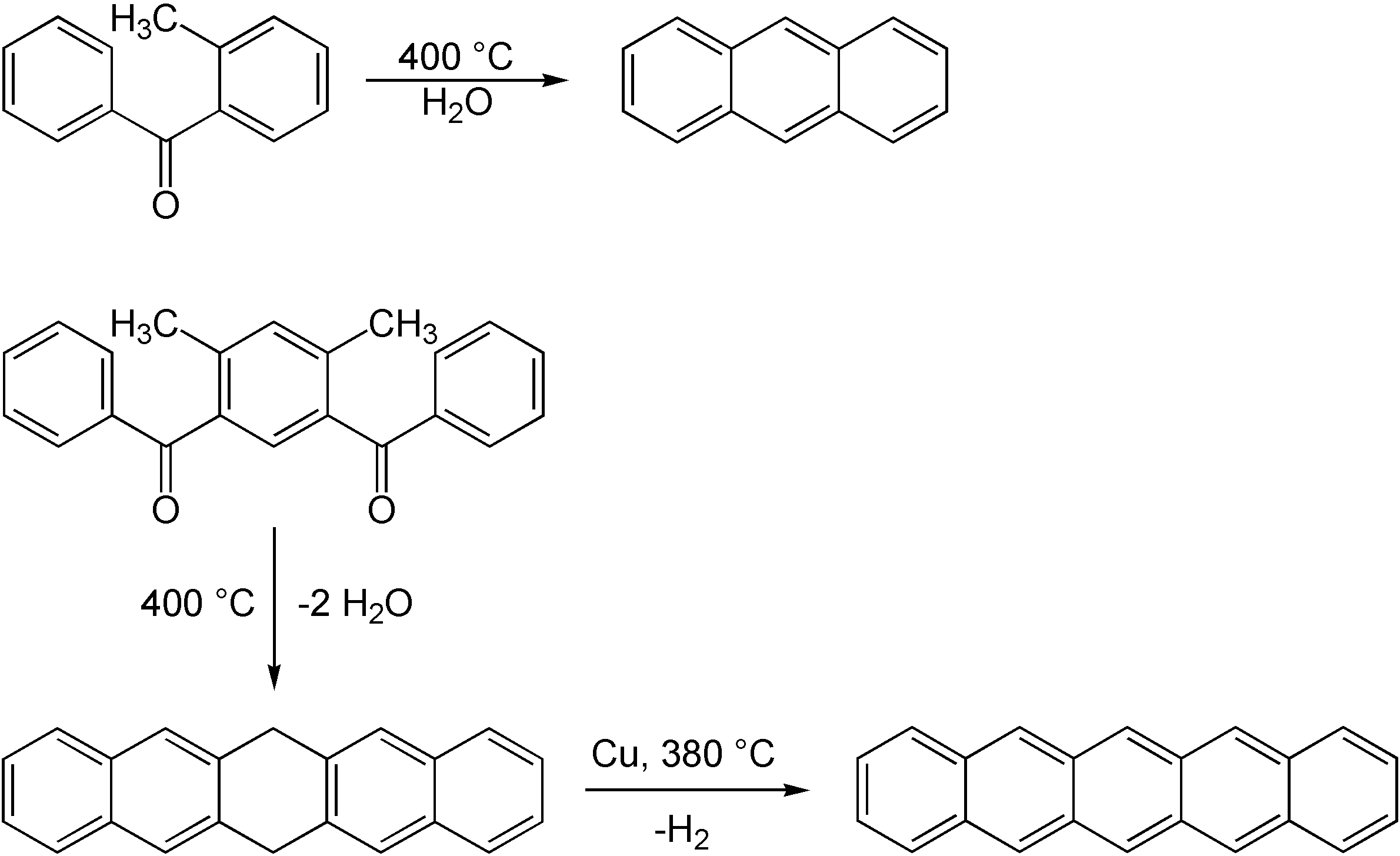
Chemical reaction
The Elbs reaction is an organic reaction describing the pyrolysis of an ortho methyl substituted benzophenone to a condensed polyaromatic. The reaction is named after its inventor, the German chemist Karl Elbs, also responsible for the Elbs oxidation. The reaction was published in 1884. Elbs however did not correctly interpret the reaction product due to a lack of knowledge about naphthalene structure.
Scope
The Elbs reaction enables the synthesis of condensed aromatic systems. As already demonstrated by Elbs in 1884 it is possible to obtain anthracene through dehydration. Larger aromatic systems like pentacene are also feasible. This reaction does not take place in a single step but leads first to dihydropentacene that is dehydrogenated in a second step with copper as a catalyst.
The acyl compounds required for this reaction can be obtained through a Friedel-Crafts acylation with aluminum chloride.
The Elbs reaction is sometimes accompanied by elimination of substituents and can be unsuited for substituted polyaromatics.
Mechanism
More than three plausible mechanisms for the Elbs reaction have been suggested. The first mechanism, suggested by Fieser, begins with a heat-induced cyclisation of the benzophenone, followed by a [1,3]-hydride shift to give the compound . A dehydration reaction then affords the polyaromatic.

Alternatively, in the second mechanism, due to Cook, the methylated aromatic compound instead first undergoes a tautomerization followed by an electrocyclic reaction to give the same intermediate, which then similarly undergoes a [1,3]-hydride shift and dehydration.
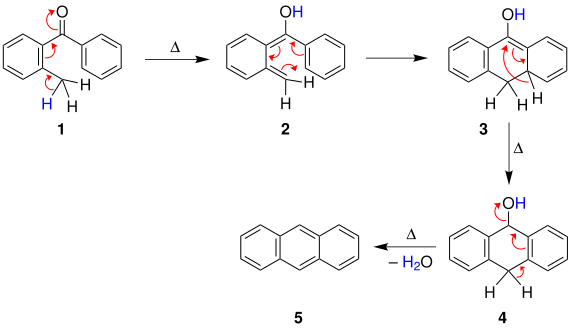
A third mechanism has also been proposed, involving pyrolytic radical generation.
Variations
It is also possible to synthesise heterocyclic compounds via the Elbs reaction. In 1956 an Elbs reaction of a thiophene derivative was published. The expected linear product was not obtained due to a change in reaction mechanism after formation of the first intermediate which caused multiple free radical reaction steps.

References
References
- [[Karl Elbs]], Einar Larsen. (1884). "Ueber Paraxylylphenylketon." ''[[Chemische Berichte. Ber. Dtsch. Chem. Ges.]]'' (in German), '''17'''(2): 2847–2849, {{doi. 10.1002/cber.188401702247.
- [[Karl Elbs. K. Elbs]]. (1886) "Beiträge zur Kenntniss aromatischer Ketone. Erste Mittheilung." ''[[Journal für Praktische Chemie. J. Prakt. Chem.]]'' (in German), '''33'''(1): 180–188, {{doi. 10.1002/prac.18860330119.
- Fieser, Louis F. (1942). "The Elbs Reaction." ''[[Organic Reactions. Org. React.]]'', '''1''': 129-154, {{doi. 10.1002/0471264180.or001.06.
- 978-3-13-541505-5.
- (2010). "Comprehensive Organic Name Reactions and Reagents".
- G. M. Badger, B. J. Christie. (1956). "Polynuclear heterocyclic systems. Part X. The elbs reaction with heterocyclic ketones." ''[[Journal of the Chemical Society. J. Chem. Soc.]]'' '''1956''': 3435–3437, {{doi. 10.1039/JR9560003435.
This article was imported from Wikipedia and is available under the Creative Commons Attribution-ShareAlike 4.0 License. Content has been adapted to SurfDoc format. Original contributors can be found on the article history page.
Ask Mako anything about Elbs reaction — get instant answers, deeper analysis, and related topics.
Research with MakoFree with your Surf account
Create a free account to save articles, ask Mako questions, and organize your research.
Sign up freeThis content may have been generated or modified by AI. CloudSurf Software LLC is not responsible for the accuracy, completeness, or reliability of AI-generated content. Always verify important information from primary sources.
Report