From Surf Wiki (app.surf) — the open knowledge base
El Salvador national football team
Men's association football team

Men's association football team
| Field | Value |
|---|---|
| Name | El Salvador |
| Badge | El Salvador crest.svg |
| Badge_size | 180px |
| Nickname | La Selecta (The National Team) |
| Los Cuscatlecos (The Cuscatlecos) | |
| La Azul y Blanco (The Blue and White) | |
| La ES (The ES) | |
| Association | Federación Salvadoreña de Fútbol (FESFUT) |
| Confederation | CONCACAF (North America) |
| Sub-confederation | UNCAF (Central America) |
| Coach | Hernán Darío Gómez |
| Captain | Julio Sibrián |
| Most caps | |
| Top scorer | Raúl Díaz Arce (39) |
| Home Stadium | Estadio Cuscatlán |
| Estadio Jorge "El Mágico" González | |
| FIFA Trigramme | SLV |
| FIFA Rank | |
| FIFA max | 49 |
| FIFA max date | April 2012 |
| FIFA min | 169 |
| FIFA min date | November 2006 |
| Elo Rank | |
| Elo max | 40 |
| Elo max date | December 1943 |
| Elo min | 125 |
| Elo min date | April 2007 |
| pattern_b1 | _slv25h |
| pattern_sh1 | _slv25h |
| pattern_so1 | _slv25h |
| leftarm1 | 0044FF |
| body1 | 0044FF |
| rightarm1 | 0044FF |
| shorts1 | 0044FF |
| socks1 | 0044FF |
| pattern_la2 | _slv25a |
| pattern_b2 | _slv25a |
| pattern_ra2 | _slv25a |
| pattern_sh2 | _slv25a |
| pattern_so2 | _slv25a |
| leftarm2 | FFFFFF |
| body2 | FFFFFF |
| rightarm2 | FFFFFF |
| shorts2 | FFFFFF |
| socks2 | FFFFFF |
| First game | 7–0 |
| (Guatemala City, Guatemala; 14 September 1921) | |
| Largest win | 12–0 |
| (San Salvador, El Salvador; 6 February 2008) | |
| Largest loss | 10–1 |
| (Elche, Spain; 15 June 1982) | |
| World cup apps | 2 |
| World cup first | 1970 |
| World cup best | Group stage (1970, 1982) |
| Regional name | Olympic Games |
| Regional cup apps | 1 |
| Regional cup first | 1968 |
| Regional cup best | Group stage (1968) |
| 2ndRegional name | CONCACAF Championship / Gold Cup |
| 2ndRegional cup apps | 20 |
| 2ndRegional cup first | 1963 |
| 2ndRegional cup best | Runners-up (1963, 1981) |
| 3rdRegional name | CONCACAF Nations League |
| 3rdRegional cup apps | 4 |
| 3rdRegional cup first | 2019–20 |
| 3rdRegional cup best | Group stage (2022–23, 2023–24) |
| 4thRegional name | CCCF Championship |
| 4thRegional cup apps | 7 |
| 4thRegional cup first | 1941 |
| 4thRegional cup best | Champions (1943) |
the men's team
Los Cuscatlecos (The Cuscatlecos) La Azul y Blanco (The Blue and White) La ES (The ES) | Sub-confederation = UNCAF (Central America) Estadio Jorge "El Mágico" González (Guatemala City, Guatemala; 14 September 1921) (San Salvador, El Salvador; 6 February 2008) (Elche, Spain; 15 June 1982)
The El Salvador national football team () represents El Salvador in men's international football, which is governed by the Federación Salvadoreña de Fútbol () founded in 1935. It has been an affiliate member of FIFA since 1938 and a founding affiliate member of CONCACAF since 1961. Regionally, it is an affiliate member of UNCAF in the Central American Zone. From 1938 to 1961, it was a member of CCCF, the former governing body of football in Central America and Caribbean and a predecessor confederation of CONCACAF, and also a member of PFC, the former unified confederation of the Americas, from 1946 to 1961.
El Salvador has qualified for the FIFA World Cup twice (1970 and 1982). It also participated once in the Olympic Games (1968).
El Salvador has participated twenty times in CONCACAF's premier continental competition, finishing as runners-up twice in the CONCACAF Championship (1963 and 1981). The team's best performance under the CONCACAF Gold Cup format was reaching the quarter-finals six times. It has participated twice in League A and twice in League B of the CONCACAF Nations League.
Regionally, the team won the CCCF Championship in 1943, and one gold medal at the Central American and Caribbean Games in 1954. It also finished third place six times in the Copa Centroamericana.
The Estadio Cuscatlán, also known as "El Coloso de Montserrat" and "La Catedral del Espectáculo", is the official home stadium of the El Salvador national football team. Since 2017, the national team has had a kit sponsorship contract with England-based supplier Umbro. Raúl Díaz Arce is the all-time top-scorer for the national team, with 39 goals, while Darwin Cerén has the most caps, with 103 appearances.
History
Beginnings
Although El Salvador played a few games in the early part of the twentieth century, they did not form an official national team until 1921, when players such as José Pablo Huezo, Carlos Escobar Leyva or Santiago Barrachina revolutionised football in the country. In September 1921, El Salvador were invited to Guatemala to take part in the Independence Centenary Games, to celebrate 100 years of Central American Independence. The tournament was contested by Guatemala, Honduras, Costa Rica, and El Salvador. The Guatemalans and Costa Ricans had more experience than the Salvadorans and Hondurans. It was a knockout tournament with Guatemala playing Honduras and El Salvador playing Costa Rica. El Salvador, wearing white shorts and black shirts, used a classic 2–3–5 scheme with their team consisting of Carlos Escobar Leyva; Spanish resident Santiago Barrachina, José Pablo Huezo; Benjamín Sandoval, Emilio Dawson, and Frenchman Emilio Detruit; Víctor Recinos, brothers Guillermo and José E. Alcaine, Guillermo Sandoval and Enrique Lindo. By half-time Costa Rica led 3–0, and at the final whistle, after two 40-minute halves, won 7–0.
El Salvador's other matches in the 1920s were friendlies against Costa Rica and Honduras. They lost their first friendly 3–0 against Costa Rica, while the second and third ended in a 1–0 loss and 0–0 draw against Honduras. On 7 December 1928, El Salvador recorded their first ever win, 5–0 over Honduras, the team that would become their traditional rivals, with Gustavo "Taviche" Marroquín scoring every goal. The game was played at Campo Marte, San Salvador, and was also the first time the team had scored in an international match.
1930s
In the early 1930s, El Salvador appointed their first official national coach, the American Mark Scott Thompson, in preparation for the 1930 Central American and Caribbean Games in Havana. El Salvador finished in fourth place at the games. The Salvadoran Football Federation was founded in 1935. By this time, El Salvador were coached by the Spaniard, Pablo Ferre Elías. The 1935 Central American and Caribbean Games took place in El Salvador's new government-funded Estadio Flor Blanca, at that time the biggest stadium in the country. The Salvadoran squad consisted of Edmundo Majano as goalkeeper; Tobias Rivera and Raúl Castro in defence; Américo Gonzalez and Napoleon Cañas as midfielders; and Álex Morales, Rogelio Aviles, Fidel Quintanilla, Miguel "Americano" Cruz, and Andrés Hernández as strikers. Previously the national team had worn black and white striped jerseys and this was the first time they turned out in a blue strip. The team finished in third place as bronze medal winners.
In 1938, the Salvadoran Football Federation became affiliates of FIFA. El Salvador participated in the 1938 Central American and Caribbean Games, hosted in Panama, which were won by Mexico, with Costa Rica in second place. El Salvador won two and lost three of their five matches. A match for third place against Colombia was cancelled because of the bad state of the players, and El Salvador finished in fourth place.
1940s
On 26 April 1940, the first national football federation was approved, with Dr. Luis Rivas Palacios as president. In 1941, the first Central American and Caribbean Championship (CCCF) took place in Costa Rica, organised by CONCACAF, the international governing body for football in North America, Central America and the Caribbean. El Salvador competed alongside Costa Rica, Curaçao, Nicaragua and Panama. El Salvador were runners-up, recording two wins, one draw and one loss.
The 1943 CCCF Championship took place in San Salvador with the participation of Costa Rica, Guatemala and Nicaragua. El Salvador were coached by the former national player Américo González. El Salvador and Guatemala finished with the same number of points, Guatemala failed to attend a deciding play-off, resulting in El Salvador winning their first international title. El Salvador's 10–1 win over Nicaragua set the team's record for the most goals scored in a single game. It was also the second time a Salvadoran player (Miguel "Americano" Cruz) had scored five goals in a match. El Salvador defended their title in the 1946 CCCF Championship in Costa Rica alongside six other participants and finished in third place, winning three matches and losing two. In the 1948 CCCF Championship, hosted in Guatemala, Costa Rica won the championship for the third time, with El Salvador finishing in fifth place.
1950s
El Salvador did not participate in qualification for the World Cups in 1954, 1958, 1962 and 1966. During these years El Salvador had a good squad, including goalkeeper Manuel "Tamalón" Garay, Rafael "Chapuda" Reyes, Conrado Miranda, Miguel "Americano" Cruz, Rafael Corado and Mando Rivas.
In the group stage of the 1950 Central American and Caribbean Games in Mexico, El Salvador recorded two wins, one draw and one loss. They began the final round by beating Curaçao 3–1, but lost their other two matches, leaving them in fifth place. In 1953, El Salvador took part in their fifth CCCF Championship. The hosts, Costa Rica, became champions for the fourth time, and El Salvador finished in fifth place again.
At the 1954 Central American and Caribbean Games, El Salvador won their second international title under the Carbilio Tomasino, with a team consisting of Yohalmo Aurora, Manuel "Tamalón" Garay, Hugo Moreno, Armando Larín, Luis Regalado, Conrado Miranda, Fernando Barrios, Ramón "Pezote" Chávez, José Hernández, Mario Montoya, Juan Francisco "Cariota" Barraza, Ricardo "Chilenito" Valencia, Alfredo "Baiza" Ruano, and Obdulio Hernández. They began with a 2–2 draw against Colombia, and then beat Cuba 3–1, Mexico 3–2 and Panama 1–0 with a goal by Barraza. The win against Mexico, with two goals from Montoya and one from Valencia, was the first by a Central American team against Mexico.
In the 1955 CCCF Championship, hosted in Honduras, Costa Rica became champions for the fifth time, with El Salvador finishing fourth. El Salvador did not participate in the 1957 and 1960 CCCF Championships.
1960s
El Salvador returned to participate in the 1961 CCCF Championship, hosted in Costa Rica, alongside nine other national teams. El Salvador were placed in a four-team first group with Honduras, the Netherlands Antilles, and Nicaragua, which they topped with two wins and a draw. In the final round they finished in second place behind Costa Rica, who won their seventh CCCF Championship. Afterwards the tournament was dissolved and replaced with the CONCACAF Championship.
In the first CONCACAF Championship, in 1963, El Salvador hosted both the qualification round and the final tournament. Costa Rica became the first champions, and El Salvador finished as runners-up. In 1964, the Chilean Hernán Carrasco Vivanco, who would later revolutionize Salvadoran football, became the coach of the national team. He led the national team for the first time at the 1965 CONCACAF Championship, hosted in Guatemala, where they won two games, drew one and lost two, finishing in fourth place. In 1966, El Salvador took part in the Central American and Caribbean Games for the sixth time, in Puerto Rico. They finished in fourth place.
In 1968, El Salvador qualified for the Olympic Games for the first time. They lost 4–0 to Hungary, 3–1 to Israel, and drew 1–1 with Ghana. The coach at this time was Rigoberto Guzmán.
Gregorio Bundio and his assistant José Santacolomba coached the team in the qualifying stages for the 1970 World Cup. This was the first time that El Salvador participated in World Cup qualifying. As hosts, Mexico qualified automatically, leaving one further qualification spot available for the CONCACAF region. El Salvador won Group 3, winning three and losing one. They qualified for a play-off against their traditional rivals, the Group 2 winners Honduras. The first game, on 8 June 1969 in the Honduran capital of Tegucigalpa, was won 1–0 by the home team and was followed by crowd violence. El Salvador won the second game 3–0 a week later in San Salvador, which was followed by even greater violence. A play-off match took place in Mexico City on 26 June, which El Salvador won 3–2 after extra time. On 14 July, as a result of existing tensions being exacerbated by these matches, the two countries began the hundred-hour-long conflict known as the Football War. As a result, El Salvador and Honduras were both disqualified from entering 1969 CONCACAF Championship qualification.
In the deciding World Cup qualifier, El Salvador faced Haiti. El Salvador won the away leg 2–1, with goals from Elmer Acevedo and Mauricio "Pipo" Rodríguez, but lost the second leg 3–0 at home. El Salvador finally won the play-off on 8 October with a goal by Juan Ramón "Mon" Martínez in extra time, allowing them to qualify for the World Cup finals at the first attempt.
"El Pajaro Picón Picón" was a Colombian song written by Eliseo Herrera which was very popular in El Salvador during the World Cup qualifying stages. During a radio show, Mauricio Bojórquez parodied the song, which he named "Arriba con la Selección". That parody became so famous that it became the official anthem of the El Salvador national football team.
1970s
In the World Cup finals El Salvador were drawn into a group with Belgium, Mexico and the Soviet Union. El Salvador lost their first game 3–0 to Belgium in Mexico City on 3 June. The second match, against Mexico on 7 June, was marred by a controversial call near the end of the first half, with the score still at 0–0. The Egyptian referee Ali Kandil appeared to signal for a free kick to El Salvador in their own half. However, a Mexican player took the kick, passing to Javier Valdivia, who scored. The Salvadoran players protested vigorously, to the extent of physically jostling the Bermudan linesman, Keith Dunstan, but the goal was allowed to stand. El Salvador restarted the game by kicking the ball into the crowd in protest. They eventually lost 4–0. The team's third game took place on 10 June, with El Salvador losing 2–0 to the Soviet Union to finish at the bottom of Group A.
El Salvador advanced from the first round of 1971 CONCACAF Championship qualification by beating Nicaragua 4–2 on aggregate. In the second round, they withdrew from their play-off against Honduras, allowing their opponents to qualify by default. The national team also took part in the 1973 CONCACAF Championship qualification, which doubled as qualification for the 1974 World Cup, but they did not advance to the final stage after they were eliminated by Guatemala 2–0 on aggregate (1–0, 1–0). The team was managed by Hector D'Angelo.
El Salvador participated at the Pan American Games for the first time in 1975 in Mexico. They began with a 4–1 win against Nicaragua on 14 October, with a hat-trick from "Pajarito" Huezo, on the début of Francisco "Paco" Jovel. They then lost 2–0 to Brazil and drew 0–0 against Costa Rica, with "Pelé" Zapata missing a penalty. They finished in third place in Group D and failed to advance to the next round.
In 1977 CONCACAF Championship qualification, El Salvador finished second in their group, behind Guatemala and ahead of Costa Rica and Panama, to qualify for the final tournament, hosted in Mexico. They finished in third place, behind Haiti and Mexico, with the hosts winning the tournament. El Salvador participated in the 1978 Central American and Caribbean Games, hosted in Colombia. Cuba were crowned champions for the fourth time and El Salvador finished ninth.
1980s
El Salvador played Costa Rica, Guatemala, Honduras and Panama in 1981 CONCACAF Championship qualification, in a home-and-away round-robin group with the top two teams advancing to the final tournament. El Salvador and Honduras finished with equal points at the top of the group, with Honduras winning the group on goal difference. Once again the finals doubled up as World Cup qualification, this time for the 1982 World Cup, with the top two of the six teams qualifying. Going into the final matches, El Salvador had four points and were in third place on goal difference, with Mexico and Canada both also having four points, behind Honduras with seven. On 19 November 1981, El Salvador beat Haiti 1–0, with a penalty by Norberto Huezo. On 21 November, Canada drew 2–2 with Cuba and were eliminated. In the decisive match the following day, Honduras and Mexico drew 0–0, meaning El Salvador qualified for the World Cup for the second time.
El Salvador took a 20-man squad to Spain, two players short of the maximum number allowed, as a controversial cost–saving measure. They were coached by "Pipo" Rodríguez. In their first match on 15 June in Elche, they were defeated 10–1 by Hungary, a World Cup Finals record margin of victory. A silver lining was that Luis Ramírez Zapata scored the country's first World Cup goal during the game, albeit when the Salvadorans were already 5–0 down. When Zapata scored, some Salvadorans cried out not to celebrate the goal because it might make the Hungarians angry and encourage them to score more. Displaying much-improved levels of organisation and commitment, El Salvador lost 1–0 to Belgium on 19 June in Elche and 2–0 to the world champions, Argentina, on 23 June in Alicante.
There were several reasons the tournament went so badly for El Salvador. First of all, their reduced squad meant that they omitted Gilberto Quinteros and Miguel González. According to Luis Guevara Mora, the 20-year-old goalkeeper, the Salvadoran Football Federation decided to take members of the Federation, as well as their friends and family, and spent so much money they could not afford to bring a full squad. The team took many stops throughout Europe under the direction of the Federation, taking three days to arrive in Spain and were the last team to do so. Once they arrived, there was more trouble. Adidas sent four white and three blue uniforms for each player, but only three white and one blue arrived. The remaining uniforms were said to have been taken away by the association. They decided to play with the white uniform and keep the blue as a keepsake. Next, someone stole the balls that the team needed to train with. The day before the match against Hungary, the Hungarians had the 25 balls the organization had given them while El Salvador had none and were unable to train. To make things even worse, El Salvador had never seen Hungary play, and the only knowledge that they had about the team was an outdated video that they had bought. On the field there were more problems. Hungary's fourth goal was caused by Francisco Jovel's sudden deafness after he had received a heavy blow on the cheek. When Guevara Mora called to him to stop a ball, the defender did not hear him, and the ball went past Jovel in front of the net. After the match, the Salvadoran squad had a tense meeting with the coaching staff and Federation. The coach was dismissed immediately and the matches against Belgium and Argentina were managed by players Jovel, Huezo and Fagoaga. Although the tournament overall was a big disappointment, Jorge "Mágico" González was considered by the national and international press as the best player, and he stayed in Spain to play for Cádiz CF and Real Valladolid.
In 1985 CONCACAF Championship qualification, El Salvador beat Puerto Rico 8–0 on aggregate (5–0, 3–0) to qualify for the final tournament. They were placed in a group with Honduras and Suriname, with the top team advancing. They finished second in the group with five points, one point behind Honduras. In 1989 CONCACAF Championship qualification they eliminated the Netherlands Antilles 6–0 on aggregate (1–0, 5–0). El Salvador finished last, with just two points, in the round-robin final tournament.
1990s
At a CONCACAF congress, held in Guatemala on 26 January 1991, a new tournament, called the UNCAF Nations Cup, was conceived for Central American teams. The inaugural tournament was hosted in 1991, hosted by Costa Rica. The tournament also doubled as qualification for the CONCACAF Gold Cup, a new tournament which replaced the CONCACAF Championship. In qualification, La Selecta defeated Nicaragua 5–2 on aggregate (3–2, 2–0) and advanced to the final tournament. In the finals, they played three games, drawing one and losing two, finishing in last place and failing to advance to the 1991 CONCACAF Gold Cup. The 1993 UNCAF Nations Cup once again served as qualification to the Gold Cup, this time for the 1993 CONCACAF Gold Cup. Coached by Jorge Vieira, La Selecta advanced to the final tournament automatically. There they played three games, once again drawing one and losing two to finish last and fail to advance to the Gold Cup.
In 1994 World Cup qualification, El Salvador eliminated Nicaragua 10–1 on aggregate (5–0, 5–1) in the first round, then finished first in a group composed of Bermuda (0–1, 4–1), Canada (1–1, 3–2), and Jamaica (2–0, 2–1) in the second round. In the third round, El Salvador began with a win against Mexico at home, but lost their next four games, including two defeats against Canada. They beat Honduras 2–1 at home in their final game, but finished third in the group and were eliminated.
El Salvador hosted the 1995 UNCAF Nations Cup. In their first round, they topped a group containing Costa Rica and Belize, and lost 1–0 to Guatemala in the knockout round. They won the third place match 2–1 against Costa Rica and advanced to the 1996 CONCACAF Gold Cup alongside Guatemala and the tournament winners, Honduras. This was their first appearance at the Gold Cup. At the finals of the 1996 Gold Cup, El Salvador defeated Trinidad and Tobago 3–2, with goals from Raúl Díaz Arce (2) and Ronald Cerritos in their first game, but then lost 2–0 to the United States and did not advance from the first round.
At the 1997 UNCAF Nations Cup, hosted in Guatemala, El Salvador lost 3–0 to Honduras in their first match but defeated Panama 2–0 in their second. In the second group stage they finished in third place, losing 1–0 to both Guatemala and Costa Rica, and drawing 0–0 against Honduras. They advanced to the 1998 CONCACAF Gold Cup, hosted in the United States. El Salvador were coached by Kiril Dojcinovski. In the group stage, they drew 0–0 with Guatemala, and lost to Brazil (4–0) and Jamaica (2–0).
In 1998 World Cup qualification, El Salvador received a bye to the third round, where they were drawn into a group with Canada, Cuba, and Panama. They finished second behind Canada and advanced to the six-team final round. El Salvador finished in fifth place with two wins, four draws, and four defeats. This was the closest they had come to qualifying for a World Cup since 1982.
At the 1999 UNCAF Nations Cup, hosted in Costa Rica, El Salvador drew 1–1 with Guatemala and defeated Nicaragua 1–0 in the first round, with Magdonio Corrales scoring in both games. In the second group stage, they lost 3–1 to Honduras, 1–0 Guatemala and 4–0 to Costa Rica to finish bottom of the group, and failed to advance to the 2000 CONCACAF Gold Cup. They were coached by Mario Peres Ulibarri.
2000s
In 2002 World Cup qualification, El Salvador topped a first round group ahead of Belize and Guatemala, but finished third behind and Jamaica in the second round, and were eliminated.
In the 2001 UNCAF Nations Cup in Honduras, El Salvador topped their first-round group, defeating Nicaragua 3–0, Panama 2–1, and drawing 1–1 with the hosts. In the final round they drew all their games to finish third and advance to the 2002 CONCACAF Gold Cup. They were coached by Carlos Recinos. In the Gold Cup, El Salvador lost their first match in Group A to Mexico (1–0), but defeated Guatemala by the same score, with a goal from Santos Cabrera. This allowed them to advance to the quarter-finals of the Gold Cup for the first time, but they lost 4–0 at that stage to the eventual champions, the United States.
At the 2003 UNCAF Nations Cup in Panama, El Salvador finished third again, with Juan Ramón Paredes as head coach. In the tournament, they won 2–1 against Panama, lost 1–0 to Costa Rica, beat Nicaragua 3–0 and Honduras 1–0, and lost 2–0 against Guatemala. They qualified for the 2003 CONCACAF Gold Cup, where they were drawn into Group C with Martinique and the United States. El Salvador 2–0 lost to the United States but beat Martinique 1–0 with a goal from Marvin González. In the quarter-finals, they were beaten 5–2 by Costa Rica, with three of the seven goals coming from penalty kicks.
The 2006 World Cup qualifiers and 2005 UNCAF Nations Cup, hosted in Guatemala, were both huge disasters for El Salvador. In the former they received a bye to the second round, where they inched past Bermuda 4–3 on aggregate (2–1, 2–2). In the third round they finished last in a group that contained Jamaica, Panama and the United States, with just four points from six games. In the 2005 UNCAF Nations Cup they went out in the first round after losing against Panama (1–0) and Costa Rica (2–1), which meant they also failed to qualify for the 2005 CONCACAF Gold Cup. They were coached by Carlos Cavagnaro.
Coached by Carlos de los Cobos, El Salvador hosted the 2007 UNCAF Nations Cup, and won their first-round group after 2–1 wins over Belize and Nicaragua, and a 0–0 draw with Guatemala. In the semi-finals, they lost 1–0 to the eventual champions, Costa Rica, and finished the tournament in fourth after Guatemala beat them by the same scored in the third place play-off. This allowed them to qualify for the 2007 CONCACAF Gold Cup, where they began with a 2–1 win against Trinidad and Tobago 2–1, with goals from Ramón Sánchez and Dennis Alas. They lost their next two matches against Guatemala (1–0) and the United States (4–0) and exited the tournament.
On 16 June 2007, El Salvador met Hungary at the Estadio Cuscatlán in a repeat of their match at the 1982 World Cup. Many of the same players that had played the original World Cup match played again. The match was drawn 2–2, with goals from Lázár Szentes and Ferenc Csongrádi for Hungary and two goals from Luis Ramírez Zapata for El Salvador.
At the 2009 UNCAF Nations Cup in Honduras, El Salvador finished second in their group after Belize 4–1, drawing 1–1 with Nicaragua and losing 2–0 to Honduras, and Nicaragua. Their semi-final against Costa Rica was called off after 60 minutes, with Costa Rica leading 1–0, when El Salvador were reduced to six players. Alexander Escobar and Eliseo Quintanilla were sent off in the first half, while Deris Umanzor, Rodolfo Zelaya and their goalkeeper Juan José Gómez were injured and had to leave the field after El Salvador had already used their three substitutions. The game was awarded as a 3–0 win to Costa Rica. In the third place play-off, they lost 1–0 to Honduras after a goal by Roger Espinoza. At the 2009 CONCACAF Gold Cup, El Salvador began by beating Costa Rica 2–1, with two goals by Osael Romero. However, they lost 1–0 against Canada and Jamaica and were eliminated.
2010s
In 2010 World Cup qualification El Salvador beat Anguilla 16–0 on aggregate and Panama 3–2 on aggregate in the first two rounds. In their third round group, they finished second in the group behind Costa Rica, ahead of Haiti and Suriname, to advance to the Hexagonal round. Despite drawing against the United States and beating Mexico, El Salvador finished in fifth place and were eliminated. Rudis Corrales was their top scorer in qualification with 8 goals.
On 11 May 2010, the FIFA Emergency Committee suspended the Salvadoran Football Federation (FESFUT) on account of government interference, as the statutes ratified by the FESFUT general assembly in August 2009 had not been entered in the country's official register, and that the government had failed to acknowledge the authority of the Normalisation Committee set up to represent FESFUT. The suspension was lifted by 28 May, allowing La Selecta to participate in international tournaments. El Salvador's under-21 team qualified for the 2010 Central American and Caribbean Games (CAC) in Mayagüez, Puerto Rico. However, CONCACAF decided to suspend football at the 2010 CAC shortly after. El Salvador were also able to participate in the qualifying tournament for the 2012 Summer Olympics.
In the 2011 Copa Centroamericana, the new version of the reorganized UNCAF Nations Cup, El Salvador qualified from their first-round group in second place after defeating Nicaragua 2–0 and Belize 5–2, and losing 2–0 against Panama. In the semi-finals they lost 2–0 to Honduras, and lost 5–4 in a penalty shootout to Panama, after a 0–0 draw. This performance qualified El Salvador for the 2011 CONCACAF Gold Cup. The team was coached by José Luis Rugamas. Forward Rafael Burgos jointly received the Golden Boot with Costa Rica's Marco Ureña, with three goals.
In April 2011, two months before the start of the Gold Cup, José Luis Rugamas was replaced as coach by Rubén Israel. At the Gold Cup, El Salvador began with a 5–0 defeat to Mexico. They drew 1–1 with Costa Rica, with Rodolfo Zelaya's 25-yard free-kick opener being equalised by a Costa Rican goal in injury time, and beat Cuba 6–1 to reach the knockout stage for the first time since 2003. In the quarter-finals they drew 1–1 with Panama, with Panama scoring a controversial equaliser through Luis Tejada one minute from the end. Their coach Israel called the decision an "error of haste." Panama won the penalty shoot-out 5–3.
In 2014 World Cup qualification, El Salvador received a bye to the second round, where they began with a 3–2 win against the Dominican Republic, with goals scored by Rodolfo Zelaya (2) and Cristián Bautista. They then beat the Cayman Islands 4–1 with goals from Bautista, Luis Anaya (2) and Xavier García before winning the return against the Dominican Republic 2–1. They beat the Cayman Islands 4–0 at home, with goals by Víctor Turcios, Steve Purdy, Jaime Alas and Herbert Sosa. The last of these was the thousandth goal scored by the national team. Two comfortable wins over Suriname gave them a perfect record of six wins in six matches.
In the next round, El Salvador snatched a draw against Costa Rica in San José after being 2–0 down, but a home defeat against Mexico four days later precipitated the departure of Israel, whose poor relations with Jaime Rodríguez, the president of the National Institute of Sport Salvador (INDES) were widely known. The Salvadoran Football Association (FESFUT) named the Mexican Juan de Dios Castillo as his replacement.
Despite a good start, a 1–0 win in a friendly match against Guatemala, a 2–2 draw at the Estadio Cuscatlán in a qualifier against modest Guyana earned him the wrath of the public. A 3–2 victory in Georgetown, with a penalty saved by El Salvador's goalkeeper Dagoberto Portillo in additional time, kept their qualifying hopes alive, but these were ended by a 1–0 home defeat against Costa Rica. Juan de Dios Castillo was sacked in November 2012 and replaced on 17 December by the Peruvian Agustín Castillo, a five-time national champion with C.D. FAS.
El Salvador finished third in the 2013 Copa Centroamericana, allowing them to qualify for the 2013 CONCACAF Gold Cup in the United States. In that tournament, a 1–0 win over Haiti allowed them to qualify from the group stages in third place, but they lost 5–1 to the host nation in the quarter-finals.
In 2018 World Cup qualification, El Salvador won knockout ties against Saint Kitts and Nevis and Curaçao to reach the fourth round group stage, but they finished bottom of a group containing Mexico, Honduras and Canada with two draws and four defeats from their six matches.
2020s
After COVID-19 restrictions had loosened up a bit, El Salvador organized a friendly match against the US in December 2020 to start things off again. However, they lost 6–0 to the CONCACAF giants. 2022 FIFA World Cup qualification were soon on the horizon and El Salvador had to play against Grenada and Montserrat in the March 2021 calendar. El Salvador won at home against Grenada in a 2–0 victory and tied with Montserrat in a grueling 1–1 match. This was when El Salvador needed a change fast and they soon sacked Carlos de los Cobos. They hired a Hugo Pérez as their new coach, who was also coaching the El Salvador Sub-23s in the Olympic Qualifiers in the same year. Hugo Perez made radical changes to the team and called up more newer players to help represent El Salvador. When June rolled by, El Salvador's next opponents were the US Virgin Islands and Antigua & Barbudas. El Salvador crushed the Virgin Islands with a 7–0 victory away and won again at home against Antigua in a 3–0 win; El Salvador were on their way to the second round of qualifications. El Salvador then faced off against Saint Kitts & Nevis in a round robin format. El Salvador managed to pull off a 0–4 victory away and a 2–0 victory at home, which got them to the final round of qualifications for the first time in over 10 years. In preparation for the upcoming 2021 CONCACAF Gold Cup, El Salvador organized three friendlies. On June 26, El Salvador played against Guatemala to a 0–0 standstill. However, Hugo Perez was trying to experiment with more younger and less or known players at the time to form an underwhelming B Team. El Salvador then flew to Croatia to face their next opponents. On July 2, La Selecta faced off against NK Istra 1961 to a 2–1 defeat. On July 4, El Salvador faced the Asian Cup winners, Qatar, to a 1–0 defeat.
On July 11, El Salvador played their first game in the 2021 CONCACAF Gold Cup against their Central American rivals, Guatemala, to a 2–0 victory. On July 14, El Salvador faced Trinidad & Tobago to another 2–0 victory to land El Salvador in the Quarter-Finals and gain 6 points for the first time in the Gold Cup. On July 18, El Salvador played their last game against Mexico to prove how much they've grown or not. El Salvador lost to Mexico in a tense 1–0 defeat. In the quarter-finals, El Salvador faced off against Qatar and lost once again in a 3–2 defeat, ending their Gold Cup run.
On September 19, 2023, FESFUT hired Spanish manager Rubén de la Barrera to coach to the El Salvador national team.
Barrera would leave after 3 months and David Dóniga would take over on January 2, 2024.
It was announced to the public that a friendly bout was arranged by Inter Miami CF (where Lionel Messi was playing at the time) to face off against El Salvador on 19 January 2024 in Estadio Cuscatlán, where the match ended in a 0–0 stalemate. From the period of friendlies in February to March, El Salvador faced Costa Rica to a 2–0 defeat in San Jose, then faced Bonaire to a highly scrutinized 1–1 result in Washington DC, then took on world champions Argentina to a 3–0 defeat, and eventually ended with a match against Honduras in a vigorous 1–1 draw. On June 6, 2026 World cup qualifiers commenced in the CONCACAF region as El Salvador faced Puerto Rico to an excruciating draw of 0–0. However, on June 9, El Salvador took on Saint Vincent and The Grenadines away and ended up claiming the victory in a 1–3 result. It was a significant breakthrough as El Salvador has never won a match since 2022 against Grenada. After 2 friendly matches against Peru (0–1 loss June 14) and Guatemala (0–1 win July 27), El Salvador prepared themselves for the upcoming CONCACAF Nations League in a duration of 3 months. In the month of September, El Salvador defeated Montserrat (1–4) and Bonaire (2–1). In October, El Salvador faced off against Saint Vincent and The Grenadines twice, each sharing wins (2–3 win and 1–2 loss). In November, El Salvador concluded their campaign by defeating Bonaire and Montserrat; all in a 1–0 verdict and topping their group to ascend to Nations League A after relegation. The team and David Dóniga were heavily criticized during this period for mediocre performances. On February 24, 2025, David Doniga would end up relinquishing his position as head coach for the national team.
On February 25, 2025, INDES and FESFUT would officially proclaim Hernán Darío Gómez to be the new incumbent head coach of the national team.
From March to May, El Salvador played 3 exhibition fixtures where they faced Houston Dynamo(2–1 loss), Pachuca(1–1 draw), and Guatemala(1–1 draw). On June 7 and 10, El Salvador concluded their 2nd round of qualifiers against Anguilla and Suriname. El Salvador defeated Anguilla 0–3 and measured up to a highly contested 1–1 draw against Suriname at home and advance to the final round of qualifying.
In the same month, El Salvador would go on to have one of their worst Gold Cup performances since 1998. Only able to claim one point from Curaçao in a 0–0 draw, failing to score a single goal, and finishing their tenure with 2 losses against Honduras and Canada, which would drop them into last place in their group.
El Salvador would participate in the final round of world cup qualifiers from September to November of 2025. From the period time that was given to them, El Salvador managed to defeat Guatemala away in their first fixture. However, El Salvador failed to secure any meaningful results afterwards; losing the rest of their 5 games (home and away) to Suriname, Panama, and Guatemala. El Salvador concluded their campaign with only three points and finishing last in their group.
Match fixing
The national team has had accusations of several players losing matches on purpose in exchange for monetary rewards. Some of these allegations involved games against Venezuela, Mexico, USA, and Costa Rica. Fourteen players were handed lifetime bans from football on 20 September 2013: Luis Anaya, Osael Romero, Ramón Sánchez, Christian Castillo, Miguel Granadino, Miguel Montes, Dagoberto Portillo, Dennis Alas, Darwin Bonilla, Ramón Flores, Alfredo Pacheco, José Mardoqueo Henríquez, Marvin González, and Reynaldo Hernández. Carlos Monteagudo received a ban of 18 months. Eliseo Quintanilla and Víctor Turcios received six-month bans. Alexander Escobar, Christian Sánchez, and under-20 goalkeeper Yimmy Cuellar received bans of 30 days. After a further 20-day investigation, Rodrigo Martínez was sentenced to a ban of five years, Rodolfo Zelaya to a ban of one year, and Benji Villalobos to a ban of six months.
On 6 September 2016, the team revealed that they had turned down an offer to ensure that their result against Canada saw Honduras progress to the next round of World Cup qualification. Their coach Ramon Maradiaga was later fined 20,000 Swiss francs and banned from football for two years for not disclosing the approach.
Stadium
Main article: Estadio Jorge "Mágico" González, Estadio Cuscatlán, Estadio Nacional de El Salvador
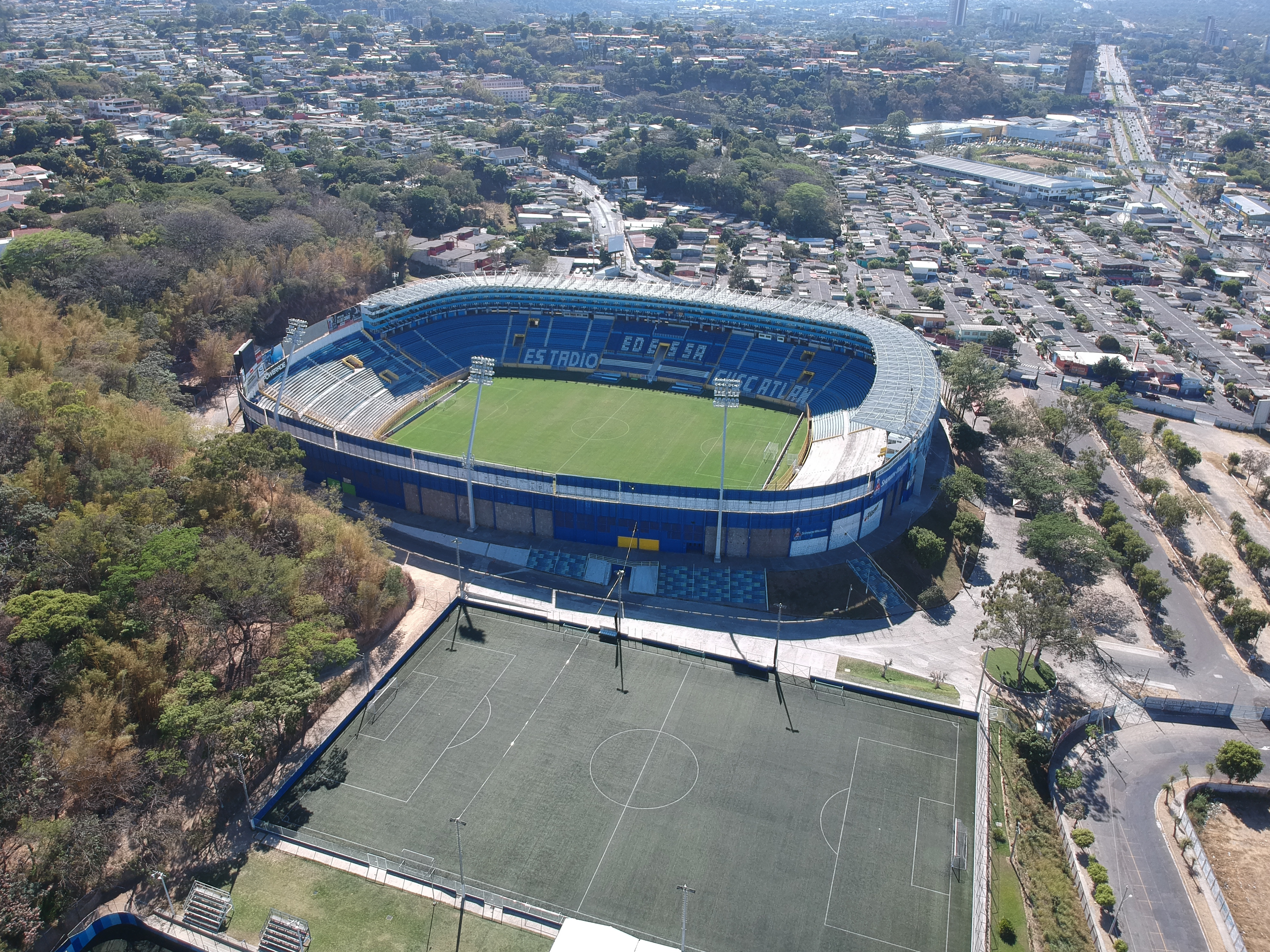
El Salvador's national stadium is the Estadio Cuscatlán in San Salvador, which saw its first game in 1976.
During the national team's early history, the national stadium was the Campo Marte, 16 acres of land that housed a small stadium, now known as Parque Infantil, between 1928 and 1934. Succeeding, El Salvador played at the Estadio Nacional de la Flor Blanca, now known as Estadio Jorge "Mágico" González, also in San Salvador. It was opened on 19 April 1932 during the presidency of Maximiliano Hernández Martínez in preparation for the 1935 Central American and Caribbean Games. On 24 March 1935 El Salvador played its first game at the Flor Blanca against Cuba and won 4–1. El Salvador played at this stadium during qualification for the 1970 World Cup. On 15 November 2000, a one-off game was played at the stadium, to commemorate a major refurbishment, against Jamaica in the 2002 World Cup qualifiers.
In 1969, EDESSA (Estadios Deportivos de El Salvador Sociedad Anónima) proposed the idea of a new national stadium. This resulted in construction of the Estadio Cuscatlán, with the president of El Salvador, General Fidel Sánchez Hernández, breaking ground on 24 March 1971. The stadium held its first game on 24 July 1976, a friendly between El Salvador and the German Bundesliga champions, Borussia Mönchengladbach. It ended in a 2–0 victory to the German side. The Borussia squad featured players from their 1974 World Cup winning squad, including Berti Vogts, Rainer Bonhof, Wolfgang Kleff and Jupp Heynckes, alongside Allan Simonsen, who later won the 1977 Ballon d'Or and joined Barcelona. El Salvador's team was Tomás Pineda (Mauricio "Tarzán" Alvarenga), Guillermo "Billy" Rodríguez Bou, Ramón Fagoaga, Humberto "Imacasa" Recinos, Eduardo "Conejo" Valdés, Víctor "Pato" Valencia, Warner Solís, Félix "Garrobita" Pineda (César "Piscucha" Acevedo), Luis "Pelé" Ramírez Zapata (Abraham Coreas) & Ismael "Cisco" Díaz (David Cabrera). Borussia also fielded Wolfgang Kneib, Hans-Jürgen Wittkamp, Horst Wohlers, Dietmar Danner, Hans Klinkhammer, Carsten Nielsen and Uli Stielike. Since that match, El Salvador has used the stadium for almost every major home game, and it is also the home ground of Alianza. On 25 May 1978, EDESSA agreed to sign a 99-year lease of the stadium to CLIMA (Asociación de Clubes de Liga Mayor A) to operate and control which events are held there.
Team image
El Salvador's traditional first kit colour is blue with white trim, their second kit being white with blue trim. The current home and away kit features the traditional colours with the exception of bold curved trims that run from the center of the neck and open to the sides, forming two panels on the chest that contain the Umbro logo and emblem of the Salvadoran Football Federation. At the center of the kit El Salvador national emblem, once again, is shown. The right sleeve shows the national flag.
El Salvador and Mitre announced a new partnership in 2008 that saw them supply the Central American national football team with home and away kits, training, and bench wear until August 2010. Mitre, and their Panamanian partner, The Harari Group, designed the kit that El Salvador used. The kit was showcased by the team on February 11, 2009, as they started their FIFA World Cup qualifying campaign against Trinidad & Tobago in the CONCACAF (Central-American Football Union) Hexagonal Cup.
On 22 October 2010, the FESFUT extended the contract with Mitre by four years. The first home and away kit made by Mitre feature a watermark of the country's national shield on the center of the shirt and some horizontal stripes along the kit. The current kit featured white remains along the neck, at the bottom of the kit, and over the shoulders. When this kit was introduced in 2009 it also introduced a new logo that replaced the typical logo of an "E" and an "S" surrounded by a circle. Umbro has become the new kit supplier of the El Salvador national football team. Replacing Mitre, the first Umbro El Salvador football kits were released 15 June 2017, and were debuted in the 2017 Gold Cup.
Kit sponsorship
| Kit supplier | Period |
|---|---|
| United States Pony | 1980–1982 |
| West Germany Adidas | 1982–1987 |
| United States Pony | 1988–1988 |
| Japan Mikasa | 1989–1991 |
| United States Pony | 1991–1992 |
| El Salvador Galaxia | 1992–1992 |
| United States Score | 1992–1995 |
| United States Reebok | 1996 |
| Italy Lanzera | 1996–1998 |
| Italy Kappa | 1999–2000 |
| Spain Joma | 2001–2002 |
| El Salvador Galaxia | 2003 |
| Mexico Atletica | 2004–2007 |
| El Salvador Milán | 2007 |
| Mexico Atletica | 2007–2009 |
| United Kingdom Mitre | 2009–2017 |
| United Kingdom Umbro | 2017–present |
Results and fixtures
Main article: El Salvador national football team results (2020–present)
The following is a list of match results in the last 12 months, as well as any future matches that have been scheduled.
2025
- González
- Escobar
- Henríquez
- Mauricio
- Hernández
- Ramírez
- Lom
- Ortiz
- Gil
- Alvarado
- Gil
- Lonwijk
- Quioto
- Ramírez
- J. David
- Buchanan
- Osorio
- Dijksteel
- Balker
- Klas
- Fajardo
- Santis
- Chery
- Margaret
- Klas
- Blackman
- Davis
- Rodríguez
Coaching staff
As of February 2025 https://www.elsalvador.com/deportes/selecciones/hernan-dario-bolillo-gomez-nuevo-tecnico-selecta-fesfut-indes/1202556/2025/
| Position | Staff |
|---|---|
| Head coach | COL Hernán Darío Gómez |
| Assistant coach | COL Édgar Carvajal |
| Assistant coach | SLV Juan Carlos Serrano |
| Fitness coach | COL Mauricio Roldán |
| Goalkeeping coach | SLV Álvaro Misael Alfaro |
| Director of football | Vacant |
| Coordinator of football | SLV Juan Carlos Serrano |
Coaching history
Since the creation of the national team in 1921, several coaches have been in charge of managing El Salvador. From 1930 to 1935, Mark Scott Thompson was appointed as El Salvador's first ever manager. , the El Salvador national football team has presented itself with 60 managers in the national team. It is reported that all 3 titles (1943, 1954 and 2002) have been won by Salvadoran born managers. Conrado Miranda has managed in 4 different occasions and Armando Contreras Palma in 3. Chilean Hernán Vivanco was manager when El Salvador competed at their first World Cup. Mauricio Rodríguez managed to qualify El Salvador to another World Cup. Rodríguez participated at the 1970 FIFA World Cup.
- USA Mark Scott Thompson (1930–1935)
- ESP Pablo Ferré Elías (1935–1938)
- CHIHUN Máximo Garay (1940–1941)
- ENG Charlie Slade (1941–1943)
- SLV Américo González (1943–1948)
- ARG Rodolfo Orlandini (1949–1951)
- SLV Marcelo Estrada (1953)
- SLV Carbilio Tomasino (1954–1959)
- SLV Emilio Guardado (1959–1960)
- SLV Conrado Miranda (1961)
- URU Luis Comitante (1963)
- CHI Hernán Carrasco Vivanco (1965–1967)
- SLV Rigoberto Guzmán (1968)
- ARG Gregorio Bundio (1968–1970)
- CHI Hernán Carrasco Vivanco (1970)
- SLV Conrado Miranda (1971)
- ARG Héctor D'Angelo (1972)
- BRA Jorge Tupinambá (1973)
- SLV Mauricio Rodríguez (1973–1974)
- SLV Conrado Miranda (1975)
- SLV Marcelo Estrada (1975–1976)
- SLV Raúl Magaña (1976)
- BRA Pinto Beltrao (1976)
- URU Juan Ricardo Faccio (1977)
- SLV Julio Contreras (1977)
- SLV Ricardo Tomasino (1978)
- SLV Raúl Magaña (1979)
- SLV Salvador Mariona (1979)
- SLV Mauricio Rodríguez (1979–1982)
- SLV Armando Palma (1983)
- SLV Raúl Magaña (1984)
- ARG Juan Quarterone (1984–1985)
- SLV Paulo Roberto Cabrera (1986)
- SLV Raúl Magaña (1987)
- YUG Milovan Đorić (1988)
- YUG Miroslav Vukašinović (1988–1989)
- SLV Conrado Miranda (1989)
- YUG Kiril Dojčinovski (1989)
- SLV Óscar Benítez (1991)
- URU Jorge Aude (1991)
- URU Aníbal Ruiz (1992)
- BRA Jorge Vieira (1993)
- CHI Néstor Matamala (1993)
- SLV Ricardo Tenorio (1993)
- MKD Kiril Dojčinovski (1994)
- ARG José Pastoriza (1995–1996)
- SLV Armando Palma (1996)
- SRB Milovan Đorić (1997)
- MKD Kiril Dojčinovski (1998)
- CHI Julio Escobar (1998)
- BRA Marinho Peres (1999)
- SLV Ricardo Tenorio (1999)
- SLV Óscar Benítez (1999–2000)
- SLV Carlos Recinos (2000–2002)
- SLV Juan Ramón Paredes (2002–2004)
- SLV Armando Palma (2004)
- ARG Carlos Cavagnaro (2005)
- SLV Miguel Aguilar (2005–2006)
- MEX Carlos de los Cobos (2006–2009)
- SLV José Luis Rugamas (2010–2011)
- URU Rubén Israel (2011–2012)
- MEX Juan de Dios Castillo (2012)
- PER Agustín Castillo (2012–2013)
- SLV Mauricio Alfaro (2014)
- ESP Albert Roca (2014–2015)
- SLV Jorge Rodríguez (2015)
- HON Ramón Maradiaga (2015–2016)
- COL Eduardo Lara (2016–2017)
- MEX Carlos de los Cobos (2018–2021)
- USASLV Hugo Pérez (2021–2023)
- ESP Rubén de la Barrera (2023)
- ESP David Dóniga (2024–2025)
- COL Hernán Darío Gómez (2025–present)
Players
Current squad
The following players were named in the squad for the 2026 FIFA World Cup qualification matches against Suriname and Panama on 13 and 18 November 2025, respectively.
Caps and goals as of 19 November 2025, after the match against Panama.
Recent call-ups
The following players have been called up within the last 12 months. INJ INJ Player withdrew from the current squad due to injury.
COV Player withdrew due to testing positively for COVID-19 or having to self-isolate because of it.
PRE Preliminary squad.
RET Player had announced retirement from international football.
SUS Player is serving a suspension.
WD Withdrawn.
Player records
| 1991–2000 |
|---|
| 2 |
| 23 |
| 52 |
|
| 2008–2019 |
|---|
| 3 |
| 21 |
| 62 |
|
| 1976–1998 |
|---|
| 4 |
| 20 |
| 66 |
|
| 2012–present |
|---|
| 19 |
| 40 |
|
| 1953–1969 |
|---|
| 19 |
| 47 |
|
| 1979–1989 |
|---|
| 7 |
| 17 |
| 78 |
|
| 2001–2011 |
|---|
| 16 |
| 58 |
|
| 1971–1989 |
|---|
| 16 |
| 77 |
|
| 2007–2013 |
|---|
| 15 |
| 14 |
|
| 1935–1950 |
|---|
| 15 |
| 68 |
|
| 2006–2012 |
|---|
| 15 |
| 76 |
| |1988–2000 |}
Competitive record
FIFA World Cup
Main article: El Salvador at the FIFA World Cup
| FIFA World Cup record | Qualification record | Year | Round | Position | Pld | W | D | L | GF | GA | Squad | Pld | W | D | L | GF | GA | Total | Group stage | 2/21 | 6 | 0 | 0 | 6 | 1 | 22 | — | 170 | 73 | 35 | 62 | 269 | 200 |
|---|---|---|---|---|---|---|---|---|---|---|---|---|---|---|---|---|---|---|---|---|---|---|---|---|---|---|---|---|---|---|---|---|---|
| Uruguay 1930 | Not a FIFA member | Not a FIFA member | |||||||||||||||||||||||||||||||
| Italy 1934 | |||||||||||||||||||||||||||||||||
| France 1938 | Did not participate | Did not participate | |||||||||||||||||||||||||||||||
| Brazil 1950 | Withdrew | Withdrew | |||||||||||||||||||||||||||||||
| Switzerland 1954 | Did not participate | Did not participate | |||||||||||||||||||||||||||||||
| Sweden 1958 | |||||||||||||||||||||||||||||||||
| Chile 1962 | |||||||||||||||||||||||||||||||||
| England 1966 | |||||||||||||||||||||||||||||||||
| Mexico 1970 | Group stage | 16th | 3 | 0 | 0 | 3 | 0 | 9 | Squad | 10 | 7 | 0 | 3 | 19 | 12 | ||||||||||||||||||
| West Germany 1974 | Did not qualify | 2 | 0 | 0 | 2 | 0 | 2 | ||||||||||||||||||||||||||
| Argentina 1978 | 11 | 4 | 4 | 3 | 18 | 16 | |||||||||||||||||||||||||||
| Spain 1982 | Group stage | 24th | 3 | 0 | 0 | 3 | 1 | 13 | Squad | 13 | 7 | 4 | 2 | 14 | 6 | ||||||||||||||||||
| Mexico 1986 | Did not qualify | 6 | 4 | 1 | 1 | 15 | 2 | ||||||||||||||||||||||||||
| Italy 1990 | 8 | 2 | 2 | 4 | 8 | 8 | |||||||||||||||||||||||||||
| United States 1994 | 14 | 8 | 1 | 5 | 28 | 18 | |||||||||||||||||||||||||||
| France 1998 | 16 | 5 | 5 | 6 | 23 | 22 | |||||||||||||||||||||||||||
| South Korea Japan 2002 | 10 | 6 | 1 | 3 | 23 | 15 | |||||||||||||||||||||||||||
| Germany 2006 | 8 | 2 | 2 | 4 | 6 | 14 | |||||||||||||||||||||||||||
| South Africa 2010 | 20 | 8 | 3 | 9 | 39 | 21 | |||||||||||||||||||||||||||
| Brazil 2014 | 12 | 7 | 2 | 3 | 28 | 16 | |||||||||||||||||||||||||||
| Russia 2018 | 10 | 3 | 3 | 4 | 12 | 16 | |||||||||||||||||||||||||||
| Qatar 2022 | 20 | 7 | 5 | 8 | 27 | 19 | |||||||||||||||||||||||||||
| Canada Mexico United States 2026 | 10 | 3 | 2 | 5 | 9 | 13 | |||||||||||||||||||||||||||
| Morocco Portugal Spain 2030 | To be determined | To be determined | |||||||||||||||||||||||||||||||
| Saudi Arabia 2034 |
| FIFA World Cup history | First match | Biggest win | Biggest defeat | Best result | Worst result |
|---|---|---|---|---|---|
| 3–0 | |||||
| (3 June 1970; Mexico City, Mexico) | |||||
| — | |||||
| 10–1 | |||||
| (15 June 1982; Elche, Spain) | |||||
| Group stage (1970, 1986) | |||||
| — |
CONCACAF Gold Cup
Main article: El Salvador at the CONCACAF Gold Cup
| CONCACAF Championship / Gold Cup record | Qualification record | Year | Round | Position | Pld | W | D | L | GF | GA | Squad | Pld | W | D | L | GF | GA | Total | Runners-up | 20/28 | 77 | 22 | 21 | 34 | 81 | 111 | — | 108 | 49 | 22 | 37 | 143 | 107 | |||||||||||||||
|---|---|---|---|---|---|---|---|---|---|---|---|---|---|---|---|---|---|---|---|---|---|---|---|---|---|---|---|---|---|---|---|---|---|---|---|---|---|---|---|---|---|---|---|---|---|---|---|---|
| El Salvador 1963 | Runners-up | 2nd | 7 | 3 | 3 | 1 | 17 | 11 | — | Qualified as hosts | ||||||||||||||||||||||||||||||||||||||
| Guatemala 1965 | Fourth place | 4th | 5 | 2 | 1 | 2 | 7 | 9 | — | 2 | 2 | 0 | 0 | 7 | 1 | |||||||||||||||||||||||||||||||||
| Honduras 1967 | Did not participate | Did not participate | ||||||||||||||||||||||||||||||||||||||||||||||
| Costa Rica 1969 | Banned | Banned | ||||||||||||||||||||||||||||||||||||||||||||||
| Trinidad and Tobago 1971 | Withdrew | Withdrew | ||||||||||||||||||||||||||||||||||||||||||||||
| Haiti 1973 | Did not qualify | 2 | 0 | 0 | 2 | 0 | 2 | |||||||||||||||||||||||||||||||||||||||||
| Mexico 1977 | Third place | 3rd | 5 | 2 | 1 | 2 | 8 | 9 | — | 6 | 2 | 3 | 1 | 10 | 7 | |||||||||||||||||||||||||||||||||
| Honduras 1981 | Runners-up | 2nd | 5 | 2 | 2 | 1 | 2 | 1 | — | 8 | 5 | 2 | 1 | 12 | 5 | |||||||||||||||||||||||||||||||||
| 1985 | Fourth place | 4th | 4 | 2 | 1 | 1 | 7 | 2 | — | 2 | 2 | 0 | 0 | 8 | 0 | |||||||||||||||||||||||||||||||||
| 1989 | Round-robin | 5th | 6 | 0 | 2 | 4 | 2 | 8 | — | 2 | 2 | 0 | 0 | 6 | 0 | |||||||||||||||||||||||||||||||||
| United States 1991 | Did not qualify | 5 | 2 | 1 | 2 | 7 | 11 | |||||||||||||||||||||||||||||||||||||||||
| Mexico United States 1993 | 3 | 0 | 1 | 2 | 1 | 5 | ||||||||||||||||||||||||||||||||||||||||||
| United States 1996 | Group stage | 6th | 2 | 1 | 0 | 1 | 3 | 4 | Squad | 4 | 3 | 0 | 1 | 7 | 3 | |||||||||||||||||||||||||||||||||
| United States 1998 | 8th | 3 | 0 | 1 | 2 | 0 | 6 | Squad | 5 | 1 | 1 | 3 | 2 | 5 | ||||||||||||||||||||||||||||||||||
| United States 2000 | Did not qualify | 8 | 1 | 2 | 5 | 6 | 15 | |||||||||||||||||||||||||||||||||||||||||
| United States 2002 | Quarter-finals | 8th | 3 | 1 | 0 | 2 | 1 | 5 | Squad | 6 | 2 | 4 | 0 | 8 | 4 | |||||||||||||||||||||||||||||||||
| Mexico United States 2003 | 6th | 3 | 1 | 0 | 2 | 3 | 7 | Squad | 5 | 3 | 0 | 2 | 6 | 4 | ||||||||||||||||||||||||||||||||||
| United States 2005 | Did not qualify | 2 | 0 | 0 | 2 | 1 | 3 | |||||||||||||||||||||||||||||||||||||||||
| United States 2007 | Group stage | 9th | 3 | 1 | 0 | 2 | 2 | 6 | Squad | 5 | 2 | 1 | 2 | 4 | 5 | |||||||||||||||||||||||||||||||||
| United States 2009 | 9th | 3 | 1 | 0 | 2 | 2 | 3 | Squad | 5 | 1 | 1 | 3 | 5 | 8 | ||||||||||||||||||||||||||||||||||
| United States 2011 | Quarter-finals | 7th | 4 | 1 | 2 | 1 | 8 | 8 | Squad | 5 | 2 | 1 | 2 | 7 | 6 | |||||||||||||||||||||||||||||||||
| United States 2013 | 7th | 4 | 1 | 1 | 2 | 4 | 8 | Squad | 4 | 1 | 2 | 1 | 2 | 2 | ||||||||||||||||||||||||||||||||||
| Canada United States 2015 | Group stage | 9th | 3 | 0 | 2 | 1 | 1 | 2 | Squad | 4 | 2 | 0 | 2 | 4 | 3 | |||||||||||||||||||||||||||||||||
| United States 2017 | Quarter-finals | 8th | 4 | 1 | 1 | 2 | 4 | 6 | Squad | 5 | 2 | 1 | 2 | 5 | 4 | |||||||||||||||||||||||||||||||||
| Costa Rica Jamaica United States 2019 | Group stage | 9th | 3 | 1 | 1 | 1 | 1 | 4 | Squad | 4 | 3 | 0 | 1 | 7 | 2 | |||||||||||||||||||||||||||||||||
| United States 2021 | Quarter-finals | 6th | 4 | 2 | 0 | 2 | 6 | 4 | Squad | 6 | 5 | 0 | 1 | 10 | 1 | |||||||||||||||||||||||||||||||||
| Canada United States 2023 | Group stage | 14th | 3 | 0 | 2 | 1 | 3 | 4 | Squad | 4 | 1 | 2 | 1 | 6 | 5 | |||||||||||||||||||||||||||||||||
| Canada United States 2025 | 15th | 3 | 0 | 1 | 2 | 0 | 4 | Squad | 6 | 5 | 0 | 1 | 12 | 6 |
| CONCACAF Championship & Gold Cup history | First match | Biggest win | Biggest defeat | Best result | Worst result |
|---|---|---|---|---|---|
| 1–1 | |||||
| (23 March 1963; San Salvador, El Salvador) | |||||
| 6–1 | |||||
| (25 March 1963; San Salvador, El Salvador) | |||||
| 6–1 | |||||
| (12 June 2011; Chicago, United States) | |||||
| 5–0 | |||||
| (5 June 2011; Arlington, United States) | |||||
| Runners-up (1963, 1981) | |||||
| Group stage (1996, 1998, 2007, 2009, 2015, 2019, | |||||
| 2023, 2025) |
CONCACAF Nations League
| CONCACAF Nations League record | League phase | Finals | Season | Division | Group | Pld | W | D | L | GF | GA | P/R | Year | Result | Pld | W | D | L | GF | GA | Squad | Total | — | — | 20 | 11 | 3 | 6 | 30 | 18 | — | Total | 0 Titles | — | — | — | — | — | — | — |
|---|---|---|---|---|---|---|---|---|---|---|---|---|---|---|---|---|---|---|---|---|---|---|---|---|---|---|---|---|---|---|---|---|---|---|---|---|---|---|---|---|
| 2019–20 | B | B | 6 | 5 | 0 | 1 | 10 | 1 | USA 2021 | Ineligible | ||||||||||||||||||||||||||||||
| 2022–23 | A | D | 4 | 1 | 2 | 1 | 6 | 5 | USA 2023 | Did not qualify | ||||||||||||||||||||||||||||||
| 2023–24 | A | A | 4 | 0 | 1 | 3 | 2 | 6 | USA 2024 | |||||||||||||||||||||||||||||||
| 2024–25 | B | A | 6 | 5 | 0 | 1 | 12 | 6 | USA 2025 | Ineligible | ||||||||||||||||||||||||||||||
| 2026–27 | A | To be determined | Flag of none.svg 2027 | To be determined |
| CONCACAF Nations League history | First match | Biggest win | Biggest defeat | Best result | Worst result |
|---|---|---|---|---|---|
| 3–0 | |||||
| (7 September 2019; San Salvador, El Salvador) | |||||
| 3–0 | |||||
| (7 September 2019; San Salvador, El Salvador) | |||||
| 1–4 | |||||
| (5 September 2024; Rincon, Bonaire) | |||||
| 2–0 | |||||
| (7 September 2023; Guatemala City, Guatemala) | |||||
| — | |||||
| — |
Copa Centroamericana
| Copa Centroamericana record | Year | Round | Position | Pld | W | D | L | GF | GA | Total | Third place | 14/14 | 57 | 19 | 14 | 24 | 54 | 67 |
|---|---|---|---|---|---|---|---|---|---|---|---|---|---|---|---|---|---|---|
| Costa Rica 1991 | Fourth place | 4th | 3 | 0 | 1 | 2 | 2 | 9 | ||||||||||
| Honduras 1993 | Fourth place | 4th | 3 | 0 | 1 | 2 | 1 | 5 | ||||||||||
| El Salvador 1995 | Third place | 3rd | 4 | 2 | 0 | 2 | 5 | 5 | ||||||||||
| Guatemala 1997 | Third place | 3rd | 5 | 3 | 1 | 1 | 5 | 5 | ||||||||||
| Costa Rica 1999 | Fourth place | 4th | 5 | 1 | 1 | 3 | 3 | 9 | ||||||||||
| Honduras 2001 | Third place | 3rd | 6 | 2 | 4 | 0 | 8 | 4 | ||||||||||
| Panama 2003 | Third place | 3rd | 5 | 3 | 0 | 2 | 6 | 4 | ||||||||||
| Guatemala 2005 | Round 1 | 6th | 2 | 0 | 0 | 2 | 1 | 3 | ||||||||||
| El Salvador 2007 | Fourth place | 4th | 5 | 2 | 1 | 2 | 4 | 5 | ||||||||||
| Honduras 2009 | Fourth place | 4th | 5 | 1 | 1 | 3 | 5 | 6 | ||||||||||
| Panama 2011 | Fourth place | 4th | 5 | 2 | 1 | 2 | 7 | 6 | ||||||||||
| Costa Rica 2013 | Third place | 3rd | 4 | 1 | 2 | 1 | 2 | 2 | ||||||||||
| United States 2014 | Fourth place | 4th | 4 | 2 | 0 | 2 | 4 | 3 | ||||||||||
| Panama 2017 | Third place | 3rd | 5 | 2 | 1 | 2 | 5 | 4 |
CCCF Championship
| CCCF Championship record | Year | Round | Position | Pld | W | D | L | GF | GA | Total | 1 Title | 7/10 | 41 | 20 | 5 | 16 | 100 | 81 |
|---|---|---|---|---|---|---|---|---|---|---|---|---|---|---|---|---|---|---|
| Costa Rica 1941 | Runners-up | 2nd | 4 | 2 | 1 | 1 | 15 | 8 | ||||||||||
| El Salvador 1943 | Champions | 1st | 6 | 4 | 1 | 1 | 28 | 11 | ||||||||||
| Costa Rica 1946 | Third place | 3rd | 5 | 3 | 0 | 2 | 15 | 11 | ||||||||||
| Guatemala 1948 | Fifth place | 5th | 8 | 2 | 1 | 5 | 6 | 17 | ||||||||||
| Panama 1951 | Did not enter | |||||||||||||||||
| Costa Rica 1953 | Fifth place | 5th | 6 | 2 | 1 | 3 | 10 | 14 | ||||||||||
| Honduras 1955 | Fourth place | 4th | 6 | 3 | 0 | 3 | 8 | 13 | ||||||||||
| Netherlands Antilles 1957 | Did not enter | |||||||||||||||||
| Cuba 1960 | Withdrew | |||||||||||||||||
| Costa Rica 1961 | Runners-up | 2nd | 6 | 4 | 1 | 1 | 18 | 7 |
Olympic Games
| Olympic Games record | Year | Round | Position | Pld | W | D | L | GF | GA | Squad | Total | Group stage | 1/11 | 3 | 0 | 1 | 2 | 2 | 8 | — | |||||||||
|---|---|---|---|---|---|---|---|---|---|---|---|---|---|---|---|---|---|---|---|---|---|---|---|---|---|---|---|---|---|
| France 1900 | Only club teams participated | ||||||||||||||||||||||||||||
| United States 1904 | |||||||||||||||||||||||||||||
| United Kingdom 1908 | No national representative | ||||||||||||||||||||||||||||
| Sweden 1912 | |||||||||||||||||||||||||||||
| Belgium 1920 | |||||||||||||||||||||||||||||
| France 1924 | |||||||||||||||||||||||||||||
| Netherlands 1928 | |||||||||||||||||||||||||||||
| Nazi Germany 1936 | Not an IOC member | ||||||||||||||||||||||||||||
| United Kingdom 1948 | Did not participate | ||||||||||||||||||||||||||||
| Finland 1952 | |||||||||||||||||||||||||||||
| Australia 1956 | |||||||||||||||||||||||||||||
| Italy 1960 | |||||||||||||||||||||||||||||
| Japan 1964 | |||||||||||||||||||||||||||||
| Mexico 1968 | Group stage | 15th | 3 | 0 | 1 | 2 | 2 | 8 | Squad | ||||||||||||||||||||
| West Germany 1972 | Did not participate | ||||||||||||||||||||||||||||
| Canada 1976 | |||||||||||||||||||||||||||||
| Soviet Union 1980 | |||||||||||||||||||||||||||||
| United States 1984 | |||||||||||||||||||||||||||||
| South Korea 1988 | Did not qualify | ||||||||||||||||||||||||||||
| Since 1992 | See El Salvador national under-23 football team |
Pan American Games
| Pan American Games record | Year | Round | Position | Pld | W | D | L | GF | GA | Total | Preliminary round | 2/12 | 6 | 2 | 2 | 2 | 5 | 4 | ||||||||
|---|---|---|---|---|---|---|---|---|---|---|---|---|---|---|---|---|---|---|---|---|---|---|---|---|---|---|
| Argentina 1951 | Did not qualify | |||||||||||||||||||||||||
| Mexico 1955 | ||||||||||||||||||||||||||
| United States 1959 | ||||||||||||||||||||||||||
| Brazil 1963 | ||||||||||||||||||||||||||
| Canada 1967 | ||||||||||||||||||||||||||
| Colombia 1971 | ||||||||||||||||||||||||||
| Mexico 1975 | Preliminary round | 10th | 3 | 1 | 1 | 1 | 4 | 3 | ||||||||||||||||||
| Puerto Rico 1979 | Did not qualify | |||||||||||||||||||||||||
| Venezuela 1983 | ||||||||||||||||||||||||||
| United States 1987 | Preliminary round | 7th | 3 | 1 | 1 | 1 | 1 | 1 | ||||||||||||||||||
| Cuba 1991 | Did not qualify | |||||||||||||||||||||||||
| Argentina 1995 | ||||||||||||||||||||||||||
| Since 1999 | See El Salvador national under-23 football team |
Central American and Caribbean Games
| Central American and Caribbean Games record | Year | Round | Position | Pld | W | D | L | GF | GA | Total | 1 Gold medal | 7/14 | 32 | 11 | 3 | 18 | 55 | 83 |
|---|---|---|---|---|---|---|---|---|---|---|---|---|---|---|---|---|---|---|
| Cuba 1930 | Fourth place | 4th | 5 | 1 | 0 | 4 | 13 | 25 | ||||||||||
| El Salvador 1935 | Bronze medal | 3rd | 5 | 2 | 0 | 3 | 15 | 20 | ||||||||||
| Panama 1938 | Fourth place | 4th | 5 | 2 | 0 | 3 | 7 | 19 | ||||||||||
| Colombia 1946 | Did not qualify | |||||||||||||||||
| Guatemala 1950 | Fourth place | 4th | 3 | 1 | 0 | 2 | 4 | 5 | ||||||||||
| Mexico 1954 | Gold medal | 1st | 4 | 3 | 1 | 0 | 9 | 5 | ||||||||||
| Venezuela 1959 | Did not qualify | |||||||||||||||||
| Jamaica 1962 | ||||||||||||||||||
| Puerto Rico 1966 | Fourth place | 4th | 5 | 1 | 2 | 2 | 5 | 9 | ||||||||||
| Panama 1970 | Did not qualify | |||||||||||||||||
| Dominican Republic 1974 | ||||||||||||||||||
| Colombia 1978 | Group stage | 9th | 5 | 1 | 0 | 4 | 2 | 21 | ||||||||||
| Cuba 1982 | Did not qualify | |||||||||||||||||
| Dominican Republic 1986 | ||||||||||||||||||
| Since 1990 | Youth teams participated |
Head-to-head record
Main article: El Salvador national football team records and statistics
| Opponents | Pld | W | D | L | GF | GA | GD | Total (62) |
|---|---|---|---|---|---|---|---|---|
| 3 | 3 | 0 | 0 | 19 | 0 | +19 | ||
| 1 | 1 | 0 | 0 | 3 | 0 | +3 | ||
| 3 | 0 | 0 | 3 | 0 | 7 | −7 | ||
| 1 | 0 | 0 | 1 | 0 | 4 | −4 | ||
| 1 | 1 | 0 | 0 | 2 | 0 | +2 | ||
| 1 | 1 | 0 | 0 | 3 | 0 | +3 | ||
| 2 | 0 | 0 | 2 | 0 | 4 | −4 | ||
| 9 | 9 | 0 | 0 | 26 | 6 | +20 | ||
| 5 | 2 | 1 | 2 | 8 | 6 | +2 | ||
| 5 | 1 | 2 | 2 | 6 | 9 | −3 | ||
| 3 | 2 | 1 | 0 | 4 | 2 | +2 | ||
| 3 | 0 | 0 | 3 | 0 | 13 | −13 | ||
| 18 | 4 | 4 | 10 | 13 | 24 | −11 | ||
| 2 | 2 | 0 | 0 | 8 | 1 | +7 | ||
| 3 | 0 | 0 | 3 | 0 | 3 | −3 | ||
| 1 | 0 | 1 | 0 | 2 | 2 | 0 | ||
| 8 | 1 | 2 | 5 | 9 | 18 | −9 | ||
| 60 | 9 | 13 | 38 | 50 | 130 | −80 | ||
| 9 | 7 | 2 | 0 | 24 | 4 | +20 | ||
| 23 | 12 | 9 | 2 | 31 | 17 | +14 | ||
| 1 | 1 | 0 | 0 | 1 | 0 | +1 | ||
| 4 | 3 | 0 | 1 | 7 | 4 | +3 | ||
| 10 | 1 | 2 | 7 | 8 | 31 | −23 | ||
| 1 | 0 | 0 | 1 | 0 | 2 | −2 | ||
| 1 | 0 | 1 | 0 | 1 | 1 | 0 | ||
| 2 | 0 | 0 | 2 | 1 | 6 | −5 | ||
| 3 | 2 | 1 | 0 | 7 | 3 | +4 | ||
| 89 | 23 | 27 | 39 | 75 | 104 | −29 | ||
| 2 | 1 | 1 | 0 | 5 | 4 | +1 | ||
| 27 | 15 | 6 | 6 | 36 | 18 | +18 | ||
| 78 | 18 | 21 | 39 | 76 | 126 | −50 | ||
| 4 | 0 | 1 | 3 | 3 | 17 | −14 | ||
| 1 | 0 | 0 | 1 | 0 | 1 | −1 | ||
| 1 | 0 | 0 | 1 | 1 | 3 | −2 | ||
| 1 | 0 | 0 | 1 | 1 | 2 | −1 | ||
| 26 | 6 | 10 | 10 | 18 | 27 | −9 | ||
| 2 | 0 | 0 | 2 | 0 | 8 | −8 | ||
| 4 | 1 | 1 | 2 | 2 | 3 | −1 | ||
| 37 | 4 | 1 | 32 | 20 | 106 | −86 | ||
| 1 | 1 | 0 | 0 | 2 | 0 | +2 | ||
| 6 | 5 | 1 | 0 | 11 | 3 | +8 | ||
| 1 | 0 | 1 | 0 | 2 | 2 | 0 | ||
| 31 | 27 | 3 | 1 | 120 | 21 | +99 | ||
| 45 | 14 | 11 | 20 | 58 | 64 | −6 | ||
| 6 | 0 | 0 | 6 | 1 | 11 | −10 | ||
| 7 | 2 | 0 | 5 | 6 | 15 | −9 | ||
| 4 | 2 | 2 | 0 | 10 | 2 | +8 | ||
| 2 | 0 | 0 | 2 | 2 | 4 | −2 | ||
| 1 | 1 | 0 | 0 | 1 | 0 | +1 | ||
| 5 | 0 | 0 | 5 | 1 | 10 | −9 | ||
| 4 | 3 | 1 | 0 | 12 | 3 | +9 | ||
| 2 | 2 | 0 | 0 | 5 | 0 | +5 | ||
| 5 | 4 | 0 | 1 | 16 | 7 | +9 | ||
| 1 | 0 | 0 | 1 | 1 | 4 | −3 | ||
| 1 | 0 | 1 | 0 | 1 | 1 | 0 | ||
| 1 | 0 | 0 | 1 | 0 | 2 | −2 | ||
| 12 | 8 | 1 | 3 | 30 | 14 | +16 | ||
| 13 | 4 | 4 | 5 | 16 | 17 | −1 | ||
| 28 | 1 | 7 | 20 | 16 | 63 | −47 | ||
| 1 | 1 | 0 | 0 | 7 | 0 | +7 | ||
| 5 | 2 | 0 | 3 | 6 | 7 | −1 | ||
| 1 | 0 | 1 | 0 | 0 | 0 | 0 | ||
| 638 | 207 | 140 | 291 | 794 | 964 | −170 |
FIFA ranking history
The following is a chart of the yearly averages of El Salvador's FIFA ranking.
Honours
Continental
Subregional
- CCCF Championship
- Copa de Naciones UNCAF / Copa Centroamericana
- Central American and Caribbean Games
- Gold medal (1): 1954
- Bronze medal (1): 1935
Summary
Only official honours are included, according to FIFA statutes (competitions organized/recognized by FIFA or an affiliated confederation).
| Competition | Total | Total | 1 | 4 | 2 | 7 |
|---|---|---|---|---|---|---|
| CONCACAF Championship | 0 | 2 | 1 | 3 | ||
| CCCF Championship | 1 | 2 | 1 | 4 |
;Notes
- Official subregional competition organized by CCCF, direct predecessor confederation of CONCACAF and the former governing body of football in Central America and Caribbean (1938–1961).
Notes
References
References
- "El Salvador – Record International Players". [[RSSSF]].
- "EL SALVADOR MEN'S RANKING". fifa.com.
- "La actividad de la selección en 2018". El Gráfico.
- "El Gráfico".
- Hatcher, Dan. (2008-09-14). "El Salvador Soccer Team Name Ideas".
- "Nace la pasion...". elsalvador.com.
- "Historia del Fútbol Salvadoreño". fesfut.org.sv.
- "el nacimiento de 'la selecta'". El Diario de Hoy.
- "1921 to 2008 El Salvador match results by "Barrie Courtney"".
- Gomez, Omar. "Los Directores en La Selecta". El Balon Cuscatleco.
- Gomez, Omar. "El Salvador en Los Juegos Deportivos". El Balon Cuscatleco.
- Garin, Erik. (21 Apr 2011). "Central American Games 1935 (El Salvador)".
- "El Salvador". [[FIFA]].
- (24 Feb 2004). "Central American and Caribbean Games Games 1938 (Panama)".
- (2006-05-25). "CCCF Championship 1941".
- (2004-02-14). "CONCACAF Nations Cup 1963".
- Gomez, Omar. "El Salvador en Juegos Olimpicos". Elbaloncuscatleco.com.
- "Olympic Football Tournament Mexico City 1968 Hungary-El Salvador". FIFA.
- "Olympic Football Tournament Mexico City 1968 Israel-El Salvador". FIFA.
- "Olympic Football Tournament Mexico City 1968 Ghana-El Salvador". FIFA.
- Goldstein, Erik. (1992). "Wars and Peace Treaties, 1816–1991". Routledge.
- "El Pájaro Picón y La Guerra de Fútbol". lacomunidad.elpais.com.
- (2006-04-12). "FIFA Match Report for Belgium-El Salvador on June 3, 1970". [[FIFA]].
- (2007-09-20). "FIFA Match Report for Mexico-El Salvador on June 7, 1970". [[FIFA]].
- (2006-04-12). "FIFA Match Report for Soviet Union-El Salvador on June 10, 1970". [[FIFA]].
- "El Salvador en eliminatorias rumbo a La Copa Mundo". Elbaloncuscatleco.com.
- Garin, Erik. (2008-11-27). "Panamerican Games 1975 (Mexico)".
- "La historia de la clasificacion a la Copa Mundo 1982". Elbaloncuscatleco.com.
- (1998-07-13). "CONCACAF Nations Cup 1981".
- (2010-11-11). "Did You Know? table". [[FIFA]].
- (2006-04-12). "FIFA Match Report for Hungary-El Salvador on June 15, 1982". [[FIFA]].
- (20 May 2014). "World Cup: 25 stunning moments ... No18: El Salvador humiliated in Spain". Guardian.
- "Top 10 Curiosidades Sobre el Partido El Salvador Vs Hungria – YouTube".
- (2006-04-12). "FIFA Match Report for Belgium-El Salvador on June 19, 1982". [[FIFA]].
- (2006-04-12). "FIFA Match Report for Argentina-El Salvador on June 23, 1982". [[FIFA]].
- Gomez, Omar. "El Salvador en la Copa Mundo 1982". elbaloncuscatleco.com.
- "El Salvador en UNCAF". Elbaloncuscatleco.com.
- Mazet, François. (9 July 2001). "CONCACAF Championship, Gold Cup 1991".
- (2001-11-01). "UNCAF Tournament 1995". [[RSSSF]].
- (2001-11-01). "UNCAF Nations Cup 1995".
- "El Salvador en CONCACAF". Elbaloncuscatleco.com.
- Stokkermans, Karel. (22 October 2001). "CONCACAF Championship, Gold Cup 1996".
- (2003-01-26). "UNCAF Nations Cup 1997".
- Stokkermans, Karel. (22 October 2001). "CONCACAF Championship, Gold Cup 1998".
- Courtney, Barrie. (2 Mar 2005). "Qualifying Tournament for Gold Cup 1999".
- Stokkermans, Karel. (26 November 2009). "World Cup 2002 Qualifying".
- (2007-02-21). "UNCAF Nations Cup 2001".
- Gonzalez, Miguel Alvin. (29 April 2002). "CONCACAF Championship, Gold Cup 2002".
- (2005-03-02). "UNCAF Nations Cup 2003".
- (5 Mar 2005). "CONCACAF Championship, Gold Cup 2003".
- (26 November 2009). "World Cup 2006 Qualifying".
- Courtney, Barrie. (2 Mar 2005). "Qualifying Tournament for Gold Cup 2005 – Details".
- Courtney, Barrie. (2 May 2007). "Qualifying Tournament for Gold Cup 2007 – Details".
- (29 January 2009). "CONCACAF Championship, Gold Cup 2007".
- Gomez, Omar. "Los Mundialistas del '82 en el 2007". elbaoncuscatleco.com.
- Lugo, Erik Francisco. (28 Oct 2010). "UNCAF Nations Cup 2009".
- (25 March 2011). "CONCACAF Championship, Gold Cup 2009".
- (28 October 2010). "World Cup 2010 Qualifying".
- (2010-04-12). "Suspension of the Salvadoran Football Association". [[FIFA]].
- (2010-04-27). "Suspension of Salvadoran Football Association lifted". [[FIFA]].
- Lugo, Erik Francisco. (25 March 2011). "2011 Copa Centroamericana".
- "'We have come to honor the work,' Israel". elsalvadorfc.com.
- McCauley, Kevin. (5 June 2011). "Mexico Vs. El Salvador, 2011 Gold Cup: Final Score, El Tri Win 5–0; 'Chicharito' Javier Hernandez Nets Hat Trick". sbnation.com.
- McCauley, Kevin. (9 June 2011). "Costa Rica Vs. El Salvador Final Score, Gold Cup 2011: Ticos Snatch Late Draw". sbnation.com.
- Lewis, Michael. (17 June 2011). "El Salvador ignoring past against Panama". goldcup.org.
- Lugo, Erik Francisco. (16 June 2011). "2011 CONCACAF Championship, Gold Cup 2011".
- Hernández, Diego. (19 June 2011). ""Debemos la eliminación a un error humano", señaló Israel". goal.com.
- CONCACAF. (19 June 2011). "Panama returns to Gold Cup semifinals". CONCACAF.com.
- "Triunfo bueno, marcador engañoso". elgrafico.com.
- Arteaga, Ernesto. "Anaya, goleador inesperado". elgrafico.com.
- "Otra victoria con susto". elgrafico.com.
- "El Salvador gana y llega a mil goles". elgrafico.com.
- (2009-03-10). "UNCAF Nations Cup 2013".
- "FESFUT anuncia a Rubén de la Barrera como director técnico de la selección de El Salvador". [[La Prensa Gráfica]].
- Tovar, Diego. "La escuadra cuscatleca sumó su primera victoria en las eliminatorias rumbo al Mundial 2026.".
- (6 September 2016). "World Cup 2018 qualifying: El Salvador 'refuse bribe to fix match'". BBC Sport.
- (2 May 2018). "Fifa bans former El Salvador coach for two years for involvement in match-fixing case". BBC Sport.
- Guevara, Ricardo. (11 October 1999). "El campo para los niños". elsalvador.com.
- Gomez, Omar. "Estadio Jorge Magico Gonzalez". El Balon Cuscatleco.
- (7 June 2009). "EDESSA primero ideas para la construcción del Estadio Cuscatlán". AA-Company.
- Zelada, Victor. (25 July 2011). "La primera pincelada azul". El Diario de Hoy (El Salvador).
- (2005-07-22). "Monumental Estadio Cuscatlán". elsalvadorguia.com.
- Gomez, Omar. "Historia". El Balon Cusctatleco.
- (3 August 2011). "El Salvador Mitre 2011/13 Home Jersey / Camiseta". footballfasion.org.
- (2009-03-09). "Mitre (El Salvador)". [[Mitre Sports International.
- (2010-11-02). "Mitre and El Salvador extend partnership". [[Mitre Sports International.
- "El Salvador Home Kit". Soccer Shop USA.
- (19 March 2025). "FINAL {{!}} La Selecta pierde ante Houston Dynamo". El Salvador.com.
- (22 March 2025). "1–1.- El Salvador y Pachuca empatan en un partido amistoso en homenaje a 'Mágico' González". [[Infobae]].
- (31 May 2025). "Guatemala no lo liquida y El Salvador se lo empata sobre hora". Claro Sports.
- (2002-08-06). "CCCF Championship 1943 (San Salvador, El Salvador, Dec 5–19)".
- (2007-04-02). "Central American and Caribbean Games 1954 (Mexico)".
- (2005-12-21). "Central American and Caribbean Games 2002 (El Salvador)".
- (2008-01-24). "Directores". El Balon Cuscatleco.
- "El Salvador – Record International Players".
- "World Football Elo Ratings".
This article was imported from Wikipedia and is available under the Creative Commons Attribution-ShareAlike 4.0 License. Content has been adapted to SurfDoc format. Original contributors can be found on the article history page.
Ask Mako anything about El Salvador national football team — get instant answers, deeper analysis, and related topics.
Research with MakoFree with your Surf account
Create a free account to save articles, ask Mako questions, and organize your research.
Sign up freeThis content may have been generated or modified by AI. CloudSurf Software LLC is not responsible for the accuracy, completeness, or reliability of AI-generated content. Always verify important information from primary sources.
Report