From Surf Wiki (app.surf) — the open knowledge base
El Lahun

| Field | Value |
|---|---|
| name | El Lahun |
| native_name | اللاهون |
| ⲗⲉϩⲱⲛⲉ | |
| native_name_lang | ar |
| settlement_type | Village |
| pushpin_map | Egypt |
| pushpin_map_caption | Location in Egypt |
| coordinates | |
| subdivision_type | Country |
| subdivision_name | Egypt |
| subdivision_type1 | City |
| subdivision_name1 | Faiyum |
| unit_pref | Metric |
| area_magnitude | |
| area_blank2_title | |
| area_blank2_km2 | |
| population_density_km2 | auto |
| website | |
| area_urban_footnotes | |
| area_rural_footnotes | |
| area_metro_footnotes |
ⲗⲉϩⲱⲛⲉ tags --| area_footnotes =
El Lahun ( El Lāhūn, alt. Illahun, Lahun, or Kahun, (the latter being a neologism coined by archaeologist William Matthew Flinders Petrie) is a town and pyramid complex in Faiyum, Egypt founded by Senusret II. The Pyramid of Senusret II () is located near the modern town, and is often called the Pyramid of Lahun. The site was occupied during the Middle Kingdom into the late Thirteenth Dynasty, and then again in the New Kingdom. The ancient name of the site was rꜣ-ḥn.t, literally, "Mouth (or Opening) of the Canal". It was known as Ptolemais Hormos () in Ptolemaic Egypt. There are multiple areas at El Lahun including the Pyramid of Senwosret II, cemeteries, the Valley temple, and the town of Kahun. It contains many artifacts of daily life like pottery from the Middle Kingdom and evidence of administrative procedures seen on papyri and seals.
Excavation history
El Lahun was initially excavated by William Flinders Petrie in 1889-1890. He mapped the town of Kahun, located the pyramid's entrance, and found many objects of daily life and went back in 1920 to continue his work. His excavations uncovered pottery and other artifacts from the city Kom. Ludwig Borchardt had also worked there in 1899 recording the architecture in Kahun. Borchardt found 1000s of papyri related to the temple during his time at Lahun. From 1989 to 1997 Egyptologist Nicholas B. Millet worked there with the University of Toronto. The most current excavations and work at Lahun are being done by Zoltan Horvath and a Hungarian team.
Also found in the town were the Kahun papyri, comprising about 1000 fragments, covering legal, medical, religious, and astronomical matters. Re-excavation of the area in 2009 by Egyptian archaeologists revealed a cache of pharaonic-era mummies in brightly painted wooden coffins in the sand-covered desert rock surrounding the pyramid.
El Lahun layout
Pyramid
The pyramid at Lahun is dedicated to King Senwosret II. It is located west of the town and the first entrance discovered was found on the south side farther away from the pyramid than expected. Like the other Twelfth Dynasty pyramids in the Faiyum, the Pyramid of Lahun is made of mudbrick, but here the core of the pyramid consists of a network of stone walls that were infilled by mudbrick. The pyramid stands on an artificial terrace cut from sloping ground. On the north side many mastabas were found, probably for the burial of personages associated with the royal court. In front of each mastaba is a narrow shaft leading down to the burial chamber underneath. Also on the north side is the Queen's Pyramid or subsidiary pyramid believed to have been for Queen Atmuneferu based on the inscription.
Within the pyramid complex multiple tombs were discovered by Petrie during his excavations. Those buried here were most likely family based on the names found in the tombs and the grave goods. One tomb with a large quantity of grave goods is that of princess Sithathor-yunit, the daughter of the Senwosret II. Artifacts found were a crown, pectorals, bracelets, necklaces, and cowries. File:Pectoral of a Princess, reign of Senusret II. Metropolitan Museum of Art.jpg|Pectoral of Sithathor-yunet, reign of Senwosret II. Metropolitan Museum of Art. File:Crown of Sit-Hathor Yunet (Senusret II's daughter).jpg|Crown of Sithathor-yunet File:Pectoral of Senusret II by John Campana.jpg|Pectoral of Senusret II File:Cowrie Shell Girdle, Lion Bracelets, Bracelets with the Name of Amenemhat III, and Anklets of Princess Sithathoryunet MET DP348612.jpg|Cowrie Shell Girdle, Lion Bracelets, Bracelets with the Name of Amenemhat III, and Anklets of Princess Sithathoryunet
Cemeteries
There have been many cemeteries found between the pyramid and the town. There appears to be a mixture of elite burials and pit burials depending on the cemetery. In the Bashkatib cemetery, there have been multiple types of burials found: open graves, shallow shaft tombs, stairway tombs, and deep shaft tombs. Abdel Rahman el-Aydi found four cemeteries with an Egyptian mission. They mostly date to the Middle Kingdom like the rest of the site, but there have been ones that date to the Roman period.
Valley Temple
The Valley temple at Lahun is located slightly southwest of the town. The temple was most likely used for the royal mortuary cult of Senswosret II. It no longer exists as it lays under modern day cultivation. Originally, it would have been connected to the pyramid, but there is no evidence of a causeway connecting the two areas. There have also been papyri found associated with the temple and the mortuary cult and even a day-book where "letters to and from the mayor were copied". Other papyri at the temple included information about the cult of Anubis that was inside the temple and correspondence between the mayor and temple accountant. These recorded the inventory of the temple and what goods were required for it to operate.
Town layout
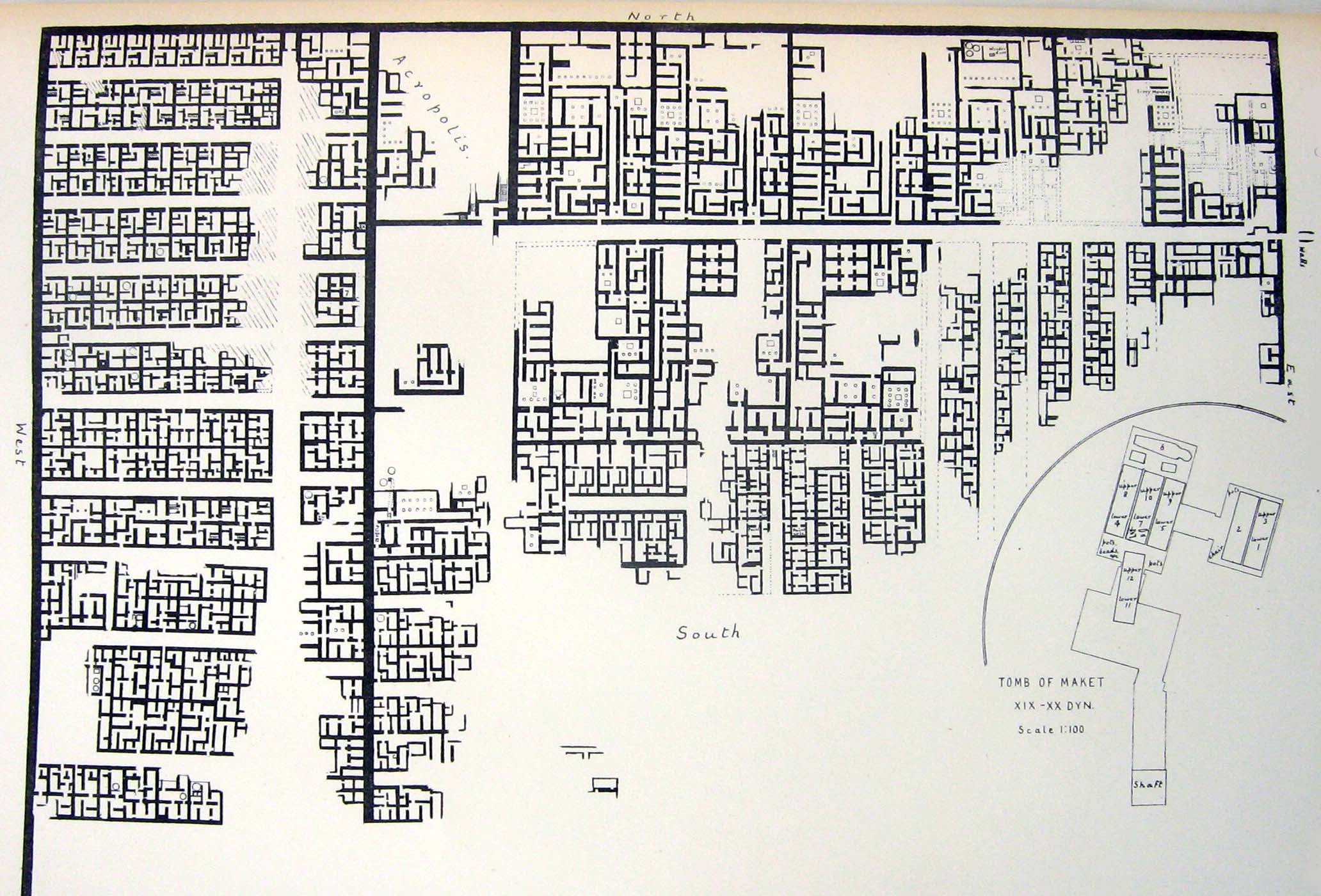
The village of el Lahun, also known as Kahun, is believed to have been inhabited by the workers who both constructed the pyramid and then served the funerary cult of the king. The main function "has usually been linked to the funerary cult of Senwosret II – whose nearby pyramid complex has been understood as the main reason for its existence – housing administrators, as well as temple staff for the upkeep of his royal mortuary cult." The village is about 1.1 km from the pyramid and lies in the desert a short distance from the edge of cultivation. The town was orthogonally planned, with mudbrick town walls on three sides. The fourth wall may have collapsed and been washed away during the annual inundation or covered due to the cultivation in the area. The town was rectangular in shape and was divided internally by a mudbrick wall running north to south that was added after the initial eastern part of the town was built. This wall divided about one third of the area of the town and created a western section with rows of back-to-back, side-by-side single room houses. The eastern section of the town contains mansions, medium sized houses, and small houses similar to the ones in the western section. The mansions are located in the north part of the eastern section and there are seven in total with four along the northern wall and the other three across the street. The medium and small houses are located east and south of the mansions in the eastern section.
Houses
In Kahun there are three main types of houses found: mansions, medium size houses, and smaller homes. The mansions are about 2,700 m2, medium are 100-168 m2, and small houses are 50 m2 or smaller. The small and medium houses are in the western section, and south and east of the mansions. The houses located in the western section are smaller and much closer together than ones south and east of the mansions.
Multiple artifacts have been found in these houses. In the smaller houses papyri and copper tools have been found which can tell us a little about what the people who lived here did.
Mansions and acropolis
Mansions were significantly larger than the other houses that most of the workers and villagers lived in. Mansions also contained granaries on one side of the building that could hold enough grain for the entire town. They are located on the north edge of the town next to the northern wall. These mansions were also separated into smaller units within that may have housed the entire family, the staff, and administrative activities. There are also administrative sections in the mansions that contained seals and a few papyri detailing administrative duties and dealings as well as names of individuals.
A major feature of the town was the so-called "acropolis" building. The acropolis is roughly the same size as the other mansions at Lahun and is located at the end of the main street to the west. It is next to the four mansions on the north side. It was most likely made for the mayor based on the seals and seal impressions found. The platform the mudbrick building was built on was carved out of stone that already existed; it was only carved down to create the platform. It rests above the rest of the town on this platform.
Discoveries
Papyri and Seals

Many of these papyri also tell stories that were religious or literary. There were ones about the gods and their myths and tales that were found in other sites. Also, papyri dealing with the chronology of the Ancient Egyptian world have been found called Sothic cycle. The papyrus containing the Sothic date was found by Petrie and has narrowed Lahun's establishment to a fifty year timespan during the 12th Dynasty. The papyrus says that it is "Month 8 Day 16 of a Year 7". This date is one of the most definitive dates relating to Ancient Egypt. Knowing this date has allowed Egyptologists to organize the Middle Kingdom around Year 7 of Senwosret III's reign. With other archaeological information from Lahun and other sites they are better able to determine the chronology of Egypt.
The seals were found in some buildings in the town. They were attached to "boxes, vases, and bags" and marked what they contained. They have the names of the people who owned the seals, or inscriptions to someone the object the seal was on was going to. The seals state who the person was and what their title was including high priest, citizen, or inspector. The town was not the only place seals were found. Some were discovered by Petrie in the pyramid, precincts, and other areas during excavations. These ones also had the names of the people and their titles on them.
Objects of daily life
Other objects of daily life have been found in the town and in the pyramid complex. These include copper tools found in what is believed to be the western workmen's section, flint tools, and pottery which is both local and foreign. The pottery would have included bowls, storage jars, water jars, plates, and other tableware. Cosmetic jars have been found in houses and the most common ones found have been kohl jars. Jewelry has been found in the town and inside tombs that could have been potentially used by the owners in their daily lives or important objects that they waned in their afterlife. File:Spouted jar, brown smooth pottery. From a box containing infant burial, with a lock of hair, shell, slip of wood, and beads. 12th Dynasty. From Lahun (Kahun), Faiyum, Egypt. The Petrie Museum of Egyptian Archaeology, London.jpg|Spouted jar, brown smooth pottery. From a box containing infant burial, with a lock of hair, shell, slip of wood, and beads. 12th Dynasty. From Lahun (Kahun), Faiyum, Egypt. Petrie Museum, London File:Dried date, peach, apricot, and stones. From Lahun, Fayum, Egypt. Late Middle Kingdom. The Petrie Museum of Egyptian Archaeology, London.jpg|Dried date, peach, apricot, and stones. From Lahun, Fayum, Egypt. Late Middle Kingdom. Petrie Museum, London File:A bag of white linen, unopened. Contains rolls of linen only. Foundation deposit, Heb Sed Chapel at Lahun, Fayum, Egypt. 12th Dynasty. The Petrie Museum of Egyptian Archaeology, London.jpg|A bag of white linen, unopened. Contains rolls of linen only. Foundation deposit, Heb Sed Chapel at Lahun, Fayum, Egypt. 12th Dynasty. Petrie Museum, London
Mummies

Bibliography
- G. Brunton: Lahun I: The Treasure (BSAE 27 en ERA 20 (1914)), London 1920.
- A.R. David: The Pyramid Builders of Ancient Egypt: A Modern Investigation of Pharaoh’s Workforce, London, Boston en Henley 1986.
- B. Gunn: The Name of the Pyramid-Town of Sesostris II, in JEA 31 (1945), p. 106-107.
- B. J. Kemp: Ancient Egypt: Anatomy of a Civilization, London 1989.
- N. Moeller: The Archaeology of Urbanism in Ancient Egypt, Cambridge, England: University of Cambridge Press 2016.
- W.M.F. Petrie, G. Brunton, M. A. Murray: Lahun II (BSAE 33 en ERA 26 (1920)), London 1923.
- W.M.F. Petrie, F. Ll. Griffith, P.E. Newberry: Kahun, Gurob, and Hawara, London 1890.
- W.M.F. Petrie: Illahun, Kahun, and Gurob, London 1891.
- S. Quirke: (ed.), Lahun Studies, New Malden 1998.
- S. Quirke: Lahun: A Town in Egypt 1800 BC, and the History of Its Landscape, London 2005.
- A. Scharff: Illahun und die mit Königsnamen des Mittleren Reiches gebildeten Ortsnamen, in ZÄS 59 (1924), p. 51-55.
- K. Szpakowska: Daily Life in Ancient Egypt: Recreating Lahun, Malden, Oxford, Carlton 2008
- H. E. Winlock: The Treasure of el Lahun, New York 1973.
References
References
- Peust, Carsten. "Die Toponyme vorarabischen Ursprungs im modernen Ägypten".
- Moeller, Nadine. (2018). "The archaeology of urbanism in ancient Egypt: from the predynastic period to the end of the Middle Kingdom". Cambridge University Press.
- Petrie, W. M. Flinders. (1891). "Illahun, Kahun, and Gurob".
- Borchardt, Ludwig. (1899). "Der zweite Papyrusfund von Kahn und die zeitliche Festlegung des mittleren Reiches des ägyptischen Geschichte.". Zeitschrift für Ägyptische Sprache und Altertumskunde.
- Frey, Rosa A., and James E. Knudstad. (2008). "The Re-examination of Selected Architectural Remains at El-Lahun.". Journal of the Society of the Studies of Egyptian Archaeology.
- Horvath, Zoltan. (2009). "El-Lahun Survey Project: The Archaeological Mission of the Museum of Fine Arts". Bulletin du Musée Hongrois des Beaux-Arts.
- [https://news.yahoo.com/s/nm/20090426/sc_nm/us_egypt_mummies_1 Johnson, C. Cache of mummies unearthed at Egypt's Lahun pyramid. April 26, 2009.]
- Petrie, W. M. Flinders. (1891). "Illahun, Kahun, and Gurob".
- Petrie, W. M. Flinders. (1891). "Illahun, Kahun, and Gurob".
- Brunton, Guy. (1920). "Lahun I: The Treasure". Bernard Quartich.
- Brunton, Guy. (1920). "Lahun I: The Treasure". Bernard Quartich.
- (1923). "Lahun II". Bernard Quartich.
- Moeller, Nadine. (2018). "The archaeology of urbanism in ancient Egypt: from the predynastic period to the end of the Middle Kingdom". Cambridge University Press.
- (1923). "Lahun II". Bernard Quartich.
- Kemp, Barry. (2018). "Ancient Egypt: Anatomy of a Civilization". Routledge.
- Kemp, Barry. (2018). "Ancient Egypt: Anatomy of a Civilization". Routledge.
- Quirke, Stephen. (2005). "Lahun: a town in Egypt 1800 BC, and the history of its landscape". Golden House Publications.
- [https://www.academia.edu/37265998/The_Foundation_and_Purpose_of_the_Settlement_at_Lahun_during_the_Middle_Kingdom_The_Foundation_and_Purpose_of_the_Settlement_at_Lahun_during_the_Middle_Kingdom_A_New_Evaluation Nadine Moeller, The Foundation and Purpose of the Settlement at Lahun during the Middle Kingdom: A New Evaluation in R.K. Ritner (ed.), Essays for the Library of Seshat. Studies Presented to Janet H. Johnson on the occasion of her 70th birthday, SOAC 70, Chicago: The Oriental Institute, (2018), p.187.]
- Moeller, Nadine. (2018). "The archaeology of urbanism in ancient Egypt: from the predynastic period to the end of the Middle Kingdom". Cambridge University Press.
- Moeller, Nadine. (2018). "The archaeology of urbanism in ancient Egypt: from the predynastic period to the end of the Middle Kingdom". Cambridge University Press.
- "Archived copy".
- Moeller, Nadine. (2018). "The archaeology of urbanism in ancient Egypt: from the predynastic period to the end of the Middle Kingdom". Cambridge University Press.
- Moeller, Nadine. (2018). "The archaeology of urbanism in ancient Egypt: from the predynastic period to the end of the Middle Kingdom". Cambridge University Press.
- Moeller, Nadine. (2018). "The archaeology of urbanism in ancient Egypt: from the predynastic period to the end of the Middle Kingdom". Cambridge University Press.
- Moeller, Nadine. (2018). "The archaeology of urbanism in ancient Egypt: from the predynastic period to the end of the Middle Kingdom". Cambridge University Press.
- Kemp, Barry. "Ancient Egypt: Anatomy of a Civilization". Routledge.
- Moeller, Nadine. (2018). "The archaeology of urbanism in ancient Egypt: from the predynastic period to the end of the Middle Kingdom". Cambridge University Press.
- Quirke, Stephen. (2005). "Lahun: a town in Egypt 1800 BC, and the history of its landscape". Golden House Publications.
- Depuydt, Leo. (2000). "Sothic Chronology and the Old Kingdom". Journal of the American Research Center in Egypt.
- Depuydt, Leo. (2000). "Sothic Chronology and the Old Kingdom". Journal of the American Research Center in Egypt.
- Depuydt, Leo. (2000). "Sothic Chronology and the Old Kingdom". Journal of the American Research Center in Egypt.
- Depuydt, Leo. (2000). "Sothic Chronology and the Old Kingdom". Journal of the American Research Center in Egypt.
- Petrie, W. M. Flinders. (1891). "Illahun, Kahun, and Gurob".
- (1923). "Lahun II". Bernard Quartich.
- (1923). "Lahun II". Bernard Quartich.
- Petrie, W. M. Flinders. (1891). "Illahun, Kahun, and Gurob".
- Szpakowska, Kasia Maria. (2008). "Daily life in ancient Egypt: recreating Lahun". Blackwell Pub.
- Szpakowska, Kasia Maria. (2008). "Daily life in ancient Egypt: recreating Lahun". Blackwell Pub.
- Szpakowska, Kasia. (2008). "Daily life in ancient Egypt: recreating Lahun". Blackwell Publishing.
- [http://www.redorbit.com/news/science/1869258/archeologists_find_new_tombs_in_egypt/index.html] {{Webarchive. link. (2020-10-22)
- redOrbit. (2009-04-27). "New Cache Of Mummies Discovered In Egypt - Redorbit". Redorbit.
This article was imported from Wikipedia and is available under the Creative Commons Attribution-ShareAlike 4.0 License. Content has been adapted to SurfDoc format. Original contributors can be found on the article history page.
Ask Mako anything about El Lahun — get instant answers, deeper analysis, and related topics.
Research with MakoFree with your Surf account
Create a free account to save articles, ask Mako questions, and organize your research.
Sign up freeThis content may have been generated or modified by AI. CloudSurf Software LLC is not responsible for the accuracy, completeness, or reliability of AI-generated content. Always verify important information from primary sources.
Report