From Surf Wiki (app.surf) — the open knowledge base
Einzel lens
Focused beam with lossless energy

Focused beam with lossless energy
An einzel lens (from – single lens{{cite book
The electrostatic potential in the lens is symmetric, so the ions will regain their initial energy on exiting the lens, although the velocity of the outer particles will be altered such that they converge on to the axis. This causes the outer particles to arrive at the focus intersection slightly later than the ones that travel along a straight path, as they have to travel an extra distance.
Theory
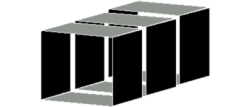

The equation for the change in radial velocity for a particle as it passes between any pair of cylinders in the lens is:
\Delta v_r = \int \frac{qE_r(r,z)}{m v_z} dz,
with z axis passing through the middle of the lens, and r being the direction normal to z. If the lens is constructed with cylindrical electrodes, the field is symmetrical around z. E_r(r,z) is the magnitude of the electric field in the radial direction for a particle at a particular radial distance and distance across the gap, m is the mass of the particle passing through the field, v_z is the velocity of the particle and q is the charge of the particle. The integral occurs over the gap between the plates. This is also the interval where the lensing occurs.
The pair of plates is also called an electrostatic immersion lens, thus an einzel lens can be described as two or more electrostatic immersion lenses. Solving the equation above twice to find the change in radial velocity for each pair of plates can be used to calculate the focal length of the lens.
Application to television tubes
The einzel lens principle in a simplified form was also used as a focusing mechanism in display and television cathode ray tubes, and has the advantage of providing a good sharply focused spot throughout the useful life of the tube's electron gun, with minimal or no readjustment needed (many monochrome TVs did not have or need focus controls), although in high-resolution monochrome displays and all colour CRT displays a (technician-adjustable) focus potentiometer control is provided.
References
References
- "Radio and Television" by C. A. Quarrington, 1952–1963.
- "Television Receiver Servicing" by E. A. W. Spreadbury, 1953.
This article was imported from Wikipedia and is available under the Creative Commons Attribution-ShareAlike 4.0 License. Content has been adapted to SurfDoc format. Original contributors can be found on the article history page.
Ask Mako anything about Einzel lens — get instant answers, deeper analysis, and related topics.
Research with MakoFree with your Surf account
Create a free account to save articles, ask Mako questions, and organize your research.
Sign up freeThis content may have been generated or modified by AI. CloudSurf Software LLC is not responsible for the accuracy, completeness, or reliability of AI-generated content. Always verify important information from primary sources.
Report