From Surf Wiki (app.surf) — the open knowledge base
Eight Provinces of Korea
Administrative divisions of Korea during the Joseon dynasty
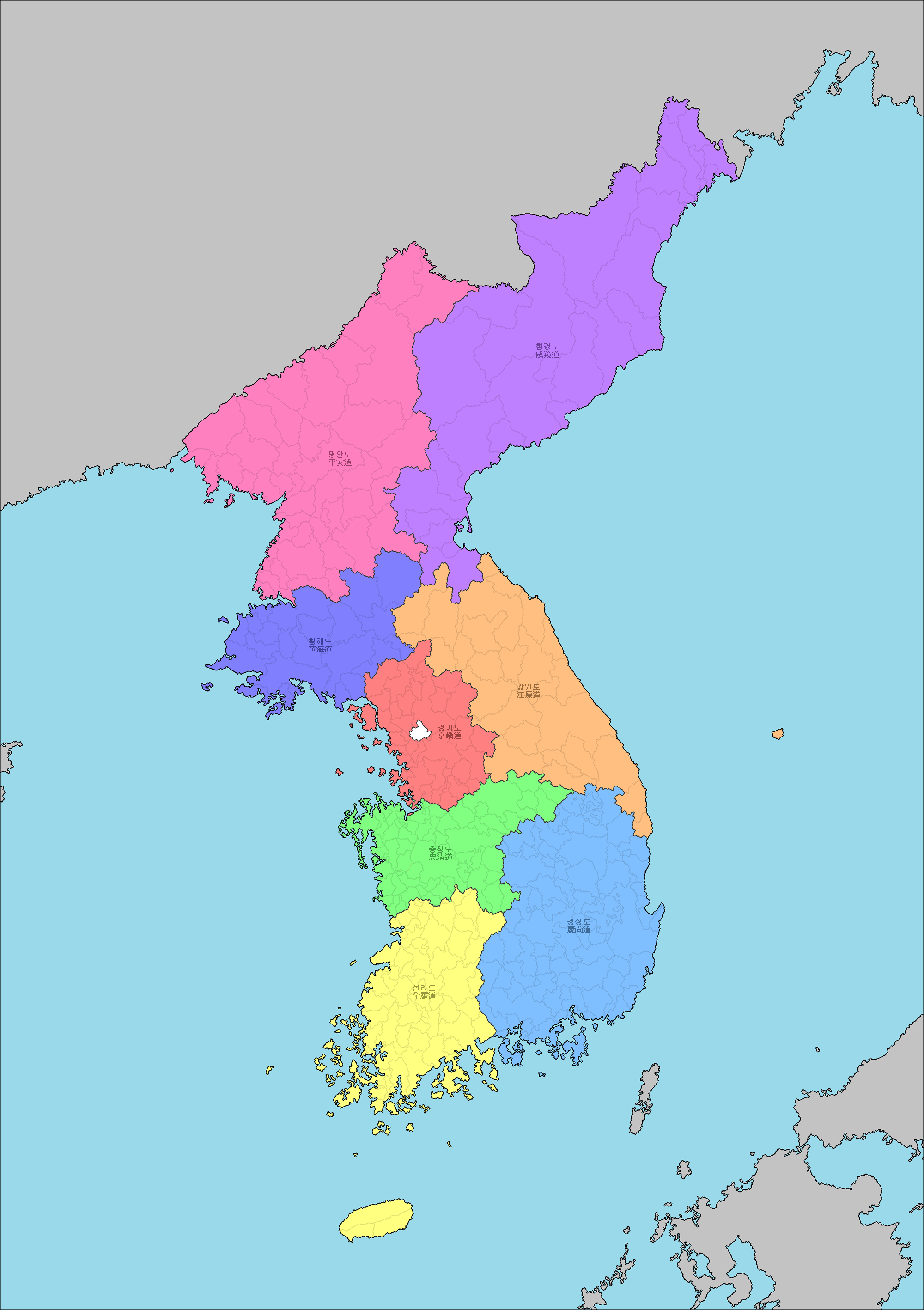
Administrative divisions of Korea during the Joseon dynasty
| Field | Value |
|---|---|
| title | Eight Provinces of Korea |
| image | Eight provinces of Korea-en.svg |
| hangul | 팔@도 |
| hanja | 八道 |
During most of the Joseon dynasty, Korea was divided into eight provinces (do; ). The eight provinces' boundaries remained unchanged for about 480 years from 1413 to 1895, and formed a geographic paradigm that is still reflected today in the Korean Peninsula's administrative divisions, dialects, and regional distinctions. The names of all eight provinces are still preserved today, in one form or another. These eight historical provinces form both North and South Korea, and are not to be confused with the modern provinces that make up North Korea or South Korea.
History
Provinces before 1895
In 1413 (the 13th year of the reign of King Jeongjong), the north-eastern boundary of Korea was extended to the Tumen River. The country was reorganized into eight provinces: Chungcheong, Gangwon, Gyeonggi, Gyeongsang, Jeolla, P'unghae (renamed Hwanghae in 1417), P'yŏngan, and Yŏnggil (eventually renamed Hamgyŏng in 1509).
Districts of 1895–96
For almost 500 years, the eight-province system remained virtually unchanged. In 1895 (the 32nd year of the reign of King Gojong), the five-century-old provincial system was abolished. On May 26 of that year—as part of the Gabo Reform—the country was redivided into 23 districts, each named for the city or county that was its capital.
Each district name in the following list links to the article on the province from which the district was formed, and where more detailed information on the district is provided:
- Andong
- Chuncheon
- Chungju
- Daegu
- Dongnae
- Gangneung
- Gongju
- Haeju
- Hamhŭng
- Hanseong
- Hongju
- Incheon
- Jeju
- Jeonju
- Jinju
- Kaesŏng
- Kanggye
- Kapsan
- Kyŏngsŏng
- Naju
- Namwon
- P'yŏngyang
- Ŭiju
Restored provinces of 1896
The new system of districts did not last long, however, as one year later, on August 4, 1896, the former eight provinces were restored, with five of them (Chungcheong, Gyeongsang, Jeolla, Hamgyŏng, and P'yŏngan), being divided into north and south halves, to form a total of 13 provinces. This structure remained unchanged through the entire lifetime of the Korean Empire (1897–1910) and the Japanese Colonial Period (1910–1945). Since the end of World War II and the division of Korea in 1945, special cities and administrative regions and a handful of new provinces have been added in both the South and North.
Cultural significance
The boundaries between the eight provinces for the most part followed rivers, mountain chains, and other natural boundaries, and consequently corresponded closely to dialect and cultural divisions. Due to the correspondence between provincial boundaries and Korean geography, most provincial boundaries and names have mostly survived to the present day; most Koreans are keenly aware of the regional and dialect distinctions that still exist.
For example, a regional rivalry (akin to that between the Northeast United States and Southern United States) exists between Gyeongsang and Jeolla residents (Gyeongsang and Jeolla mostly corresponding to the ancient kingdoms of Silla and Baekje respectively) due to historic, social, economic, and political differences, some of which have continued into the present day in more muted form. Most of the traditional provinces also had alternative regional names which are still used today (especially Honam, Yeongdong, and Yeongnam) informally if not on paper.
Modern-day usage
The term Paldo ("Eight Provinces") is itself often used as a shorthand to denote Korea as a whole, or to describe the traditional folk culture of Korea's regions. Thus, one sometimes finds such expressions as:
- Paldo kimchi in reference to the many varieties of kimchi unique to particular regions of Korea;
- Paldo Arirang to denote the hundreds of regional versions of the popular folk song Arirang; and
- Paldo sori to broadly refer to the diversity of folk music (sori; "sounds") across Korea.
Cf. the four Provinces of Ireland—where reference to the ancient provinces is used to talk of the entire island of Ireland.
Names
Except Gyeonggi (see note below), each province took its name from the initial Hanja (Sino-Korean characters) of two of its principal cities. The origin of each province's name is detailed in the table below.
Table of provinces
The table below lists the eight provinces in romanized spelling, Hangul and Hanja; the origin of their names; their capitals, dialects, and regional names; and the 13 provinces that replaced them in 1896. (The capitals and regional names are as of the mid 19th century. Since they were not official, other regional names were also used, but the ones in the table are the most widely used or representative.)
| Province | Hangul | Hanja | Name Origin | Capital | Regional Name | Dialect | Post-1896 Provinces | Present Provincial divisions | ||
|---|---|---|---|---|---|---|---|---|---|---|
| Chungcheong | 충청도 | 忠淸道 | Chungju + Cheongju | Gongju | Hoseo | Chungcheong Dialect | ||||
| Gangwon | 강원도 | 江原道 | Gangneung + Wonju | Wonju | Gwandong | |||||
| (Yeongseo, Yeongdong) | Gangwon Dialect | |||||||||
| Gyeonggi | 경기도 | 京畿道 | Hanseong | |||||||
| (Seoul) | Gyeonggi | Gyeonggi | Seoul Dialect | |||||||
| Gyeongsang | 경상도 | 慶尙道 | Gyeongju + Sangju | Daegu | Yeongnam | Gyeongsang Dialect | ||||
| Hamgyŏng | 함경도 | 咸鏡道 | Hamhŭng + Kyŏngsŏng | Hamhŭng | Kwanbuk | |||||
| (Kwanbuk, Kwannam) | Hamgyŏng Dialect | |||||||||
| Hwanghae | 황해도 | 黃海道 | Hwangju + Haeju | Haeju | Haesŏ | Hwanghae Dialect | ||||
| Jeolla | 전라도 | 全羅道 | Jeonju + Naju | Jeonju | Honam | group=note | name=jeju | The distinctive Jeju Dialect is used on Jeju Island, which became a separate province in 1946.}} | ||
| P'yŏngan | 평안도 | 平安道 | P'yŏngyang + Anju | P'yŏngyang | Kwansŏ | P'yŏngan Dialect |
Notes
This article was imported from Wikipedia and is available under the Creative Commons Attribution-ShareAlike 4.0 License. Content has been adapted to SurfDoc format. Original contributors can be found on the article history page.
Ask Mako anything about Eight Provinces of Korea — get instant answers, deeper analysis, and related topics.
Research with MakoFree with your Surf account
Create a free account to save articles, ask Mako questions, and organize your research.
Sign up freeThis content may have been generated or modified by AI. CloudSurf Software LLC is not responsible for the accuracy, completeness, or reliability of AI-generated content. Always verify important information from primary sources.
Report