From Surf Wiki (app.surf) — the open knowledge base
Egyptian vulture
Species of Old World vultures of the genus Neophron

Species of Old World vultures of the genus Neophron
| Field | Value |
|---|---|
| state | collapsed |
| pop1 | Nominate |
| data1 | {{birdbox/population |
| unit | mm |
| massunit | g |
| wingm | 470–536 |
| wingf | 460–545 |
| culmen | 31–34 |
| tailm | 220–251 |
| tailf | 240–267 |
| tarsus | 75–87 |
| weight | 1600–2400 |
| pop2 | ginginianus |
| data2 | {{birdbox/population |
| unit | mm |
| wingm | 393–490 |
| wingf | 455–505 |
| tarsus | 72–85 |
| tail | 228–251 |
| pop3 | majorensis |
| data3 | {{birdbox/population |
| unit | mm |
| massunit | g |
| wing | 485–554 |
| tarsus | 73.5–93 |
| tail | 240–285 |
| weight | 1900–2850 |
the Egyptian vulture species of vulture
- N. p. ginginianus (Latham, 1790)
- N. p. majorensis Donázar et al., 2002
- N. p. percnopterus (Linnaeus, 1758)
The Egyptian vulture (Neophron percnopterus), also called the white scavenger vulture or pharaoh's chicken, is a small Old World vulture in the monotypic genus Neophron. It is widely distributed from the Iberian Peninsula, North Africa, West Asia and India. The contrasting underwing pattern and wedge-shaped tail make it distinctive in flight as it soars in thermals during the warmer parts of the day. Egyptian vultures feed mainly on carrion but are opportunistic and will prey on small mammals, birds, and reptiles. They also feed on the eggs of other birds, breaking larger ones by tossing a large pebble onto them.
The use of tools is rare in birds and apart from the use of a pebble as a hammer, Egyptian vultures also use twigs to roll up wool for use in their nest. Egyptian vultures that breed in the temperate regions migrate south in winter while tropical populations are relatively sedentary. Populations of this species declined in the 20th century and some island populations are endangered by hunting, accidental poisoning, and collision with power lines.
Taxonomy and systematics
The Egyptian vulture was formally described by Carl Linnaeus in 1758 in the tenth edition of his Systema Naturae under the binomial name Vultur percnopterus. The genus Neophron was proposed by Jules-César Savigny in 1809. The genus Neophron contains only a single extant species. A few prehistoric species from the Neogene period in North America placed in the genus Neophrontops (the name meaning "looks like Neophron") are believed to have been very similar to these vultures in lifestyle, but the genetic relationships are unclear. A fossil species Neophron lolis has been described from the late Miocene of Spain. The genus Neophron is considered to represent the oldest branch of the vultures which consists of separated (or polyphyletic) clades. Along with its nearest evolutionary relatives, the lammergeier (Gypaetus barbatus) and the palm-nut vulture (Gypohierax angolensis), they are sometimes placed in a separate subfamily, the Gypaetinae.
Subspecies
There are three widely recognised subspecies of the Egyptian vulture, although there is considerable gradation due to movement and intermixing of the populations. The nominate subspecies, N. p. percnopterus, with a dark grey bill, has the largest range, occurring in southern Europe, northern Africa, the Middle East, Central Asia, and north-western India. Populations breeding in the temperate zone migrate south during winter.
The Indian subcontinent is the range of subspecies N. p. ginginianus, the smallest of the three subspecies, which is identifiable by a pale yellow bill. The subspecies name is derived from Gingee in southern India from where the French explorer Pierre Sonnerat described it as Le Vautour de Gingi and it was given a Latin name by John Latham in his Index Ornithologicus (1790).
A small population that is found only in the eastern Canary Islands was found to be genetically distinct and identified as a new subspecies, N. p. majorensis in 2002. Known locally as the guirre they are genetically more distant from N. p. percnopterus, significantly greater even than N. p. ginginianus is from N. p. percnopterus. Unlike neighbouring populations in Africa and southern Europe, it is non-migratory and consistently larger in size. The subspecies name majorensis is derived from "Majorata", the ancient name for the island of Fuerteventura. The island was named by Spanish conquerors in the 15th century after the "Majos", the main native Guanche tribe there. One study in 2010 suggested that the species established on the island about 2,500 years ago when the island was first colonized by humans.
Nikolai Zarudny and Härms described a subspecies, rubripersonatus, from Baluchistan in 1902. This was described as having a deeper reddish orange skin on the head and a yellow-tipped dark bill. This has rarely been considered a valid subspecies but the intermediate pattern of bill colouration suggests intermixing of subspecies.
Etymology
The genus name is derived from Greek mythology. Timandra was the mother of Neophron. Aegypius was a friend of Neophron and about the same age. It upset Neophron to know that his mother Timandra was having a love affair with Aegypius. Seeking revenge, Neophron made advances towards Aegypius' mother, Bulis. Neophron succeeded and enticed Bulis into entering the dark chamber where his mother and Aegypius were to meet soon. Neophron then distracted his mother, tricking Aegypius into entering the chamber and sleeping with his own mother Bulis. When Bulis discovered the deception she gouged out the eyes of her son Aegypius before killing herself. Aegypius prayed for revenge and Zeus, on hearing the prayer, changed Aegypius and Neophron into vultures. "Percnopterus" is derived from Greek for "black wings": "περκνός" (perknos, meaning "blue-black") and πτερόν (pteron, meaning wing).
Description

The adult's plumage is white, with black flight feathers in the wings. Wild birds usually appear soiled with a rusty or brown shade to the white plumage, derived from mud or iron-rich soil. Captive specimens without access to soil have clean white plumage. It has been suggested as a case of cosmetic colouration. The bill is slender and long, and the tip of the upper mandible is hooked. The nostril is an elongated horizontal slit. The neck feathers are long and form hackles. The wings are pointed, with the third primary being the longest; the tail is wedge shaped. The legs are pink in adults and grey in juveniles. The claws are long and straight, and the third and fourth toes are slightly webbed at the base.
The bill is black in the nominate subspecies but pale or yellowish in adults of the smaller Indian ginginianus. Rasmussen and Anderton (2005) suggest that this variation may need further study, particularly due to the intermediate black-tipped bill described in rubripersonatus. The facial skin is yellow and unfeathered down to the throat. The sexes are indistinguishable in plumage but breeding males have a deeper orange facial skin colour than females. Females average slightly larger and are about 10–15% heavier than males. Young birds are blackish or chocolate brown with black and white patches. The adult plumage is attained only after about five years. The adult Egyptian vulture measures 47 – from the point of the beak to the extremity of the tail feathers. Males of the smaller N. p. ginginianus are about 47 – long, while females are 52 – long. The wingspan is about 2.7 times the body length. Birds from Spain weigh about 1.9 kg while birds of the Canary Island subspecies majorensis, representing a case of island gigantism, are heavier with an average weight of 2.4 kg.
The Egyptian vulture is among the smallest true Old World vultures, the only smaller species appears to be the marginally lighter palm-nut vulture, which may be an outlier from other vultures.
Distribution and movements

Egyptian vultures are widely distributed across the Old World with their breeding range from southern Europe to northern Africa east to western and southern Asia. They are rare vagrants in Sri Lanka. They occur mainly on the dry plains and lower hills. In the Himalayas, they go up to about 2000 m in summer. In Armenia, breeding pairs have been found up to 2,300 meters a.s.l.
Most Egyptian vultures in the subtropical zone of Europe migrate south to Africa in winter. Vagrants may occur as far south as in South Africa although they bred in the Transkei region prior to 1923. They nest mainly on rocky cliffs, sometimes adopting ledges on tall buildings in cities and on large trees. Like many other large soaring migrants, they avoid making long crossings over water. Italian birds cross over through Sicily and into Tunisia making short sea crossings by passing through the islands of Marettimo and Pantelleria with rare stops on the island country of Malta. Those that migrate through the Iberian Peninsula cross into Africa over the Strait of Gibraltar while others cross further east through the Levant. In summer, some African birds fly further north into Europe and vagrants have been recorded in England, Ireland, and southern Sweden.
Migrating birds can sometimes cover 500 km in a single day until they reach the southern edge of the Sahara, 3500 to from their summer home. Young birds that have not reached breeding age may overwinter in the grassland and semi-desert regions of the Sahel.
Fossil record
Fossils of the Egyptian vulture found in the Nefud Desert of Saudi Arabia are estimated to date to the Middle Pleistocene about 500,000 years ago.
Behaviour and ecology
The Egyptian vulture is usually seen singly or in pairs, soaring in thermals along with other scavengers and birds of prey, or perched on the ground or atop a building. On the ground, they walk with a waddling gait.
They feed on a range of food, including mammal faeces (including those of humans), insects in dung, carrion, vegetable matter, and sometimes small animals. It is the only Old World vulture species that regularly feeds on faeces. The carotenoids (primarily lutein) that the vultures absorb from the vegetal matter in the excrement that they ingest results in their bright yellow face colouration.
When it joins other vulture species at a dead animal, it tends to stay on the periphery and waits until the larger species leave. Pairs may also scrounge for food from other vultures, particularly griffons. Recently fledged young will sometimes fly to other nests, competing with young vultures for food, stealing or even soliciting food from the (unrelated) adults bringing food. Wild rabbits (Oryctolagus cuniculus) form a significant part of the diet of Spanish vultures. In the Iberian Peninsula, landfills are an important food source, with the vultures more likely to occupy territories close to landfill sites. Studies suggest that they feed on ungulate faeces to obtain carotenoid pigments responsible for their bright yellow and orange facial skin. The ability to assimilate carotenoid pigments may serve as a reliable signal of fitness.
Egyptian vultures are mostly silent but make high-pitched mewing or hissing notes at the nest and screeching noises when squabbling at a carcass. Young birds have been heard making a hissing croak in flight. They also hiss or growl when threatened or angry.[[File:Egyptian_vulture_krause.jpg|thumb|150px|Eggs showing colour variation, chromolithographs by [[Georg Krause (oologist)|Georg Krause]]]]Egyptian vultures roost communally on large trees, buildings or on cliffs. Roost sites are usually chosen close to a dump site or other suitable foraging area. In Spain and Morocco, summer roosts are formed mainly by immature birds. The favourite roost trees tended to be large dead pines. The number of adults at the roost increases towards June. It is thought that breeding adults may be able to forage more efficiently by joining the roost and following others to the best feeding areas. Breeding birds that failed to raise young may also join the non-breeding birds at the roost during June. Allopreening has been observed in Canarian Egyptian vultures between mated pairs of individuals as well as pairs of unrelated and same-sex individuals, particularly females.
Breeding
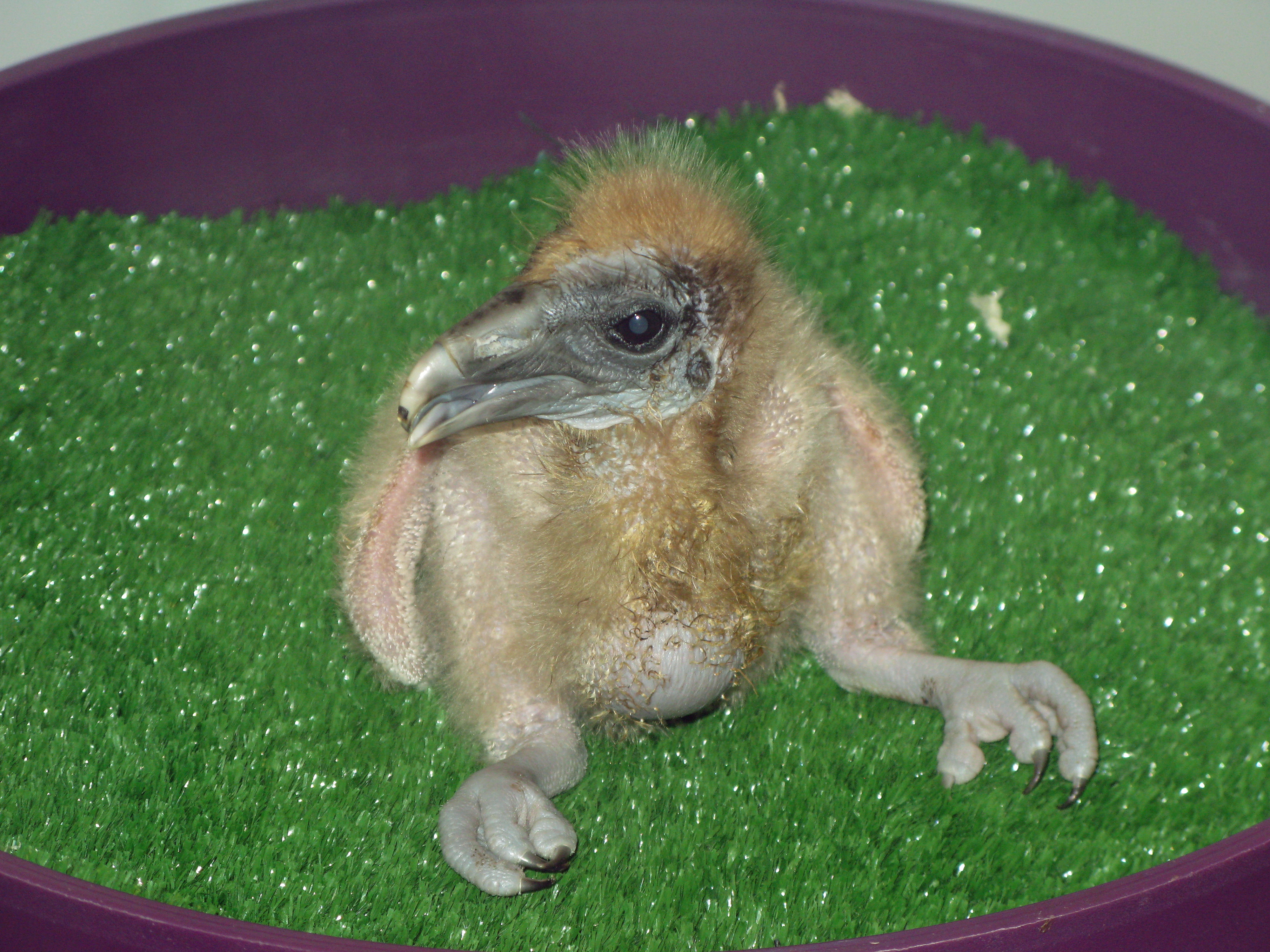
Extra-pair copulation with neighbouring birds has been recorded and may be a reason for adult males to stay close to the female before and during the egg laying period. Females may sometimes associate with two males and all three help in raising the brood. The typical clutch consists of two eggs which are incubated in turns by both parents. The eggs are brick red with the broad end covered more densely with blotches of red, brown, and black. The parents begin incubating soon after the first egg is laid leading to asynchronous hatching. The first egg hatches after about 42 days. The second chick may hatch three to five days later and a longer delay increases the likelihood that it will die of starvation. In cliffs where the nests are located close to each other, young birds have been known to clamber over to neighbouring nests to obtain food. In the Spanish population, young fledge and leave the nest after 90 to 110 days. Fledged birds continue to remain dependent on their parents for at least a month. Once the birds begin to forage on their own, they move away from their parents' territory; young birds have been found nearly 500 km away from their nest site. One-year-old European birds migrate to Africa and stay there for at least one year. A vulture that fledged in France stayed in Africa for three years before migrating north in spring. After migrating back to their breeding areas, young birds move widely in search of good feeding territories and mates. The full adult plumage is attained in the fourth or fifth year. Egyptian vultures have been known to live for up to 51 years in captivity and at least 21 years in the wild. The probability of survival in the wild varies with age, increasing till the age of 2 and then falling at the age of 5. Older birds have an annual survival probability varying from 0.75 for non-breeders to 0.83 for breeding birds.
Tool use
_(detail).jpg)
Threats and conservation
Healthy adults do not have many predators, but human activities pose many threats. Collisions with power lines, hunting, intentional poisoning, lead accumulation from ingesting gunshot in carcasses, and pesticide accumulation take a toll on populations. Young birds at the nest are sometimes taken by golden eagles, eagle owls, and red foxes. Only rarely do adult birds attempt to drive away predators. Young birds that fall off of cliff ledges may be preyed on by mammalian predators such as jackals, foxes and wolves. Like all birds they serve as hosts for ectoparasitic birdlice including Aegypoecus perspicuus as well as organisms that live within them such as mycoplasmas.
Egyptian vulture populations have declined in most parts of its range. In Europe and most of the Middle East, populations in 2001 were half of those from 1980. In India, the decline has been rapid with a 35% decrease each year since 1999. In 1967–70, the area around Delhi was estimated to have 12,000–15,000 of these vultures, with an average density of about 5 pairs per 10 km2. The exact cause of the decline is not known, but has been linked with the use of the NSAID Diclofenac, which has been known to cause death in Gyps vultures.

In Italy, the number of breeding pairs declined from 30 in 1970 to 9 in the 1990s. Nearly all breeding failures were due to human activities. In Spain, which holds about 50% of the European population suggested causes of decline include poisoning by accumulation of lead, pesticides (especially due to large-scale use in the control of Schistocerca gregaria locust swarms), and electrocution. Windfarms may also pose a threat. Poorly designed power transmission lines in east Africa electrocute many wintering vultures. A shortage of carrion resulting from new rules for disposal of dead animals following the outbreak of Bovine Spongiform Encephalitis in parts of Europe during 2000 may have also had an effect on some populations. In Armenia direct persecution for trophy and for local illegal trade of animals as pets has been recorded.
The population of Egyptian vultures in the Canary Islands has been isolated from those in Europe and Africa for a significant period of time leading to genetic differentiation. The vulture population there declined by 30% in the ten years between 1987 and 1998. The Canarian Egyptian vulture was historically common, occurring on the islands of La Gomera, Tenerife, Gran Canaria, Fuerteventura, and Lanzarote. It is now restricted to Fuerteventura and Lanzarote, the two easternmost islands. The total population in 2000 was estimated at 130 individuals, including 25–30 breeding pairs. Island birds also appear to accumulate significant amounts of lead from scavenging on hunted animal carcasses. The long-term effect of this poison at a sub-lethal level is not known, though it is known to alter the mineralization of their bones.
In order to provide safe and uncontaminated food for nesting birds, attempts have been made to create "vulture restaurants" where carcasses are made available. However, these interventions may also encourage other opportunist predators and scavengers to concentrate at the site and pose a threat to vultures nesting in the vicinity.
Since 2012, conservation efforts have been implemented to protect Egyptian vultures along breeding grounds, migration routes and wintering areas of the eastern European population; these measures include monitoring, nest guarding, supplementary feeding, insulating hazardous electric power lines and removing poison baits and carcasses with trained dogs. Adult annual survival and juvenile monthly survival appear to have increased, leading to a notable rise in population growth.
In Iran, a community-based project was launched in 2023 on Qeshm Island with the aim to reduce threats to the small breeding population of Egyptian vultures through awareness campaigns, installation of bird-friendly electric poles, and engaging fishers and local stakeholders in conservation efforts.
In culture
The Bible makes a reference to the Egyptian vulture under the Hebrew name of rachamah/racham which has been translated into English as "gier-eagle".
In Ancient Egypt, several hieroglyphs include the Egyptian vulture including what is listed as G1 in the Gardiner's sign list - . The bird was held sacred to Isis and Mut in ancient Egyptian religion. The use of the vulture as a symbol of royalty in Egyptian culture and their protection by Pharaonic law made the species common on the streets of Egypt and gave rise to the name "pharaoh's chicken". The habit of coprophagy in Egyptian vultures gives them the Spanish names of "churretero" and "moñiguero", which mean "dung-eater". In the Balkans, it is considered as a herald of spring and as a bird of good omen. British sportsmen in colonial India considered them to be among the ugliest birds, and their habit of feeding on faeces was particularly despised. In British India they were known as "shawks" a contraction of shit-hawk. In Sindh, it is believed that the yolk of the egg of the vulture can remove venom and cure snake bite and scorpion stings. A southern Indian temple at Thirukalukundram near Chengalpattu was famed for a pair of birds that reputedly visited the temple for "centuries". These birds were ceremonially fed by the temple priests and arrived before noon to feed on offerings made from rice, wheat, ghee, and sugar. Although normally punctual, the failure of the birds to turn up was attributed to the presence of "sinners" among the onlookers. Legend has it the vultures (or "eagles") represented eight sages who were punished by Shiva, with two of them leaving in each of a series of epochs.
Footnotes
Cited works
- {{cite journal | doi-access = free
- {{cite journal | access-date = 3 July 2011 | archive-url = https://web.archive.org/web/20120326124750/http://www.raptormigration.org/Agostini%20et%20al%202004%20-%20Ring.pdf | archive-date = 26 March 2012
- {{cite journal | doi-access = free
- {{cite book | author2-link = Sidney Dillon Ripley
- {{cite journal | doi-access = free
- {{cite book
- {{cite journal
- {{cite journal | hdl-access = free
- {{cite journal
- {{cite journal
- {{cite journal | access-date = 22 April 2012 | archive-date = 20 April 2022 | archive-url = https://web.archive.org/web/20220420185225/http://www.globalraptors.org/grin/researchers/uploads/155/ageing_egyptian_vultures.pdf
- {{cite journal |archive-url=https://web.archive.org/web/20110924040913/http://www.ebd.csic.es/carnivoros/personal/carrete/martina/recursos/34.%20Cortes-avizanda%20et%20al%20%282009%29%20Anim%20Cons.pdf |archive-date=24 September 2011 |hdl-access=free
- {{cite journal
- {{cite book
- {{cite journal
- {{cite book
- {{cite journal
- {{cite journal
- {{cite journal
- {{cite journal
- {{cite journal | doi-access = free
- {{cite book | editor-last = Muntaner | editor-first = J. | chapter-url = http://www.ebd.csic.es/carnivoros/personal/donazar/s_p_pdfs/60_Communal%20roosts%20of%20egyptian%20vultures.pdf | access-date = 27 March 2015 | archive-date = 16 July 2015 | archive-url = https://web.archive.org/web/20150716174923/http://www.ebd.csic.es/carnivoros/personal/donazar/s_p_pdfs/60_Communal%20roosts%20of%20egyptian%20vultures.pdf
- {{cite journal | hdl-access = free
- {{cite journal
- {{cite journal
- {{cite journal
- {{cite book
- {{cite journal
- {{cite book | editor1-last = Parry-Jones | editor1-first = J. | editor2-first = T. |editor2-last = Katzner
- {{cite journal | access-date = 8 August 2010 | archive-date = 24 September 2020 | archive-url = https://web.archive.org/web/20200924155457/http://www.alimochefuerteventura.com/documentos/Ground-nesting-by%20Egyptian-Vultures.pdf
- {{cite journal
- {{cite journal | editor1-last = Penteriani | editor1-first = Vincenzo
- {{cite journal | doi-access = free
- {{cite journal
- {{cite book
- {{cite book
- {{cite journal | access-date = 7 August 2010 | archive-url = https://web.archive.org/web/20140320062324/http://www.gypaetus.com/fotos/noticias/Hern_ndez___Margalida_2009.pdf | archive-date = 20 March 2014
- {{cite journal | hdl-access = free
- {{cite journal
- {{cite book
- {{cite book
- {{cite journal |trans-title=The Egyptian vulture
- {{cite journal | hdl-access = free
- {{cite book
- {{cite journal | hdl-access = free
- {{cite journal | access-date = 24 April 2012 | archive-url = https://web.archive.org/web/20140320062326/http://www.gypaetus.com/fotos/noticias/Ibis_2012.pdf | archive-date = 20 March 2014
- {{cite journal
- {{cite book | editor1-first = Ernst | editor1-last = Mayr | editor2-last = Cottrell | editor2-first = G.W.
- {{cite journal
- {{cite journal
- {{cite journal
- {{cite journal
- {{cite journal | access-date = 10 August 2010 | archive-url = https://web.archive.org/web/20140320062324/http://web.uam.es/personal_pdi/ciencias/jonate/Ecologia/Tema%2018/Negro_etal,%202002.pdf | archive-date = 20 March 2014 | hdl-access = free
- {{cite journal | doi-access = free
- {{cite journal
- {{cite journal
- {{cite book
- {{cite journal
- {{cite book
- {{cite journal
- {{cite journal
- {{cite journal
- {{cite journal
- {{cite journal | hdl-access = free
- {{Cite journal | doi-access = free
- {{cite book
- {{cite journal
- {{cite journal
- {{cite book | author-link = D'Arcy Wentworth Thompson
- {{cite journal
- {{cite book
- {{cite journal
- {{cite book
- {{cite journal
- {{cite journal | access-date = 9 August 2010 | archive-url = https://web.archive.org/web/20120316083636/http://www.uni-heidelberg.de/institute/fak14/ipmb/phazb/pdf-files/1995%20Pdf.Pubwink/24.%201995.pdf | archive-date = 16 March 2012
- {{cite journal
- {{cite journal
- {{cite journal
References
- (2021). "''Neophron percnopterus''".
- Gill F, D Donsker & P Rasmussen (Eds). 2020. IOC World Bird List (v10.2).{{doi. 10.14344/IOC.ML.10.2.
- Savigny, J.-C.. (1809). "Systèmes de diverses classes d'animaux sans vertèbres, principalement de celles des côtes de l'Égypte et de la Syrie, offrant les caractères tant distinctifs que naturels des ordres, familles et genres, avec la description des espèces". L'Imprimerie Impériale.
- Sánchez-Marco, A.. (2022). "Two new Gypaetinae (Accipitridae, Aves) from the late Miocene of Spain". Historical Biology.
- (2008). "Effect of human activities on Egyptian vulture breeding success". Animal Conservation.
- (2008). "CRC Handbook of Avian Body Masses". CRC Press.
- (2017). "Egyptian Vulture in Armenia".
- (2019). "'Rather rare' Egyptian vulture lands in Malta".
- (16 October 1868). "Capture of an Egyptian vulture". Chelmsford Chronicle.
- (15 June 2021). "Isles of Scilly: Egyptian vulture seen in UK for first time in 150 years". BBC.
- (17 July 2021). "Egyptian vulture spotted in Ireland for the first time". BBC News.
- Sandgren, B.. (1978). "Smutsgam ''Neophron percnopterus'' anträffad i Sverige". Vår Fågelvärld.
- (2016). "Middle Pleistocene vertebrate fossils from the Nefud Desert, Saudi Arabia: Implications for biogeography and palaeoecology". [[Quaternary Science Reviews]].
- (13 June 2013). "Need and Seek for Dietary Micronutrients: Endogenous Regulation, External Signalling and Food Sources of Carotenoids in New World Vultures". PLOS ONE.
- (2017). "Landfills determine the distribution of an expanding breeding population of the endangered Egyptian Vulture ''Neophron percnopterus''". Ibis.
- (2016). "Significant population of Egyptian Vulture Neophron percnopterus found in Morocco". Ostrich.
- Wood, J.G.. (1875). "Wood's Bible Animals.". William Garretson & Co..
- (2024). "Long-term conservation efforts at flyway scale can halt the population decline in a globally endangered migratory raptor". Animal Conservation.
- "Develop the guideline on Egyptian vulture participatory conservation program based on tourism in Qeshm Island". The GEF Small Grants Programme.
- Quirke, S.G.J.. (2017). "The writing of the Birds. Ancient Egyptian Hieroglyphs Before and After the Founding of Alexandria.". Electryone.
- (2022). "Following the White Vulture: Ethno-ornithology along the Flyway of the Egyptian Vulture (Neophron percnopterus)". Human Ecology.
- Partridge, Eric. (2003). "The Routledge Dictionary of Historical Slang". Routledge.
- Dewar, Douglas. (1915). "Birds of the Indian Hills". John Lane, The Bodley Head.
- Roberts, T.J.. (1991). "The Birds of Pakistan. Volume 1". Oxford University Press.
- Mudaliyar, M.M. Kumarasami. (1923). "Tirukalukunram (Pakshi-Tirtham)". The Diocesan Press.
This article was imported from Wikipedia and is available under the Creative Commons Attribution-ShareAlike 4.0 License. Content has been adapted to SurfDoc format. Original contributors can be found on the article history page.
Ask Mako anything about Egyptian vulture — get instant answers, deeper analysis, and related topics.
Research with MakoFree with your Surf account
Create a free account to save articles, ask Mako questions, and organize your research.
Sign up freeThis content may have been generated or modified by AI. CloudSurf Software LLC is not responsible for the accuracy, completeness, or reliability of AI-generated content. Always verify important information from primary sources.
Report