From Surf Wiki (app.surf) — the open knowledge base
Egyptian pound
Currency of Egypt

Currency of Egypt
| Field | Value |
|---|---|
| local_name | جنيه مصرى |
| local_name_lang | arz |
| image_1 | File:Kingtutcoinobv without background.png |
| image_2 | File:EGP 200 Pounds Apr 2007 (Back).jpg |
| image_title_1 | Obverse of a modern E£1 coin |
| image_title_2 | Reverse of the E£200 banknote |
| image_width_1 | 100 |
| image_width_2 | 150 |
| iso_code | EGP |
| subunit_name_1 | Piastre (قرش, "qirsh") |
| symbol | £, E£, £E, LE, EGP, .ج.م |
| rarely_used_banknotes | 25 PT, 50 PT |
| frequently_used_banknotes | £1, £5, £10, £20, £50, £100, £200 |
| used_coins | 25 PT, 50 PT, £1 |
| subunit_ratio_1 | |
| subunit_ratio_2 | |
| subunit_name_2 | Millieme (مليم,‎ mallīm) |
| subunit_inline_note_2 | (obsolete) |
| date_of_introduction | |
| replaced_currency | Egyptian piastre |
| using_countries | Egypt |
| unofficial_users | Gaza Strip |
| issuing_authority | Central Bank of Egypt |
| issuing_authority_website | |
| inflation_rate | 27.130% (as of 2024) |
The Egyptian pound ( ; abbreviations: £, E£, £E, LE, or EGP in Latin, and ج.م. in Arabic, ISO code: EGP) is the official currency of Egypt. It is divided into 100 piastres, (or qirsh, قرش ; plural قروش ; abbreviation: PT, short for "piastre tarif")) and was historically divided into 1,000 milliemes (مليم ; , abbreviated to m or mill).
Since July 6, 2022, the 10- and 20-pound notes have been made out of polymer plastic paper.
History
At the early history, Egypt had the Egyptian Gold stater. The coin was the first coin ever minted in Ancient Egypt, around 360 BC.
At the beginning of the 19th century, Egypt and Turkey shared a common currency, the Ottoman piastre, divided into 40 paras. However, under Muhammad Ali, Egypt started to issue its own coinage, and in 1834, , a decree was issued, adopting an exclusively Egyptian monetary system whereby Egypt went into a silver and gold bimetallic standard based on the Maria Theresa thaler rated at 20 piastres. The Maria Theresa thaler was a popular silver trade coin in the region around that time.
In the wake of this currency reform, Egypt minted a gold coin known as the bedidlik, equal to 100 piastres, and a silver rial coin of 20 piastres corresponding to the Maria Theresa thaler. In 1839, a piastre contained 1.146 grams of silver, and meanwhile the British gold sovereign was rated at 97.5 piastres. While 100 Egyptian piastres and the bedidlik coin were referred to as a pound in the English-speaking world, this was not the principal unit in the new Egyptian monetary system of 1834. Reference to an Egyptian pound unit of account appeared in 1884 on a E£50 promissory note signed by General Gordon at the Siege of Khartoum, but it wasn't until the next year in 1885 that this unit of account would become the official unit.
Meanwhile, back in 1840, despite Egypt's separate coinage, it was agreed under the Turkish-Egyptian treaty dated that same year, that the Turkish and Egyptian coins should nevertheless maintain equal value. However, in 1844, the Ottoman piastre was devalued in conjunction with the creation of a new Ottoman lira unit, and Egypt did not follow suit. Hence the Egyptian and Turkish units split from each other in value, with the Egyptian unit continuing its exchange value of 97.5 piastres to the pound sterling.
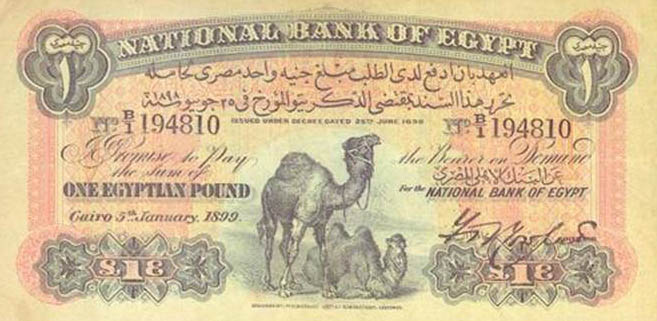
In 1885, Egypt went into a purely gold standard, and the Egyptian pound unit, known as the arz, was introduced at E£1 = 7.4375 grams of fine gold. This unit was chosen on the basis of the gold content in the British gold sovereign and maintaining the exchange value of 97.5 piastres to the pound sterling, and it replaced the Egyptian piastre (arz) as the chief unit of currency. This reform resulted in the Maria Theresa thaler being adjusted to 21 piastres, with 20 piastres now being rated at 5 French francs, and the foreign exchange rates were fixed by force of law for the important currencies which had become acceptable in the settlement of internal transactions. It wasn't however until 1899 that banknotes started to appear with the word "pounds" on them, written in English. Meanwhile, the piastre continued to circulate as of a pound, the para was discontinued in 1909, and the piastre was divided into tenths (عشر القرش arz). These tenths were renamed milliemes (arz) in 1916.
Then, at the outbreak of World War I, with the gold specie standard being suspended in the UK, the Egyptian pound used a sterling peg of one pound and sixpence sterling to one Egyptian pound. Inverted, this gives E£0.975 for one pound sterling.
This exchange value of 97.5 piastres to the pound sterling continued until the early 1960s when Egypt devalued slightly and switched to a peg to the United States dollar, at a rate of E£1 = US$2.3.
The Egyptian pound was also used in Anglo-Egyptian Sudan between 1899 and 1956, and Cyrenaica when it was under British occupation and later an independent emirate between 1942 and 1951. It also circulated in Mandatory Palestine from 1918 to 1927, when the Palestine pound was introduced.
The Egyptian pound continued with its exchange rate of E£ = £1 0s 6d sterling up until the beginning of the 1960s.
Nomenclature
Used for historical values or in vernacular speech
Several unofficial popular names are used to refer to different denominations of Egyptian currency. These include (from the word nickel) nekla (نكلة) for 2 milliemes, ta'rifa (تعريفة) for 5 milliemes, "nos franc" (نص فرانك) for 2 piastres, arz (شلن) (i.e. a shilling) for 5 piastres, bariza (بريزة) for 10 piastres, and reyal (ريال) ("real") for 20 piastres. [[File:Egyptian_self-taught_(Arabic)_-_20_Piastres,_Tariff.png|alt=Egyptian self-taught (Arabic) - 20 Piastres, Tariff|thumb|160px|The 1914 issue of 5 milliemes, arz]] Since the piastre and millieme are no longer legal tender, the smallest denomination currently minted being the 25 PT coin (functioning as one-quarter of E£1), these terms have mostly fallen into disuse and survive as curios. A few have survived to refer to pound notes: bariza now refers to the E£10 note and reyal can be used in reference to the E£20 note.
Informal
Different sums of the Egyptian pound have nicknames in vernacular speech, for example: E£1 bolbol (بلبل) "nightingale" or gondi (جندى) "soldier"; E£1,000 bako (باكو) "pack"; E£1,000,000 arnab (أرنب) "rabbit"; E£1,000,000,000 feel (فيل) "elephant".
Coins
Between 1837 and 1900, copper 1 and 5 para, silver 10 and 20 para, 1, 5, 10, and 20 piastre (pt), gold 5pt, 10pt. and 20pt and E£1 coins were introduced, with gold 50 PT coins issued in 1839.


Copper 10 para coins were introduced in 1853, although the silver coin continued to be issued. Copper 10 para coins were again introduced in 1862, followed by copper 4 para and 2 PT coins in 1863. Gold 25 PT coins were introduced in 1867.
In 1885, the para was replaced by the millieme in order to decimalise the currency and a new coinage was introduced. The issue consisted of bronze , , 1, 2 and 5 millieme (m), silver 1 PT, 2 PT, 5 PT, 10 PT and 20 PT coins. The gold coinage practically ceased, with only small numbers of 5 PT and 10 PT coins issued.

In 1916 and 1917, a new base metal coinage was introduced consisting of bronze m and holed, cupro-nickel 1m, 2m, 5m and 10m coins. Silver 2 PT, 5 PT, 10 PT and 20 PT coins continued to be issued, and a gold E£1 coin was reintroduced. Between 1922 and 1923, the gold coinage was extended to include 20 PT and 50 PT and E£1 and E£5 coins. In 1924, bronze replaced cupro-nickel in the 1m coin and the holes were removed from the other cupro-nickel coins. In 1938, bronze 5m and 10m coins were introduced, followed in 1944 by silver, hexagonal 2 PT coins.
Between 1954 and 1956, a new coinage was introduced, consisting of aluminium-bronze 1m, 5m and 10m and silver 5 PT, 10 PT and 20 PT coins, with the size of the silver coinage significantly reduced. An aluminium-bronze 2m coin was introduced in 1962. In 1967 the silver coinage was abandoned and cupro-nickel 5 and 10 piastre coins were introduced.

Aluminium replaced aluminium-bronze in the 1m, 5m and 10m coins in 1972, followed by brass in the 5m and 10m coins in 1973. Aluminium-bronze 2 PT and cupro-nickel 20 PT coins were introduced in 1980, followed by aluminium-bronze 1 PT and 5 PT coins in 1984. In 1992, brass 5 and 10 piastre coins were introduced, followed by holed, cupro-nickel 25 piastre coins in 1993. The size of 5 PT coins was reduced in 2004, 10 PT and 25 PT coins - in 2008.

On 1 June 2006, 50 PT and E£1 coins dated 2005 were introduced, and its equivalent banknotes were temporarily phased out from circulation in 2010. The coins bear the face of Cleopatra VII and Tutankhamun's mask, and the E£1 coin is bimetallic. The size and composition of 50 PT coins were reduced in 2007.
| Value | Debut | Image | Specifications | Description | Obverse | Reverse | Diameter (mm) | Thickness (mm) | Mass (g) | Composition | Obverse | Reverse | ||||
|---|---|---|---|---|---|---|---|---|---|---|---|---|---|---|---|---|
| 5 PT** | 1984 | [[File:5qershObverse1984.jpg | 55px | 5qershObverse1984]] | [[File:5qershReverse1984.jpg | 55px | 5qershReverse1984]] | 23 | 1.2 | 4.9 | Copper 95%Aluminium 5% | 3 pyramids of Giza | ||||
| 1992 | 21 | 1.1 | 3.2 | Copper 92% | ||||||||||||
| Aluminium 8% | Islamic pottery | |||||||||||||||
| 2004–2008 | 17 | 1.04 | 2.4 | Steel 94% | ||||||||||||
| Nickel 2% | ||||||||||||||||
| Copper plating 4% | ||||||||||||||||
| 10 PT** | 1984 | 25 | 1.35 | 5.2 | Copper 75%Nickel 25% | Mosque of Muhammad Ali | ||||||||||
| 1992 | [[File:10 EPT obverse.JPG | 55px]] | [[File:10 EPT reverse.JPG | 55px]] | 23 | 1.2 | 4.9 | Copper 95%Aluminum 5% | ||||||||
| 2008 | 19 | 1.1 | 3.2 | Steel 94% | ||||||||||||
| Copper 2% | ||||||||||||||||
| Nickel plating 4% | ||||||||||||||||
| 20 PT** | 1984 | 27 | 1.4 | 6 | Copper 75%Nickel 25% | |||||||||||
| 1992 | [[File:20 EPT reverse.JPG | 55px]] | 25 | 1.35 | 5.2 | Copper 95% | ||||||||||
| Aluminium 5% | Al-Azhar mosque | |||||||||||||||
| 25 PT | 1993** | 1.4 | ||||||||||||||
| 2008-22 | 21 | 1.26 | 4.5 | Steel 94% | ||||||||||||
| Copper 2% | ||||||||||||||||
| Nickel plating 4% | ||||||||||||||||
| 50 PT | 2005 | [[File:50 Egyptian piastres obverse.JPG | 70px]] | [[File:50 Egyptian piastres reverse.jpg | 70px]] | 25 | 1.58 | 6.5 | Copper 75% | |||||||
| Zinc 20% | ||||||||||||||||
| Nickel 5% | ||||||||||||||||
| 2007-21 | 23 | 1.7 | Steel 94% | |||||||||||||
| £1*** | 2005 | [[File:100 EPT obverse.JPG | 70px]] | [[File:100 EPT reverse.JPG | 70px]] | 25 | 1.89 | 8.5 | Bimetal | Tutankhamun's mask | ||||||
| Ring | Centre | |||||||||||||||
| Copper 75% | ||||||||||||||||
| Nickel 25% | Copper 75% | |||||||||||||||
| Zinc 20% | ||||||||||||||||
| Nickel 5% | ||||||||||||||||
| 2007–2022 | 1.96 | Steel 94% | ||||||||||||||
| Copper 2% | ||||||||||||||||
| Nickel plating 4% | Steel 94% | |||||||||||||||
| Nickel 2% | ||||||||||||||||
| Copper plating 4% |
** 1 para = piastre.*
*** Not in circulation as of 2008 (Still legal tender nevertheless).*
**** As to commemorate the branching of the Suez canal, the obverse had the Arabic phrase, قناة السويس الجديدة "New Suez Canal".*
Banknotes
In 1899, the National Bank of Egypt introduced notes in denominations of 50 PT, £1, £5, £10, £50, and £100. Between 1916 and 1917, 25 PT notes were added, together with government currency notes for 5 PT and 10 PT issued by the Ministry of Finance. In 1961, the Central Bank of Egypt took over from the National Bank and issued notes in denominations of 25 and 50 piastres, £1, £5, £10 and £20 notes were introduced in 1976, followed by £100 in 1978, £50 in 1993 and £200 in 2007.
.png)
.png)
All Egyptian banknotes are bilingual, with Arabic texts and Eastern Arabic numerals on the obverse, and English texts and Western Arabic numerals on the reverse. Obverse designs tend to feature an Islamic building with reverse designs featuring Ancient Egyptian motifs (buildings, statues and inscriptions). During December 2006, it was mentioned in articles in Al Ahram and Al Akhbar newspapers that there were plans to introduce £200 and £500 notes. As of 2024, there are £200 notes circulating but there are still no plans for issuing £500 notes. Starting from 2011 the 25 PT, 50 PT and £1 banknotes were phased out in favour of more extensive use of coins. However, as of June 2016 the National Bank of Egypt reintroduced the £1 banknote into circulation as well as 25 PT and 50 PT notes in response to a shortage of small change.
The governor of the Central Bank of Egypt announced that the Central Bank of Egypt will issue polymer notes by the beginning of 2021. This change comes as the CBE moves its headquarters to the new administrative capital. On July 31, 2021, the President of Egypt reviewed the notes of £10 and £20, to be issued in November 2021. In August 2021, the Central Bank was forced to confirm that rainbow holograms on the new banknotes were a secure watermarking feature to prevent counterfeiting, after online critics suggested it was a covert message of support for LGBT rights. Just nearly 2 years after the £10 note was released, the Central Bank of Egypt released the new £20 polymer banknote. The paper variants of the same denominations will continue to be legal tender.
| Image | Value | Dimensions (millimeters) | Main color | Description | Year of first issue | Reverse | Obverse | Reverse | Obverse | ||
|---|---|---|---|---|---|---|---|---|---|---|---|
| [[File:EGP 25 Piastres 2008 (Front).png | 300px]] | [[File:EGP 25 Piastres 2008 (Back).png | 300px]] | 25 PT | 130 × 70 | Blue | Ayesha mosque | Coat of arms of Egypt | 1985 | ||
| [[File:0.50 EGP obverse 2017-1-8.jpg | 300px]] | [[File:0.50 EGP reverse 2017-1-8.jpg | 300px]] | 50 PT | 135 × 70 | Brown/yellow-green | Al-Azhar Mosque | Ramesses II | |||
| [[File:1EGP-2001(5).png | 300px]] | [[File:1 Egyptian Pound Backside.jpg | 300px]] | £1 | 140 × 70 | Beige | Mosque and mausoleum of Qaitbay | Abu Simbel temples | 1978 | ||
| [[File:5EGP-2012.png | 300px]] | [[File:5 EGP reverse 2011-5-19.jpg | 300px]] | £5 | 145 × 70 | Bluish-green | Mosque of Ibn Tulun | A Pharaonic engraving of Hapi (god of the annual flooding of the Nile) offering bounties. | 1981 | ||
| [[File:10 EGP 2022 Polymer - front.jpg | 300x300px]] | [[File:10 EGP 2022 Polymer - observe.jpg | 300x300px]] | £10 | 132 × 69 | Orange | Al-Fattah Al-Aleem Mosque | Hatshepsut | 2022 | ||
| [[File:20 EGP 2022 Polymer - front 01.jpg | 300x300px]] | [[File:20 EGP 2022 Polymer - rear.jpg | 300x300px]] | £20 | 137 × 69 | Mint Green | Muhammad Ali Mosque | A Pharaonic war chariot and Queen Cleopatra | 2023 | ||
| [[File:EGP 50 Pounds Dec 2001 (Front).jpg | 300px]] | [[File:EGP 50 Pounds Dec 2001 (Back).jpg | 300px]] | £50 | 160 × 70 | Brownish-red | Abu Hurayba Mosque (Qijmas al-Ishaqi Mosque) | Temple of Edfu | 1993 | ||
| [[File:EGP 100 Pounds 2015 (Front).jpg | 300px]] | [[File:100 EGP reverse 2014-1-26.jpg | 300px]] | £100 | 165 × 70 | Cyan | Sultan Hassan Mosque | Great Sphinx of Giza | 1994 | ||
| [[File:EGP 200 Pounds Apr 2007 (Front).jpg | 300px]] | [[File:EGP 200 Pounds Apr 2007 (Back).jpg | 300px]] | £200 | 165 × 72 | Olive | Mosque of Qani-Bay | The Seated Scribe | 2007 |
Historical and current exchange rates
References
Bibliography
References
- (26 January 2021). "Macroeconomic Policy in Fragile States". Oxford University Press.
- "Inflation Rates".
- (1899). "Statesman's Year-Book 1899 American Edition – page 178".
- "Egyptian Pound (EGP): Definition as Currency of Egypt and Trade".
- "Page:Statesman's Year-Book 1899 American Edition.djvu/1478 - Wikisource, the free online library".
- "World Bank Editorial Style Guide 2020 - page 135".
- Published by H. Plecher. (2020-04-29). "• Egypt- Inflation rate 2021". Statista.
- (1899). "Statesman's Year-Book 1899 American Edition – page 178".
- Museum, Egypt. (2022-07-22). "Gold in Ancient Egypt".
- Markus A. Denzel. (2010). "Handbook of World Exchange Rates, 1590-1914". Ashgate Publishing.
- (2009). "Standard Catalog of World Paper Money Specialized Issues". Krause.
- (27 April 2022). "اللحلوح والبلبل والمهموز والسبيك والطقش.. لماذا دلع المصريين الجنيه؟".
- (10 December 2004). "Developments of Note Issue".
- "Coins from Egypt – Numista".
- "Nach Thund".
- (15 September 2012). ""المركزى": تراجع قيمة الجنيه لن يدفعنا لطرح ورقة نقدية من فئة 500 - اليوم السابع".
- "عودة الجنيه المصري الورقي اليوم بعد اختفائه أكثر من 5 سنوات".
- (2020-09-12). "Egypt to roll out new plastic currency starting 2021: Amer".
- (2021-08-01). "ننشر أول صور للعملات البلاستيكية الجديدة فئة 10 و20 جنيها".
- Powys Maurice, Emily. (3 August 2021). "Bank of Egypt forced to confirm new rainbow note isn't for LGBT+ rights after backlash". [[PinkNews]].
- (3 August 2021). "CBE confirms continued validity of all paper currencies". [[Egypt Independent]].
This article was imported from Wikipedia and is available under the Creative Commons Attribution-ShareAlike 4.0 License. Content has been adapted to SurfDoc format. Original contributors can be found on the article history page.
Ask Mako anything about Egyptian pound — get instant answers, deeper analysis, and related topics.
Research with MakoFree with your Surf account
Create a free account to save articles, ask Mako questions, and organize your research.
Sign up freeThis content may have been generated or modified by AI. CloudSurf Software LLC is not responsible for the accuracy, completeness, or reliability of AI-generated content. Always verify important information from primary sources.
Report