From Surf Wiki (app.surf) — the open knowledge base
Effigia
Extinct genus of Archosaurs

Extinct genus of Archosaurs
Effigia is an extinct genus of shuvosaurid known from the Late Triassic of New Mexico, south-western USA. With a bipedal stance, long neck, and a toothless beaked skull, Effigia and other shuvosaurids bore a resemblance to the ornithomimid dinosaurs of the Cretaceous Period. However, shuvosaurids were not dinosaurs, but were instead a specialized family of poposauroid pseudosuchians, meaning that their closest living relatives are crocodilians.
Discovery
The 2-meter (6 ft 7 in) holotype fossil was collected by Edwin H. Colbert in 1947. At this time Colbert led an excavation to collect blocks of rock from the Whitaker Quarry of Ghost Ranch, near Abiquiu, New Mexico. Colbert's expedition intended to recover abundant fossils of the basal theropod dinosaur Coelophysis, and he believed that no other large vertebrates were present in the quarry. As a result, his crew did not even open the plaster jackets of most of the blocks that were shipped to the American Museum of Natural History. The plaster jacket containing the holotype of Effigia started to be prepared in 2004, and the specimen was uncovered by graduate student Sterling Nesbitt at the AMNH. Nesbitt was opening jackets of blocks in order to find new specimens of Coelophysis. Upon finding the remains of Effigia, he instantly recognized this was not a dinosaur and proceeded to track down the rest of the blocks from that area of the quarry. Nesbitt and Mark Norell, curator at the museum, named it Effigia okeeffeae in January 2006 after Georgia O'Keeffe, who spent many years at Ghost Ranch.
Convergence
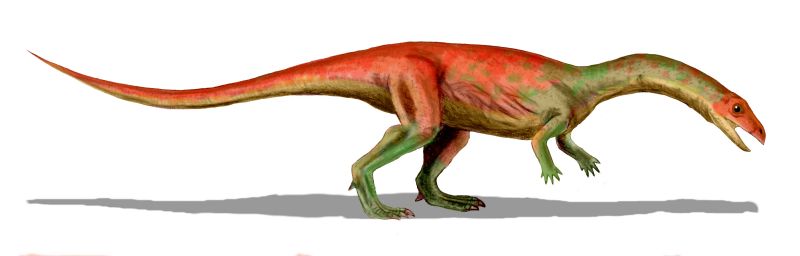
Effigia is noted for its remarkable similarity to ornithomimid dinosaurs. In 2007, Nesbitt's description demonstrated that Effigia was very similar to Shuvosaurus, and is definitely a member of the archosaur subgroup Pseudosuchia (the line leading towards modern crocodilians). Its similarity to ornithomimids represents a case of "extreme" convergent evolution. Nesbitt also demonstrated that Shuvosaurus was the same animal as Chatterjeea, and that it belonged to an exclusive clade containing closely related suchians such as Shuvosaurus and Poposaurus (Poposauroidea). Within this group, Effigia forms an even more exclusive clade with Shuvosaurus and the South American Sillosuchus (Shuvosauridae). In 2007, Lucas and others suggested that "Effigia" was synonymous with "Shuvosaurus" and used the new combination "Shuvosaurus okeeffeae" for the animal. This proposal has not been accepted by Nesbitt.
Paleobiology
Examination of Effigia's jaws suggest it was a specialist herbivore that filled a niche as a browser feeding on softer plant material, due to its weak jaws and sharp beak. It was previously suggested that it pecked for food like ostriches or other ratites, but biomechanical studies have estimated that its skull could not withstand such forces.
References
References
- (2006-05-07). "Extreme convergence in the body plans of an early suchian (Archosauria) and ornithomimid dinosaurs (Theropoda)". Proceedings of the Royal Society B: Biological Sciences.
- Nesbitt, Sterling J.. (2011). "The Early Evolution of Archosaurs: Relationships and the Origin of Major Clades". [[Bulletin of the American Museum of Natural History]].
- AMNH. (October 2015). "Fossils of Ghost Ranch".
- Nesbitt, S. (2007). "The anatomy of ''Effigia okeeffeae'' (Archosauria, Suchia), theropod-like convergence, and the distribution of related taxa." ''Bulletin of the American Museum of Natural History'', '''302''': 84 pp. http://digitallibrary.amnh.org/dspace/handle/2246/5840
- (2007). "Taxonomy of ''Shuvosaurus'', a Late Triassic archosaur from the Chinle Group, American Southwest". New Mexico Museum of Natural History and Science Bulletin.
- (2021). "Cranial functional morphology of the pseudosuchian ''Effigia'' and implications for its ecological role in the Triassic". The Anatomical Record.
This article was imported from Wikipedia and is available under the Creative Commons Attribution-ShareAlike 4.0 License. Content has been adapted to SurfDoc format. Original contributors can be found on the article history page.
Ask Mako anything about Effigia — get instant answers, deeper analysis, and related topics.
Research with MakoFree with your Surf account
Create a free account to save articles, ask Mako questions, and organize your research.
Sign up freeThis content may have been generated or modified by AI. CloudSurf Software LLC is not responsible for the accuracy, completeness, or reliability of AI-generated content. Always verify important information from primary sources.
Report