From Surf Wiki (app.surf) — the open knowledge base
Eelpout
Family of fishes

Family of fishes
the family of marine fish
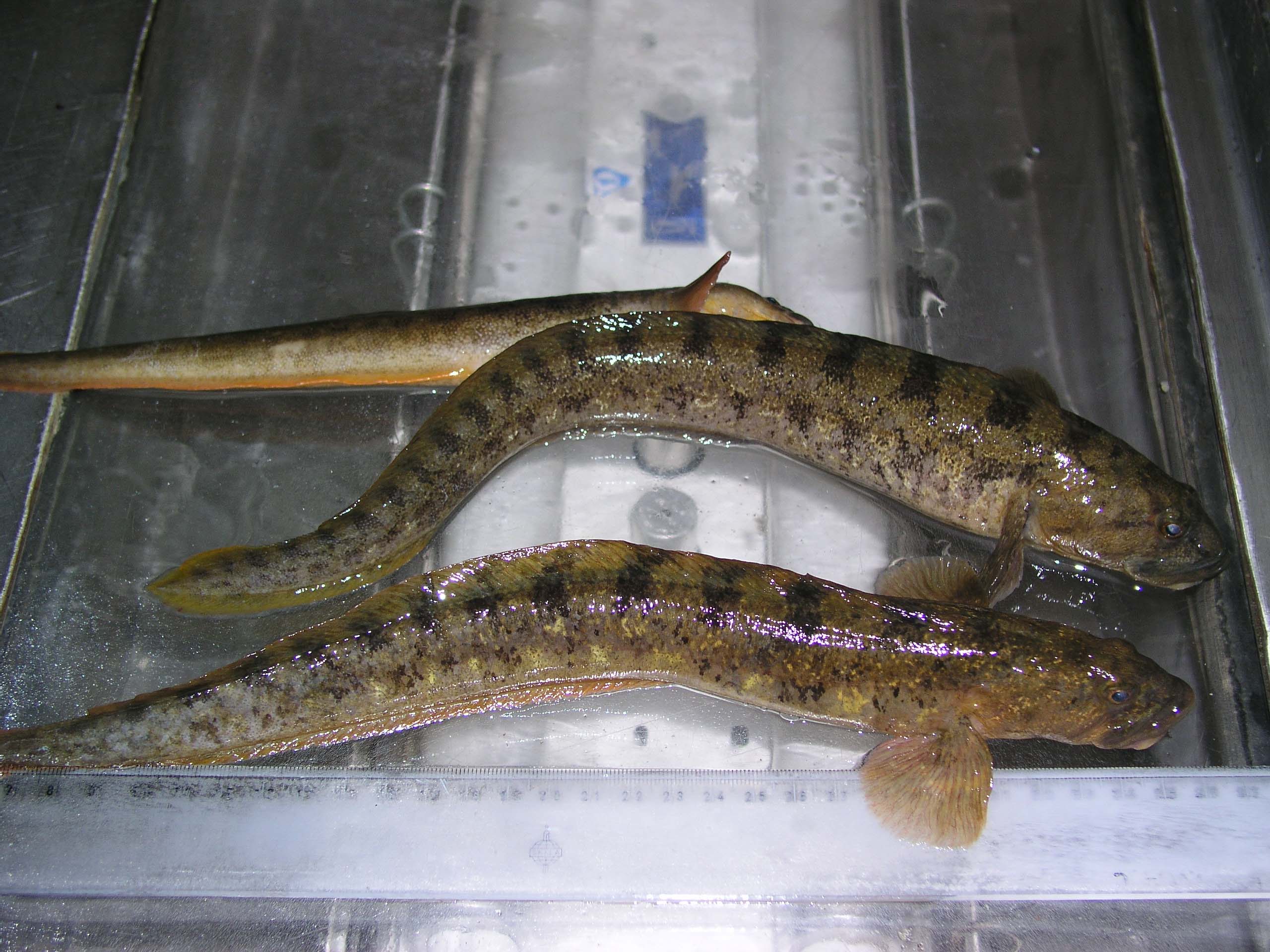
The eelpouts are the ray-finned fish family Zoarcidae. As the common name suggests, they are somewhat eel-like in appearance. All of the 300 species are marine and mostly bottom-dwelling, some at great depths. Eelpouts are predominantly found in the Northern Hemisphere. The Arctic, north Pacific and north Atlantic oceans have the highest concentration of species; however, species are found around the globe.
They are conventionally placed in the "perciform" assemblage; in fact, the Zoarcoidei seem to be specialized members of the Gasterosteiformes-Scorpaeniformes group of Acanthopterygii.
The largest member of the family is Zoarces americanus, which may reach 1.1 m in length. Other notable genera include Lycodapus and Gymnelus.
Taxonomy
The eelpout family was first proposed as the family Zoarchidae in 1839 by the English naturalist William Swainson but the spelling was changed to Zoarcidae after the spelling of the genus Zoarces was corrected by Theodore Gill in 1861. Other authorities classify this family in the infraorder Zoarcales within the suborder Cottoidei of the Perciformes because removing the Scorpaeniformes from the Perciformes renders that taxon non monophyletic.
Fishes of the World mentions four subfamilies but does not assign genera to the subfamilies and this has been followed by FishBase and Catalog of Fishes.
Evolution and adaptations
Eelpout species have evolved to efficiently give birth to future generations. They utilize demersal eggs, which are eggs that are deposited on the seafloor, and can be either free or connected to the substrate. These egg clusters can range from 9.2 mm, to 9.8 mm, which are the largest compared to any other marine egg cluster. It has been found that eelpouts grow larger and heavier in areas where the water is relatively shallow. In these areas, this species consumes molluscs, invertebrates, and small fish. The difference of biodiversity at varying depths has led to the evolution of distinct populations, connecting to the study that temperature might have a significant effect on them. Studies have shown that there are three large families of eelpout species; Zoarcidae, Stichaeidae, and Pholidae. These species have been thought to have evolved in northern, colder seas, each diverging off of each other at different points in time, millions of years ago. The notched-fin eelpout, which is commonly found in the Sea of Okhotsk, have shown researchers what the average length of an adult eelpout is, usually sitting between 21 and 26 cm long (females typically larger than males). Their size has been found to increase as the depth of water in which they have been studied lowers. They feed commonly on Gammarids (small, shrimp like organisms), Polychaetes (marine worms), and Bivalves (clams and muscles) on the seafloor.
Subfamilies and genera
The eelpouts are classified into four subfamilies and 61 genera with around 300 species:


- subfamily Gymnelinae Gill, 1863
- Andriashevia Fedorov & Neelov, 1978
- Barbapellis Iglésias, Dettai & Ozouf-Costaz, 2012
- Bilabria Schmidt, 1936
- Davidijordania Popov, 1931
- Ericandersonia Shinohara & Sakurai, 2006
- Gymnelopsis Soldatov, 1922
- Gymnelus Reinhardt 1834
- Hadropareia Schmidt, 1904
- Krusensterniella Schmidt, 1904
- Magadanichthys Shinohara, Nazarkin & Chereshnev, 2006
- Melanostigma Günther, 1881
- Nalbantichthys Schultz, 1967
- Opaeophacus Bond & Stein, 1984
- Puzanovia Fedorov, 1975
- Seleniolycus Anderson, 1988
- subfamily Lycodinae Gill, 1861
- Aiakas Gosztonyi, 1977
- Argentinolycus Matallanas & Corbella, 2012
- Austrolycus Regan, 1913
- Bellingshausenia Matallanas, 2009
- Bentartia Matallanas, 2010
- Bothrocara Bean, 1890
- Bothrocarina Suvorov, 1935
- Crossostomus Lahille, 1908
- Dadyanos Whitley, 1951
- Derepodichthys Gilbert, 1896
- Dieidolycus Anderson, 1988
- Eucryphycus Anderson, 1988
- Exechodontes DeWitt, 1977
- Gosztonyia Matallanas, 2009
- Hadropogonichthys Fedorov, 1982
- Iluocoetes Jenyns, 1842
- Japonolycodes Shinohara, Sakurai & Machida, 2002
- Letholycus Anderson, 1988
- Lycenchelys Gill, 1884
- Lycodapus Gilbert, 1890
- Lycodes Reinhardt, 1831
- Lycodichthys Pappenheim, 1911
- Lycodonus Goode & Bean, 1883
- Lycogrammoides Soldatov & Lindberg, 1928
- Lyconema Gilbert, 1896
- Maynea Cunningham, 1871
- Notolycodes Gosztonyi, 1977
- Oidiphorus McAllister & Rees 1964
- Ophthalmolycus Regan, 1913
- Pachycara Zugmayer. 1911
- Patagolycus Matallanas & Corbella, 2012
- Petroschmidtia Taranetz & Andriashev, 1934
- Phucocoetes Jenyns, 1842
- Piedrabuenia Gosztonyi, 1977
- Plesienchelys Anderson, 1988
- Pogonolycus Norman, 1937
- Pyrolycus Machida & Hashimoto, 2002
- Santelmoa Matallanas, 2010
- Taranetzella Andriashev, 1952
- Thermarces Rosenblatt & Cohen, 1986
- Zestichthys Jordan & Hubbs, 1925
- subfamily Lycozarcinae Andriashev, 1939
- Lycozoarces Popov, 1935
- subfamily Zoarcinae Swainson, 1839
- Zoarces Cuvier 1829
Characteristics
The body of eelpouts is relatively elongated and laterally compressed. Their heads are relatively small and ovoid. Juveniles have a more rounded snout and relatively larger eye than adults. Their scales are absent or very small. The dorsal and anal fins are continuous down their bodies up to their caudal fin. They produce the pigment biliverdin, which turns their bones green. This feature has no apparent evolutionary function and is harmless. Overall, there is no sexual dimorphism.
Biology
Little is known about eelpout populations because they often slip through nets in sampling studies, and because some species live in inaccessibly deep habitats. Species for which trophic ecology has been documented are typically, if not always, benthic scavengers or predators. At least one species has also adapted the ability to breathe air when out of water.
Timeline
ImageSize = width:1000px height:auto barincrement:15px PlotArea = left:10px bottom:50px top:10px right:10px
Period = from:-65.5 till:10 TimeAxis = orientation:horizontal ScaleMajor = unit:year increment:5 start:-65.5 ScaleMinor = unit:year increment:1 start:-65.5 TimeAxis = orientation:hor AlignBars = justify
Colors =
- legends id:CAR value:claret id:ANK value:rgb(0.4,0.3,0.196) id:HER value:teal id:HAD value:green id:OMN value:blue id:black value:black id:white value:white id:cenozoic value:rgb(0.54,0.54,0.258) id:paleogene value:rgb(0.99,0.6,0.32) id:paleocene value:rgb(0.99,0.65,0.37) id:eocene value:rgb(0.99,0.71,0.42) id:oligocene value:rgb(0.99,0.75,0.48) id:neogene value:rgb(0.999999,0.9,0.1) id:miocene value:rgb(0.999999,0.999999,0) id:pliocene value:rgb(0.97,0.98,0.68) id:quaternary value:rgb(0.98,0.98,0.5) id:pleistocene value:rgb(0.999999,0.95,0.68) id:holocene value:rgb(0.999,0.95,0.88)
BarData= bar:eratop bar:space bar:periodtop bar:space bar:NAM1 bar:NAM2
bar:space bar:period bar:space bar:era
PlotData= align:center textcolor:black fontsize:M mark:(line,black) width:25 shift:(7,-4)
bar:periodtop from: -65.5 till: -55.8 color:paleocene text:Paleocene from: -55.8 till: -33.9 color:eocene text:Eocene from: -33.9 till: -23.03 color:oligocene text:Oligocene from: -23.03 till: -5.332 color:miocene text:Miocene from: -5.332 till: -2.588 color:pliocene text:Plio. from: -2.588 till: -0.0117 color:pleistocene text:Pleist. from: -0.0117 till: 0 color:holocene text:H.
bar:eratop from: -65.5 till: -23.03 color:paleogene text:Paleogene from: -23.03 till: -2.588 color:neogene text:Neogene from: -2.588 till: 0 color:quaternary text:Q.
PlotData= align:left fontsize:M mark:(line,white) width:5 anchor:till align:left
color:pliocene bar:NAM1 from: -5.332 till: 0 text: Anarhichas color:pleistocene bar:NAM2 from: -2.588 till: 0 text: Anarrhichthys
PlotData= align:center textcolor:black fontsize:M mark:(line,black) width:25
bar:period from: -65.5 till: -55.8 color:paleocene text:Paleocene from: -55.8 till: -33.9 color:eocene text:Eocene from: -33.9 till: -23.03 color:oligocene text:Oligocene from: -23.03 till: -5.332 color:miocene text:Miocene from: -5.332 till: -2.588 color:pliocene text:Plio. from: -2.588 till: -0.0117 color:pleistocene text:Pleist. from: -0.0117 till: 0 color:holocene text:H.
bar:era from: -65.5 till: -23.03 color:paleogene text:Paleogene from: -23.03 till: -2.588 color:neogene text:Neogene from: -2.588 till: 0 color:quaternary text:Q.
References
References
- (2014). "Family-group names of Recent fishes". Zootaxa.
- Kawahara, R.. (2008). "Interrelationships of the 11 gasterosteiform families (sticklebacks, pipefishes, and their relatives): a new perspective based on whole mitogenome sequences from 75 higher teleosts". Molecular Phylogenetics and Evolution.
- (2016). "Fishes of the World". Wiley.
- (2017). "Phylogenetic classification of bony fishes". BMC Evolutionary Biology.
- (2004). "Family Zoarcidae Swainson 1839 — eelpouts". California Academy of Sciences Annotated Checklists of Fishes.
- {{FishBase family. (2022)
- (1990). "INDEX". Elsevier.
- Publishers, Estonian Academy. (2016). "Proceedings of the Estonian Academy of Sciences, Biology and Ecology". Estonian Academy Publishers.
- Radchenko, O. A.. (2016). "Timeline of the evolution of eelpouts from the suborder Zoarcoidei (Perciformes) based on DNA variability". Journal of Ichthyology.
- (July 2010). "Spatial and length distribution, sex composition, and feeding of the notched-fin eelpout Zoarces elongatus (Perciformes: Zoarcidae) in the Sea of Okhotsk". Russian Journal of Marine Biology.
- {{Cof family
- Anderson, M. Eric. (1988-02-05). "''Eucryphycus'', a new genus of California eelpout (Teleostei: Zoarcidae) based on ''Maynea californica'' Starks and Mann, 1911". Proceedings of the California Academy of Sciences.
- "Family Zoarcidae: Eelpouts". Burke Museum.
- "Zoarces viviparus (Linnaeus, 1758), Eelpout".
- Anderson, M. Eric. (1989-12-20). "Review of the eelpout genus ''Pachycara'' Zugmayer, 1911 (Teleostei: Zoarcidae), with descriptions of six new species". Proceedings of the California Academy of Sciences.
- (May 18, 1979). "Aquarium Observations on Feeding by Melanostigma pammelas (Pisces: Zoarcidae)". Copeia.
- (1839). "On the Natural History and Classification of Fishes, Amphibians, and Reptiles". Longman, Orme, Brown, Greene, & Longmans.
This article was imported from Wikipedia and is available under the Creative Commons Attribution-ShareAlike 4.0 License. Content has been adapted to SurfDoc format. Original contributors can be found on the article history page.
Ask Mako anything about Eelpout — get instant answers, deeper analysis, and related topics.
Research with MakoFree with your Surf account
Create a free account to save articles, ask Mako questions, and organize your research.
Sign up freeThis content may have been generated or modified by AI. CloudSurf Software LLC is not responsible for the accuracy, completeness, or reliability of AI-generated content. Always verify important information from primary sources.
Report