From Surf Wiki (app.surf) — the open knowledge base
Edwin Hubble
American astronomer (1889–1953)
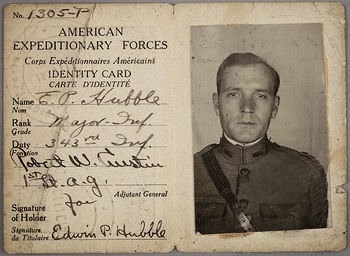
American astronomer (1889–1953)
| Field | Value | |
|---|---|---|
| image | Studio portrait photograph of Edwin Powell Hubble (cropped).JPG | |
| caption | Portrait by Johan Hagemeyer, 1931 | |
| birth_name | Edwin Powell Hubble | |
| birth_date | ||
| birth_place | Marshfield, Missouri, U.S. | |
| death_date | ||
| death_place | San Marino, California, U.S. | |
| spouse | ||
| field | Astronomy | |
| work_institutions | ||
| alma_mater | ||
| known_for | ||
| prizes | ||
| signature | Edwin Hubble signature.svg | |
| module | {{Infobox military person | embed = yes |
| allegiance | ||
| branch | United States Army | |
| serviceyears | 1918 | |
| rank | Major | |
| unit | 86th Division, 2nd Battalion, 343rd Infantry Regiment | |
| battles | World War I |
Edwin Powell Hubble (November 20, 1889 – September 28, 1953) was an American astronomer. He played a crucial role in establishing the fields of extragalactic astronomy and observational cosmology.
Hubble proved that many objects previously thought to be clouds of dust and gas and classified as "nebulae" were actually galaxies beyond the Milky Way. He used the strong direct relationship between a classical Cepheid variable's luminosity and pulsation period (discovered in 1908 by Henrietta Swan Leavitt) for scaling galactic and extragalactic distances.
Hubble confirmed in 1929 that the recessional velocity of a galaxy increases with its distance from Earth, a behavior that became known as Hubble's law, although it had been proposed two years earlier by Georges Lemaître. The Hubble law implies that the universe is expanding. A decade before, the American astronomer Vesto Slipher had provided the first evidence that the light from many of these nebulae was strongly red-shifted, indicative of high recession velocities.
Hubble's name is most widely recognized for the Hubble Space Telescope, which was named in his honor, with a model prominently displayed in his hometown of Marshfield, Missouri.
Early life and education
Edwin Hubble was born in 1889 to Virginia Lee Hubble (née James) (1864–1934) and John Powell Hubble, an insurance executive, in Marshfield, Missouri, and moved to Wheaton, Illinois, in 1900. In his younger days, he was noted more for his athletic prowess than his intellectual abilities, although he did earn good grades in every subject except spelling. Edwin was a gifted athlete, playing baseball, football, and running track in both high school and college. He won seven first places and a third place in a single high school track and field meet in 1906, and he played a variety of positions on the basketball court, from center to shooting guard. Hubble led the University of Chicago's basketball team to their first Big Ten Conference title in 1907.
Undergraduate studies
Hubble's studies at the University of Chicago were concentrated on mathematics, astronomy and philosophy, which resulted in a Bachelor of Science degree by 1910. For a year he was also a student laboratory assistant for the physicist Robert Millikan, a future Nobel Prize winner. Hubble also became a member of Kappa Sigma fraternity. A Rhodes Scholar, he spent three years at The Queen's College, Oxford studying jurisprudence instead of science (as a promise to his dying father), and later added studies in literature and Spanish, eventually earning a master's degree.
In 1909, Hubble's father moved his family from Chicago, Illinois to Shelbyville, Kentucky, so that the family could live in a small town, ultimately settling in nearby Louisville. His father died in the winter of 1913, while Edwin was still in England. In the following summer, Edwin returned home to care for his mother, two sisters, and younger brother, along with his brother William. The family moved once more to Everett Avenue, in Louisville's Highlands neighborhood, to accommodate Edwin and William.
Hubble was a dutiful son, who despite his intense interest in astronomy since boyhood, acquiesced to his father's request to study law, first at the University of Chicago and later at Oxford University. In this time, he also took some math and science courses. After the death of his father in 1913, Edwin returned to the Midwest from Oxford but did not have the motivation to practice law. Instead, he proceeded to teach Spanish, physics and mathematics at New Albany High School in New Albany, Indiana, where he also coached the boys' basketball team. After a year of high-school teaching, he entered graduate school with the help of his former professor from the University of Chicago to study astronomy at the university's Yerkes Observatory, where he received his Ph.D. in 1921. His dissertation was titled "Photographic Investigations of Faint Nebulae". At Yerkes, he had access to its 40-inch refractor telescope built by George Ellery Hale in 1897, as well as an innovative 26-inch (61 cm) reflector telescope.
Doctoral studies
After the United States declaration of war on Germany (1917), Hubble rushed to complete his Ph.D. dissertation so he could join the military. Hubble volunteered for the United States Army and was assigned to the newly created 86th Division, where he served in the 2nd Battalion, 343rd Infantry Regiment. He rose to the rank of major, and was found fit for overseas duty on July 9, 1918; the 86th Division moved overseas, but never saw combat as it was broken up and its personnel used as replacements in other units. After the end of World War I, Hubble spent a year at University of Cambridge, where he renewed his studies of astronomy.
Career
In 1919, Hubble was offered a staff position at the Carnegie Institution for Science's Mount Wilson Observatory, near Pasadena, California, by George Ellery Hale, the founder and director of the observatory. Hubble remained on staff at Mount Wilson until his death in 1953. Shortly before his death, Hubble became the first astronomer to use the newly completed giant 200 in reflector Hale Telescope at the Palomar Observatory near San Diego, California.
Hubble also worked as a civilian for United States Army at Aberdeen Proving Ground in Maryland during World War II as the Chief of the External Ballistics Branch of the Ballistic Research Laboratory during which he directed a large volume of research in exterior ballistics which increased the effective firepower of bombs and projectiles. His work was facilitated by his personal development of several items of equipment for the instrumentation used in exterior ballistics, the most outstanding development being the high-speed clock camera, which made possible the study of the characteristics of bombs and low-velocity projectiles in flight. The results of his studies were credited with improving the design, performance, and military effectiveness of bombs and rockets. For his work there, he received the Legion of Merit award.
Discoveries
Universe goes beyond the Milky Way galaxy
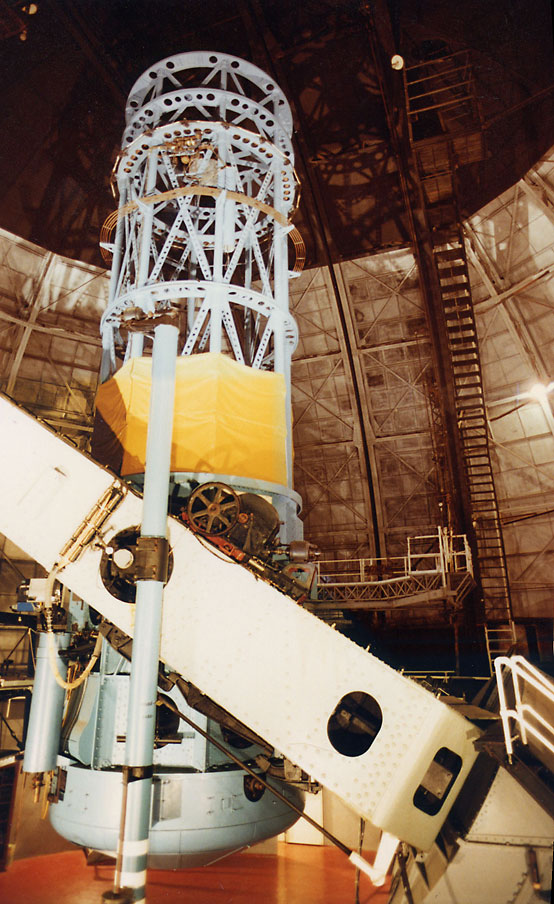
Edwin Hubble's arrival at Mount Wilson Observatory, California, in 1919 coincided roughly with the completion of the 100 in Hooker Telescope, then the world's largest. At that time, the prevailing view of the cosmos was that the universe consisted entirely of the Milky Way galaxy.
Using the Hooker Telescope at Mount Wilson, Hubble identified Cepheid variables, a standard candle discovered by Henrietta Swan Leavitt. Comparing their apparent luminosity to their intrinsic luminosity gives their distance from Earth. Hubble found Cepheids in several nebulae, including the Andromeda Nebula and Triangulum Nebula. His observations, made in 1924, proved conclusively that these nebulae were much too distant to be part of the Milky Way and were, in fact, entire galaxies outside the Milky Way galaxy; thus, today they are no longer considered nebulae.
This was first hypothesized as early as 1755 when Immanuel Kant's General History of Nature and Theory of the Heavens appeared. Hubble's hypothesis was opposed by many in the astronomy establishment of the time, in particular by Harvard Universitybased Harlow Shapley. Despite the opposition, Hubble, then a thirty-five-year-old scientist, had his findings first published in The New York Times on November 23, 1924, then presented them to other astronomers at the January 1, 1925, meeting of the American Astronomical Society. Hubble's results for the Andromeda galaxy were not formally published in a peer-reviewed scientific journal until 1929.
Hubble's findings fundamentally changed the scientific view of the universe. Supporters state that Hubble's discovery of nebulae outside of our galaxy helped pave the way for future astronomers. Although some of his more renowned colleagues simply scoffed at his results, Hubble published his findings. This published work earned him the American Association Prize and five hundred dollars from Burton E. Livingston of the Committee on Awards.
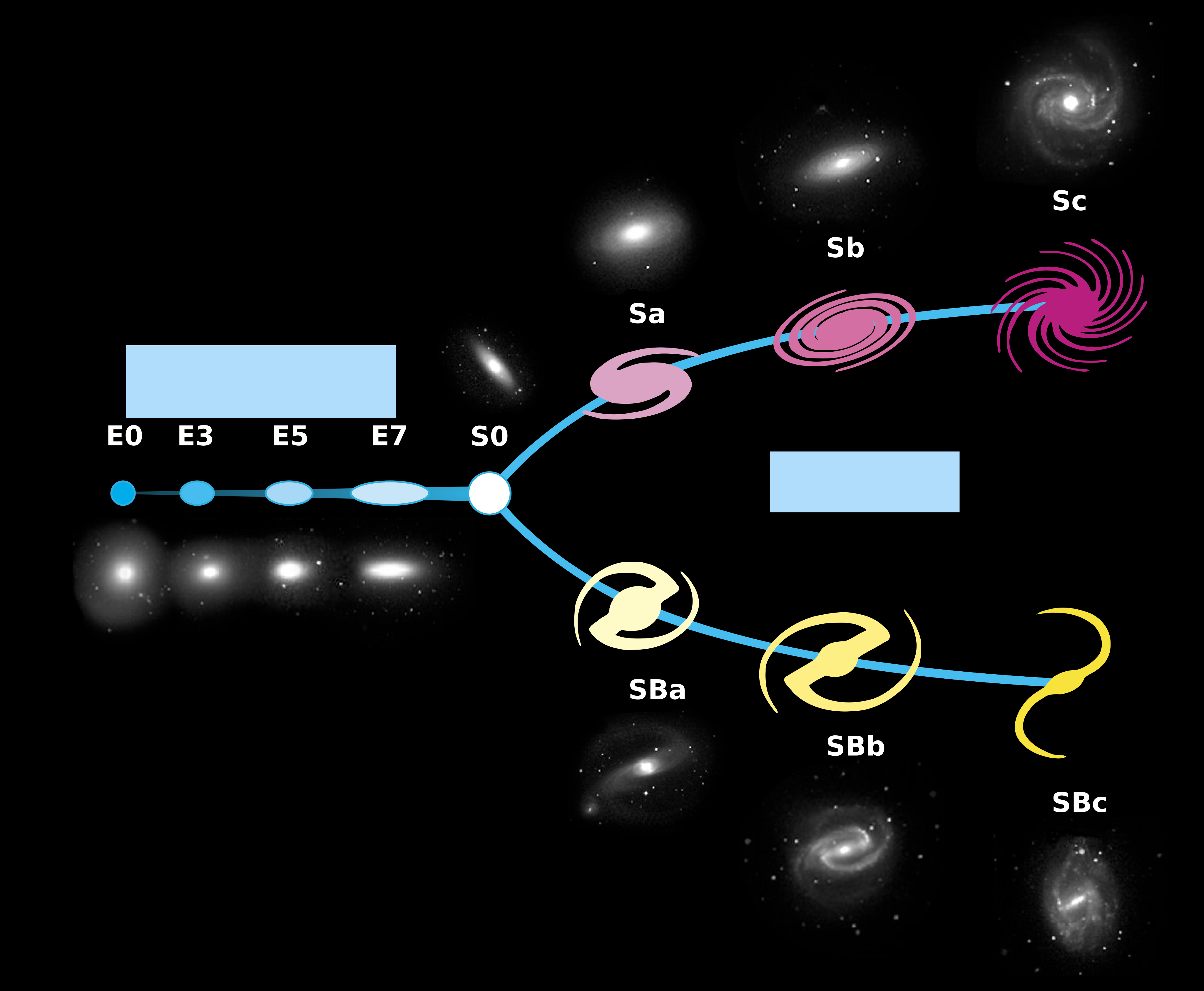
Hubble also devised the most commonly used system for classifying galaxies, grouping them according to their appearance in photographic images. He arranged the different groups of galaxies in what became known as the Hubble sequence.
Redshift increases with distance
Hubble went on to estimate the distances to 24 extra-galactic nebulae, using a variety of methods. In 1929, Hubble examined the relationship between these distances and their radial velocities as determined from their redshifts. All of his estimated distances are now known to be too small, by up to a factor of about 7. This was due to factors such as the fact that there are two kinds of Cepheid variables or confusing bright gas clouds with bright stars. However, his distances were more or less proportional to the true distances, and combining his distances with measurements of the redshifts of the galaxies by Vesto Slipher, and by his assistant Milton L. Humason, he found a roughly linear relationship between the distances of the galaxies and their radial velocities (corrected for solar motion), a discovery that later became known as Hubble's law.
This meant that the greater the distance between any two galaxies, the greater their relative speed of separation. When interpreted that way, Hubble's measurements on 46 galaxies lead to a value for the Hubble constant of 500 km/s/Mpc, which is much higher than the currently accepted values of 74 km/s/Mpc (cosmic distance ladder method) or 68 km/s/Mpc (CMB method) due to errors in their distance calibrations.
Yet the reason for the redshift remained unclear. Georges Lemaître predicted on theoretical grounds based on Einstein's equations for general relativity the redshift-distance relation, and published observational support for it, two years before the discovery of Hubble's law. Although he used the term "velocities" in his paper (and "apparent radial velocities" in the introduction), he later expressed doubt about interpreting these as real velocities. In 1931, he wrote a letter to the Dutch cosmologist Willem de Sitter expressing his opinion on the theoretical interpretation of the redshift-distance relation:
Today, the "apparent velocities" in question are usually thought of as an increase in proper distance that occurs due to the expansion of the universe. Light traveling through an expanding metric will experience a Hubble-type redshift, a mechanism somewhat different from the Doppler effect, although the two mechanisms become equivalent descriptions related by a coordinate transformation for nearby galaxies.
In the 1930s, Hubble was involved in determining the distribution of galaxies and spatial curvature. These data seemed to indicate that the universe was flat and homogeneous, but there was a deviation from flatness at large redshifts. According to Allan Sandage,
There were methodological problems with Hubble's survey technique that showed a deviation from flatness at large redshifts. In particular, the technique did not account for changes in luminosity of galaxies due to galaxy evolution. Earlier, in 1917, Albert Einstein had found that his newly developed theory of general relativity indicated that the universe must be either expanding or contracting. Unable to believe what his own equations were telling him, Einstein introduced a cosmological constant (a "fudge factor") to the equations to avoid this "problem". When Einstein learned of Hubble's redshifts, he immediately realized that the expansion predicted by general relativity must be real, and in later life, he said that changing his equations was "the biggest blunder of [his] life". Einstein visited Mount Wilson Observatory in 1931, and met Hubble. Einstein announced there that "the visit had changed his mind".
Hubble also discovered the asteroid 1373 Cincinnati on August 30, 1935. In 1936 he wrote The Observational Approach to Cosmology and The Realm of the Nebulae which explained his approaches to extra-galactic astronomy and his view of the subject's history.
In December 1941, Hubble reported to the American Association for the Advancement of Science that results from a six-year survey with the Mount Wilson telescope did not support the expanding universe theory. According to a Los Angeles Times article reporting on Hubble's remarks, "The nebulae could not be uniformly distributed, as the telescope shows they are, and still fit the explosion idea. Explanations which try to get around what the great telescope sees, he said, fail to stand up. The explosion, for example, would have had to start long after the earth was created, and possibly even after the first life appeared here." (Hubble's estimate of what we now call the Hubble constant would put the Big Bang only 2 billion years ago.)
Personal life
Hubble married Grace Lillian (Burke) Leib (1889–1980), daughter of John Patrick and Luella (Kepford) Burke, on February 26, 1924.
Hubble was raised as a Protestant Christian, but some of his later statements suggest uncertainty.
Health issues and death
Hubble had a heart attack in July 1949 while on vacation in Colorado. He was cared for by his wife and continued on a modified diet and work schedule. He died of cerebral thrombosis (a blood clot in his brain) on September 28, 1953, in San Marino, California. No funeral was held for him, and his wife never revealed his burial site.
Hubble's papers comprising the bulk of his correspondence, photographs, notebooks, observing logbooks, and other materials, are held by the Huntington Library in San Marino, California. They were donated by his wife Grace Burke Hubble upon her death in 1980.
Controversies
Accusations concerning Lemaître's priority
In 2011, the journal Nature reported claims that Hubble might have played a role in the redaction of key parts of the 1931 English translation of Lemaître's 1927 paper, which formulated what was later called Hubble's law and also gave observational evidence. Historians quoted in the article were skeptical that the redactions were part of a campaign to ensure Hubble retained priority. However, the observational astronomer Sidney van den Bergh published a paper suggesting that while the omissions may have been made by a translator, they may still have been deliberate.
In November 2011, the astronomer Mario Livio reported in Nature that a letter he found in the Lemaître archive demonstrated that the redaction had been made by Lemaître himself, who apparently saw no point in publishing scientific content which had already been reported in 1929 by Hubble. However, the fact remains that Lemaître published the law in French, two years prior to Hubble.
Campaign to obtain a Nobel Prize
During Hubble's life the Nobel Prize in Physics did not cover astronomy. Hubble spent much of the later part of his career attempting to have astronomy considered part of physics, instead of being a separate science. He did this largely so that astronomers—including himself—could be recognized by the Nobel Committee for their contributions to astrophysics. This campaign was unsuccessful in Hubble's lifetime, but shortly after his death, the Nobel Prize Committee decided that astronomical work would be eligible for the physics prize. However, the Nobel prize is not awarded posthumously.
Honors
Awards
- Newcomb Cleveland Prize in 1924;
- Bruce Medal in 1938;
- Franklin Medal in 1939;
- Gold Medal of the Royal Astronomical Society in 1940;
- Legion of Merit for outstanding contribution to ballistics research in 1946.
Honors
- Elected member of the United States National Academy of Sciences in 1927;
- Elected member of the American Philosophical Society in 1929.
Namesakes
- Asteroid 2069 Hubble;
- The crater Hubble on the Moon;
- Orbiting Hubble Space Telescope;
- Edwin P. Hubble Planetarium, located in the Edward R. Murrow High School, Brooklyn, New York;
- Edwin Hubble Highway, the stretch of Interstate 44 passing through his birthplace of Marshfield, Missouri;
- Hubble Middle School, a public school in Wheaton, Illinois, where he lived from 11 years old and up.
Postage stamp
On March 6, 2008, the United States Postal Service released a 41-cent stamp honoring Hubble on a sheet titled "American Scientists" designed by artist Victor Stabin.
(The assertion that he would have won the Nobel Prize in 1953 is likely false, although he was nominated for the prize that year.{{cite arXiv
The other scientists on the "American Scientists" sheet include Gerty Cori, biochemist; Linus Pauling, chemist, and John Bardeen, physicist.
Other notable appearances
- 1934 delivered the Halley Lecture at University of Oxford;
- Hall of Famous Missourians 2003;
- 2008 "American Scientists" US stamp series, $0.41;
- 2017 Indiana Basketball Hall of Fame.
In popular culture
The play Creation's Birthday, written by Cornell physicist Hasan Padamsee, tells Hubble's life story.
References
References
- "Biography of Edwin Hubble (1889–1953)". NASA.
- Redd, Nola Taylor. "Famous Astronomers {{!}} List of Great Scientists in Astronomy". Perch.
- "Most Influential Astronomers of All Time". Jerrick Ventures LLC.
- Hubble, Edwin. (December 1926). "Extragalactic nebulae". Astrophysical Journal.
- (1999). "The Optical Gravitational Lensing Experiment. Cepheids in the Magellanic Clouds. IV. Catalog of Cepheids from the Large Magellanic Cloud". Acta Astronomica.
- (2008). "The Optical Gravitational Lensing Experiment. The OGLE-III Catalog of Variable Stars. I. Classical Cepheids in the Large Magellanic Cloud". Acta Astronomica.
- (1908). "1777 variables in the Magellanic Clouds". Annals of Harvard College Observatory.
- (2001). "Final Results from the ''Hubble Space Telescope'' Key Project to Measure the Hubble Constant". The Astrophysical Journal.
- (2010). "The Hubble Constant". Annual Review of Astronomy and Astrophysics.
- (November 14, 2011). "Astronomer Sleuth Solves Mystery of Big Cosmos Discovery by Nola Taylor Redd, ''Space.com'', November 14, 2011".
- Hubble, Edwin. (1929). "A relation between distance and radial velocity among extra-galactic nebulae". [[Proceedings of the National Academy of Sciences of the United States of America]].
- Slipher, V. M.. (1917). "Nebulæ". American Philosophical Society.
- Segal, I. E.. (December 1993). "Geometric derivation of the chronometric redshift". Proceedings of the National Academy of Sciences USA.
- (May 16, 1864). "Virginia Lee Hubble (James) (c. 1864–1934)".
- Christianson. (1996). "Edwin Hubble: Mariner of the nebulae". University of Chicago Press.
- Lemonick. (March 29, 1999). "Astronomer Edwin Hubble". The Times.
- The Rhodes Trust. "Rhodes Scholars: Complete List, 1903–2010". The Rhodes Trust.
- Kielkopf. "Edwin Hubble, Family, and Friends in Louisville 1909–1916".
- Hubble, Edwin Powell. (1920). "Photographic investigations of faint nebulae". The University of Chicago Press.
- "Edwin Hubble {{!}} American astronomer".
- (August 11, 1918). "Major Edwin Hubble is Made Lieutenant Colonel". Springfield Missouri Republican.
- Christianson. (1996). "Edwin Hubble: Mariner of the Nebulae". University of Chicago Press.
- Sharov, Alexander S., Igor D. Novikov, "Edwin Hubble, The Discoverer of the Big Bang Universe". Cambridge, UK: The Cambridge University Press (1989), p. 101.
- A Science Odyssey: People and Discoveries.
- 1929: Edwin Hubble Discovers the universe is expanding.
- (1993). "Edwin Hubble, the discoverer of the Big Bang universe". Cambridge University Press.
- Bartusiak. (2010). "The Day We Found the Universe". Random House Digital, Inc.
- (1929). "A spiral nebula as a stellar system, Messier 31". [[The Astrophysical Journal]].
- (2002). "life in the universe Astronomy Encyclopedia. Philip's. Credo Reference".
- (2000). "Toward a new millennium in galaxy morphology". Springer.
- (2018). "Milky Way Cepheid Standards for Measuring Cosmic Distances and Application to Gaia DR2: Implications for the Hubble Constant". The Astrophysical Journal.
- (May 10, 2018). "The answer to life, the universe and everything might be 73. Or 67". the Guardian.
- (2020). "Planck 2018 results. VI. Cosmological parameters". Astronomy and Astrophysics.
- (March 18, 2019). "Large Magellanic Cloud Cepheid Standards Provide a 1% Foundation for the Determination of the Hubble Constant and Stronger Evidence for Physics Beyond LambdaCDM". The Astrophysical Journal.
- (November 2011). "Lost in translation: Mystery of the missing text solved Mario Livio ''Nature'' 479, 171–173 (10 November 2011)". Nature.
- Kirshner. (January 6, 2004). "Hubble's diagram and cosmic expansion". Proceedings of the National Academy of Sciences.
- (1989). "Edwin Hubble 1889–1953". The Journal of the Royal Astronomical Society of Canada.
- Public Broadcasting Station (PBS). "Cosmological Constant". PBS.org.
- (July 22, 2025). "Carnegie Science and Caltech: A History of Collaboration".
- (June 1, 2016). "Case Files: Edwin Hubble | The Franklin Institute".
- (December 31, 1941). "Savant Refutes Theory of Exploding Universe – Mt. Wilson Astronomer Reports Results of Long Searching With 100-Inch Telescope". The Los Angeles Times.
- Harnisch. (December 31, 2011). "Hubble: No Evidence of 'Big Bang' Theory".
- (October 11, 2011). "Fool Me Twice: Fighting the Assault on Science in America". Harmony/Rodale.
- Christianson. (1996). "Edwin Hubble: Mariner of the Nebulae". University of Chicago Press.
- Bezzi. (2000). "Hubble Time". iUniverse.
- Bryson. (2010). "Short History of Nearly Everything: Special Illustrated Edition". Random House Digital, Incorporated.
- Kupperberg. (2005). "Hubble and the Big Bang". The Rosen Publishing Group.
- Heilbron. (2005). "The Oxford guide to the history of physics and astronomy". Oxford University Press US.
- "Edwin Powell Hubble Papers: Finding Aid".
- (June 6, 2011). "The Curious Case of Lemaitre's Equation No. 24". Journal of the Royal Astronomical Society of Canada.
- (1927). "Un Univers homogène de masse constante et de rayon croissant rendant compte de la vitesse radiale des nébuleuses extra-galactiques". Annales de la Société Scientifique de Bruxelles.
- Christianson. (1996). "Edwin Hubble: mariner of the nebulae". University of Chicago Press.
- "Newcomb Cleveland Prize Recipients". [[American Association for the Advancement of Science.
- "Past Recipients of the Catherine Wolfe Bruce Gold Medal". Astronomical Society of the Pacific.
- "Laureates Search". [[Franklin Institute]].
- (2014). "Gold Medal Winners". RAS.
- Cudnik, Brian. (2012). "Faint Objects and How to Observe Them". Springer Verlag.
- "Edwin Hubble".
- "APS Member History".
- "PLANETARIUM". Edward R. Murrow High School.
- Heim, Michael. (2007). "Exploring Missouri Highways: Trip Trivia". Exploring America's Highway.
- "School Information / School Information".
- (April 19, 2014). "Hubble of the Century Sees Galaxies". [[Socialbilitty]].
- Hubble, Edwin Powell. "Red-shifts in the Spectra of Nebulae." Oxford (1934). https://www.worldcat.org/title/9863838.
- "Edwin Hubble (1889–1953)". Missouri House of Representatives.
- "Edwin Hubble". U.S. Stamp Gallery.
- "Edwin Hubble". Indiana Basketball Hall of Fame.
- (November 1, 2011). "On stage: Hubble's contentious life and science". Symmetry.
This article was imported from Wikipedia and is available under the Creative Commons Attribution-ShareAlike 4.0 License. Content has been adapted to SurfDoc format. Original contributors can be found on the article history page.
Ask Mako anything about Edwin Hubble — get instant answers, deeper analysis, and related topics.
Research with MakoFree with your Surf account
Create a free account to save articles, ask Mako questions, and organize your research.
Sign up freeThis content may have been generated or modified by AI. CloudSurf Software LLC is not responsible for the accuracy, completeness, or reliability of AI-generated content. Always verify important information from primary sources.
Report