From Surf Wiki (app.surf) — the open knowledge base
Edward Brickell White
American architect
American architect
| Field | Value |
|---|---|
| name | Edward Brickell White |
| image_size | (if image is smaller than 250px) |
| nationality | American |
| birth_date | |
| birth_place | South Carolina |
| death_date | |
| death_place | New York |
| alma_mater | United States Military Academy |
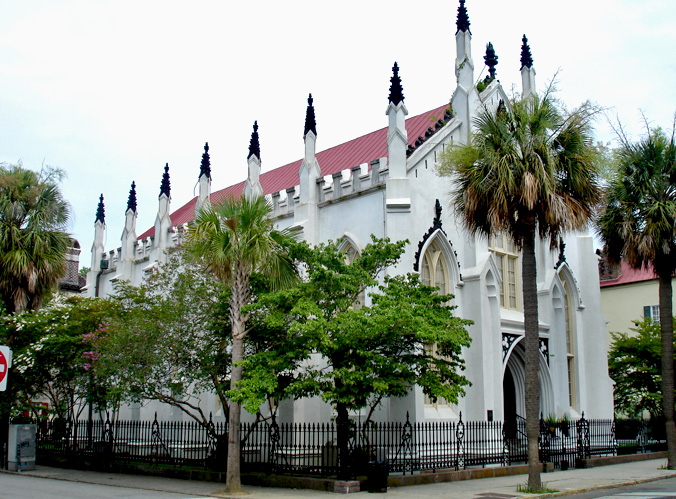
| significant_buildings | Huguenot Church |
| Robert William Roper House | |
| Market Hall | |
| St. Philip's Episcopal Church (steeple only) | |
Robert William Roper House Market Hall St. Philip's Episcopal Church (steeple only)
St. Matthew's German Evangelical Lutheran Church (original sanctuary)
Edward Brickell White (January 29, 1806 – May 10, 1882), also known as E. B. White, was an architect in the United States. He was known for his Gothic Revival architecture and his use of Roman and Greek designs.
Life
Edward Brickell White was born on January 29, 1806, on the Chapel Hill Plantation of St. John's Berkeley Parish, South Carolina. His father was the planter and artist, John Blake White, and his mother was Elizabeth Allston White.
In 1826, he graduated from the United States Military Academy, where he studied engineering. He served as a lieutenant in the U.S. Army artillery. On April 8, 1832, he married Delia Adams in New London, Connecticut. Following his resignation in August 1836, he surveyed for several railroads. Later that year he moved to Charleston, South Carolina, to practice architecture, engineering, and surveying.
His first major work was the Greek Revival Market Hall, which is a National Historic Landmark (NHL) in Charleston.
He was the architect of many churches including the Gothic Revival Huguenot Church (NHL) in Charleston; the Gothic Revival Trinity Episcopal Church in Columbia, which is on the National Register of Historic Places (NRHP); the wooden Gothic Revival Church of the Cross (NRHP) in Bluffton; and the steeple of St. Philip's Church (NHL) in Charleston. In 1842, he designed the sanctuary of St. Matthew's German Evangelical Lutheran Church in the Ansonborough section of the city. He was the architect for Grace Church Cathedral (Episcopal) at 98 Wentworth St., Charleston, SC, a Gothic Revival church built in 1847-1848. Likewise, he designed the Centenary Methodist Church at 60 Wentworth St., Charleston, SC in about 1842. In 1841, his design for St. Johannes Lutheran Church, 48 Hasell St., Charleston, SC was built.
The 21 ft granite Doric granite column for the Daniel Morgan Monument (NRHP) in Spartanburg, South Carolina, was one of his projects. He designed the Charleston High School, which is currently a private residence, and the Grace Episcopal Church that are contributing properties to the Charleston Historic District (NRHP). He designed a portico with columns and wings for the main building and Gate Lodge of the College of Charleston (NHL). He designed an expansion of a building at South Carolina Military College.
He was the superintending architect for the new Custom House in Charleston, which was designed by Ammi Burnham Young. Construction was halted in 1859 when the US Congress did not appropriate funding to cover cost overruns. A less ambitious design was completed in 1879.
During the Civil War, he joined the Confederate Army, and served at James Island and North Carolina. He rose to the rank of lieutenant colonel, commanding the 3rd South Carolina Artillery.
After the war, E.B. White supervised repairs of St. Michael's Episcopal Church in Charleston. He designed a building for Charleston Gas & Light Co.
In 1879, White moved to New York and died on May 10, 1882. He was interred in St. Michael's Episcopal Churchyard in Charleston.
Work
- High School of Charleston (1841)
- Old St. Matthew's German Evangelical Lutheran Church (1842)
- Centenary Methodist Church (Charleston, South Carolina) (1842)
- Market Hall and Sheds (1840s)
- Huguenot Church (1844)
- Trinity Episcopal Cathedral (Columbia, South Carolina) (1847)
- Grace Church Cathedral (1848)
- Church of the Cross (1857)
- St. Andrew's Church (Mount Pleasant, South Carolina) (1857)
References
References
- Edgar, Walter. (1998). "South Carolina: A History". University of South Carolina Press.
- (1973). "Market Hall and Sheds". [[National Park Service]].
- (1973). "Huguenot Church". [[National Park Service]].
- (24 February 1971). "Trinity Episcopal Church". [[National Park Service]].
- (1974). "Church of the Cross". [[National Park Service]].
- (1973). "St. Philip's Episcopal Church". [[National Park Service]].
- (1980). "Daniel Morgan Monument". [[National Park Service]].
- (1970). "Charleston Historic District". [[National Park Service]].
- (1971). "College of Charleston Complex: Main Building, Library and Gate Lodge". [[National Park Service]].
- (1974). "U.S. Customhouse". [[National Park Service]].
- Among the residences that he designed is the William Gatewood House at 21 Legare Street which was described as "recently built" is a real estate listing in February 1863.. Charleston Courier. (February 17, 1863)
- "Property File - 60 Wentworth Street (Centenary Methodist Church) | Historic Charleston Foundation".
This article was imported from Wikipedia and is available under the Creative Commons Attribution-ShareAlike 4.0 License. Content has been adapted to SurfDoc format. Original contributors can be found on the article history page.
Ask Mako anything about Edward Brickell White — get instant answers, deeper analysis, and related topics.
Research with MakoFree with your Surf account
Create a free account to save articles, ask Mako questions, and organize your research.
Sign up freeThis content may have been generated or modified by AI. CloudSurf Software LLC is not responsible for the accuracy, completeness, or reliability of AI-generated content. Always verify important information from primary sources.
Report