From Surf Wiki (app.surf) — the open knowledge base
Edmontosaurus regalis
Extinct species of dinosaur

Extinct species of dinosaur
- Thespesius edmontoni Gilmore, 1924
- Anatosaurus edmontoni (Gilmore, 1924) Lull & Wright, 1942
- Edmontosaurus edmontoni (Gilmore, 1924) Russell and Chamney, 1967
- Thespesius edmontonensis Gilmore, 1924 emend Olshevsky, 1991
Edmontosaurus regalis is a species of comb-crested hadrosaurid dinosaur. Fossils of E. regalis have been found in rocks of western North America that date from the late Campanian age of the Cretaceous Period 73 million years ago, but it may have possibly lived into the early Maastrichtian.
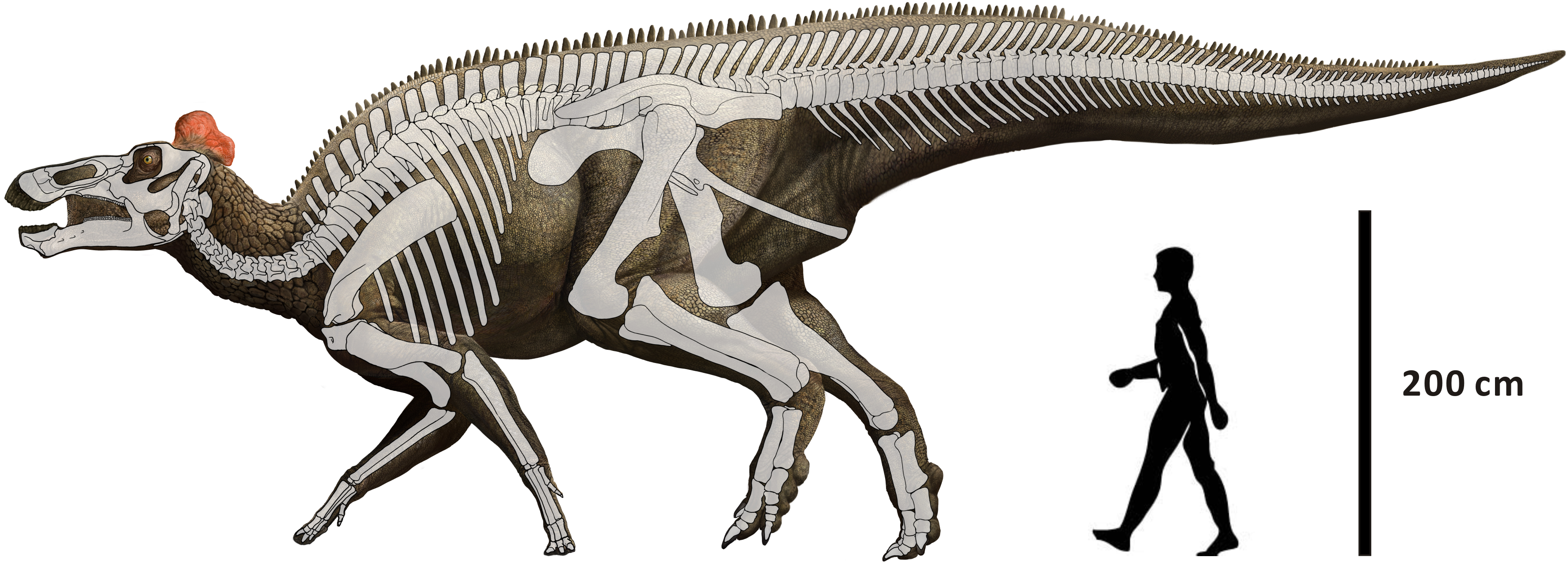
E. regalis was one of the largest hadrosaurids, measuring up to 12 m long and weighing around 4.0 MT. It is classified as a genus of saurolophine (or hadrosaurine) hadrosaurid, a member of the group of hadrosaurids that lacked large, hollow crests, and instead had smaller, solid crests or fleshy combs. The distribution of E. regalis fossils suggests that it preferred coasts and coastal plains. It was a herbivore that could move on both two legs and four. Because it is known from several bone beds, E. regalis is thought to have lived in large groups. The wealth of fossils has allowed researchers to study its paleobiology in detail, including its brain, how it may have fed, and its injuries and pathologies.
Description
Edmontosaurus regalis is known from several fossil specimens. E. regalis was among the largest of hadrosaurids, as a fully grown adult could have been 9 m long. Some of the larger specimens reached the range of 12 m to 13 m long. Its weight was on the order of 4.0 MT. The type specimen of E. regalis, NMC 2288, is estimated as 9 to long. A 2022 study proposed that E. regalis may have been heavier than its generic relative, E. annectens, but not enough samples exist to provide a valid estimate and examination on its osteohistology and growth, so the results for E. regalis aren't statistically significant.
The skull was roughly triangular in profile. One specimen preserved a soft tissue crest or wattle on top of its head. The beak was toothless, with both the upper and lower beaks being extended by keratinous material. They grew in columns, with an observed maximum of six in each and the number of columns varied based on the animal's size. There were 51 to 53 columns per maxilla and 48 to 49 per dentary (teeth of the upper jaw being slightly narrower than those in the lower jaw).

E. regalis had thirteen neck vertebrae, eighteen back vertebrae, nine hip vertebrae, and an unknown number of tail vertebrae. Each foot had three toes, with no big toe or little toe. The toes had keratinous hoof-like tips.
Discovery and history
thumb|right|Fossil skull ROM 801 The first known fossil remains that may belong to Edmontosaurus regalis were named Trachodon cavatus in 1871 by Edward Drinker Cope. The name is spelled in more recent sources as Trachodon avatus This species was assessed without comment as a synonym of Edmontosaurus regalis in two reviews, Later that same year, he described these bones under the name Hadrosaurus occidentalis. Sadly, the bones are now lost to history. was erroneously described by Glut (1997) as having been assigned to Edmontosaurus regalis by Lull and Wright. More recent reviews of hadrosaurids have concurred.
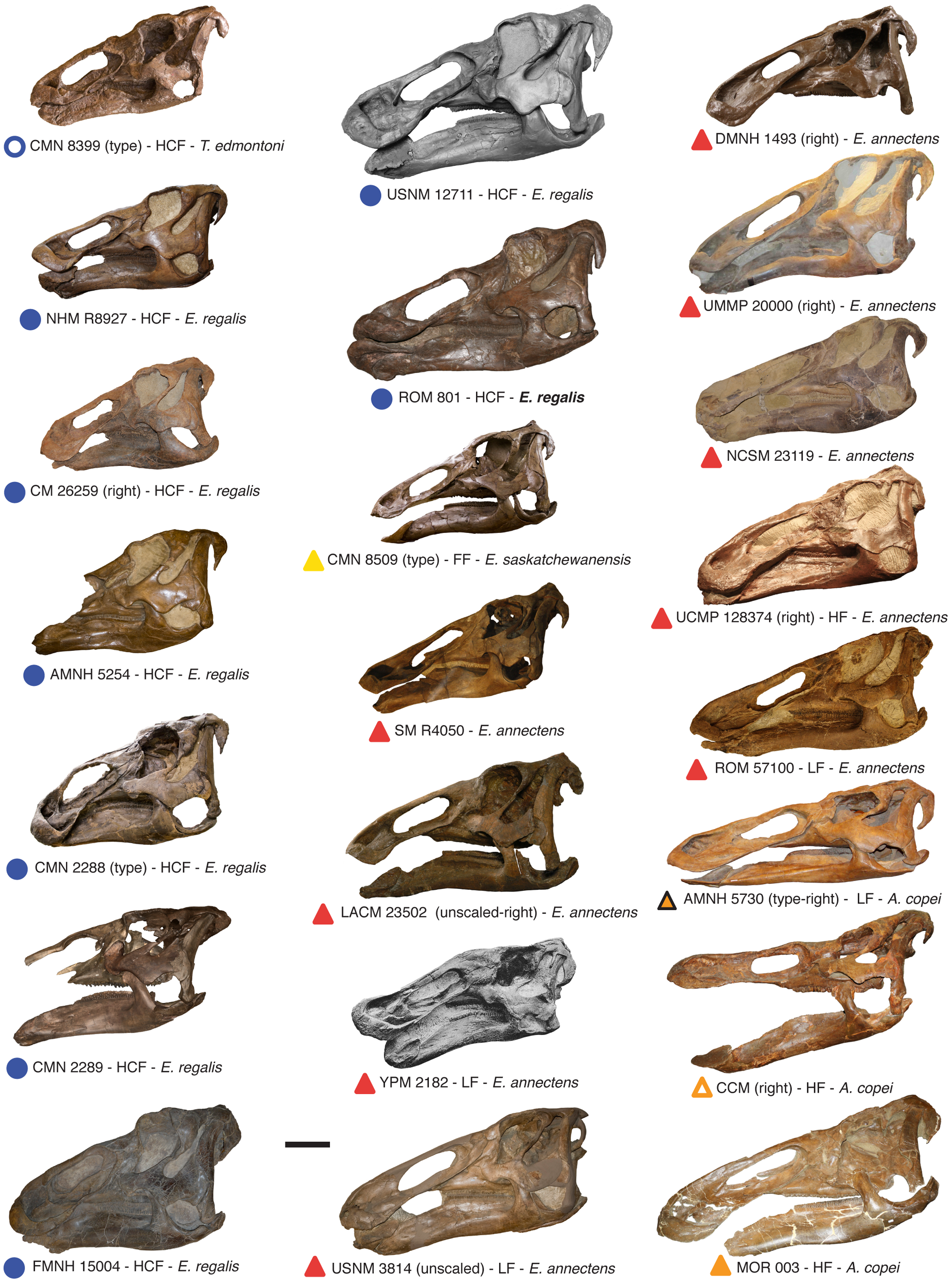
The type specimen of E. regalis is NMC 2288, which consists of a skull, articulated vertebrae up to the sixth tail vertebra, ribs, partial hips, an upper arm bone, and most of a hind limb. It was discovered in 1912 by Levi Sternberg. The second specimen, paratype NMC 2289, consists of a skull and skeleton lacking the beak, most of the tail, and part of the feet. It was discovered in 1916 by George F. Sternberg. Both skeletons were found in the Horseshoe Canyon Formation (formerly the lower Edmonton Formation) along the Red Deer River of southern Alberta. Thus, the Edmonton Formation lent Edmontosaurus its name. The name Edmontosaurus regalis (meaning "regal," or, more loosely, "king-sized"), was coined in 1917 by Lawrence Lambe. Lambe found that his new dinosaur compared best to specimens of "Diclonius mirabilis" (now assigned to Edmontosaurus annectens) and drew attention to the size and robustness of Edmontosaurus regalis. Initially, Lambe only described the skulls of the two skeletons, but returned to the genus in 1920 to describe the skeleton of NMC 2289. The postcrania of the type specimen remains undescribed, still in its plaster jackets.

Two more species that would come to be included with Edmontosaurus regalis were named from Canadian remains in the 1920s, but both would initially be assigned to the dubious genus Thespesius. Gilmore named the first, Thespesius edmontoni, in 1924. T. edmontoni also came from the Horseshoe Canyon Formation. It was based on NMC 8399, another nearly complete skeleton lacking most of the tail. NMC 8399 was discovered on the Red Deer River in 1912 by a Sternberg party. but he changed his mind. The specimen became the first dinosaur skeleton to be mounted for exhibition in a Canadian museum. Gilmore found that his new species compared closely to what he called Thespesius annectens, but left the two apart because of details of the arms and hands. He also noted that his species had more vertebrae than Marsh's in the back and neck, but proposed that Marsh was mistaken in assuming that the annectens specimens were complete in those regions.
In 1926, Charles Mortram Sternberg named Thespesius saskatchewanensis for NMC 8509, which is a skull and partial skeleton from the Wood Mountain plateau of southern Saskatchewan. He had collected this specimen in 1921 from rocks that were assigned to the Lance Formation, now the Frenchman Formation. NMC 8509 included an almost complete skull, numerous vertebrae, partial shoulder and hip girdles, and partial legs. This represented the first substantial dinosaur specimen recovered from Saskatchewan. Sternberg opted to assign it to Thespesius because that was the only hadrosaurid genus known from the Lance Formation at the time. T. saskatchewanensis was unusual because of its small size, estimated at 7 to in length.
Classification
The cladogram below follows an analysis from Godefroit et al. (2012).
Paleobiology

In a 2011 study, Campione and Evans recorded data from all known edmontosaur skulls and used it to plot a morphometric graph, comparing variable features of the skull with skull size. Their results showed that within Edmontosaurus regalis, many features previously used to classify additional species were directly correlated with skull size. Campione and Evans interpreted these results as strongly suggesting that the shape of E. regalis skulls changed dramatically as they grew. This has led to several apparent mistakes in past classification. The Campanian species Thespesius edmontoni, previously considered a synonym of E. annectens because of its small size and skull shape, is more likely a subadult specimen of E. regalis. In a 2014 study, researchers proposed that E. regalis reached maturity at 10-15 years of age. A preserved rhamphotheca present in specimen LACM 23502, housed in the Los Angeles County Museum, also indicates the beak of the related Edmontosaurus annectens was more hook-shaped and extensive than many illustrations in scientific and public media have previously depicted. Whether this was true of E. regalis as well is still unknown as of this time.
Extensive bone beds are known for Edmontosaurus regalis and such groupings of hadrosaurids are used to suggest that they were gregarious, living in herds.
Paleoecology

The Edmontonian land vertebrate age is defined by the first appearance of Edmontosaurus regalis in the fossil record. Although sometimes reported as of exclusively the early Maastrichtian age, the Horseshoe Canyon Formation was of somewhat longer duration. Deposition began approximately 73 million years ago, in the late Campanian, and ended between 68.0 and 67.6 million years ago. Edmontosaurus regalis is known from the lowest of five units within the Horseshoe Canyon Formation, but is absent from at least the second to the top.
Because of its wide distribution, which covers a distance from Alaska to Colorado and includes polar settings that would have had little light during a significant part of the year, Edmontosaurus regalis has been considered possibly migratory. A 2008 review of dinosaur migration studies by Phil R. Bell and Eric Snively proposed that E. regalis was capable of an annual 2600 km round-trip journey, provided it had the requisite metabolism and fat deposition rates. Such a trip would have required walking speeds of about 2 to and could have brought it from Alaska to Alberta. The possible migratory nature of E. regalis contrasts with many other dinosaurs, such as theropods, sauropods, and ankylosaurians, which Bell and Snively found were more likely to have overwintered. In contrast to Bell and Snively, Anusuya Chinsamy and colleagues concluded from a study of bone microstructure that polar edmontosaurs overwintered.
Contemporary fauna

As many as three quarters of the dinosaur specimens from the badlands near Drumheller may pertain to Edmontosaurus regalis. The Horseshoe Canyon Formation is interpreted as having a significant marine influence, due to the encroaching Western Interior Seaway. This shallow sea stretched from the Gulf of Mexico to the Arctic Ocean, covering the midsection of North America through much of the Cretaceous. E. regalis shared this setting with fellow hadrosaurids Hypacrosaurus and Saurolophus, the parksosaurid Parksosaurus, the ceratopsids Montanoceratops, Anchiceratops, Arrhinoceratops, and Pachyrhinosaurus, the pachycephalosaurid Stegoceras, the ankylosaurid Euoplocephalus, the nodosaurid Edmontonia, the ornithomimids Ornithomimus and Struthiomimus, a variety of poorly known small theropods that included troodontids and dromaeosaurids, and the tyrannosaurid Albertosaurus.
Edmontosaurus is found in coastal, near-marine settings, while Hypacrosaurus and Saurolophus are found in more continental lowlands. Edmontosaurus and Saurolophus are not usually found together. The typical edmontosaur habitat of this formation has been described as the back regions of bald cypress swamps and peat bogs on delta coasts. Pachyrhinosaurus also preferred this habitat to the floodplains dominated by Hypacrosaurus, Saurolophus, Anchiceratops, and Arrhinoceratops.
References
References
- (2020). "A taphonomic analysis of a multitaxic bonebed from the St. Mary River Formation (uppermost Campanian to lowermost Maastrichtian) of Alberta, dominated by cf. ''Edmontosaurus regalis'' (Ornithischia: Hadrosauridae), with significant remains of ''Pachyrhinosaurus canadensis'' (Ornithischia: Ceratopsidae)". Canadian Journal of Earth Sciences.
- Lambe, Lawrence M.. (1920). "The hadrosaur ''Edmontosaurus'' from the Upper Cretaceous of Alberta". Department of Mines, Geological Survey of Canada.
- Gilmore, Charles W.. (1924). "A new species of hadrosaurian dinosaur from the Edmonton Formation (Cretaceous) of Alberta". Department of Mines, Geological Survey of Canada.
- Sternberg, Charles M.. (1926). "A new species of ''Thespesius'' from the Lance Formation of Saskatchewan". Department of Mines, Geological Survey of Canada.
- Lull, Richard Swann. (1942). "Hadrosaurian Dinosaurs of North America". Geological Society of America.
- Glut, Donald F.. (1997). "Dinosaurs: The Encyclopedia". McFarland & Co.
- Lambert, David. (1990). "The Dinosaur Data Book". Avon Books.
- Horner, John R.. (2004). "The Dinosauria". University of California Press.
- Lull, Richard Swann; and Wright, Nelda E. (1942). ''Hadrosaurian Dinosaurs of North America''. p. 225.
- (2022). "Osteohistological and taphonomic life-history assessment of ''Edmontosaurus annectens'' (Ornithischia: Hadrosauridae) from the Late Cretaceous (Maastrichtian) Ruth Mason dinosaur quarry, South Dakota, United States, with implication for ontogenetic segregation between juvenile and adult hadrosaurids". Journal of Anatomy.
- Lull, Richard Swann; and Wright, Nelda E. (1942). ''Hadrosaurian Dinosaurs of North America''. pp. 151–164.
- (2013). "A Mummified Duck-Billed Dinosaur with a Soft-Tissue Cock's Comb". Current Biology.
- Stanton Thomas, Kathryn J.. (2004). "Microscale δ18O and δ13C isotopic analysis of an ontogenetic series of the hadrosaurid dinosaur ''Edmontosaurus'': implications for physiology and ecology". Palaeogeography, Palaeoclimatology, Palaeoecology.
- Erickson, Gregory M.. (2012). "Complex dental structure and wear biomechanics in hadrosaurid dinosaurs". Science.
- The front legs were shorter and less heavily built than the back legs. Each hand had four fingers, but no thumb (first finger). The second, third, and fourth fingers were approximately the same length and unified in life within a fleshy covering. Although the second and third finger had hoof-like claws, these bones were also within the skin and not apparent from the outside. The little finger was separate from the other three and was much shorter.Lull, Richard Swann; and Wright, Nelda E. (1942). ''Hadrosaurian Dinosaurs of North America''. pp. 98–110.
- Cope, Edward Drinker. (1871). "Supplement to the synopsis of the extinct Batrachia and Reptilia of North America". Proceedings of the American Philosophical Society.
- Weishampel, David B.. (1990). "The Dinosauria". University of California Press.
- Carpenter, Kenneth. (2002). "Late Cretaceous dinosaurs from the Denver Basin, Colorado". Rocky Mountain Geology.
- Lambe, Lawrence M.. (1902). "On Vertebrata of the mid-Cretaceous of the Northwest Territory. 2. New genera and species from the Belly River Series (mid-Cretaceous)". Contributions to Canadian Paleontology.
- Lambe, Lawrence M.. (1917). "A new genus and species of crestless hadrosaur from the Edmonton Formation of Alberta". The Ottawa Naturalist.
- Creisler, Benjamin S.. (2007). "Horns and Beaks: Ceratopsian and Ornithopod Dinosaurs". Indiana University Press.
- Lambe, Lawrence M.. (1913). "The manus in a specimen of ''Trachodon'' from the Edmonton Formation of Alberta". The Ottawa Naturalist.
- Lambe, Lawrence M.. (1914). "On the fore-limb of a carnivorous dinosaur from the Belly River Formation of Alberta, and a new genus of Ceratopsia from the same horizon, with remarks on the integument of some Cretaceous herbivorous dinosaurs". The Ottawa Naturalist.
- (2012). ""Joger, Ulrich, ed. "A New Saurolophine Dinosaur from the Latest Cretaceous of Far Eastern Russia". PLOS ONE.
- (2011). "Cranial Growth and Variation in Edmontosaurs (Dinosauria: Hadrosauridae): Implications for Latest Cretaceous Megaherbivore Diversity in North America". PLOS ONE.
- (2014). "Histologic growth dynamic study of ''Edmontosaurus regalis'' (Dinosauria: Hadrosauridae) from a bonebed assemblage of the Upper Cretaceous Horseshoe Canyon Formation, Edmonton, Alberta, Canada". Canadian Journal of Earth Sciences.
- "Enough with the "Duck-Billed Dinosaurs"".
- "Shovel-Beaked, Not Duck-Billed".
- Sullivan, Robert M.. (2006). "Late Cretaceous Vertebrates from the Western Interior". New Mexico Museum of Natural History.
- Weishampel, David B.. (2004). "The Dinosauria". University of California Press.
- Wu, X-C.. (2007). "A new ceratopsid dinosaur (Ornithischia) from the uppermost Horseshoe Canyon Formation (upper Maastrichtian), Alberta, Canada". Canadian Journal of Earth Sciences.
- Eberth, David A.. (2002). "Review and comparison of Belly River Group and Edmonton Group stratigraphy and stratigraphic architecture in the southern Alberta Plains". Canadian Society of Petroleum Geology Diamond Jubilee Convention, Programs and Abstracts.
- Bell, Phil R.. (2008). "Polar dinosaurs on parade: a review of dinosaur migration". Alcheringa.
- Lloyd, Robin. (2008-12-04). "Polar Dinosaurs Endured Cold Dark Winters". Imaginova.
- (2012). "Hadrosaurs were perennial polar residents". The Anatomical Record.
- Russell, Dale A.. (1989). "An Odyssey in Time: Dinosaurs of North America". NorthWord Press, Inc..
- Dodson, Peter. (1996). "The Horned Dinosaurs: A Natural History". Princeton University Press.
- Russell, Dale A.. (1967). "Notes on the biostratigraphy of dinosaurian and microfossil faunas in the Edmonton Formation (Cretaceous), Alberta". National Museum of Canada Natural History Papers.
- (2007-07-03). "City Site Was Dinosaur Dining Room". ScienceDaily.
- Lehman, Thomas M.. (2001). "Mesozoic Vertebrate Life". Indiana University Press.
This article was imported from Wikipedia and is available under the Creative Commons Attribution-ShareAlike 4.0 License. Content has been adapted to SurfDoc format. Original contributors can be found on the article history page.
Ask Mako anything about Edmontosaurus regalis — get instant answers, deeper analysis, and related topics.
Research with MakoFree with your Surf account
Create a free account to save articles, ask Mako questions, and organize your research.
Sign up freeThis content may have been generated or modified by AI. CloudSurf Software LLC is not responsible for the accuracy, completeness, or reliability of AI-generated content. Always verify important information from primary sources.
Report