From Surf Wiki (app.surf) — the open knowledge base
Edicts of Ashoka
3rd-century BCE inscriptions in South Asia
3rd-century BCE inscriptions in South Asia
| Field | Value | |
|---|---|---|
| name | Edicts of Ashoka | |
| image | [[File:Ashoka Lauriya Areraj inscription.jpg | 250px]] |
| image_caption | A Major Pillar Edict of Ashoka, in Lauriya Araraj, Bihar, India | |
| material | Rocks, pillars, stone slabs | |
| created | 3rd century BCE | |
| location | Nepal, India, Pakistan, Afghanistan, Bangladesh | |
| map |
The Edicts of Ashoka are a collection of more than thirty inscriptions on the Pillars of Ashoka, as well as boulders and cave walls, attributed to Emperor Ashoka of the Maurya Empire who ruled most of the Indian subcontinent from 268 BCE to 232 BCE. These inscriptions were dispersed throughout the areas of modern-day India, Bangladesh, Nepal, Afghanistan and Pakistan, and provide the first tangible evidence of Buddhism. The Edicts are the earliest written and datable texts from India, and, since they were inscribed on stone, we have the added benefit of having them exactly as they were originally inscribed. Earlier texts, such as the Vedic texts, were all composed and handed down orally until later dates.
Ashoka used the expression Dhaṃma Lipi (Prakrit in the Brahmi script: 𑀥𑀁𑀫𑀮𑀺𑀧𑀺, "Inscriptions of the Dharma") to describe his own Edicts. The edicts describe in detail Ashoka's policy on dhamma, an earnest attempt to solve some of the problems that a complex society faced. According to the edicts, the extent of his promotion of dhamma during this period reached as far as the Greeks in the Mediterranean region. While the inscriptions mention the conversion of Ashoka to Buddhism, the dhamma that he promotes is largely ecumenical and non-sectarian in nature. As historian Romila Thapar relates: In his edicts Aśoka defines the main principles of dhamma as non-violence, tolerance of all sects and opinions, obedience to parents, respect to brahmins and other religious teachers and priests, liberality toward friends, humane treatment of servants and generosity towards all. It suggests a general ethic of behaviour to which no religious or social group could object. It also could act as a focus of loyalty to weld together the diverse strands that made up the empire. Interestingly, the Greek versions of these edicts translate dhamma as eusebeia (piety) and no mention is made anywhere of the teachings of the Buddha, as would be expected if Aśoka had been propagating Buddhism.’The inscriptions show his efforts to develop the dhamma throughout his empire. Although Buddhism as well as Gautama Buddha are mentioned, the edicts focus on social and moral precepts rather than specific religious practices or the philosophical dimension of Buddhism. These were located in public places and were meant for people to read.
In these inscriptions, Ashoka refers to himself as "Beloved of the Gods" (Devanampiya). The identification of Devanampiya with Ashoka was confirmed by an inscription discovered in 1915 by C. Beadon, a British gold-mining engineer, at Maski, a town in Madras Presidency (present day Raichur district, Karnataka). Another minor rock edict, found at the village Gujarra in Gwalior State (present day Datia district of Madhya Pradesh), also used the name of Ashoka together with his titles: Devanampiya Piyadasi Asokaraja. The inscriptions found in the central and eastern part of India were written in Magadhi Prakrit using the Brahmi script, while Prakrit using the Kharoshthi script, Greek and Aramaic were used in the northwest. These edicts were deciphered by British archaeologist and historian James Prinsep.
The inscriptions revolve around a few recurring themes: Ashoka's conversion to Buddhism, the description of his efforts to spread dhamma, his moral and religious precepts, and his social and animal welfare program. The edicts were based on Ashoka's ideas on administration and behavior of people towards one another and religion.
Decipherment
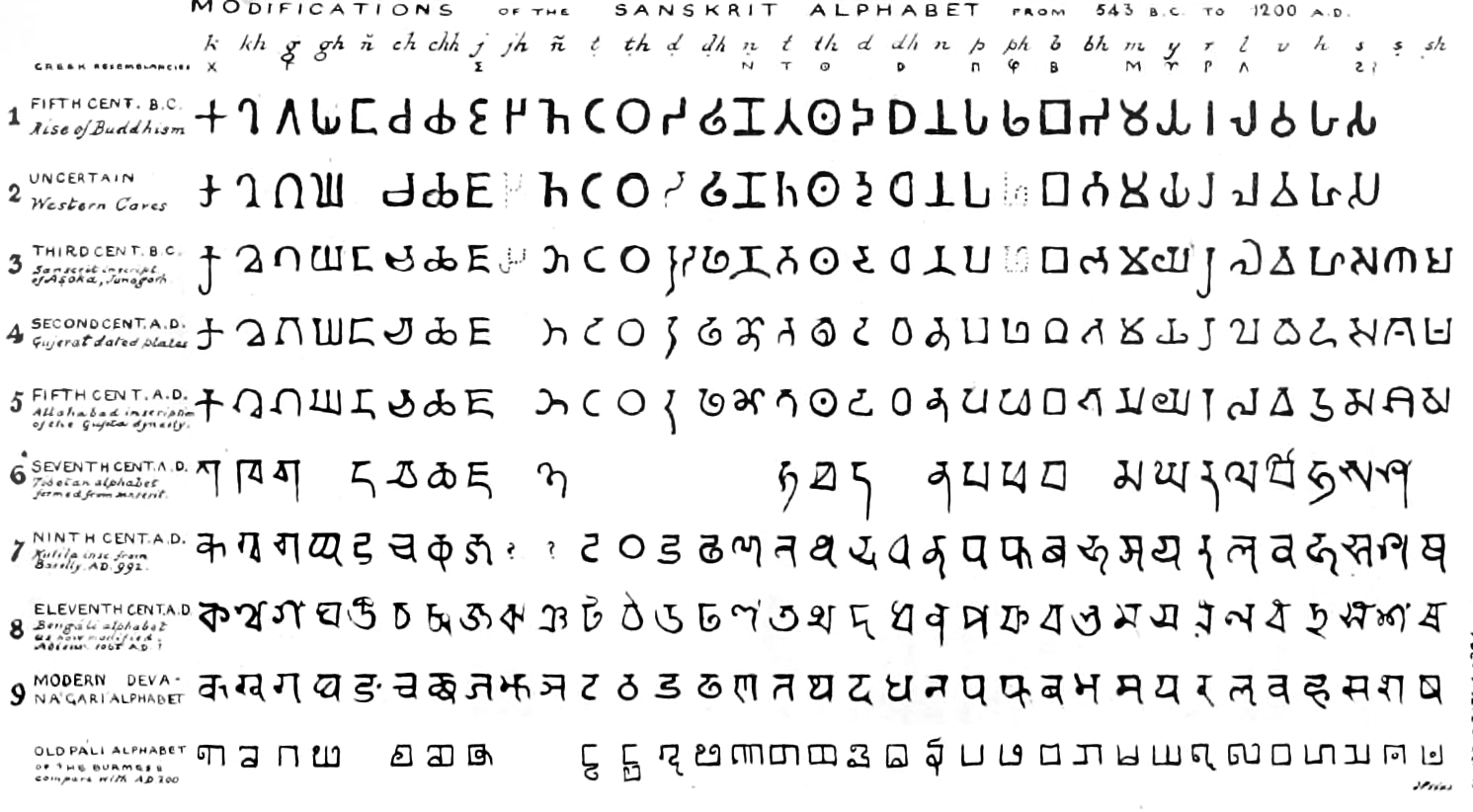
Besides a few inscriptions in Greek and Aramaic (which were discovered only in the 20th century), the Edicts were mostly written in the Brahmi script and sometimes in the Kharoshthi script in the northwest, two Indian scripts which had both become extinct around the 5th century CE, and were yet undeciphered at the time the Edicts were discovered and investigated in the 19th century.
The first successful attempts at deciphering the ancient Brahmi script were made in 1836 by Norwegian scholar Christian Lassen, who used the bilingual Greek-Brahmi coins of Indo-Greek king Agathocles to correctly and securely identify several Brahmi letters. The task was then completed by James Prinsep, an archaeologist, philologist, and official of the East India Company, who was able to identify the rest of the Brahmi characters, with the help of Major Cunningham. In a series of results that he published in March 1838 Prinsep was able to translate the inscriptions on a large number of rock edicts found around India, and to provide, according to Richard Salomon, a "virtually perfect" rendering of the full Brahmi alphabet. The edicts in Brahmi script mentioned a King Devanampriya Piyadasi which Prinsep initially assumed was a Sri Lankan king. He was then able to associate this title with Ashoka on the basis of Pali script from Sri Lanka communicated to him by George Turnour.
The Kharoshthi script, written from right to left, and associated with Aramaic, was also deciphered by James Prinsep in parallel with Christian Lassen, using the bilingual Greek-Kharoshthi coinage of the Indo-Greek and Indo-Scythian kings. "Within the incredibly brief space of three years (1834-37) the mystery of both the Kharoshthi and Brahmi scripts (were unlocked), the effect of which was instantly to remove the thick crust of oblivion which for many centuries had concealed the character and the language of the earliest epigraphs".
The Edicts
The Edicts are divided into four categories, according to their size (Minor or Major) and according to their medium (Rock or Pillar). Chronologically, the minor inscriptions tend to precede the larger ones, while rock inscriptions generally seem to have been started earlier than the pillar inscriptions:
- Minor Rock Edicts: Edicts inscribed at the beginning of Ashoka's reign; in Prakrit, Greek and Aramaic.
- Minor Pillar Edicts: Schism Edict, Queen's Edict, Rummindei Edict, Nigali Sagar Edict; in Prakrit.
- Major Rock Edicts: 14 Edicts (termed 1st to 14th) and 2 separate ones found in Odisha; in Prakrit and Greek.
- Major Pillar Edicts: 7 Edicts, inscribed at the end of Ashoka's reign; in Prakrit.
;General content The Minor Rock Edicts (in which Ashoka is sometimes named in person, as in Maski and Gujarra) as well as the Minor Pillar Edicts are very religious in their content: they mention extensively the Buddha (and even previous Buddhas as in the Nigali Sagar inscription), the Sangha, Buddhism and Buddhist scriptures (as in the Bairat Temple Edict).
On the contrary, the Major Rock Edicts and Major Pillar Edicts are essentially moral and political in nature: they never mention the Buddha or explicit Buddhist teachings, but are preoccupied with order, proper behavior and non violence under the general concept of "Dharma", and they also focus on the administration of the state and positive relations with foreign countries as far as the Hellenistic Mediterranean of the mid-3rd century BCE.
Minor Rock Edicts
Main article: Minor Rock Edicts
The Minor Rock Edicts of Ashoka (r.269-233 BCE) are rock inscriptions which form the earliest part of the Edicts of Ashoka. They predate Ashoka's Major Rock Edicts.
Chronologically, the first known edict, sometimes classified as a Minor Rock Edict, is the Kandahar Bilingual Rock Inscription, in Greek and in Aramaic, written in the 10th year of his reign (260 BCE) at the border of his empire with the Hellenistic world, in the city of Old Kandahar in modern Afghanistan.
Ashoka then made the first edicts in the Indian language, written in the Brahmi script, from the 11th year of his reign (according to his own inscription, "two and a half years after becoming a secular Buddhist", i.e. two and a half years at least after returning from the Kalinga conquest of the eighth year of his reign, which is the starting point for his remorse towards the horrors of the war, and his gradual conversion to Buddhism). The texts of the inscriptions are rather short, the technical quality of the engraving of the inscriptions is generally very poor, and generally very inferior to the pillar edicts dated to the years 26 and 27 of Ashoka's reign.
There are several slight variations in the content of these edicts, depending on location, but a common designation is usually used, with Minor Rock Edict N°1 (MRE1) and a Minor Rock Edict N°2 (MRE2, which does not appear alone but always in combination with Edict N°1), the different versions being generally aggregated in most translations. The Maski version of Minor Rock Edict No.1 is historically particularly important in that it confirmed the association of the title "Devanampriya" with the name "Asoka", thereby clarifying the historical author of all these inscriptions. In the Gujarra version of Minor Rock Edict No.1 also, the name of Ashoka is used together with his full title: Devanampiya Piyadasi Asokaraja.

There is also a unique Minor Rock Edict No.3, discovered next to Bairat Temple, for the Buddhist clergy, which gives a list of Buddhist scriptures (most of them unknown today) which the clergy should study regularly.
A few other inscriptions of Ashoka in Aramaic, which are not strictly edicts, but tend to share a similar content, are sometimes also categorized as "Minor Rock Edicts". The dedicatory inscriptions of the Barabar caves are also sometimes classified among the Minor Rock Edicts of Ashoka.
The Minor Rock Edicts can be found throughout the territory of Ashoka, including in the frontier area near the Hindu Kush, and are especially numerous in the southern, newly conquered, frontier areas of Karnataka and southern Andhra Pradesh.
Minor Pillar Edicts
Main article: Minor Pillar Edicts
The Minor Pillar Edicts of Ashoka refer to five separate minor Edicts inscribed on columns, the Pillars of Ashoka. These edicts are preceded chronologically by the Minor Rock Edicts and may have been made in parallel with the Major Rock Edicts.
The inscription technique is generally very poor compared for example to the later Major Pillar Edicts, however the Minor Pillar Edicts are often associated with some of the artistically most sophisticated pillar capitals of Ashoka, such as the Lion Capital of Ashoka, which crowned the Sarnath Minor Pillar Edict, or the very similar, but less well-preserved Sanchi lion capital, which crowned the very clumsily inscribed Schism Edict of Sanchi. This suggests that the most sophisticated capitals were actually the earliest in the sequence of Ashokan pillars and that style degraded over a short period of time.
These edicts were probably made at the beginning of the reign of Ashoka (reigned 268-232 BCE), from the year 12 of his reign, that is, from 256 BCE.
The Minor Pillar Edicts are the Schism Edict, warning of punishment for dissent in the Samgha, the Queen's Edict, and the Rummindei Edict as well as the Nigali Sagar Edict which record Ashoka's visits and Buddhist dedications in the area corresponding to today's Nepal. The Rummindei and Nigali Sagar edicts, inscribed on pillars erected by Ashoka later in his reign (19th and 20th year) display a high level of inscriptional technique with a good regularity in the lettering.
Major Rock Edicts
Main article: Major Rock Edicts
The Major Rock Edicts of Ashoka refer to 14 separate major Edicts, which are significantly detailed and extensive. These Edicts were concerned with practical instructions in running the empire such as the design of irrigation systems and descriptions of Ashoka's beliefs in peaceful moral behavior. They contain little personal detail about his life. These edicts are preceded chronologically by the Minor Rock Edicts.
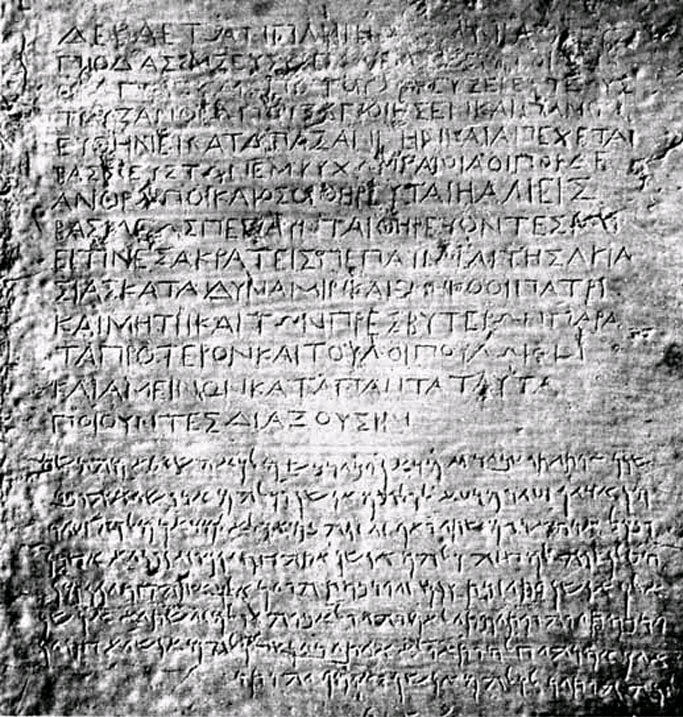
Three languages were used, Prakrit, Greek and Aramaic. The edicts are composed in non-standardized and archaic forms of Prakrit. Prakrit inscriptions were written in Brahmi and Kharosthi scripts, which even a commoner could read and understand. The inscriptions found in the area of Pakistan are in the Kharoshthi script. Other Edicts are written in Greek or Aramaic. The Kandahar Greek Edict of Ashoka (including portions of Edict No.13 and No.14) is in Greek only, and originally probably contained all the Major Rock Edicts 1-14.
The Major Rock Edicts of Ashoka are inscribed on large rocks, except for the Kandahar version in Greek (Kandahar Greek Edict of Ashoka), written on a stone plaque belonging to a building. The Major Edicts are not located in the heartland of Mauryan territory, traditionally centered on Bihar, but on the frontiers of the territory controlled by Ashoka.
Major Pillar Edicts
Main article: Major Pillar Edicts
The Major Pillar Edicts of Ashoka refer to seven separate major Edicts inscribed on columns, the Pillars of Ashoka, which are significantly detailed and extensive.
These edicts are preceded chronologically by the Minor Rock Edicts and the Major Rock Edicts, and constitute the most technically elegant of the inscriptions made by Ashoka. They were made at the end of his reign, from the years 26 and 27 of his reign, that is, from 237 to 236 BCE. Chronologically they follow the fall of Seleucid power in Central Asia and the related rise of the Parthian Empire and the independent Greco-Bactrian Kingdom circa 250 BCE. Hellenistic rulers are not mentioned anymore in these last edicts, as they only appear in Major Rock Edict No.13 (and to a lesser extent Major Rock Edict No.2), which can be dated to about the 14th year of the reign of Ashoka circa 256–255. The last Major Pillar Edicts (Edict No.7) is testamental in nature, making a summary of the accomplishments of Ashoka during his life.
The Major Pillar Edicts of Ashoka were exclusively inscribed on the Pillars of Ashoka or fragments thereof, at Kausambi (now Allahabad Pillar), Topra Kalan, Meerut, Lauriya-Araraj, Lauria Nandangarh, Rampurva (Champaran), and fragments of these in Aramaic (Kandahar, Edict No.7 and Pul-i-Darunteh, Edict No.5 or No.7 in Afghanistan) However several pillars, such as the bull pillar of Rampurva, or the pillar of Vaishali do not have inscriptions, which, together with their lack of proper foundation stones and their particular style, led some authors to suggest that they were in fact pre-Ashokan.
The Major Pillar Edicts (excluding the two fragments of translations found in modern Afghanistan) are all located in Central India.
The Pillars of Ashoka are stylistically very close to an important Buddhist monument, also built by Ashoka in Bodh Gaya, at the location where the Buddha had reached enlightenment some 200 years earlier: the Diamond Throne. The sculpted decorations on the Diamond Throne clearly echo the decorations found on the Pillars of Ashoka. The Pillars dated to the end of Ashoka's reign are associated with pillar capitals that tend to be more solemn and less elegant than the earlier capitals, such as those of Sanchi or Sarnath. This led some authors to suggest that the artistic level under Ashoka tended to fall towards the end of his reign.
Languages of the Edicts
Three languages were used: Ashokan Prakrit, Greek (the language of the neighbouring Greco-Bactrian Kingdom and the Greek communities in Ashoka's realm) and Aramaic (an official language of the former Achaemenid Empire). The Prakrit displayed local variations, from early Gandhari language in the northwest, to Old Ardhamagadhi in the east, where it was the "chancery language" of the court. The language level of the Prakrit inscriptions tends to be rather informal or colloquial.
Four scripts were used. Prakrit inscriptions were written in the Brahmi and Kharosthi scripts, the latter for the area of modern Pakistan. The Greek and Aramaic inscriptions used their respective scripts, in the northwestern areas of Ashoka's territory, in modern Pakistan and Afghanistan.
While most Edicts were in Ashokan Prakrit, a few were written in Greek or Aramaic. The Kandahar Rock Inscription is bilingual Greek-Aramaic. The Kandahar Greek Edict of Ashoka is in Greek only, and originally probably contained all the Major Rock Edicts 1-14. The Greek language used in the inscription is of a very high level and displays philosophical refinement. It also displays an in-depth understanding of the political language of the Hellenic world in the 3rd century BCE. This suggests a highly cultured Greek presence in Kandahar at that time.
By contrast, in the rock edicts engraved in southern India in the newly conquered territories of Karnataka and Andhra Pradesh, Ashoka only used the Prakrit of the North as the language of communication, with the Brahmi script, and not the local Dravidian idiom, which can be interpreted as a kind of authoritarianism in respect to the southern territories.
Ashoka's edicts were the first written inscriptions in India after the ancient city of Harrapa fell to ruin.{{cite web
Content of the Edicts
The Dharma preached by Ashoka is explained mainly in term of moral precepts, based on the doing of good deeds, respect for others, generosity and purity. The expressions used by Ashoka to express the Dharma, were the Prakrit word Dhaṃma, the Greek word Eusebeia (in the Kandahar Bilingual Rock Inscription and the Kandahar Greek Edict of Ashoka), and the Aramaic word Qsyt ("Truth") (in the Kandahar Bilingual Rock Inscription).
Empire boundaries
The initial translation of this Edict by James Prinsep differs from that of E. Hultzsch. His translation is as follows:
Moral precepts
; Right behaviour
; Benevolence Ashoka's Dharma meant that he used his power to try to make life better for his people and he also tried to change the way people thought and lived. He also thought that dharma meant doing the right thing.
; Kindness to prisoners Ashoka showed great concern for fairness in the exercise of justice, caution and tolerance in the application of sentences, and regularly pardoned prisoners.
; Respect for animal life
The Mauryan Empire was the first Indian empire to unify most of the country and it had a clear-cut policy of exploiting as well as protecting natural resources with specific officials tasked with protection duty. When Ashoka embraced Buddhism in the latter part of his reign, he brought about significant changes in his style of governance, which included providing protection to fauna, and even relinquished the imperial hunt. He was perhaps the first ruler in history to advocate conservation measures for wildlife. Reference to these can be seen inscribed on the stone edicts.
And there are also some festival meetings which are considered meritorious by King Devanampriya Priyadarsin. Formerly in the kitchen of King Devanampriya Priyadarsin many hundred thousands of animals were killed daily for the sake of curry. But now, when this rescript on morality is caused to be written, then only three animals are being killed (daily), (viz.) two peacocks (and) one deer, but even this deer not regularly. But even these three animals shall not be killed (in future). (Major Rock Edict No.1)}}
(Major Pillar Edict No.5)}}
Ashoka advocated restraint in the number that had to be killed for consumption, protected some of them, and in general condemned violent acts against animals, such as castration.
However, the edicts of Ashoka reflect more the desire of rulers than actual events; the mention of a 100 'panas' (coins) fine for poaching deer in imperial hunting preserves shows that rule-breakers did exist. The legal restrictions conflicted with the practices then freely exercised by the common people in hunting, felling, fishing and setting fires in forests.
Religious precepts

;Buddhism Explicit mentions of Buddhism or the Buddha only appear in the Minor Rock Edicts and the Minor Pillar Edicts.
Ashoka also expressed his devotion for the Buddhas of the past, such as the Koṇāgamana Buddha, for whom he enlarged a stupa in the 14th year of his reign, and made a dedication and set up a pillar during a visit in person in the 20th year of his reign, as described in his Minor Pillar Edict of Nigali Sagar, in modern Nepal.
;Belief in a next world
; Religious exchange
Far from being sectarian, Ashoka, based on a belief that all religions shared a common, positive essence, encouraged tolerance and understanding of other religions.
Social and animal welfare
According to the edicts, Ashoka took great care of the welfare of his subjects (human and animal), and those beyond his borders, spreading the use of medicinal treatments, improving roadside facilities for more comfortable travel, and establishing "officers of the faith" throughout his territories to survey the welfare of the population and the propagation of the Dharma. The Greek king Antiochos ("the Yona king named Antiyoga" in the text of the Edicts) is also named as a recipient of Ashoka's generosity, together with the other kings neighbouring him.
; Medicinal treatments
; Roadside facilities
; Officers of the faith
; Birthplace of the historical Buddha Main article: Lumbini pillar inscription
In a particularly famous Edict, the Rummindei Edict in Lumbini, Nepal, Ashoka describes his visit in the 21st year of his reign, and mentions Lumbini as the birthplace of the Buddha. He also, for the first time in historical records, uses the epithet "Sakyamuni" (Sage of the Shakyas), to describe the historical Buddha.
| Translation | ||
|---|---|---|
| (English) | Transliteration | |
| (original Brahmi script) | Inscription | |
| (Prakrit in the Brahmi script) | ||
| Adapted from transliteration by E. Hultzsch.}} |
Ashoka's proselytism according to the Edicts
In order to propagate welfare, Ashoka explains that he sent emissaries and medicinal plants to the Hellenistic kings as far as the Mediterranean, and to people throughout India, claiming that Dharma had been achieved in all their territories as well. He names the Greek rulers of the time, inheritors of the conquest of Alexander the Great, from Bactria to as far as Greece and North Africa, as recipients of the Dharma, displaying a clear grasp of the political situation at the time.
Proselytism beyond India
|Extract from Major Rock Edict No.13.}}
The distance of 600 yojanas ( 2,000 km) corresponds roughly to the distance between the center of India and Greece.
In the Gandhari original Antiochos is referred to as Amtiyoge nama Yona-raja (lit. "The Greek king by the name of Antiokos"), beyond whom live the four other kings: param ca tena Atiyogena cature 4 rajani Tulamaye nama Amtekine nama Makā nama Alikasudaro nama (lit. "And beyond Antiochus, four kings by the name of Ptolemy, the name of Antigonos, the name of Magas, the name Alexander".
- Amtiyaka (𑀅𑀁𑀢𑀺𑀬𑀓) or Amtiyoga (𑀅𑀁𑀢𑀺[[File:Brahmi yo 2nd century CE.jpg|10px]]𑀕), refers to Antiochus II Theos (261–246 BCE), King of the Seleucid Empire from Syria to Bactria in the east from 305 to 250 BCE, and was therefore a direct neighbor of Ashoka.
- Tulamāya (𑀢𑀼𑀮𑀫𑀬) refers to Ptolemy II Philadelphos of Egypt (285–247 BCE), king of the dynasty founded by Ptolemy I, a former general of Alexander the Great, in Egypt.
- Amtekina (𑀅𑀁𑀢𑁂𑀓𑀺𑀦) refers to Antigonus II Gonatas of Macedonia (278–239 BCE).
- Makā (𑀫𑀓𑀸) refers to Magas of Cyrene (300–258 BCE).
- Alikyaṣadala (𑀅𑀁𑀮𑀺[[File:Brahmi Kya.jpg|10px]]𑀱𑀤𑀮) refers to Alexander II of Epirus (272–258 BCE).
All the kings mentioned in Ashoka's Major Rock Edict No.13 are famous Hellenistic rulers, contemporary of Ashoka:
File:AntiochusIIMET.jpg|Seleucid king Antiochus II Theos of Syria (261–246 BCE). Ptolemy II Philadelphos and Arsinoe II.jpg|Ptolemy II Philadelphos of Egypt (285–247 BCE) with his sister Arsinoe II. File:Antigonus_Gonatas_British_Museum.jpg|Antigonus II Gonatas of Macedon (278–239 BCE). File:King Magas of Cyrene.jpg|Magas of Cyrene (300–258 BCE). Image:Arte ellenistica, alessandro d'epiro, agata, 260 ac. ca.JPG|Alexander II of Epirus (272–258 BCE) on a cameo of agate.
; Emissaries
It is not clear in Hellenic records whether these emissaries were actually received, or had any influence on the Hellenic world. But the existence of the edicts in a very high-level Greek literary and philosophical language testifies to the high sophistication of the Greek community of Kandahar, and to a true communication between Greek intellectuals and Indian thought. According to historian Louis Robert, it becomes quite likely that these Kandahar Greeks who were very familiar with Indian culture could in turn transmit Indian ideas to the philosophical circles of the Mediterranean world, in Seleucia, Antioch, Alexandria, Pella or Cyrene. He suggests that the famous Ashoka emissaries sent to the Western Hellenistic Courts according to Ashoka's Major Rock Edict No.13 were in fact Greek subjects and citizens of Kandahar, who had the full capacity to carry out these embassies.
Another document, the Mahavamsa (XII, 1st paragraph), also states that in the 17th year of his reign, at the end of the Third Buddhist Council, Ashoka sent Buddhist missionaries to eight parts of Southern Asia and the "country of the Yonas" (Greeks) to propagate Buddhism.
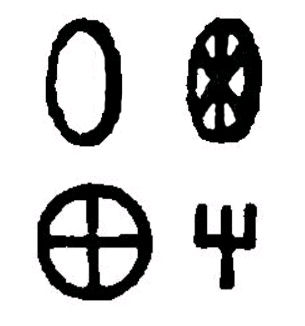
;Presence in the West Overall, the evidence for the presence of Buddhists in the west from that time is very meager. But some scholars point to the possible presence of Buddhist communities in the Hellenistic world, in particular in Alexandria. According to Ptolemy also, Indians were present in Alexandria, to whom he was much indebted for his knowledge of India (As.Res.III.53). Clement of Alexandria too mentioned the presence of Indians in Alexandria. A possible Buddhist gravestone from the Ptolemaic period has been found by Flinders Petrie, decorated with a depiction of what may be Dharmachakra and Trishula. According to the 11th century Muslim historian Al-Biruni, before the advent of Islam, Buddhists were present in Western Asia as far as the frontiers of Syria.
; Possible influences on Western thought
Colonial era scholars such as Rhys Davids have attributed Ashoka's claims of "Dharmic conquest" to mere vanity, and expressed disbelief that Greeks could have been in any way influenced by Indian thought.
But numerous authors have noted the parallels between Buddhism, Cyrenaicism and Epicureanism, which all strive for a state of ataraxia ("equanimity") away from the sorrows of life. The positions of philosophers such as Hegesias of Cyrene were close to Buddhism, his ideas recalling the Buddhist doctrine of suffering: he lived in the city of Cyrene where Magas ruled, the same Magas under whom the Dharma prospered according to Ashoka, and he may have been influenced by Ashoka's missionaries.
The religious communities of the Essenes of Palestine and the Therapeutae of Alexandria may also have been communities based on the model of Buddhist monasticism, following Ashoka's missions. According to semitologist André Dupont-Sommer, speaking about the consequences of Ashoka's proselytism: "It is India which would be, according to us, at the beginning of this vast monastic current which shone with a strong brightness during about three centuries in Judaism itself". This influence would even contribute, according to André Dupont-Sommer, to the emergence of Christianity: "Thus was prepared the ground on which Christianity, that sect of Jewish origin influenced by the Essenes, which was so quickly and so powerfully to conquer a very large part of the world."
Proselytism within Ashoka's territories
Inside India proper, in the empire of Ashoka, many different populations were the object of the emperor's proselytism. Greek communities also lived in the northwest of the Mauryan Empire, currently in Pakistan, notably ancient Gandhara, and in the region of Gedrosia, nowadays in Southern Afghanistan, following the conquest and the colonization efforts of Alexander the Great around 323 BCE. These communities therefore seem to have been still significant during the reign of Ashoka. The Kambojas are a people of Central Asian origin who had settled first in Arachosia and Drangiana (today's southern Afghanistan), and in some of the other areas in the northwestern Indian subcontinent in Sindh, Gujarat and Sauvira. The Nabhakas, the Nabhapamkits, the Bhojas, the Pitinikas, the Andhras and the Palidas were other people under Ashoka's rule:
Influences
Achaemenid inscriptional tradition
The inscriptions of Ashoka may show Achaemenid influences, including formulaic parallels with Achaemenid inscriptions, presence of Iranian loanwords (in Aramaic inscriptions), and the very act of engraving edicts on rocks and mountains (compare for example Behistun inscription). To describe his own Edicts, Ashoka used the word Lipī (𑀮𑀺𑀧𑀺), now generally simply translated as "writing" or "inscription". It is thought the word "lipi", which is also orthographed "dipi" (𐨡𐨁𐨤𐨁) in the two Kharosthi versions of the rock edicts, comes from an Old Persian prototype dipî (𐎮𐎡𐎱𐎡) also meaning "inscription", which is used for example by Darius I in his Behistun inscription, suggesting borrowing and diffusion. There are other borrowings of Old Persian terms for writing-related words in the Edicts of Ahoka, such as nipista or nipesita (𐨣𐨁𐨤𐨁𐨯𐨿𐨟, "written" and "made to be written") in the Kharoshthi version of Major Rock Edict No.4, which can be related to the word nipištā (𐎴𐎡𐎱𐎡𐏁𐎫𐎠, "written") from the daiva inscription of Xerxes I at Persepolis.
Hellenistic inscriptions
It has also been suggested that inscriptions bearing the Delphic maxims from the Seven Sages of Greece, inscribed by philosopher Clearchus of Soli in the neighbouring city of Ai-Khanoum circa 300 BCE, may have influenced the writings of Ashoka. These Greek inscriptions, located in the central square of Ai-Khanoum, put forward traditional Greek moral rules which are very close to the Edicts, both in term of formulation and content.
Ancestor of the Hindu–Arabic numeral system

The first examples of the Hindu–Arabic numeral system appeared in the Brahmi numerals used in the Edicts of Ashoka, in which a few numerals are found, although the system is not yet positional (the zero, together with a mature positional system, was invented much later around the 6th century CE) and involves different symbols for units, dozens or hundreds. This system is later further documented with more numerals in the Nanaghat inscriptions (1st century BCE), and later in the Nasik Caves inscriptions (2nd century CE), to acquire designs which are largely similar to the Hindu–Arabic numerals used today.
The number "6" in particular appears in Minor Rock Edict No.1 when Ashoka explains he has "been on tour for 256 days". The evolution to the modern glyph for 6 appears rather straightforward. It was written in one stroke, somewhat like a cursive lowercase "e". Gradually, the upper part of the stroke (above the central squiggle) became more curved, while the lower part of the stroke (below the central squiggle) became straighter. The Arabs dropped the part of the stroke below the squiggle. From there, the European evolution to the modern 6 was very straightforward, aside from a flirtation with a glyph that looked more like an uppercase G.
Influence on the Indian epigraphy
Main article: Early Indian epigraphy
Ashokan inscriptions in Prakrit precede by several centuries inscriptions in Sanskrit, probably owing to the great prestige which Ashokan inscriptions gave to the Prakrit language. Louis Renou called it "the great linguistical paradox of India" that the Sanskrit inscriptions appear later than Prakrit inscriptions, although Prakrit is considered as a descendant of the Sanskrit language.
Ashoka was probably the first Indian ruler to create stone inscriptions, and in doing so, he began an important Indian tradition of royal epigraphical inscriptions. The earliest known stone inscriptions in Sanskrit are in the Brahmi script from the first century BCE. These early Sanskrit inscriptions include the Ayodhyā (Uttar Pradesh) and Hāthībādā-Ghosuṇḍī (near Chittorgarh, Rajasthan) inscriptions. Other important inscriptions dated to the 1st century BCE, in relatively accurate classical Sanskrit and Brahmi script are the Yavanarajya inscription on a red sandstone slab and the long Naneghat inscription on the wall of a cave rest stop in the Western Ghats. Besides these few examples from the 1st century BCE, the bulk of early Sanskrit inscriptions were made from the 1st and 2nd-century CE by the Indo-Scythian Northern Satraps in Mathura (Uttar Pradesh), and the Western Satraps in Gujarat and Maharashtra. According to Salomon, the Scythian rulers of northern and western India while not the originators, were promoters of the use of Sanskrit language for inscriptions, and "their motivation in promoting Sanskrit was presumably a desire to establish themselves as legitimate Indian or at least Indianized rulers and to curry the favor of the educated Brahmanical elite".
The Brahmi script used in the Edicts of Ashoka, as well as the Prakrit language of these inscriptions was in popular use down through the Kushan period, and remained readable down to the 4th century CE during the Gupta period. After that time the script underwent significant evolutions which rendered the Ashokan inscriptions unreadable. This still means that Ashoka's Edicts were for everyone to see and understand for a period of nearly 700 years in India, suggesting that they remained significantly influential for a long time.
Later mention
The Chinese traveller Fa Hian in his writings refers to one of Ashoka's edicts in Ni-li city. However, the specific edict mentioned by Fa-Hien has not yet been discovered.On the surface of this pillar is an inscription to the following effect: “King Asoka presented the whole of Jambudvipa to the priests of the four quarters, and redeemed it again with money, and tins he did three times.” Three or four hundred paces to the north of the pagoda is the spot where Asoka was horn (or resided). On this spot he raised the city of Ni-li, and in the midst of it erected a stone pillar, also about 35 feet in height, on the top of which he placed the figure of a lion, and also engraved an historical record on the pillar giving an account of the successive events connected with Ni-li, with the corresponding year, day, and month. — Chapter XXVII, The travels of Fa Hian (400 A.D.)
Questions of authorship
According to Christopher I. Beckwith — whose theories are not accepted by mainstream scholarship — Ashoka, whose name only appears in the Minor Rock Edicts, should be differentiated from the King Piyadasi, or Devanampiya Piyadasi (i.e. "Beloved of the Gods Piyadasi", "Beloved of the Gods" being a fairly widespread title for "King"), who is named as the author of the Major Pillar Edicts and the Major Rock Edicts. Beckwith also highlights the fact that neither Buddhism nor the Buddha are mentioned in the Major Edicts, but only in the Minor Edicts.
Beckwith proposed that possibly Piyadasi and Ashoka were two different rulers. According to Beckwith, Piyadasi was living in the 3rd century BCE, probably the son of Chandragupta Maurya known to the Greeks as Amitrochates, and only advocating for piety ("Dharma") in his Major Pillar Edicts and Major Rock Edicts, without ever mentioning Buddhism, the Buddha or the Samgha. Since he does mention a pilgrimage to Sambhodi (Bodh Gaya, in Major Rock Edict No.8) however, he may have adhered to an "early, pietistic, popular" form of Buddhism. Also, the geographical spread of his inscription shows that Piyadasi ruled a vast Empire, contiguous with the Seleucid Empire in the West.
On the contrary, for Beckwith, Ashoka himself was a later king of the 1st-2nd century CE, whose name only appears explicitly in the Minor Rock Edicts and allusively in the Minor Pillar Edicts, and who does mention the Buddha and the Samgha, explicitly promoting Buddhism. He may have been an unknown or possibly invented ruler named Devanampriya Asoka, with the intent of propagating a later, more institutional version of the Buddhist faith. His inscriptions cover a very different and much smaller geographical area, clustering in Central India. According to Beckwith, the inscriptions of this later Ashoka were typical of the later forms of "normative Buddhism", which are well attested from inscriptions and Gandhari manuscripts dated to the turn of the millennium, and around the time of the Kushan Empire. The quality of the inscriptions of this Ashoka is significantly lower than the quality of the inscriptions of the earlier Piyadasi.
However, many of Beckwith's methodologies and interpretations concerning early Buddhism, inscriptions, and archaeological sites have been criticized by other scholars, such as Johannes Bronkhorst and Osmund Bopearachchi. According to Patrick Olivelle, Beckwith's theory is "an outlier and no mainstream Ashokan scholar would subscribe to that view."
Timeline
| Regnal years | |
|---|---|
| of Ashoka | Type of Edict |
| (and location of the inscriptions) | |
| Year 8 | End of the Kalinga War and conversion to the Dharma |
| Year 10 | Minor Rock Edicts |
| Kandahar Bilingual Rock Inscription | |
| (in Greek and Aramaic, Kandahar) | |
| Minor Rock Edicts in Aramaic: | |
| Laghman Inscription, Taxila inscription | |
| Year 11 and later | Minor Rock Edicts (n°1, n°2 and n°3) |
| (Panguraria, Maski, Palkigundu and Gavimath, Bahapur/Srinivaspuri, Bairat, Ahraura, Gujarra, Sasaram, Rajula Mandagiri, Yerragudi, Udegolam, Nittur, Brahmagiri, Siddapur, Jatinga-Rameshwara) | |
| Year 12 and later | Barabar Caves inscriptions |
| Minor Pillar Edicts | Major Rock Edicts in Greek: Edicts n°12-13 (Kandahar) |
| Major Rock Edicts in Indian language: | |
| Edicts No.1 ~ No.14 | |
| (in Kharoshthi script: Shahbazgarhi, Mansehra Edicts | |
| (in Brahmi script: Kalsi, Girnar, Sopara, Sannati, Yerragudi, Delhi Edicts) | |
| Major Rock Edicts 1-10, 14, Separate Edicts 1&2: | |
| (Dhauli, Jaugada) | |
| Schism Edict, Queen's Edict | |
| (Sarnath Sanchi Allahabad) | |
| Lumbini inscription, Nigali Sagar inscription | |
| Year 26, 27 | |
| and later | Major Pillar Edicts |
| In Indian language: | |
| Major Pillar Edicts No.1 ~ No.7 | |
| (Allahabad pillar Delhi-Meerut Delhi-Topra Rampurva Lauria Nandangarh Lauriya-Araraj Amaravati) | |
Notes
- Gandhari original of Edict No. 13 (Greek kings: Paragraph 9): Text
References
Citations
Sources
- Cunningham, Alexander (1877). Inscriptions of Asoka, Calcutta : Office of the Superintendent of Government Printing
- Dhammika, S. (1993). "The Edicts of King Asoka: An English Rendering", The Wheel Publication No. 386/387, Kandy Sri Lanka: Buddhist Publication Society,
- Gombrich, Richard; Guruge, Ananda (1994). King Ashoka and Buddhism: Historical and Literary studies, Kandy: Sri Lanka; Buddhist Publication Society, 1st edition,
References
- [[Patrick Olivelle. Olivelle, Patrick]] (2024). "Imperial ideology and religious pluralism in the Asokan inscriptional corpus." ''Empires and Gods. The Role of Religions in Imperial History''. (Eds. Rüpke, Jörg & Biran, Michal & Pines, Yuri, Berlim: Walter De Gruyter), p 27, https://archive.org/details/relig-org-polit-empre-empires-gods-ru-pke-biran-pires-livro/page/26/mode/2up
- Singh, Upinder. (2008). "A History of Ancient and Early Medieval India: From the Stone Age to the 12th Century". Pearson Education India.
- "The Ashokan rock edicts are a marvel of history".
- Thapar, Romila. (2012-06-01). "The Decline of the Mauryas". Oxford University Press.
- Malalasekera, Gunapala Piyasena. (1990). "Encyclopaedia of Buddhism". Government of Ceylon.
- (1838). "Journal of the Asiatic Society of Bengal.". Calcutta : Printed at the Baptist Mission Press [etc.].
- (2017). "Buddhism and Gandhara: An Archaeology of Museum Collections". Taylor & Francis.
- [http://asi.nic.in/asi_monu_whs_sanchi_detail.asp More details about Buddhist monuments at Sanchi] {{Webarchive. link. (21 July 2011 , Archaeological Survey of India, 1989.)
- (1838). "Journal of the Asiatic Society of Bengal.". Calcutta : Printed at the Baptist Mission Press [etc.].
- Prinsep, J. (1837). "Interpretation of the most ancient of inscriptions on the pillar called lat of Feroz Shah, near Delhi, and of the Allahabad, Radhia and Mattiah pillar, or lat inscriptions which agree therewith". Journal of the Asiatic Society.
- Prinsep, J.. (1837). "Further elucidation of the lat or Silasthambha inscriptions from various sources". Proceedings of the Asiatic Society of Bengal.
- Prinsep, J.. (1837). "Note on the Facsimiles of the various Inscriptions on the ancient column at Allahabad, retaken by Captain Edward Smith, Engineers.". Proceedings of the Asiatic Society of Bengal.
- (1998). "Sir Aurel Stein: Archaeological Explorer". University of Chicago Press.
- Roy Sourindranath, The Story of Indian Archaeology, 1784-1947, ASI, New Delhi, 1961, p.26.
- 395] {{Webarchive. link. (27 December 2022)
- Valeri P. Yailenko [https://www.persee.fr/doc/dha_0755-7256_1990_num_16_1_1467 ''Les maximes delphiques d'Aï Khanoum et la formation de la doctrine du dharma d'Asoka''] {{Webarchive. link. (12 June 2019 Dialogues d'histoire ancienne vol.16 n°1, 1990, p.243)
- (1990). "Inscriptions of Ashoka: A Reappraisal". Annals of the Bhandarkar Oriental Research Institute.
- [[John Irwin (curator). John Irwin]], [https://www.scribd.com/document/136703111/Chronology-of-Asokan-Pillars "The True Chronology of Aśokan Pillars"] {{Webarchive. link. (30 April 2018, in:''[[Artibus Asiae]]'', Vol. 44, No. 4 (1983), {{p.). 247-265
- Minor Rock Edict 1
- "The Cambridge Shorter History of India". CUP Archive.
- (2009). "Ashoka". Penguin UK.
- (1979). "Asokan studies".
- link. (27 December 2022)
- Romila Thapar. (1997). "Asoka and the Decline of the Mauryas". Oxford University Press.
- (1983). "The True Chronology of Aśokan Pillars". Artibus Asiae.
- link. (30 March 2019)
- (1990). "Les maximes delphiques d'Aï Khanoum et la formation de la doctrine du dhamma d'Asoka". Dialogues d'Histoire Ancienne.
- (2016-08-05). "This excerpt from a new book demolishes Emperor Ashoka's reputation as a pacifist". Hindustan Times.
- "The Edicts of King Ashoka".
- Une nouvelle inscription grecque d'Açoka, Schlumberger, Daniel, Comptes rendus des séances de l'Académie des Inscriptions et Belles-Lettres Année 1964 Volume 108 Numéro 1 pp. 126-140 [https://www.persee.fr/doc/crai_0065-0536_1964_num_108_1_11695] {{Webarchive. link. (4 June 2018)
- (1993). "A History of Indian Buddhism: From Śākyamuni to Early Mahāyāna". Motilal Banarsidass.
- (2012). "Aśoka and the Decline of the Mauryas". Oxford University Press.
- link. (27 December 2022)
- link. (27 December 2022)
- (1983). "The True Chronology of Aśokan Pillars". Artibus Asiae.
- (1975). "'Aśokan' Pillars: A Re-Assessment of the Evidence - III: Capitals". The Burlington Magazine.
- (1993). "A History of Indian Buddhism: From Śākyamuni to Early Mahāyāna". Motilal Banarsidass.
- link. (27 December 2022)
- Buddhist Architecture, Huu Phuoc Le [https://books.google.com/books?id=9jb364g4BvoC&pg=PA240 p.240]
- (2012). "Ashoka: The Search for India's Lost Emperor". Little, Brown Book Group.
- link. (30 March 2019)
- Une nouvelle inscription grecque d'Açoka, Schlumberger, Daniel, Comptes rendus des séances de l'Académie des Inscriptions et Belles-Lettres Année 1964 Volume 108 Numéro 1 pp. 136-140 [https://www.persee.fr/doc/crai_0065-0536_1964_num_108_1_11695] {{Webarchive. link. (4 June 2018)
- link. (27 December 2022)
- Hiltebeitel, Alf. (2011). "Dharma: Its Early History in Law, Religion, and Narrative". Oxford University Press, US.
- Hultzsch, E.. (1989). "Inscriptions of Asoka, Vol. I". Indological Book House, Varanasi.
- Cunningham, Alexander. (1969). "Complete Works of Alexander Cunningham: Inscriptions of Asoka Vol I". Indological Book House, Varanasi.
- Chakravarti, Monmohan. (1906). "Animals in the inscriptions of Piyadasi". Memoirs of the Asiatic Society of Bengal.
- Rangarajan, M. (2001) India's Wildlife History, p. 8.
- {{harvnb. Hultzsch. 1925
- {{harvnb. Hultzsch. 1925
- {{harvnb. Hultzsch. 1925
- (2008). "A History of Ancient and Early Medieval India: From the Stone Age to the 12th Century". Pearson Education India.
- (2017). "Political Violence in Ancient India". Harvard University Press.
- "King Asoka and Buddhism, Edited by Anuradha Seneviratna, p.44".
- (2015). "Ashoka in Ancient India". Harvard University Press.
- Kosmin, Paul J.. (2014). "The Land of the Elephant Kings". Harvard University Press.
- Kumar, Raj. (2003). "Essays on Indian Society". Discovery Publishing House.
- Filliozat, Jean. (1974). "Laghu-Prabandhāḥ.". Brill Archive.
- Sadasivan, S. N.. (2000). "A Social History of India". APH Publishing.
- (2018). "Asian Cultural Traditions: Second Edition". Waveland Press.
- Bozeman, Adda Bruemmer. "Politics and culture in international history". Transaction Publishers.
- Gupta, C. C. Das. (1951). "A NOTE ON AN EXPRESSION IN ROCK EDICT XIII OF AŚOKA". Proceedings of the Indian History Congress.
- Thapar, Romila. (1997). "Aśkoa and the decline of the Mauryas". Oxford University Press.
- S. Dhammika, The Edicts of King Ashoka. [https://www.cs.colostate.edu/~malaiya/ashoka.html The Fourteen Rock Edicts/13] {{Webarchive. link. (11 May 2011)
- Thomas Mc Evilly "The shape of ancient thought", Allworth Press, New York, 2002, p. 368.
- Lahiri, Nayanjot. (2015). "Ashoka in Ancient India". Harvard University Press.
- Une nouvelle inscription grecque d'Açoka [article], Schlumberger, Daniel, Comptes rendus des séances de l'Académie des Inscriptions et Belles-Lettres Année 1964 [https://www.persee.fr/doc/crai_0065-0536_1964_num_108_1_11695 p. 139] {{Webarchive. link. (4 June 2018)
- Mahavamsa. "Chapter XII".
- Jermsawatdi, Promsak. (1979). "Thai Art with Indian Influences". Abhinav Publications.
- (2007). "The Spread of Buddhism". BRILL.
- "LacusCurtius • Dio Chrysostom — Discourse 32".
- Sugirtharajah, R. S.. (2013). "The Bible and Asia". Harvard University Press.
- Thomas Mc Evilly "The shape of ancient thought", Allworth Press, New York, 2002, p. 383.
- (1799). "Asiatic Researches Or Transactions Vol. 3".
- Dayal, Har. (1999). "The Bodhisattva Doctrine in Buddhist Sanskrit Literature". Motilal Banarsidass.
- Skilton, Andrew. (2013). "Concise History of Buddhism". Windhorse Publications.
- "Compareti - Buddhist Activity in Pre-Islamic Persia - Transoxiana 12".
- William Simpson. (1898). "The Buddhist Praying Wheel". Journal of the Royal Asiatic Society.
- (2015). "Ashoka in Ancient India". Harvard University Press.
- (1998). "A Comparative History of World Philosophy: From the Upanishads to Kant". SUNY Press.
- (2017). "Buddhism, Virtue and Environment". Routledge.
- (2014). "Berenice II and the Golden Age of Ptolemaic Egypt, Dee L. Clayman, Oxford University Press, 2014, p.33". Oxford University Press.
- "The philosopher Hegesias of Cyrene (nicknamed ''Peisithanatos'', "The Death-Persuader") was contemporary of Magas and was probably influenced by the teachings of the Buddhist missionaries to Cyrene and Alexandria. His influence was such that he was ultimately prohited to teach" —Jean-Marie Lafont . Les Dossiers d'Archéologie (254): 78, [[INALCO]]
- "Éric Volant, ''Culture et mort volontaire'', quoted in".
- [https://books.google.com/books?id=wjW_BgAAQBAJ&pg=PA184 Historical Dictionary of Ancient Greek Philosophy, Anthony Preus, Rowman & Littlefield, 2015, p.184]
- (2000). "Asoka". Asian Educational Services.
- (1987). "Indian Buddhism: A Survey with Bibliographical Notes". Motilal Banarsidass.
- Essénisme et Bouddhisme, [[André Dupont-Sommer]], Comptes rendus des séances de l'[[Académie des Inscriptions et Belles-Lettres]] Year 1980 124-4 [https://www.persee.fr/doc/crai_0065-0536_1980_num_124_4_13784 pp.704-715] {{Webarchive. link. (4 June 2018)
- "C'est l'Inde qui serait, selon nous, au départ de ce vaste courant monastique qui brilla d'un vif éclat durant environ trois siècles dans le judaïsme même" in Essénisme et Bouddhisme, [[André Dupont-Sommer]], Comptes rendus des séances de l'[[Académie des Inscriptions et Belles-Lettres]] Year 1980 124-4 pp. 698-715 [https://www.persee.fr/doc/crai_0065-0536_1980_num_124_4_13784 p.710-711] {{Webarchive. link. (4 June 2018)
- "Ainsi s'était préparé le terrain où prit naissance le Christianisme, cette secte d'origine juive, essénienne ou essénisante, qui devait si vite et si puissamment conquérir une très grande partie du monde."in Essénisme et Bouddhisme, Dupont-Sommer, André, Comptes rendus des séances de l'Académie des Inscriptions et Belles-Lettres Year 1980 124-4 pp. 698-715 [https://www.persee.fr/doc/crai_0065-0536_1980_num_124_4_13784 p.715] {{Webarchive. link. (4 June 2018)
- Sagar, Krishna Chandra. (1992). "Foreign Influence on Ancient India". Northern Book Centre.
- [http://www.iranicaonline.org/articles/asoka-mauryan-emperor "Ashoka"] {{Webarchive. link. (4 May 2018 in ''[[Encyclopaedia Iranica]]'')
- Sharma, R. S.. (2006). "India's Ancient Past". Oxford University Press.
- Indian History Congress. (2007). "Proceedings - Indian History Congress".
- (2010). "The Idea of Writing: Play and Complexity". BRILL.
- Erskine, Andrew. (2009). "A Companion to the Hellenistic World". John Wiley & Sons.
- Valeri P. Yailenko, Les maximes delphiques d'Aï Khanoum et la formation de la doctrine du dharma d'Asoka, Dialogues d'histoire ancienne, Vol. 16, No.1, 1990 [https://www.persee.fr/doc/dha_0755-7256_1990_num_16_1_1467 pp.239-256] {{Webarchive. link. (12 June 2019)
- Henk Singor, Leiden University [http://www.singor.org/publ/singor201201.pdf King Ashoka's Philanthropia] {{Webarchive. link. (28 April 2016)
- (2014). "Makers of Mathematics". Courier Corporation.
- (2009). "The Britannica Guide to Theories and Ideas That Changed the Modern World". Britannica Educational Publishing.
- (2014). "Taming the Unknown: A History of Algebra from Antiquity to the Early Twentieth Century". Princeton University Press.
- (2002). "777 Mathematical Conversation Starters". MAA.
- Georges Ifrah, ''The Universal History of Numbers: From Prehistory to the Invention of the Computer'' transl. David Bellos et al. London: The Harvill Press (1998): 395, Fig. 24.66
- (2014). "King Ashoka's Philanthropia".
- Theo Damsteegt. (1978). "Epigraphical Hybrid Sanskrit". Brill Academic.
- Sonya Rhie Quintanilla. (2007). "History of Early Stone Sculpture at Mathura: Ca. 150 BCE - 100 CE". BRILL Academic.
- (2015). "Greek Buddha: Pyrrho's Encounter with Early Buddhism in Central Asia". Princeton University Press.
- (1869). "Travels of Fah-Hian and Sung-Yun, Buddhist pilgrims : from China to India (400 A.D. and 518 A.D.)". London : Trübner.
- (2017). "Greek Buddha: Pyrrho's Encounter with Early Buddhism in Central Asia". Princeton University Press.
- Beckwith, Christopher I.. (2015). "Greek Buddha: Pyrrho's Encounter with Early Buddhism in Central Asia". Princeton University Press.
- Beckwith, Christopher I.. (2015). "Greek Buddha: Pyrrho's Encounter with Early Buddhism in Central Asia". Princeton University Press.
- Bopearachchi, Osmund. (2016). "Review of C.I. Beckwith, ''Greek Buddha''". Ancient West & East.
- Bronkhorst, Johannes. (2016). "How the Brahmins Won". Brill.
- Olivelle, Patrick. (2024). "Ashoka: Portrait of a Philosopher King". Yale University Press.
- Yailenko, Les maximes delphiques d'Aï Khanoum et la formation de la doctrine du dhamma d'Asoka, 1990, [https://www.persee.fr/doc/dha_0755-7256_1990_num_16_1_1467 p. 243] {{Webarchive. link. (12 June 2019 .)
- link. (27 December 2022)
- link. (27 December 2022)
This article was imported from Wikipedia and is available under the Creative Commons Attribution-ShareAlike 4.0 License. Content has been adapted to SurfDoc format. Original contributors can be found on the article history page.
Ask Mako anything about Edicts of Ashoka — get instant answers, deeper analysis, and related topics.
Research with MakoFree with your Surf account
Create a free account to save articles, ask Mako questions, and organize your research.
Sign up freeThis content may have been generated or modified by AI. CloudSurf Software LLC is not responsible for the accuracy, completeness, or reliability of AI-generated content. Always verify important information from primary sources.
Report