From Surf Wiki (app.surf) — the open knowledge base
Economy of Nepal
none
none
| Field | Value | ||||||||
|---|---|---|---|---|---|---|---|---|---|
| country | Nepal | ||||||||
| image | Kathmandu City on lockdown.jpg | ||||||||
| caption | Kathmandu, the financial centre and capital of Nepal | ||||||||
| currency | Nepalese rupee (NPR, रू) | ||||||||
| year | 16 July - 15 July | ||||||||
| organs | WTO and SAFTA | ||||||||
| group | {{plainlist | ||||||||
| *Least developed<ref>{{cite web | url | https://www.imf.org/external/pubs/ft/weo/2019/01/weodata/weoselco.aspx?g=2200&sg=All+countries+%2f+Emerging+market+and+developing+economies | title=World Economic Outlook Database, April 2019 | publisher=International Monetary Fund | website=IMF.org | access-date=29 September 2019}} | |||
| *Lower-middle income economy<ref>{{cite web | url | https://datahelpdesk.worldbank.org/knowledgebase/articles/906519-world-bank-country-and-lending-groups | title=World Bank Country and Lending Groups | publisher=World Bank | website=datahelpdesk.worldbank.org | access-date=1 July 2020}}}} | |||
| population | 29,164,578 (2021) | ||||||||
| gdp | {{plainlist | ||||||||
| name | "IMFWEONP" | ||||||||
| * $194.852 billion (PPP, 2026 est)<ref name | "IMFWEONP"/}} | ||||||||
| growth | {{plainlist | ||||||||
| *5.2% (FY2026-27)projected.<ref>{{cite web | title | International Monetary Fund | url=https://www.imf.org/en/Countries/NPL#countrydata | website=www.img.org | publisher=International Monetary Fund | access-date=22 May 2023}}}} | |||
| per capita | {{plainlist | ||||||||
| * $1,658 (nominal, 2026 est.)<ref name | "IMFWEONP"/ | ||||||||
| * $6,578 (PPP, 2026 est.)<ref name | "IMFWEONP"/}} | ||||||||
| sectors | {{plainlist | ||||||||
| *(2022 est.)<ref name | "CIAWFBT"}} | ||||||||
| inflation | % | ||||||||
| poverty | {{plainlist | ||||||||
| *10.8% (2022)<ref>{{cite web | title | Poverty headcount ratio at national poverty lines (% of population) - Nepal | url=http://www.xinhuanet.com/english/2020-07/23/c_139235741.htm | website=xinhuanet.net | publisher=Xinhuanet | access-date=18 January 2020 | archive-date=27 July 2020 | archive-url=https://web.archive.org/web/20200727023126/http://www.xinhuanet.com/english/2020-07/23/c_139235741.htm | url-status=dead }} |
| *25.3% on less than $3.20/day (2022)<ref>{{cite web | title | Poverty headcount ratio at $3.20 a day (2011 PPP) (% of population) - Nepal | url=https://data.worldbank.org/indicator/SI.POV.LMIC?locations=NP&name_desc=false | website=data.worldbank.org | publisher=World Bank | access-date=1 July 2020 | archive-date=6 November 2022 | archive-url=https://web.archive.org/web/20221106091405/https://data.worldbank.org/indicator/SI.POV.LMIC?locations=NP&name_desc=false | url-status=dead }}}} |
| gini | 32.8 (2010) | ||||||||
| hdi | {{plainlist | ||||||||
| (2023)<ref>{{cite web | url | http://hdr.undp.org/en/indicators/137506 | title=Human Development Index (HDI) | publisher=HDRO (Human Development Report Office) United Nations Development Programme | website=hdr.undp.org | access-date=11 December 2024}} (145nd) | |||
| * 0.437 IHDI (2021)<ref>{{cite web | title | Inequality-adjusted HDI (IHDI) | url=http://hdr.undp.org/en/indicators/138806 | website=hdr.undp.org | publisher=UNDP | access-date=22 May 2024}}}} | |||
| labour | {{plainlist | ||||||||
| * 16,016,973 (2020)<ref>{{cite web | url | https://data.worldbank.org/indicator/SL.TLF.TOTL.IN?locations=NP&name_desc=true | title=Labor force, total | publisher=World Bank | access-date=2 November 2019 | archive-date=4 December 2023 | archive-url=https://web.archive.org/web/20231204132238/https://data.worldbank.org/indicator/SL.TLF.TOTL.IN?locations=NP&name_desc=true | url-status=dead }} | |
| *semi skilled labor<ref name | "CIAWFBT"/ | ||||||||
| *76.2% employment rate (2020)<ref>{{cite web | url | https://data.worldbank.org/indicator/SL.EMP.TOTL.SP.NE.ZS?locations=NP&name_desc=false | title=Employment to population ratio, 15+, total (%) (national estimate) | publisher=World Bank | access-date=14 September 2019 | archive-date=8 December 2023 | archive-url=https://web.archive.org/web/20231208191146/https://data.worldbank.org/indicator/SL.EMP.TOTL.SP.NE.ZS?locations=NP&name_desc=false | url-status=dead }}}} | |
| occupations | {{plainlist | ||||||||
| *(2020)<ref name | "CIAWFBT"/}} | ||||||||
| unemployment | 12.6% (2022) | ||||||||
| industries | tourism, carpets, textiles; small rice, jute, sugar, and oilseed mills; cigarettes, cement and brick production | ||||||||
| exports | $3.744 billion (2024-25) | ||||||||
| export-goods | clothing, pulses, carpets, textiles, juice, jute goods | ||||||||
| export-partners | {{plainlist | ||||||||
| <ref name | "CIAWFBT"/}} | ||||||||
| imports | $17.78 billion (2024-25) | ||||||||
| import-goods | petroleum products, machinery and equipment, gold, electrical goods, medicine | ||||||||
| import-partners | {{plainlist | ||||||||
| <ref name | "CIAWFBT"/}} | ||||||||
| FDI | {{plainlist | ||||||||
| *$20 billion (31 July 2013 est.)<ref name | "CIAWFBT"/ | ||||||||
| *Abroad: NA<ref name | "CIAWFBT"/}} | ||||||||
| gross external debt | $11 billion (31 December 2020) | ||||||||
| debt | 41.38% of GDP (2021/22) | ||||||||
| revenue | 10.925 billion (2017 est.) | ||||||||
| expenses | 15.945 billion (2017 est.) | ||||||||
| balance | −1% (of GDP) (2022 est.) | ||||||||
| reserves | $19.8 billion (mid-december 2025) | ||||||||
| spelling | Oxford |
- Least developed
- Lower-middle income economy}}
- $49.112 billion (nominal, 2026 est) name="IMFWEONP"
- $194.852 billion (PPP, 2026 est)}}
- 3.7% (FY2024-25)
- 4.3% (FY2025-26)
- 5.2% (FY2026-27)projected.}}
- $1,658 (nominal, 2026 est.)
- $6,578 (PPP, 2026 est.)}}
- Agriculture: 24.5%
- Industry: 13.7%
- Services: 61.8%
- (2022 est.)}}
- 10.8% (2022)
- 25.3% on less than $3.20/day (2022)}}
- 0.622 (2023) (145nd)
- 0.437 IHDI (2021)}}
- 16,016,973 (2020)
- semi skilled labor
- 76.2% employment rate (2020)}}
- agriculture: 43.1%
- industry: 21.24%
- services: 35.66%
- (2020)}} | export-goods = clothing, pulses, carpets, textiles, juice, jute goods | export-partners = {{plainlist|
- India(-) 67% (2024-25)
- USA(+) 12% (2024-25)
- Others(-) 21% (2024-25) | import-goods = petroleum products, machinery and equipment, gold, electrical goods, medicine | import-partners = {{plainlist|
- India(+) 71%(2024-25)
- China(+) 17%(2024-25)
- Others(-) 12% (2024-25)
- $20 billion (31 July 2013 est.)
- Abroad: NA}}
Nepal’s economy is largely driven by agriculture, services, industry, and tourism. Agriculture remains the main source of livelihood for most of the population, while the service sector including trade, transport, and communications has become increasingly important. In recent years, hydropower , manufacturing, and information technology have shown growing potential, supported by government efforts to attract investment and improve infrastructure. The country continues to pursue policies aimed at sustainable growth and regional economic integration.
Foreign investments and taxation
Huge numbers of Small Foreign Investments come to Nepal via the Non Resident Nepali, who are investing in many sectors. Nepal has a huge potential for hydroelectricity. Accordingly, a large number of foreign companies are willing to invest in Nepal, but political instability has stopped the process. Nepal has entered into agreements for avoidance of double taxation (all in credit method) with 10 countries (PSRD) since 2000. Similarly, it has Investment protection agreements with 5 countries (PSRD) since 1983. In 2014, Nepal restricted the Foreign aid by setting a minimum limit for foreign grants, soft and commercial loans from its development partners.
Imports and exports
Nepal's merchandise trade balance has improved somewhat since 2000 with the growth of the carpet and garment industries. In the fiscal year 2000–2001, exports posted a greater increase (14%) than imports (4.5%), helping bring the trade deficit down by 4% from the previous year to $749 million. Recently, the European Union has become the largest buyer of ready-made garments; fruits and vegetables (mostly apples, pears, tomatoes, various salads, peach, nectarine, potatoes, rice) from Nepal. Exports to the EU accounted for 46.13 percent of the country's garment exports.
The annual monsoon rain strongly influences economic growth. From 1996 to 1999, real GDP growth averaged less than 4%. The growth rate recovered in 1999, rising to 6% before slipping slightly in 2001 to 5.5%.
Strong export performance, including earnings from tourism, and external aid have helped improve the overall balance of payments and increase international reserves. Nepal receives substantial amounts of external assistance from the United Kingdom, the United States, Japan, Germany, and the Nordic countries.
Several multilateral organisations such as the World Bank, the Asian Development Bank, and the UN Development Programme also provide assistance. In June 1998, Nepal submitted its memorandum on a foreign trade regime to the World Trade Organization and in May 2000 began direct negotiations on its accession.
Resources
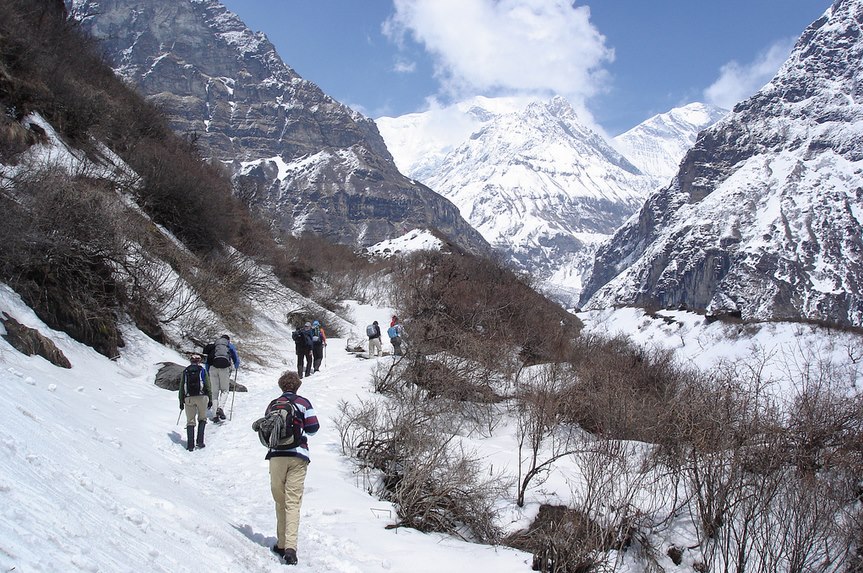
Progress has been made in exploiting Nepal's natural resources, tourism, and hydroelectricity. With eight of the world's 10 highest mountain peaks, including Mount Everest at 8,848.86 m. In the early 1990s, one large public sector project and a number of private projects were planned; some have been completed. The most significant private sector financed hydroelectric projects currently in operation are the Khimti Khola (60 MW) and the Bhote Koshi Project (36 MW). The project is still undergoing and has dependency on China, India and Japan to take the further steps.


Nepal has 83,000 MW of theoretical and 42,133 MW of technically/financially viable hydroelectric potential, however the total installed capacity, at present, is 2500 MW and increasing.
The environmental impact of Nepal's hydroelectric Own calendar (Bikram Sambat) New year in mid- April projects has been limited by the fact that most are "run-of-the-river" with only one storage project undertaken to date. The largest hydroelectric plant under consideration is the West Seti Dam (750 MW) storage project dedicated to exports to be built by the private sector. Negotiations with India for a power purchase agreement have been underway for several years, but agreement on pricing and financing remains a problem. Currently demand for electricity is increasing at 8-10% a year whereas Nepal's option to have agreement with India will make this fulfilment against demand. As of June 2022 surplus electricity up to 364 MWp by Nepal is exported to India.
Population pressure on natural resources is increasing. Over-population is already straining the "carrying capacity" of the middle hill areas, particularly the Kathmandu Valley, resulting in the depletion of forest cover for crops, fuel, and fodder and contributing to erosion and flooding. Although steep mountain terrain makes exploitation difficult, mineral surveys have found small deposits of limestone, magnesite, zinc, copper, iron, mica, lead, and cobalt. Coal mining is also done with 11522 tones produced in 2018 alone.
The development of hydroelectric power projects also cause some tension with local indigenous groups, recently empowered by Nepal's ratification of ILO Convention 169.
Macro-economic trend
This is a chart of trend of gross domestic product of Nepal at market prices estimated by the International Monetary Fund and EconStats with figures in millions of Nepali Rupees.
| Year | Gross domestic product | |
|---|---|---|
| 1960 | ||
| 1965 | ||
| 1970 | ||
| 1975 | ||
| 1980 | ||
| 1985 | ||
| 1990 | ||
| 1995 | ||
| 2000 |
The following table shows the main economic indicators in 1980–2024.
| Year | GDP (in billion US$ PPP) | GDP per capita (in US$ PPP) | GDP (in billion US$ nominal) | GDP growth (real) | Inflation (in Percent) | Government debt (in % of GDP) |
|---|---|---|---|---|---|---|
| 1980 | 7.68 | 491 | 2.26 | −2.3% | 9.8% | n/a |
| 1985 | 12.59 | 718 | 3.21 | 6.1% | 4.1% | n/a |
| 1990 | 18.37 | 936 | 4.44 | 4.6% | 8.9% | n/a |
| 1995 | 26.70 | 1197 | 5.38 | 3.5% | 7.7% | n/a |
| 2000 | 36.70 | 1494 | 6.54 | 6.1% | 3.4% | 50.8% |
| 2005 | 49.01 | 1865 | 9.33 | 3.5% | 4.5% | 45.1% |
| 2006 | 52.23 | 1969 | 10.32 | 3.4% | 8.0% | 42.9% |
| 2007 | 55.47 | 2076 | 11.78 | 3.4% | 6.2% | 37.9% |
| 2008 | 59.99 | 2232 | 14.31 | 6.1% | 6.7% | 36.8% |
| 2009 | 63.10 | 2335 | 14.66 | 4.5% | 12.6% | 39.5% |
| 2010 | 66.94 | 2465 | 18.25 | 4.8% | 9.6% | 35.4% |
| 2011 | 70.66 | 2591 | 21.69 | 3.4% | 9.6% | 32.4% |
| 2012 | 75.34 | 2756 | 21.70 | 4.7% | 8.3% | 34.5% |
| 2013 | 79.32 | 2897 | 22.16 | 3.5% | 9.9% | 31.9% |
| 2014 | 85.55 | 3115 | 22.72 | 6.0% | 9.0% | 27.6% |
| 2015 | 89.78 | 3252 | 24.36 | 4.0% | 7.2% | 25.7% |
| 2016 | 91.02 | 3267 | 24.52 | 0.4% | 9.9% | 25.0% |
| 2017 | 100.97 | 3583 | 28.97 | 9.0% | 4.5% | 25.0% |
| 2018 | 111.09 | 3897 | 33.11 | 7.6% | 4.1% | 31.1% |
| 2019 | 121.06 | 4199 | 34.19 | 6.7% | 4.6% | 34.0% |
| 2020 | 122.69 | 4180 | 33.43 | −2.4% | 6.2% | 43.3% |
| 2021 | 134.00 | 4461 | 36.93 | 4.8% | 3.6% | 43.3% |
| 2022 | 151.64 | 4964 | 41.18 | 5.6% | 6.3% | 42.7% |
| 2023 | 160.16 | 5153 | 40.91 | 2.0% | 7.8% | 47.1% |
| 2024 | 169.12 | 5348 | 43.67 | 3.1% | 5.6% | 49.7% |
Statistics
GDP: purchasing power parity - $84.37 Billion (2018 est.)
GDP - real growth rate: 21.77% (2017)
GDP - per capita: purchasing power parity (current international $) - $2700 (2017 est.) GDP - composition by sector:
agriculture: 17%
industry: 13.5%
services: 60.5% (2017 est.)
tourism: 9%
Population below poverty line: 25.6% (2017/2018)
Household income or consumption by percentage share:
lowest 10%: 3.2%
highest 10%: 29.8% (1995–96)
Inflation rate (consumer prices): 4.5% (2017)
Labour force: 4 million (2016 est.)
Labor force - by occupation: agriculture 19%, services 69%, industry 12% (2014 est.)
Unemployment rate: 1.47% (2017 est.)
Budget:
revenues: $5.954 billion
expenditures: $5.974 billion, including capital expenditures of $NA (2017 est.)
Industries: tourism, carpet, textile; small rice, jute, sugar, and oilseed mills; cigarette; cement and brick production
Industrial production growth rate: 10.9% (2017 est.):
Electricity - production: 41,083 GWh (2017)
Electricity - production by source:
fossil fuel: 7.5%
hydro: 91.5%
nuclear: 0.3%
other: 0.7% (2001)
**Available energy:**6957.73 GWh (2017) **NEA Hydro:**2290.78 GWh (2014) **NEA Thermal:**9.56 GWh (2014) **purchase (total):**2331.17 GWh (2014) **India (purchase):**2175.04 GWh (2017) **Nepal (IPP):**1258.94 GWh (2014)
Electricity - consumption: 4,776.53 GWh (2017)
Electricity - exports: 856 GWh (2001) Electricity - imports: 12 GWh (2001)
Oil - production: 0 oilbbl/d (2001 est.)
Oil - consumption: 1600 oilbbl/d 2001
Agriculture - products: Fruits and vegetables, mostly: apples, pears, tomatoes, peaches, nectarines, potatoes, rice, maize, wheat, sugarcane, root crops, milk, and buffalo meat.
Exports: $1.29 billion f.o.b., but does not include unrecorded border trade with India (2020 est.)
Exports - commodities: carpets, clothing, leather goods, jute goods, grain
Exports - partners: India 56.6%, US 11.5%, Turkey 9.2% (2016 est.)
Imports: $1.6 billion f.o.b. (2021 est.)
Imports - commodities: gold, machinery and equipment, petroleum products, electrical goods, medicine
Imports - partners: India 70.1%, China 10.3%, UAE 2.6%, Singapore 2.1%, Saudi Arabia 1.2%. (2016 est.)
Debt - external: $9.1 billion (2022 est.)
Economic aid - recipient: $2 billion (FY 2019/20)
Currency: 1 Nepali rupee (NPR) = 100 paisa
Fiscal year: 16 July - 15 July
References
References
- "World Economic Outlook Database, April 2019". [[International Monetary Fund]].
- "World Bank Country and Lending Groups". [[World Bank]].
- (24 March 2023). "Population, total - Nepal". [[Central Bureau of Statistics (Nepal)]].
- "World Economic Outlook Database, 2025". [[International Monetary Fund]].
- "International Monetary Fund". [[International Monetary Fund]].
- "The World Factbook". [[Central Intelligence Agency]].
- "Nepal's September Inflation".
- "Poverty headcount ratio at national poverty lines (% of population) - Nepal". Xinhuanet.
- "Poverty headcount ratio at $3.20 a day (2011 PPP) (% of population) - Nepal". World Bank.
- "GINI index (World Bank estimate)". [[World Bank]].
- "Human Development Index (HDI)". [[Human Development Report.
- "Inequality-adjusted HDI (IHDI)". [[United Nations Development Programme.
- "Labor force, total". World Bank.
- "Employment to population ratio, 15+, total (%) (national estimate)". World Bank.
- "Nepal's Debt".
- "Nepal's Forex".
- "Nepal puts a minimum amount limit on foreign aid and loans". news.biharprabha.com.
- (11 October 2011). "EU as Nepal's largest exporter". ktm2day.
- (27 March 2015). "UK should cut aid to Nepal if "endemic" corruption persists: report". Reuters.
- (27 March 2015). "DFID's bilateral programme in Nepal". The [[International Development Committee]] of the House of Commons.
- (15 June 2013). "A Conversation with Departing Nepal Chief of the UK Aid Agency".
- (8 August 2024). "Nepal's Electricity".
- (2 June 2022). "Nepal starts exporting surplus electricity to India". english.onlinekhabar.com.
- [http://blog.nibrinternational.no/#post13 Jones, Peris: When the lights go out. Hydroelectric power and indigenous rights in Nepal] {{webarchive. link. (30 April 2011 . ''NIBR International Blog 11.03.10'')
- "Report for Selected Countries and Subjects".
- "Nepal Economy Profile 2019".
- (June 2018). "Economic Survey 2017/18". Ministry of finance.
This article was imported from Wikipedia and is available under the Creative Commons Attribution-ShareAlike 4.0 License. Content has been adapted to SurfDoc format. Original contributors can be found on the article history page.
Ask Mako anything about Economy of Nepal — get instant answers, deeper analysis, and related topics.
Research with MakoFree with your Surf account
Create a free account to save articles, ask Mako questions, and organize your research.
Sign up freeThis content may have been generated or modified by AI. CloudSurf Software LLC is not responsible for the accuracy, completeness, or reliability of AI-generated content. Always verify important information from primary sources.
Report