From Surf Wiki (app.surf) — the open knowledge base
Economy of Japan
none
none
| Field | Value | ||||||||
|---|---|---|---|---|---|---|---|---|---|
| country | Japan | ||||||||
| image | Tokyo Marunouchi in autumn.jpg | ||||||||
| image_size | 310px | ||||||||
| caption | Marunouchi in Tokyo, the financial centre of Japan | ||||||||
| currency | Japanese yen (JPY, ¥) | ||||||||
| year | 1 April – 31 March | ||||||||
| organs | APEC, WTO, CPTPP, RCEP, OECD, G-20, G7 and others | ||||||||
| group | {{plainlist | ||||||||
| *Advanced economy<ref>{{cite web | url | https://www.imf.org/en/Publications/WEO/weo-database/2024/April/groups-and-aggregates | title=World Economic Outlook Database, April 2024 | publisher=International Monetary Fund | work=IMF.org | access-date=29 April 2024 | archive-date=17 April 2024 | archive-url= https://web.archive.org/web/20240417191032/https://www.imf.org/en/Publications/WEO/weo-database/2024/April/groups-and-aggregates | url-status=live}} |
| *High-income economy<ref>{{cite web | url | https://datahelpdesk.worldbank.org/knowledgebase/articles/906519-world-bank-country-and-lending-groups | title=World Bank Country and Lending Groups | publisher=World Bank | work=datahelpdesk.worldbank.org | access-date=29 September 2019 | archive-date=28 October 2019 | archive-url= https://web.archive.org/web/20191028223324/https://datahelpdesk.worldbank.org/knowledgebase/articles/906519-world-bank-country-and-lending-groups | url-status=live}} |
| * Welfare state<ref name | "Japan_welfare" /}} | ||||||||
| population | 123,262,483 (2025) | ||||||||
| gdp | {{plainlist | ||||||||
| * $4.46 trillion (nominal; )<ref name | "IMF DataMapper" | ||||||||
| * $7.123 trillion (PPP; )<ref name | "IMF DataMapper"/ | ||||||||
| gdp rank | {{plainlist | ||||||||
| growth | {{plainlist | ||||||||
| * 1.1% ()<ref name | "IMF DataMapper" / | ||||||||
| * 0.6% ()<ref name | "IMF DataMapper" / | ||||||||
| * 0.6% ()<ref name | "IMF DataMapper" / | ||||||||
| per capita | {{plainlist | ||||||||
| * $36,390 (nominal; )<ref name | "IMF DataMapper"/ | ||||||||
| * $56,440 (PPP; )<ref name | "IMF DataMapper"/ | ||||||||
| per capita rank | {{plainlist | ||||||||
| sectors | {{plainlist | ||||||||
| *(2022 est.)<ref name | "CIAWFJA" | ||||||||
| components | {{plainlist | ||||||||
| * (2022 est.)<ref name | "CIAWFJA" / | ||||||||
| inflation | 3.1% | ||||||||
| gini | 33.8 (2021) | ||||||||
| cpi | 71 out of 100 points (2024) (rank 20th) | ||||||||
| hdi | {{plainlist | ||||||||
| * 0.925 (2023)<ref name | "hdi" (23rd) | ||||||||
| * 0.845 IHDI (20th) (2023)<ref name | "hdi" /}} | ||||||||
| labor | {{plainlist | ||||||||
| * 69.349 million (2023 est.)<ref name | "STATJP" | ||||||||
| * 61.2% employment rate (May 2023)<ref>{{cite web | url | http://www.stat.go.jp/english/data/roudou/results/month/zuhyou/15416.xlsx | title=Employed person by age group | publisher=Ministry of Internal Affairs and Communications | work=stat.go.jp | access-date=2 October 2020 | archive-date=7 August 2020 | archive-url= https://web.archive.org/web/20200807192902/http://www.stat.go.jp/english/data/roudou/results/month/zuhyou/15416.xlsx | url-status=live}}}} |
| occupations | {{plainlist | ||||||||
| *(2023)<ref>{{cite web | title | Labor force by services | url= https://data.worldbank.org/indicator/SL.SRV.EMPL.ZS?locations=JP | work=Data.WorldBank.org | access-date=27 January 2019 | quote= | archive-date=27 June 2022 | archive-url= https://web.archive.org/web/20220627150250/https://data.worldbank.org/indicator/SL.SRV.EMPL.ZS?locations=JP | url-status=live}} – Labor Force by Industry and agriculture }} |
| unemployment | {{plainlist | ||||||||
| * 2.3% (July 2025)<ref name | "LABOURSTATJP" | ||||||||
| * 3.7% youth unemployment (15 to 24 year-olds; May 2023)<ref name | "LABOURSTATJP" / | ||||||||
| * 1.69 million unemployed (July 2025)<ref name | "LABOURSTATJP" /}} | ||||||||
| average gross salary | ¥452,247 / US$3,106 monthly (2024) | ||||||||
| average net salary | ¥352,541 / US$2,421 monthly (2024) | ||||||||
| industries | {{plainlist | ||||||||
| exports | $928 billion (2024) | ||||||||
| export-goods | {{plainlist | ||||||||
| *Others: 13.8%<ref name | "Japan exports, imports" /}} | ||||||||
| export-partners | |||||||||
| *(2024)<ref name | "Japan exports, imports" / | ||||||||
| imports | $932.1 billion USD (2024) | ||||||||
| import-goods | {{plainlist | ||||||||
| *Others: 14.4%<ref name | "Japan exports, imports" /}} | ||||||||
| import-partners | |||||||||
| *(2024)<ref name | "Japan exports, imports" / | ||||||||
| current account | $58.108 billion (2022) | ||||||||
| FDI | {{plainlist | ||||||||
| * Inward: $25 billion (2021)<ref name | "UNFDI" | ||||||||
| * Outward: $147 billion (2021)<ref name | "UNFDI" / | ||||||||
| gross external debt | $4.54 trillion (March 2023) | ||||||||
| (103.2% of GDP) | |||||||||
| debt | {{plainlist | ||||||||
| * 263.9% of GDP (2022)<ref name | "IMF_Finance" | ||||||||
| revenue | ¥196,214 billion | ||||||||
| 35.5% of GDP (2022) | |||||||||
| expenses | ¥239,694 billion | ||||||||
| 43.4% of GDP (2022) | |||||||||
| balance | 1.35% of GDP (2022 est.) | ||||||||
| reserves | US$1.255 trillion (September 2024) | ||||||||
| credit | {{plainlist | ||||||||
| *Standard & Poor's:<ref name | "Sovereigns rating list" | ||||||||
| *Moody's:<ref name | "guardian" / | ||||||||
| *Fitch:<ref name | "guardian" / | ||||||||
| aid | donor: ODA, $10.37 billion (2016) | ||||||||
| spelling | GB |
- Advanced economy
- High-income economy
- Welfare state}}
- $4.46 trillion (nominal; 2026f)
- $7.123 trillion (PPP; 2026f)
- 4th (nominal; 2026f)
- 5th (PPP; 2026f)
- 1.1% (2025f)
- 0.6% (2026f)
- 0.6% (2027f)
- $36,390 (nominal; 2026f)
- $56,440 (PPP; 2026f)
- 40th (nominal; 2026f)
- 42th (PPP; 2026f)
- Agriculture: 1.0%
- Industry: 26.9%
- Services: 71.4%
- (2022 est.)
- Household consumption: 55.6%
- Government consumption: 21.6%
- Investment in fixed capital: 26.0%
- Investment in inventories: 0.6%
- Exports of goods and services: 21.5%
- Imports of goods and services: −25.3%
- (2022 est.)
- 0.925 (2023) (23rd)
- 0.845 IHDI (20th) (2023)}}
- 69.349 million (2023 est.)
- 61.2% employment rate (May 2023)}}
- Agriculture: 3%
- Industry: 24%
- Services: 73%
- (2023)}}
- 2.3% (July 2025)
- 3.7% youth unemployment (15 to 24 year-olds; May 2023)
- 1.69 million unemployed (July 2025)}}
- High technology
- Motor vehicles
- Electronics
- Machine tools|steel
- Nonferrous metals|ships
- Chemicals
- Textiles
- Processed foods | export-goods = {{plainlist|
- Transport equipment 21.0%
- Machinery 19.9%
- Electrical machinery 18.7%
- Chemicals 12.4%
- Manufactured goods 10.4%
- Raw materials 1.7%
- Foodstuff 1.3%
- Mineral fuels 0.8%
- Others: 13.8%}} | export-partners =
- China 22.2%
- Hong Kong 4.9%
- United States 20.6%
- ASEAN 13.9%
- European Union 9.7%
- Taiwan 6.6%
- South Korea 6.6%
- (2024) | import-goods = {{plainlist|
- Electrical machinery 17.6%
- Mineral fuels 16.6%
- Machinery 10.5%
- Foodstuff 9.9%
- Chemicals 9.9%
- Manufactured goods 9.3%
- Raw materials 6.9%
- Transport equipment 5.0%
- Others: 14.4%}} | import-partners =
- China 22.3%
- Hong Kong 0.4%
- ASEAN 15.3%
- United States 10.5%
- European Union 10.4%
- Australia 7.1%
- United Arab Emirates 5.4%
- (2024)
- Inward: $25 billion (2021)
- Outward: $147 billion (2021) (103.2% of GDP)
- ¥1.457 quadrillion
- 263.9% of GDP (2022) 35.5% of GDP (2022) 43.4% of GDP (2022)
- Standard & Poor's:
- A+ (Domestic)
- A+ (Foreign)
- AA+ (T&C Assessment)
- Outlook: Stable
- Moody's:
- A1
- Outlook: Stable
- Fitch:
- A
- Outlook: Stable}} Japan has a highly developed mixed economy, often referred to as an East Asian model. According to the IMF forecast for 2025, it will be the fourth-largest economy in the world by nominal GDP and the fifth-largest by purchasing power parity (PPP) by the end of the year. It constituted 3.7% of the world's economy on a nominal basis in 2024. According to the same forecast, the country's nominal per capita GDP (PPP) will be $56,440 (2025). Due to a volatile currency exchange rate, Japan's nominal GDP as measured in American dollars fluctuates sharply.
A founding member of the G7 and an early member of the OECD, Japan was the first country in Asia to achieve developed country status. In 2024, Japan was the sixth-largest in the world as an importer and eight-largest as an exporter. The country also has the world's fourth-largest consumer market. Japan used to run a considerable trade surplus, but the decline of the manufacturing sector since the 1980s and increased fossil fuel imports after the Fukushima nuclear accident in 2011 have changed this trend in recent years. Being the world's largest creditor nation, Japan has a considerable net international investment surplus. The country has the world's second-largest foreign-exchange reserves, worth $1.4 trillion. Japan has the third-largest financial assets in the world, valued at $12 trillion, or 8.6% of the global GDP total as of 2020. Japan has a highly efficient and strong social security system, which comprises roughly 23.5% of GDP. The Tokyo Stock Exchange is the world's fourth-largest stock exchange by market capitalisation as of 2025.
Japan has a highly service-dominated economy, which contributes approximately 70% of GDP, with most of the remainder coming from the industrial sector. The country's automobile industry, which is the third largest in the world, dominates the industrial sector, with Toyota being the world’s largest manufacturer of cars. In 2022, Japan spent around 3.7% of GDP on research and development. As of 2025, 38 of the Fortune Global 500 companies are based in Japan.
Long having been an agricultural country, it has been estimated that Japan’s economy was among the top ten in the world by size before the industrial revolution started. Industrialisation in Japan began in the second half of the 19th century with the Meiji Restoration, initially focusing on the textile industry and later on heavy industries. The country rapidly built its colonial empire and the third most powerful navy in the world. After the defeat in the Second World War, Japan’s economy recovered and developed further rapidly, primarily propelled by its lucrative manufacturing exporting industries. It became the second largest economy in the world in 1988 and remained so until 2010, and on a nominal per capita basis, the most high-income among the G7 countries in the 1980s and 1990s. In 1995, Japan’s share of the world’s nominal GDP was 17.8%, reaching approximately 71% of that of the United States.
Driven by speculative investments and excessive lending, the Japanese asset price bubble of the early 1990s burst, triggering a prolonged period of economic stagnation marked by deflation and persistently low or negative growth, now known as the Lost Decades. From 1995 to 2023, the country’s GDP fell from $5.5 trillion to $4.2 trillion in nominal terms. At the turn of the 21st century, the Bank of Japan set out to encourage growth through a policy of quantitative easing, with the central bank purchasing government bonds at an unprecedented scale to address the persisting deflationary pressure. In 2016, the Bank of Japan introduced a negative interest policy to stimulate economic growth and combat persistent deflationary pressure. A combination of domestic policies and global economic conditions helped the country achieve its 2% inflation target, leading to the conclusion of the policy in 2024.
As of 2021, Japan has significantly higher public debt than other developed nations, at approximately 260% of GDP. 45% of this debt is held by the Bank of Japan, and most of the remainder is also held domestically. The Japanese economy faces considerable challenges posed by an ageing and declining population, which peaked at 128.5 million people in 2010 and has fallen to 122.6 million people in 2024. In 2024, the country's working age population consisted of approximately 59.6% of the total population, which was the lowest rate among all the OECD countries. According to 2023 government projections, the country's population will fall to 87 million by 2070, with only 45 million of working age.
History
Main article: Economic history of Japan
The economic history of Japan is one of the most studied. Major milestones in modern Japan's economic progress include:
- The foundation of the Tokugawa shogunate based in Edo (in 1603), initiating a period of internal economic development.
- The Meiji Restoration (in 1868) leading to Japan becoming the first non-European modern world power.
- Japan's defeat in World War II (in 1945), after which the island nation rose to become the world's second-largest economy.
- The Lost Decades (the 1990s, 2000s and 2010s), during which the country struggled to get out of deflation and extremely low or negative growth.
Edo period (1603–1868)
The beginning of the Edo period coincides with the last decades of the Nanban trade period, marked by intense interaction with European powers. Japan built its first Western-style warships, such as the San Juan Bautista, and commissioned around 350 Red Seal Ships for intra-Asian commerce. Japanese adventurers, such as Yamada Nagamasa, were active throughout Asia.
To eradicate Christian influence, Japan entered a period of isolation called sakoku in the 1630s, which led to economic stability and mild progress. In the 1650s, Japanese export porcelain production increased significantly due to a civil war in China, mainly in Kyushu. This trade dwindled by the 1740s under renewed Chinese competition but resumed after Japan’s mid-19th century opening.
Economic development during the Edo period included urbanisation, increased commodity shipping, and expanded domestic and foreign commerce. The construction trades, banking facilities, and merchant associations flourished. Daimyō-led authorities (han) oversaw rising agricultural production and rural handicrafts. By the mid-18th century, Edo had a population of over 1 million, while Osaka and Kyoto each had more than 400,000 inhabitants, becoming centres for trade and handicraft production. Rice, the economy’s base, was taxed at about 40% of the harvest and sold at the fudasashi market in Edo. Daimyō used forward contracts similar to modern futures trading to sell rice before harvest.
During the sakoku period, Japan studied Western sciences and techniques (rangaku) through Dutch traders in Dejima, including geography, medicine, natural sciences, astronomy, and mechanical sciences. Japan reopened its economy to the West after being pressured by the United States twice in 1853 and 1854.
Meiji and Imperial Period (1868–1945)
Since the mid-19th century, after the Meiji Restoration, the country was opened up to Western commerce and influence and went through a period of economic development that extended through to the First World War. Economic developments of the prewar period began with the "Rich State and Strong Army Policy" by the Meiji government. During the Meiji period (1868–1912), leaders inaugurated a new Western-based education system for all young people, sent thousands of students to Europe and the United States, and hired more than 3,000 Westerners to teach modern science, mathematics, technology, and foreign languages in Japan (Oyatoi gaikokujin). The government also built an extensive railway network, improved roads, and inaugurated a land reform program to prepare the country for further development.
To promote industrialisation, the government decided that, while it should help private business to allocate resources and to plan, the private sector was best equipped to stimulate economic growth. The greatest role of government was to help provide good economic conditions for business. In short, government was to be the guide and business the producer. In the early Meiji period, the government built factories and shipyards that were sold to entrepreneurs at a fraction of their value. Many of these businesses grew rapidly into the larger conglomerates such as Mitsubishi. Government emerged as chief promoter of private enterprise, enacting a series of pro-business policies.
Post-war period (1945–1991)

Japan underwent significant economic transformation and rapid recovery and growth, emerging from the devastation of the Second World War to become a global economic powerhouse. The immediate post-war period saw Japan slowly recovering as a democratic nation under the Allied Occupation. The Korean War (1950–1953), which happened in its now divided former colony, boosted the economy, as Japan served as a major supply hub for U.S. forces. By the 1950s and 1960s, Japan’s economy had entered a period of high growth, often referred to as the 'Japanese Economic Miracle'. Key factors in this growth included government-industry cooperation, a strong work ethic, advanced technology, and a focus on export-oriented manufacturing. Japan’s economy diversified from textiles to steel, shipbuilding, and eventually electronics and automobiles, with companies such as Toyota, Sony, Hitachi and Honda becoming household names worldwide.
In 1968, Japan became the world’s third-largest economy then the second largest in 1988, surpassing the Soviet Union, a position it held until it was surpassed by China in 2010. The government played a crucial role through policies that promoted industrial expansion and technological advancement. Japan’s emphasis on quality control and continuous improvement (kaizen) further boosted its international competitiveness. By the 1980s, Japan was leading in a wide range of industries, including automotive and consumer electronics, and was known for its formidable trade surplus and wealth. However, the late 1980s also saw the infamous Plaza Accord and the formation of an asset price bubble, with inflated real estate and stock market prices, setting the stage for the economic stagnation of the 'Lost Decades' that followed.
Lost Decades (1991–2019)

Negative interest policy started in 2016 ]]

]] Growth slowed markedly in the late 1990s, also termed the Lost Decade, after the collapse of the Japanese asset price bubble. As a consequence Japan ran massive budget deficits (added trillions in yen to the Japanese financial system) to finance large public works programs.
By 1998, Japan's public works projects still could not stimulate demand enough to end the economy's stagnation. In desperation, the Japanese government undertook "structural reform" policies intended to wring speculative excesses from the stock and real estate markets. Unfortunately, these policies led Japan into deflation on numerous occasions between 1999 and 2004. The Bank of Japan used quantitative easing to expand the country's money supply in order to raise expectations of inflation and spur economic growth. Initially, the policy failed to induce any growth, but it eventually began to affect inflationary expectations. By late 2005, the economy finally began what seems to be a sustained recovery. GDP growth for that year was 2.8%, with an annualised fourth quarter expansion of 5.5%, surpassing the growth rates of the US and European Union during the same period. Unlike previous recovery trends, domestic consumption has been the dominant factor of growth.

]] Despite having interest rates down near zero for a long period of time, the quantitative easing strategy did not succeed in stopping price deflation. This led some economists, such as Paul Krugman, and some Japanese politicians, to advocate the generation of higher inflation expectations. In July 2006, the zero-rate policy was ended. In 2008, the Japanese Central Bank still had the lowest interest rates in the developed world, but deflation had still not been eliminated and the Nikkei 225 has fallen over approximately 50% (between June 2007 and December 2008). However, on 5 April 2013, the Bank of Japan announced that it would be purchasing 60–70 trillion yen in bonds and securities in an attempt to eliminate deflation by doubling the money supply in Japan over the course of two years. Markets around the world have responded positively to the government's current proactive policies, with the Nikkei 225 adding more than 42% since November 2012. The Economist has suggested that improvements to bankruptcy law, land transfer law, and tax laws will aid Japan's economy. In recent years, Japan has been the top export market for almost 15 trading nations worldwide.
In December 2018, a free trade agreement between Japan and the European Union was cleared to commence in February 2019. It creates the world's largest free trade zone valued at 1/3rd of global gross domestic product. This reduces tariffs on Japanese cars by 10%, duties by 30% on cheese and 10% on wines and opens service markets.
Reiwa period (2020–present)
2020–21 recession
In early January 2020, Japanese economy began to suffer from the COVID-19 pandemic. In early April, Japanese Prime Minister Shinzo Abe announced a state of emergency. Less than a quarter of Japanese people expected living conditions to improve in the coming decades. In October 2020 during the pandemic, Japan and the United Kingdom formally signed the first free-trade agreement post-Brexit, which will boost trade by approximately £15.2 billion. It enables tariff-free trade on 99% of exports to Japan. On 15 February 2021, the Nikkei average breached the 30k benchmark, the highest since November 1991. It was due to strong corporate earnings, GDP data and optimism over the COVID-19 vaccination program in the country.
Post-recession (2021–present)
At the end of March 2022, the Ministry of Finance announced that the national debt reached precisely 1.017 million billion yen. The total public debt of the country, which includes debts contracted by local governments, represents 1.210 million billion yen (9,200 billion dollars) which is nearly 250% of Japan's GDP. Economist Kohei Iwahara said such an exceptional debt to GDP level is only possible because Japanese hold most of the debt: "“Japanese households hold most of their savings in bank accounts (48%) and these sums are used by commercial banks to buy Japanese government bonds. Thus, 85.7% of these bonds are held by Japanese investors.”
The Bank of Japan's main policy aim since the Lost Decades started had been to end deflation and eventually achieve 2% inflation. The increased international economic tension brought about by events such as the 2022 Russian invasion of Ukraine finally helped the country achieve the much-anticipated inflation target of 2%, and the negative interest policy was ended in March 2024. However, while other major economies focus on suppressing inflation by raising interest rates, Japan aims to firmly establish inflation by maintaining low rates. As a side effect, the Japanese yen has become extremely weak, hitting a 37.5-year low of 161 yen/USD in July 2024. Furthermore, the real effective exchange rate in May 2024, when the 2020 average is set at 100, is 68.65, the lowest level since the start of the Bank of Japan statistics in January 1970, due to a combination of low inflation in Japan and a relatively low trade share. This devaluation of the currency caused Japan to lose its status as the world’s third largest economy to Germany in nominal terms, which was approximately half the size of the country's economy a decade earlier.
Factors such as an apparent end to the 30-year struggle against deflation, improvements in corporate governance, and high corporate profits boosted the stock market. Consequently, both the Nikkei 225 and TOPIX indices surpassed the record highs they reached more than 30 years ago in 2024. The market capitalisation of the Tokyo Stock Exchange’s prime section exceeded a quadrillion yen for the first time in July 2024.
Macro-economic trend
GDP composition
Industries by GDP value-added 2012. Values are converted using the exchange rate on 13 April 2013.
| Industry | GDP value-added billions 2018 | % of total GDP |
|---|---|---|
| Other service activities | 1,238 | 23.5% |
| Manufacturing | 947 | 18.0% |
| Real estate | 697 | 13.2% |
| Wholesale and retail trade | 660 | 12.5% |
| Transport and communication | 358 | 6.8% |
| Public administration | 329 | 6.2% |
| Construction | 327 | 6.2% |
| Finance and insurance | 306 | 5.8% |
| Electricity, gas and water supply | 179 | 3.4% |
| Government service activities | 41 | 0.7% |
| Mining | 3 | 0.1% |
| Total | 5,268 | 100% |
Development of main indicators
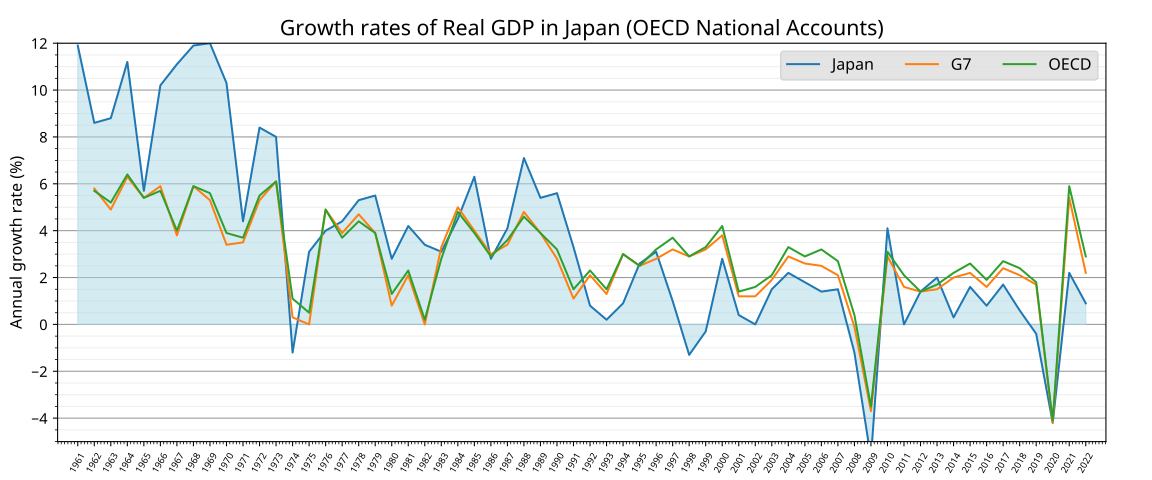
The following table shows the main economic indicators in 1980–2023 (with IMF staff estimates in 2024–2029). Inflation under 5% is in green.
| Year | GDP | |||||||
|---|---|---|---|---|---|---|---|---|
| (in bn. US$PPP) | GDP per capita | |||||||
| (in US$ PPP) | GDP | |||||||
| (in bn. US$nominal) | GDP per capita | |||||||
| (in US$ nominal) | GDP growth | |||||||
| (real) | Inflation rate | |||||||
| (in Per cent) | Unemployment | |||||||
| (in Per cent) | Government debt | |||||||
| (in % of GDP) | ||||||||
| 1980 | 1,068.1 | 9,147.0 | 1,127.9 | 9,659.0 | 3.2% | 7.8% | 2.0% | 47.8% |
| 1981 | 1,218.4 | 10,358.1 | 1,243.8 | 10,574.4 | 4.2% | 4.9% | 2.2% | 52.9% |
| 1982 | 1,336.5 | 11,283.0 | 1,157.6 | 9,772.8 | 3.3% | 2.8% | 2.4% | 57.8% |
| 1983 | 1,437.8 | 12,054.5 | 1,268.6 | 10,636.5 | 3.5% | 1.9% | 2.7% | 63.6% |
| 1984 | 1,556.7 | 12,967.1 | 1,345.2 | 11,205.4 | 4.5% | 2.3% | 2.7% | 65.6% |
| 1985 | 1,690.0 | 13,989.8 | 1,427.4 | 11,815.8 | 5.2% | 2.0% | 2.6% | 68.3% |
| 1986 | 1,781.4 | 14,667.9 | 2,121.3 | 17,466.7 | 3.3% | 0.6% | 2.8% | 74.0% |
| 1987 | 1,911.8 | 15,666.3 | 2,584.3 | 21,177.8 | 4.7% | 0.1% | 2.9% | 75.7% |
| 1988 | 2,113.5 | 17,246.0 | 3,134.2 | 25,575.1 | 6.8% | 0.7% | 2.5% | 71.8% |
| 1989 | 2,303.0 | 18,719.6 | 3,117.1 | 25,336.2 | 4.9% | 2.3% | 2.3% | 65.5% |
| 1990 | 2,506.1 | 20,302.7 | 3,196.6 | 25,896.0 | 4.9% | 3.1% | 2.1% | 63.0% |
| 1991 | 2,679.4 | 21,620.8 | 3,657.3 | 29,511.8 | 3.4% | 3.3% | 2.1% | 62.2% |
| 1992 | 2,763.7 | 22,222.4 | 3,988.3 | 32,069.1 | 0.8% | 1.7% | 2.2% | 66.6% |
| 1993 | 2,814.6 | 22,558.2 | 4,544.8 | 36,425.2 | -0.5% | 1.3% | 2.5% | 72.7% |
| 1994 | 2,899.9 | 23,177.4 | 4,998.8 | 39,953.2 | 0.9% | 0.7% | 2.9% | 84.4% |
| 1995 | 3,038.6 | 24,224.0 | 5,545.6 | 44,210.2 | 2.6% | -0.1% | 3.2% | 92.5% |
| 1996 | 3,191.2 | 25,385.0 | 4,923.4 | 39,164.3 | 3.1% | 0.1% | 3.4% | 98.1% |
| 1997 | 3,278.1 | 26,014.1 | 4,492.4 | 35,651.3 | 1.0% | 1.7% | 3.4% | 105.0% |
| 1998 | 3,272.8 | 25,903.3 | 4,098.4 | 32,436.9 | -1.3% | 0.7% | 4.1% | 116.0% |
| 1999 | 3,307.9 | 26,131.3 | 4,636.0 | 36,622.9 | -0.3% | -0.3% | 4.7% | 129.5% |
| 2000 | 3,476.3 | 27,409.2 | 4,968.4 | 39,173.0 | 2.8% | -0.7% | 4.7% | 135.6% |
| 2001 | 3,568.4 | 28,068.3 | 4,374.7 | 34,410.7 | 0.4% | -0.7% | 5.0% | 145.1% |
| 2002 | 3,625.5 | 28,457.7 | 4,182.8 | 32,832.3 | 0.0% | -0.9% | 5.4% | 154.1% |
| 2003 | 3,753.8 | 29,410.9 | 4,519.6 | 35,410.2 | 1.5% | -0.3% | 5.2% | 160.0% |
| 2004 | 3,938.9 | 30,836.4 | 4,893.1 | 38,307.1 | 2.2% | 0.0% | 4.7% | 169.5% |
| 2005 | 4,135.7 | 32,372.7 | 4,831.5 | 37,819.1 | 1.8% | -0.3% | 4.4% | 174.3% |
| 2006 | 4,321.8 | 33,831.1 | 4,601.7 | 36,021.9 | 1.4% | 0.3% | 4.1% | 174.0% |
| 2007 | 4,504.5 | 35,257.9 | 4,579.7 | 35,847.2 | 1.5% | 0.0% | 3.8% | 172.8% |
| 2008 | 4,534.6 | 35,512.2 | 5,106.7 | 39,992.1 | -1.2% | 1.4% | 4.0% | 180.7% |
| 2009 | 4,303.9 | 33,742.5 | 5,289.5 | 41,469.8 | -5.7% | -1.3% | 5.1% | 198.7% |
| 2010 | 4,534.1 | 35,535.2 | 5,759.1 | 45,135.8 | 4.1% | -0.7% | 5.1% | 205.7% |
| 2011 | 4,629.4 | 36,215.1 | 6,233.1 | 48,760.9 | 0.0% | -0.3% | 4.6% | 219.1% |
| 2012 | 4,799.6 | 37,628.8 | 6,272.4 | 49,175.1 | 1.4% | 0.0% | 4.3% | 226.1% |
| 2013 | 5,021.6 | 39,436.8 | 5,212.3 | 40,934.8 | 2.0% | 0.3% | 4.0% | 229.6% |
| 2014 | 5,034.5 | 39,604.1 | 4,897.0 | 38,522.8 | 0.3% | 2.8% | 3.6% | 233.5% |
| 2015 | 5,200.9 | 40,959.3 | 4,444.9 | 35,005.7 | 1.6% | 0.8% | 3.4% | 228.3% |
| 2016 | 5,159.7 | 40,640.5 | 5,003.7 | 39,411.4 | 0.8% | -0.1% | 3.1% | 232.4% |
| 2017 | 5,248.4 | 41,409.0 | 4,930.8 | 38,903.3 | 1.7% | 0.5% | 2.8% | 231.3% |
| 2018 | 5,403.2 | 42,714.6 | 5,040.9 | 39,850.3 | 0.6% | 1.0% | 2.4% | 232.4% |
| 2019 | 5,471.8 | 43,351.0 | 5,118.0 | 40,548.0 | -0.4% | 0.5% | 2.4% | 236.4% |
| 2020 | 5,314.1 | 42,226.3 | 5,055.6 | 40,171.9 | -4.1% | 0.0% | 2.8% | 258.3% |
| 2021 | 5,700.0 | 45,416.0 | 5,034.6 | 40,114.3 | 2.6% | -0.2% | 2.8% | 253.9% |
| 2022 | 6,159.8 | 49,210.6 | 4,256.4 | 34,004.7 | 1.0% | 2.5% | 2.6% | 257.2% |
| 2023 | 6,507.1 | 52,214.6 | 4,212.9 | 33,805.9 | 1.9% | 3.3% | 2.6% | 252.4% |
| 2024 | 6,721.0 | 54,183.9 | 4,110.5 | 33,138.2 | 0.9% | 2.2% | 2.5% | 254.6% |
| 2025 | 6,908.4 | 55,970.4 | 4,310.4 | 34,921.6 | 1.0% | 2.1% | 2.5% | 252.6% |
| 2026 | 7,094.9 | 57,778.4 | 4,499.5 | 36,642.7 | 0.8% | 2.0% | 2.5% | 251.3% |
| 2027 | 7,271.8 | 59,538.8 | 4,649.1 | 38,064.8 | 0.6% | 2.0% | 2.5% | 251.0% |
| 2028 | 7,451.9 | 61,354.8 | 4,836.3 | 39,819.6 | 0.6% | 2.0% | 2.5% | 251.0% |
| 2029 | 7,628.2 | 63,170.9 | 4,944.7 | 40,948.6 | 0.4% | 2.0% | 2.5% | 251.7% |
Sectors of the economy
Agriculture
Main article: Agriculture, forestry, and fishing in Japan

The Japanese agricultural sector accounts for about 1.1% (2017) of the total country's GDP. Only 12% of Japan's land is suitable for cultivation. Due to this lack of arable land, a system of terraces is used to farm in small areas. This results in one of the world's highest levels of crop yields per unit area, with an overall agricultural self-sufficiency rate of about 50% on fewer than 56,000 km2 (14 million acres) cultivated.
Japan's small agricultural sector, however, is also highly subsidised and protected, with government regulations that favour small-scale cultivation instead of large-scale agriculture as practiced in North America. There has been a growing concern about farming as the current farmers are aging with a difficult time finding successors.
Rice accounts for almost all of Japan's cereal production. Japan is the second-largest agricultural product importer in the world. Rice, the most protected crop, is subject to tariffs of 777.7%.
Although Japan is usually self-sufficient in rice (except for its use in making rice crackers and processed foods) and wheat, the country must import about 50% of its requirements of other grain and fodder crops and relies on imports for half of its supply of meat. Japan imports large quantities of wheat and soybeans. Japan is the 5th largest market for the European Union's agricultural exports. Over 90% of mandarin oranges in Japan are grown in Japan. Apples are also grown due to restrictions on apple imports.
Fishery
Main article: Fishing industry in Japan

Japan ranked fourth in the world in 1996 in tonnage of fish caught. Japan captured 4,074,580 metric tons of fish in 2005, down from 4,987,703 tons in 2000, 9,558,615 tons in 1990, 9,864,422 tons in 1980, 8,520,397 tons in 1970, 5,583,796 tons in 1960 and 2,881,855 tons in 1950. In 2003, the total aquaculture production was predicted at 1,301,437 tonnes. In 2010, Japan's total fisheries production was 4,762,469 fish. Offshore fisheries accounted for an average of 50% of the nation's total fish catches in the late 1980s although they experienced repeated ups and downs during that period.
Coastal fishing by small boats, set nets, or breeding techniques accounts for about one third of the industry's total production, while offshore fishing by medium-sized boats makes up for more than half the total production. Deep-sea fishing from larger vessels makes up the rest. Among the many species of seafood caught are sardines, skipjack tuna, crab, shrimp, salmon, pollock, squid, clams, mackerel, sea bream, sauries, tuna and Japanese amberjack. Freshwater fishing, including salmon, trout and eel hatcheries and fish farms, takes up about 30% of Japan's fishing industry. Among the nearly 300 fish species in the rivers of Japan are native varieties of catfish, chub, herring and goby, as well as such freshwater crustaceans as crabs and crayfish. Marine and freshwater aquaculture is conducted in all 47 prefectures in Japan.
Japan maintains one of the world's largest fishing fleets and accounts for nearly 15% of the global catch, prompting some claims that Japan's fishing is leading to depletion in fish stocks such as tuna. Japan has also sparked controversy by supporting quasi-commercial whaling.
Industry
Main article: Manufacturing in Japan
Japanese manufacturing and industry is very diversified, with a variety of advanced industries that are highly successful. Industry accounts for 30.1% (2017) of the nation's GDP. The country's manufacturing output is the third highest in the world.
Industry is concentrated in several regions, with the Kantō region surrounding Tokyo, (the Keihin industrial region) as well as the Kansai region surrounding Osaka (the Hanshin industrial region) and the Tōkai region surrounding Nagoya (the Chūkyō–Tōkai industrial region) the main industrial centers. Other industrial centers include the southwestern part of Honshū and northern Shikoku around the Seto Inland Sea (the Setouchi industrial region); and the northern part of Kyūshū (Kitakyūshū). In addition, a long narrow belt of industrial centers called the Taiheiyō Belt is found between Tokyo and Fukuoka, established by particular industries, that have developed as mill towns.
Japan enjoys high technological development in many fields, including consumer electronics, automobile manufacturing, semiconductor manufacturing, optical fibers, optoelectronics, optical media, facsimile and copy machines, and fermentation processes in food and biochemistry. However, many Japanese companies are facing emerging rivals from the United States, South Korea, and Taiwan.
Automobile manufacturing
Main article: Automobile manufacturing in Japan
Japan is the third biggest producer of automobiles in the world. Toyota is currently the world's largest car maker, and the Japanese car makers Nissan, Honda, Suzuki, and Mazda also count for some of the largest car makers in the world. By number, Japan is the world's second-largest exporter of cars after China as of 2024.
Construction
Main article: Construction industry in Japan
Defense
Main article: Defense industry in Japan
Electronics manufacturing
Main article: Japanese consumer electronics industry
Housing
Main article: Housing in Japan
Mining
Main article: Mining in Japan
Japan's mining production has been minimal, and Japan has very little mining deposits. However, massive deposits of rare earths have been found off the coast of Japan. In the 2011 fiscal year, the domestic yield of crude oil was 820 thousand kiloliters, which was 0.4% of Japan's total crude processing volume.
In 2019, Japan was the 2nd largest world producer of iodine, 4th largest worldwide producer of bismuth, the world's 9th largest producer of sulfur and the 10th largest producer of gypsum.
Science and technology
Main article: Science and technology in Japan
Semiconductor
Main article: Semiconductor industry in Japan
Services
Main article: Trade and services in Japan

Japan's service sector accounts for 68.7% (2017) of its total economic output. Banking, insurance, real estate, retailing, transportation, and telecommunications are all major industries such as MUFG, Mizuho, NTT, TEPCO, Nomura, Mitsubishi Estate, Aeon, Mitsui Sumitomo, Softbank, JR East, Seven & i Holdings, KDDI and Japan Airlines counting as some of the largest companies in the world. two of the five most circulated newspapers in the world are Japanese newspapers. The Koizumi government set Japan Post, one of the country's largest providers of savings and insurance services for privatisation by 2015. The six major keiretsus are the Mitsubishi, Sumitomo, Fuyo, Mitsui, Dai-Ichi Kangyo and Sanwa. Japan is home to 180 companies from the Forbes Global 2000 or 9% (as of 2013).
Tourism
Main article: Tourism in Japan

In 2012, Japan was the fifth most visited country in Asia and the Pacific, with over 8.3 million tourists. In 2013, due to the weaker yen and easier visa requirements for southwest Asian countries, Japan received a record 11.25 million visitors, which was higher than the government's projected goal of 10 million visitors. The government hopes to attract 40 million visitors a year by the 2020 Summer Olympics in Tokyo. Some of the most popular visited places include the Shinjuku, Ginza, Shibuya and Asakusa areas in Tokyo, and the cities of Osaka, Kobe and Kyoto, as well as Himeji Castle. Hokkaido is also a popular winter destination for visitors with several ski resorts and luxury hotels being built there.
Japan's economy is less dependent on international tourism than those of other G7 countries and OECD countries in general; from 1995 to 2014, it was by far the least visited country in the G7 despite being the second largest country in the group, and as of 2013 was one of the least visited countries in the OECD on a per capita basis. In 2013, international tourist receipts was 0.3% of Japan's GDP, while the corresponding figure was 1.3% for the United States and 2.3% for France.
Infrastructure
Main article: Energy in Japan, Transport in Japan

In 2018, Japan ranked 5th overall in the World Bank's Logistics Performance Index, and 2nd in the infrastructure category.
In 2005, one half of Japan's energy was produced from petroleum, a fifth from coal, and 14% from natural gas. Nuclear power in Japan made a quarter of electricity production but due to the Fukushima Daiichi nuclear disaster there has been a large desire to end Japan's nuclear power program. In September 2013, Japan closed its last 50 nuclear power plants nationwide, causing the nation to be nuclear free. The country has since then opted to restart a few of its nuclear reactors.
Japan's spendings on roads has been considered large. The 1.2 million kilometers of paved road are one of the major means of transportation. Japan has left-hand traffic. A single network of speed, divided, limited-access toll roads connects major cities and are operated by toll-collecting enterprises. New and used cars are inexpensive, and the Japanese government has encouraged people to buy hybrid vehicles. Car ownership fees and fuel levies are used to promote energy-efficiency.
Rail transport is a major means of transport in Japan. Dozens of Japanese railway companies compete in regional and local passenger transportation markets; for instance, 6 passenger JR enterprises, Kintetsu Railway, Seibu Railway, and Keio Corporation. Often, strategies of these enterprises contain real estate or department stores next to stations, and many major stations have major department stores near them. The Japanese cities of Fukuoka, Kobe, Kyoto, Nagoya, Osaka, Sapporo, Sendai, Tokyo and Yokohama all have subway systems. Some 250 high-speed Shinkansen trains connect major cities. All trains are known for punctuality, and a delay of 90 seconds can be considered late for some train services.
There are 98 passenger and 175 total airports in Japan, and flying is a popular way to travel. The largest domestic airport, Tokyo International Airport, is Asia's second busiest airport. The largest international gateways are Narita International Airport (Tokyo area), Kansai International Airport (Osaka/Kobe/Kyoto area), and Chūbu Centrair International Airport (Nagoya area). The largest ports in Japan include Nagoya Port, the Port of Yokohama, the Port of Tokyo and the Port of Kobe.
About 84% of Japan's energy is imported from other countries. Japan is the world's largest liquefied natural gas importer, second largest coal importer, and third largest net oil importer. Given its heavy dependence on imported energy, Japan has aimed to diversify its sources. Since the oil shocks of the 1970s, Japan has reduced dependence on petroleum as a source of energy from 77.4% in 1973 to about 43.7% in 2010 and increased dependence on natural gas and nuclear power. In September 2019, Japan will invest 10 billion on liquefied natural gas projects worldwide, in a strategy to boost the global LNG market and reinforce the security of energy supply. Other important energy source includes coal, and hydroelectricity is Japan's biggest renewable energy source. Japan's solar market is also currently booming. Kerosene is also used extensively for home heating in portable heaters, especially farther north. Many taxi companies run their fleets on liquefied natural gas. A recent success towards greater fuel economy was the introduction of mass-produced hybrid vehicles. Prime Minister Shinzō Abe, who was working on Japan's economic revival, signed a treaty with Saudi Arabia and UAE about the rising prices of oil, ensuring Japan's stable deliveries from that region.
Finance and banking
Main article: Financial services in Japan, List of banks in Japan

The Tokyo Stock Exchange is the third largest stock exchange in the world by market capitalisation, as well as the 2nd largest stock market in Asia, with 2,292 listed companies. The Nikkei 225 and the TOPIX are the two important stock market indexes of the Tokyo Stock Exchange. The Tokyo Stock Exchange and the Osaka Stock Exchange, another major stock exchange in Japan, merged on 1 January 2013, creating one of the world's largest stock exchanges. Other stock exchanges in Japan include the Nagoya Stock Exchange, Fukuoka Stock Exchange and Sapporo Securities Exchange.
Trade
Main article: Economic relations of Japan, Trade policy of Japan, List of the largest trading partners of Japan, List of exports of Japan
Labor force
Main article: Labor market of Japan

The unemployment rate in December 2013 was 3.7%, down 1.5 percentage points from the claimed unemployment rate of 5.2% in June 2009 due to the strong economic recovery.
In 2008 Japan's labor force consisted of some 66 million workers—40% of whom were women—and was rapidly shrinking. One major long-term concern for the Japanese labor force is its low birthrate. In 2005, the number of deaths in Japan exceeded the number of births, indicating that the decline in population had already started. While one countermeasure for a declining birthrate would be to increase immigration, Japan has struggled to attract potential migrants despite immigration laws being relatively lenient (especially for high-skilled workers) compared to other developed countries. This is also apparent when looking at Japan's work visa programme for "specified skilled worker", which had less than 3,000 applicants, despite an annual goal of attracting 40,000 overseas workers, suggesting Japan faces major challenges in attracting migrants compared to other developed countries regardless of its immigration policies. A Gallup poll found that few potential migrants wished to migrate to Japan compared to other G7 countries, consistent with the country's low migrant inflow.
In 1989, the predominantly public sector union confederation, SOHYO (General Council of Trade Unions of Japan), merged with RENGO (Japanese Private Sector Trade Union Confederation) to form the Japanese Trade Union Confederation. Labor union membership is about 12 million.
As of 2019 Japan's unemployment rate was the lowest in the G7. Its employment rate for the working-age population (15–64) was the highest in the G7.
Law and government
Japan ranks 27th of 185 countries in the ease of doing business index 2013.
Japan has one of the smallest tax rates in the developed world. After deductions, the majority of workers are free from personal income taxes. Consumption tax rate is 10%, while corporate tax rates are high, second highest corporate tax rate in the world, at 36.8%. However, the House of Representatives has passed a bill which increased the consumption tax to 10% in October 2015. The government has also decided to reduce corporate tax and to phase out automobile tax.
In 2016, the IMF encouraged Japan to adopt an income policy that pushes firms to raise employee wages in combination with reforms to tackle the labor market dual tiered employment system to drive higher wages, on top of monetary and fiscal stimulus. Shinzo Abe has encouraged firms to raise wages by at least three per cent annually (the inflation target plus average productivity growth).
Shareholder activism is rare despite the fact that the corporate law gives shareholders strong powers over managers. Under Prime Minister Shinzō Abe, corporate governance reform has been a key initiative to encourage economic growth. In 2012, only around 40% of leading Japanese companies had any independent directors; by 2016, the majority had begun to appoint independent directors.
The government's liabilities include the second largest public debt of any nation with debt of over one quadrillion yen, or 8,535,340,000,000 in USD. Former Prime Minister Naoto Kan has called the situation 'urgent'.
Japan's central bank has the second largest foreign-exchange reserves after China, with over one trillion US Dollars in foreign reserves.
Culture
Overview
Nemawashi (根回し), 'consensus building', in Japanese culture is an informal process of quietly betting the foundation for some proposed change or project, by talking to the people concerned, gathering support and feedback, and so forth. It is considered an important element in any major change, before any formal steps are taken, and successful nemawashi enables changes to be carried out with the consent of all sides.
Japanese companies are known for management methods such as "The Toyota Way". Kaizen (改善, Japanese for 'improvement') is a Japanese philosophy that focuses on continuous improvement throughout all aspects of life. When applied to the workplace, kaizen activities continually improve all functions of a business, from manufacturing to management and from the CEO to the assembly line workers. By improving standardised activities and processes, Kaizen aims to eliminate waste (see Lean manufacturing). Kaizen was first implemented in several Japanese businesses during the country's recovery after World War II, including Toyota, and has since spread to businesses throughout the world. The corporate application of the kaizen system has been criticised for neglecting or harming the quality of life of workers, particularly via the implementation of long working hours. However, according to the OECD, Japan's average for annual hours worked per employee is lower than the OECD average and middling among G7 countries.
Some companies have powerful enterprise unions and shuntō. The system or nenko joretsu as it is called in Japan, is the Japanese system of preferring to promote employees close to retirement. This is done to prioritise experience in executive positions and to allow older employees to achieve a higher salary level before retirement. The nenko system has been criticised for leaving younger employees at a disadvantage against older employees who may be less capable.
Relationships between government bureaucrats and companies are often close. Amakudari is the institutionalised practice where Japanese senior bureaucrats retire to high-profile positions in the private and public sectors. The practice is increasingly viewed as corrupt and a limitation on efforts to reduce ties between the private sector and the state that prevent economic and political reforms. Lifetime employment (shūshin koyō) and seniority-based career advancement have been common in the Japanese work environment. These practices have become less common in recent years.
Salaryman refers to someone whose income is salary-based; particularly those working for corporations. Coined in Japan, the word's frequent use by Japanese corporations and its prevalence in Japanese manga and anime has led to its adoption into and common usage within the English language to refer to Japanese white-collar workers, and it can be found in many English-language books and articles pertaining to Japanese culture. Immediately following World War II, becoming a salaryman was viewed as a gateway to a stable, middle-class lifestyle. In modern use, the term carries associations of long working hours, low prestige in the corporate hierarchy, absence of significant sources of income other than salary, wage slavery, and karōshi. The term salaryman refers almost exclusively to males.
An office lady, often abbreviated OL (Japanese: オーエル Ōeru), is a female office worker in Japan who performs generally pink collar tasks such as serving tea and doing secretarial or clerical work. Like many unmarried Japanese, OLs often live with their parents well into early adulthood. Office ladies are usually full-time permanent staff, with little opportunity for promotion, and there is often a tacit expectation that they leave their jobs if they get married.
Freeter is a Japanese expression for people between the age of 15 and 34 who lack full-time employment or are unemployed, excluding homemakers and students. They may also be described as underemployed or freelance workers. These people do not start a career after high school or university but instead usually live as parasite singles with their parents and earn some money with low skilled and low paid jobs. Low income makes it difficult for freeters to start a family, and lacking qualifications in the form of skilled labor experience makes it difficult for them to start a career at a later point in life.
Karōshi, which can be translated quite literally from Japanese as "death from overwork", is occupational sudden death. The major medical causes of karōshi deaths are heart attack and stroke due to stress.
Sōkaiya, (sometimes also translated as 'corporate bouncers', 'meeting-men', or 'corporate blackmailers') are a form of specialised racketeer unique to Japan, and often associated with the yakuza, who extort money from or blackmail companies by threatening to publicly humiliate companies and their management, usually in their annual meeting. Sarakin is a Japanese term for 'moneylender' or 'loan shark'. It is a contraction of the Japanese words for 'salaryman' and 'cash'. Around 14 million people, or 10% of the Japanese population, have borrowed from a sarakin. In total, there are about 10,000 firms (down from 30,000 a decade ago); however, the top seven firms make up 70% of the market. The value of outstanding loans totals 100 billion. The biggest sarakin are publicly traded and often allied with big banks.
The first "Western-style" department store in Japan (called デパート, depāto) was Mitsukoshi, founded in 1904, which has its root as a kimono store called Echigoya from 1673. When the roots are considered, however, Matsuzakaya has an even longer history, dating back to 1611 and becoming a department store in 1910. In 1924, Matsuzakaya store in Ginza allowed street shoes to be worn indoors, something innovative at the time. These former kimono shop department stores dominated the market in its earlier history. They sold luxurious products which contributed to them having sophisticated atmospheres. From the 1920s, private railway operators started to build department stores directly linked to their lines' terminuses. Seibu and Hankyu are examples of this practice. From the 1980s onwards, Japanese department stores have faced fierce competition from supermarkets and convenience stores, and they have gradually declined in prominence. Still, depāto are seen as bastions of cultural conservatism in the country. Gift certificates for department stores are frequently given as presents in Japan. Department stores in Japan generally offer a wide range of services which can include foreign exchange, travel reservations, and ticket sales for local concerts and other events.
''Keiretsu''
Main article: Keiretsu
A keiretsu is a set of companies with interlocking business relationships and shareholdings. It is a type of business group. The prototypical keiretsu appeared in Japan during the "economic miracle" following World War II. Before Japan's surrender, Japanese industry was controlled by large family-controlled vertical monopolies called zaibatsu. The Allies dismantled the zaibatsu in the late 1940s, but the companies formed from the dismantling of the zaibatsu were reintegrated. The dispersed corporations were re-interlinked through share purchases to form horizontally integrated alliances across many industries. Where possible, keiretsu companies would also supply one another, making the alliances vertically integrated as well. In this period, official government policy promoted the creation of robust trade corporations that could withstand pressures from intensified world trade competition.
The major keiretsu were each centered on one bank, which lent money to the keiretsu's member companies and held equity positions in the companies. Each central bank had great control over the companies in the keiretsu and acted as a monitoring entity and as an emergency bail-out entity. One effect of this structure was to minimise the presence of hostile takeovers in Japan, because no entities could challenge the power of the banks.
There are two types of keiretsu: vertical and horizontal. Vertical keiretsu illustrates the organisation and relationships within a company (for example all factors of production of a certain product are connected), while a horizontal keiretsu shows relationships between entities and industries, normally centered on a bank and trading company. Both are complexly woven together and sustain each other.
The Japanese recession in the 1990s had profound effects on the keiretsu. Many of the largest banks were hit hard by bad loan portfolios and forced to merge or go out of business. This had the effect of blurring the lines between the keiretsu: Sumitomo Bank and Mitsui Bank, for instance, became Sumitomo Mitsui Banking Corporation in 2001, while Sanwa Bank (the banker for the Hankyu-Toho Group) became part of Bank of Tokyo-Mitsubishi UFJ, now known as MUFG Bank. Additionally, many companies from outside the keiretsu system, such as Sony, began outperforming their counterparts within the system.
Generally, these causes gave rise to a strong notion in the business community that the old keiretsu system was not an effective business model, and led to an overall loosening of keiretsu alliances. While the keiretsu still exist, they are not as centralised or integrated as they were before the 1990s. This, in turn, has led to a growing corporate acquisition industry in Japan, as companies are no longer able to be easily "bailed out" by their banks, as well as rising derivative litigation by more independent shareholders.
Other economic indicators

Net international investment position: 266,223 / billion (1st)
Industrial production growth rate: 7.5% (2010 est.)
Investment (gross fixed): 20.3% of GDP (2010 est.)
Household income or consumption by percentage share:
- Lowest 10%: 4.8%
- Highest 10%: 21.7% (1993) Agriculture products: rice, sugar beets, vegetables, fruit, pork, poultry, dairy products, eggs, fish
Export commodities: machinery and equipment, motor vehicles, semiconductors, chemicals
Import commodities: machinery and equipment, fuels, foodstuffs, chemicals, textiles, raw materials (2001)
Exchange rates:
Japanese Yen per US$1 – 88.67 (2010), 93.57 (2009), 103.58 (2008), 117.99 (2007), 116.18 (2006), 109.69 (2005), 115.93 (2003), 125.39 (2002), 121.53 (2001), 105.16 (January 2000), 113.91 (1999), 130.91 (1998), 120.99 (1997), 108.78 (1996), 94.06 (1995)
Electricity:
- Electricity – consumption: 925.5 billion kWh (2008)
- Electricity – production: 957.9 billion kWh (2008 est.)
- Electricity – exports: 0 kWh (2008)
- Electricity – imports: 0 kWh (2008)
Electricity production by source:
- Fossil Fuel: 69.7%
- Hydro: 7.3%
- Nuclear: 22.5%
- Other: 0.5% (2008)
Electricity standards:
- 100 volts at 50 Hz from the Ōi River (in Shizuoka) Northward;
- 100 volts at 60 Hz Southward
Oil:
- production: 132700 oilbbl/d (2009) (46th)
- consumption: 4363000 oilbbl/d (2009) (3rd)
- exports: 380900 oilbbl/d (2008) (64th)
- imports: 5033000 oilbbl/d (2008) (2nd)
- net imports: 4620000 oilbbl/d (2008 est.)
- proved reserves: 44120000 oilbbl (1 January 2010 est.)
Notes
References
- "World Economic Outlook Database, April 2024". [[International Monetary Fund]].
- "World Bank Country and Lending Groups". [[World Bank]].
- (15 October 2025). "IMF DataMapper: Japan".
- "East Asia/Southeast Asia: Japan". [[Central Intelligence Agency]].
- "Income Distribution Database". OECD.
- (11 February 2025). "Corruption Perceptions Index (latest)". [[Transparency International]].
- "Human Development Index (HDI)". [[Human Development Report.
- "Seasonally adjusted series of major items (labour force, employed person, unemployed person, not in labour force, unemployment rate)". [[Ministry of Internal Affairs and Communications]].
- "Employed person by age group". [[Ministry of Internal Affairs and Communications]].
- (27 June 2022}} and [https://data.worldbank.org/indicator/SL.AGR.EMPL.ZS?locations=JP agriculture] {{Webarchive). "Labor force by services". Data.WorldBank.org.
- "労働力調査 主な結果". [[Ministry of Internal Affairs and Communications]].
- [https://www.oecd.org/content/dam/oecd/en/publications/reports/2025/04/taxing-wages-2025_20d1a01d/b3a95829-en.pdf#page176 Taxing Wages 2024: Tax and Gender through the Lens of the Second Earner. READ online.]
- [https://www.oecd.org/en/publications/taxing-wages-2025_b3a95829-en.html Taxing Wages 2024: Tax and Gender through the Lens of the Second Earner. OECD iLibrary.]
- [https://www.oecd.org/content/dam/oecd/en/publications/reports/2025/04/taxing-wages-2025_20d1a01d/b3a95829-en.pdf#page176 Taxing Wages 2024: Tax and Gender through the Lens of the Second Earner. READ online.]
- [https://www.oecd.org/en/publications/taxing-wages-2025_b3a95829-en.html Taxing Wages 2024: Tax and Gender through the Lens of the Second Earner. OECD iLibrary.]
- . (23 January 2025). ["Japan exports hit record high, but trade deficit continues"](https://www.asahi.com/sp/ajw/articles/15596481). *[[Asashi Shimbun]]*.
- . (23 January 2025). ["Japan's trade deficit shrinks 44% in 2024 on record exports"](https://english.kyodonews.net/news/2025/01/db2a513c4533-update1-japans-trade-deficit-shrinks-44-in-2024-on-record-exports.html). *[[Kyodo News]]*.
- "UNCTAD 2022". UNCTAD.
- "External Debt {{!}} Economic Indicators". CEICData.com.
- "Report for Selected Countries and Subjects: October 2022". [[International Monetary Fund]].
- "International Reserves / Foreign Currency Liquidity". [[Ministry of Finance (Japan)]].
- "Sovereigns rating list". Standard & Poor's.
- (15 April 2011). "How Fitch, Moody's and S&P rate each country's credit rating". The Guardian.
- (11 April 2017). "Development aid rises again in 2016 but flows to poorest countries dip". [[OECD]].
- Lechevalier, Sébastien. (2014). "The Great Transformation of Japanese Capitalism". [[Routledge]].
- "Select Country or Country Groups".
- "Report for Selected Countries and Subjects: October 2024". [[International Monetary Fund]].
- (2017). "Japan: 2017 Article IV Consultation : Press Release ; Staff Report ; and Statement by the Executive Director for Japan.". International Monetary Fund. Asia and Pacific Department.
- "Imports of goods and services (current US$)".
- "Exports of goods and services (BoP, current US$)".
- "Household final consumption expenditure (current US$) {{!}} Data". data.worldbank.org.
- "Trade Statistics of Japan Ministry of Finance". www.customs.go.jp.
- (27 October 2022). "国富流出「10年で約50兆円」 エネルギー輸入で大打撃". 日本経済新聞.
- (2 September 2018). "Japan, savings superpower of the world". The Japan Times.
- Chandler, Marc. (19 August 2011). "The yen is a safe haven as Japan is the world's largest creditor". Credit Writedowns.
- Obe, Mitsuru. (28 May 2013). "Japan World's Largest Creditor Nation for 22nd Straight Year". [[The Wall Street Journal]].
- "International Policy > Statistics > International Reserves/Foreign Currency Liquidity". Ministry of Finance Japan.
- "Allianz Global Wealth Report 2021".
- (2015). "Allianz Global Wealth Report 2015". [[Allianz]].
- (1999). "Do Social-Welfare Policies Reduce Poverty? A Cross-National Assessment". Social Forces.
- (2003). "Determinants of Relative Poverty in Advanced Capitalist Democracies". American Sociological Review.
- "Social Expenditure – Aggregated data". [[OECD]].
- "Monthly Reports - World Federation of Exchanges". WFE.
- "Nikkei Indexes". indexes.nikkei.co.jp.
- "In Fact: The service sector in Japan". www.rieti.go.jp.
- "World Motor Vehicle Production by Country/Region and Type". OICA.
- "Global 500 (updated)". [[Fortune (magazine).
- Maddison 2007, p. 379, table A.4.
- "第2章 持続的発展のための条件 - 内閣府". 内閣府ホームページ.
- "Japan's GDP falls behind Germany to fourth place amid weak yen {{!}} The Asahi Shimbun: Breaking News, Japan News and Analysis". The Asahi Shimbun.
- "World Bank Open Data".
- "Japanese GDP, nominal".
- "金融市場調節方式の変更と一段の金融緩和措置について : 日本銀行 Bank of Japan". 日本銀行ホームページ.
- Oh, Sunny. "Here's a lesson from Japan about the threat of a U.S. debt crisis". MarketWatch.
- (20 May 2024). "What's Up with Inflation Expectations in Japan? - San Francisco Fed".
- (22 June 2022). "Inflation and the Weak Yen". Foreign Press Center Japan.
- One, Mitsuru. "Nikkei: How the world is embracing Japan style economics". Nikkei.
- Aaron, O'Neill. (July 2022). "National debt from 2016 to 2026 in relation to gross domestic product". statista.
- (2023). "Monthly Report (Population)". Statistics Bureau of Japan.
- "Demography - Working age population - OECD Data". theOECD.
- "日本の将来推計人口(全国)".
- "Yosha Bunko". yoshabunko.com.
- (June 2024). "Hizen: The Cradle of Japanese Porcelain {{!}} Saga, Nagasaki {{!}} Japan Heritage". Japan Heritage Official Site {{!}} Stories and travel information {{!}} JNTO }}{{Dead link.
- 日本放送協会. "文字と画像で見る {{!}} 日本史". 高校講座.
- . (2020). ["Dojima rice exchange: The world's first futures exchange"](https://www.jpx.co.jp/dojima/en/index.html). *[[Osaka Exchange]]*.
- "The Coming of the 'Black Ships' (kurofune) to Japan {{!}} Edo no Taihen (great pivotal events of Edo)". library.metro.tokyo.lg.jp.
- "The Meiji Restoration and Modernization {{!}} Asia for Educators {{!}} Columbia University". afe.easia.columbia.edu.
- "Japan - The Economy - Patterns of Development". countrystudies.us.
- (8 December 2021). "5.6G: The Government's Role in Industrialization". Thothios.
- (31 May 2024). "Japan {{!}} History, Flag, Map, Population, & Facts".
- "Kaizen: Understanding the Japanese Business Philosophy". Investopedia.
- "Slowdown". www.grips.ac.jp.
- "Japan ends era of negative interest rates. Here's why".
- https://www.adb.org/publications/effectiveness-japan-negative-interest-rate-policy
- Masake, Hisane. [https://web.archive.org/web/20060311003951/http://atimes.com/atimes/Japan/HC02Dh01.html A farewell to zero]. ''Asia Times Online'' (2 March 2006). Retrieved on 28 December 2006.
- Spiegel, Mark. (20 October 2006). "Did Quantitative Easing by the Bank of Japan 'Work'?".
- Krugman, Paul. "Saving Japan". web.mit.edu.
- (7 April 2008). "Economic survey of Japan 2008: Bringing an end to deflation under the new monetary policy framework".
- Riley, Charles. (4 April 2013). "Bank of Japan takes fight to deflation". CNN.
- (12 December 2018). "EU-Japan free trade deal cleared for early 2019 start". Reuters.
- Booker, Brakkton. (16 April 2020). "Japan Declares Nationwide State of Emergency as Coronavirus Spreads". NPR.
- (7 April 2020). "Japan Declares Emergency For Tokyo, Osaka as Hospitals Fill Up". Bloomberg.
- The Economist, 28 March 2020, page 4.
- (23 October 2020). "Britain signs first major post-Brexit trade deal with Japan". Reuters.
- "UK and Japan agree historic free trade agreement". Gov.uk (Government of the United Kingdom).
- (15 February 2021). "Nikkei index hits 30,000 for first time in three decades". Nikkei.
- Sylvain Saurel. (13 May 2022). "Japan Exceeds One Million Billion Yen in Debt — "Whatever It Takes" Has Become the Norm.". Medium.com.
- (30 April 2024). "The Yen Appreciates Greatly, Rising from 160 Yen/USD to 154 Yen/USD". [[The Nikkei]].
- 日本放送協会. (3 July 2024). "円相場 一時1ドル161円90銭台に 約37年半ぶりの円安水準更新 {{!}} NHK". NHKニュース.
- Asahi Shimbun Digital. [[The Asahi Shimbun]]. link. (25 December 2023)
- (26 April 2024). "(時時刻刻)口先介入、薄れた効果 1カ月4円下落「市場に見透かされ」:朝日新聞デジタル". Asahi Shimbun Digital.
- (9 May 2024). "このままでは日本の伝統的企業が海外に買われていく…円安が止まらない日本を待ち受ける"最悪のシナリオ" 政府は円安政策を意図的に進めているように見える". PRESIDENT Online(プレジデントオンライン).
- "円の国際価値が過去最低、BIS ドルなどと大差、通貨地位揺らぐ". [[Kyodo News]].
- (15 February 2024). "Japan slips into recession, allowing Germany to overtake as world's third-largest economy". CNN.
- (15 February 2024). "Japan loses crown as world's third-largest economy after it slips into recession". The Guardian.
- "GDP - Gross Domestic Product 2012 {{!}} countryeconomy.com". countryeconomy.com.
- (4 July 2024). "Nikkei 225 reaches all-time-high, TSE's market cap reaches 1000 trillion yen". 日本経済新聞.
- [http://www.pref.gifu.lg.jp/pref/s11111/data/data.htm Statistics Division of Gifu Prefecture] {{Webarchive. link. (14 October 2007. {{in lang). ja Gifu Prefecture. Accessed 2 November 2007.
- "USD/JPY – U. S. Dollar / Japanese Yen Conversion". Yahoo! Finance.
- "Report for Selected Countries and Subjects".
- (12 June 2012). "As Farmers Age, Japan Rethinks Relationship with Food, Fields". [[PBS]].
- (17 August 2012). "Trip Report – Japan Agricultural Situation". [[United States Department of Agriculture]].
- "Japan – Agriculture".
- (13 April 2013). "With fewer, bigger plots and fewer part-time farmers, agriculture could compete". [[The Economist]].
- "Japan Immigration Work Permits and Visas". Skill Clear.
- Nagata, Kazuaki. (26 February 2008). "Japan needs imports to keep itself fed". [[The Japan Times]].
- (January 2013). "Agricultural trade in 2012: A good story to tell in a difficult year?". [[European Union]].
- Wheat, Dan. (14 October 2013). "Japan may warm to U.S. apples". Capital Press.
- "World review of fisheries and aquaculture". [[Food and Agriculture Organization]].
- Brown, Felicity. (2 September 2003). "Fish capture by country". [[The Guardian]].
- "Japan". [[Food and Agriculture Organization]].
- "World fisheries production, by capture and aquaculture, by country (2010)". Food and Agriculture Organization.
- Willoughby, Harvey. "Freshwater Fish Culture in Japan". [[National Oceanic and Atmospheric Administration]].
- Butler, Rhett Ayers. (8 August 2007). "List of Freshwater Fishes for Japan". [[Mongabay]].
- "The World Factbook". [[Central Intelligence Agency]].
- (31 August 1999). "UN tribunal halts Japanese tuna over-fishing". [[Asia Times]].
- "Manufacturing, value added (current US$) {{!}} Data". data.worldbank.org.
- Iwadare, Yoshihiko. (1 April 2004). "Strengthening the Competitiveness of Local Industries: The Case of an Industrial Cluster Formed by Three Tokai Prefecters". [[Nomura Research Institute]].
- Kodama, Toshihiro. (1 July 2002). "Case study of regional university-industry partnership in practice". Institute for International Studies and Training.
- (2010). "Evaluating the Impacts of Regional Cluster Policies using Network Analysis". International Association for Management of Technology.
- Schlunze, Rolf D.. "Location and Role of Foreign Firms in Regional Innovation Systems in Japan". [[Ritsumeikan University]].
- "Profile of Osaka/Kansai". [[Japan External Trade Organization]] Osaka.
- Karan, Pradyumna. (2010). "Japan in the 21st Century: Environment, Economy, and Society". [[University Press of Kentucky]].
- Cheng, Roger. (9 November 2012). "The era of Japanese consumer electronics giants is dead". [[CNET]].
- "2013 Production Statistics – First 6 Months". [[OICA]].
- Dawson, Chester. (2012). "World Motor Vehicle Production OICA correspondents survey". OICA.
- (2024-11-29). "How China Became the World's Largest Car Exporter". The New York Times.
- (January 1994). "Japan Mining". [[Library of Congress Country Studies]].
- (2005). "Overview". [[Ministry of Economy, Trade and Industry]].
- (September 2013). "Petroleum Industry in Japan 2013". [[Petroleum Association of Japan]].
- "USGS Iodine Production Statistics".
- "USGS Bismuth Production Statistics".
- "USGS Sulfur Production Statistics".
- "USGS Gypsum Production Statistics".
- "The World Factbook". Central Intelligence Agency.
- "Fortune Global 500". [[CNNMoney]].
- "The World's Biggest Public Companies". [[Forbes]].
- "National Newspapers Total Circulation 2011". International Federation of Audit Bureaux of Circulations.
- Fujita, Junko. (26 October 2013). "Japan govt aims to list Japan Post in three years". [[Reuters]].
- "The Keiretsu of Japan". San José State University.
- (12 June 2025). "The Full List of Forbes Global 2000 in 2025".
- "Tourism Highlights 2013 Edition". [[World Tourism Organization]].
- (9 January 2014). "Japan marks new high in tourism". [[Bangkok Post]].
- (6 January 2014). "Attracting more tourists to Japan". [[The Japan Times]].
- Williams, Carol. (11 December 2013). "Record 2013 tourism in Japan despite islands spat, nuclear fallout". [[Los Angeles Times]].
- Takahara, Kanako. (8 July 2008). "Boom time for Hokkaido ski resort area". [[The Japan Times]].
- "International tourism, number of arrivals - United States, Japan, Germany, United Kingdom, France, Italy, Canada {{!}} Data". data.worldbank.org.
- Silver, Nate. (18 August 2014). "The Countries Where You're Surrounded By Tourists". FiveThirtyEight.
- "International tourism, receipts (current US$) {{!}} Data". data.worldbank.org.
- "GDP (current US$) {{!}} Data". data.worldbank.org.
- "Global Rankings 2018 {{!}} Logistics Performance Index". lpi.worldbank.org.
- "Global Rankings 2018 {{!}} Logistics Performance Index". lpi.worldbank.org.
- [http://www.stat.go.jp/english/data/handbook/c07cont.htm Chapter 7 Energy] {{Webarchive. link. (5 January 2013, Statistical Handbook of Japan 2007)
- Hiroko Tabuchi. (13 July 2011). "Japan Premier Wants Shift Away from Nuclear Power". The New York Times.
- Kazuaki Nagata. (3 January 2012). "Fukushima meltdowns set nuclear energy debate on its ear". The Japan Times.
- (15 September 2013). "Japan goes nuclear-free indefinitely". [[CBC News]].
- "Nuclear reactor restarts in Japan displacing LNG imports in 2019 - Today in Energy - U.S. Energy Information Administration (EIA)". www.eia.gov.
- [http://www.stat.go.jp/english/data/handbook/c09cont.htm Chapter 9 Transport] {{Webarchive. link. (27 April 2011, Statistical Handbook of Japan)
- "Why Does Japan Drive On The Left?". 2pass.
- "All-Japan Road Atlas".
- (8 January 2013). "Prius No. 1 in Japan sales as green interest grows". [[USA Today]].
- The Association of Japanese Private Railways. link
- (5 November 2013). "Osaka dept stores locked in scrap for survival". [[Yomiuri Shimbun]].
- (8 January 2011). "What is Shinkansen (bullet train)? Most convenient and the fastest train service throughout Japan.". JPRail.com.
- Onishi, Norimitsu. (28 April 2005). "An obsession with being on time". [[The New York Times]].
- Aoki, Mizuho. (7 February 2013). "Bubble era's aviation legacy: Too many airports, all ailing". [[The Japan Times]].
- Mastny, Lisa. (December 2001). "Traveling Light New Paths for International Tourism". Worldwatch Paper.
- (8 November 2013). "Year to date Passenger Traffic". Airports Council International.
- (25 October 2013). "Narita airport prepares for battle with Asian hubs". [[The Japan Times]].
- "The JOC Top 50 World Container Ports". [[JOC Group Inc.]].
- (November 2013). "Nuclear Power in Japan". [[World Nuclear Association]].
- "Japan". [[Energy Information Administration]].
- Iwata, Mari. (12 November 2013). "Fukushima Watch: Some Power Companies in Black without Nuclear Restarts". [[The Wall Street Journal]].
- (1 November 2013). "A lesson in energy diversification". [[The Japan Times]].
- (26 September 2019). "Japan to invest $10 billion in global LNG infrastructure projects: minister". Reuters.
- (15 October 2013). "Japan on gas, coal power building spree to fill nuclear void". [[Reuters]].
- "International Energy Statistics". [[Energy Information Administration]].
- Watanabe, Chisaki. (31 October 2013). "Kyocera Boosts Solar Sales Goal on Higher Demand in Japan". [[Bloomberg L.P..
- Maeda, Risa. (25 October 2013). "Japan kerosene heater sales surge on power worries". [[Reuters]].
- (11 July 2013). "Japan may soon get London-style taxis". [[The Asahi Shimbun]].
- Suzuki, Takuya. (1 May 2013). "Japan, Saudi Arabia agree on security, energy cooperation". [[The Asahi Shimbun]].
- (3 May 2013). "Abe clinches nuclear technology deal with Abu Dhabi". [[The Japan Times]].
- (31 January 2007). "NYSE Calendar". [[New York Stock Exchange]].
- (5 July 2012). "Japan approves merger of Tokyo and Osaka exchanges". [[BBC News]].
- "The Nikkei 225 Index Performance". Finfacts.
- "Tokyo Stock Exchange Tokyo Price Index TOPIX". [[Bloomberg L.P..
- Smith, Simon. (22 January 2014). "Horizons introduces leveraged and inverse MSCI Japan ETFs". eftstrategy.com.
- "About JSCC History". [[Japan Securities Clearing Corporation]].
- (2020). "OECD Labour Force Statistics 2020". OECD.
- (30 June 2009). "雇用情勢は一段と悪化、5月失業率は5年8カ月ぶり高水準(Update3)". Bloomberg.
- "Will Abenomics Ensure Japan's Revival?". The New Global.
- (22 December 2005). "Japan population starts to shrink".
- Oishi, Nana. (2012). "The Limits of Immigration Policies: The Challenges of Highly Skilled Migration in Japan". American Behavioral Scientist.
- "Japan cries 'Help wanted,' but few foreigners heed the call". Nikkei Asian Review.
- (8 June 2017). "Number of Potential Migrants Worldwide Tops 700 Million". Gallup.com.
- "Interactive charts by the OECD". OECD Data.
- "Interactive charts by the OECD". OECD Data.
- "Interactive charts by the OECD". OECD Data.
- "Economy Rankings". Doing Business.
- (30 March 2012). "US displacing Japan as No 1 for highest corp taxes". [[Reuters]].
- Isidore, Chris. (27 March 2012). "U.S. corporate tax rate: No. 1 in the world". [[CNNMoney]].
- (26 June 2012). "Update: Lower House passes bills to double consumption tax". [[The Asahi Shimbun]].
- (24 November 2013). "Big firms to see tax cut on social expenses". [[The Japan News]].
- (21 November 2013). "Japan to Phase Out Automobile Tax". [[NASDAQ]].
- "Overhyped, underappreciated". The Economist.
- (20 June 2016). "IMF urges Japan to 'reload' Abenomics". Financial Times.
- "Japan: Staff Concluding Statement of the 2016 Article IV Mission". www.imf.org.
- Pesek, William. (3 July 2012). "Shareholder Activism in Japan? Not Yet". [[Bloomberg L.P..
- Nagata, Kazuaki. (27 April 2015). "New rules are pushing Japanese corporations to tap more outside directors". The Japan Times Online.
- "5. Report for Selected Countries and Subjects". [[International Monetary Fund]].
- Einhorn, Bruce. (9 August 2013). "Japan Gets to Know a Quadrillion as Debt Hits New High". [[Bloomberg L.P..
- (11 June 2010). "Kan warns of Greece-like debt crisis " Japan Today: Japan News and Discussion". Japantoday.com.
- Mayuko Tani. (20 March 2018). "AirAsia had talks with cash-strapped HNA over asset purchases". Nikkei Asian Review.
- Imai, Masaaki. (1986). "Kaizen: The Key to Japan's Competitive Success". Random House.
- Europe Japan Centre, Kaizen Strategies for Improving Team Performance, Ed. Michael Colenso, London: Pearson Education Limited, 2000
- "Interactive charts by the OECD". OECD Data.
- [http://www.oecd.org/document/17/0,3343,en_2649_34111_40353553_1_1_1_1,00.html OECD: Economic survey of Japan 2008] {{webarchive. link. (9 November 2010)
- (20 July 2006). "Japan's Economy: Free at last". The Economist.
- "Going hybrid". The Economist.
- Meyer-Ohle, Hendrik. (2009). "Japanese workplaces in transition: employee perceptions". Palgrave Macmillan.
- (2016). "Karoshi and Karou-jisatsu in Japan: causes, statistics and prevention mechanisms". Asia Pacific Business & Economics Perspectives.
- link. (3 August 2008, ''The Economist'', 22 May 2008)
- "松坂屋「ひと・こと・もの」語り". Matsuzakaya.co.jp.
- link. (23 July 2018. ''The New York Times''. 17 July 1954.)
- Ahmadjian, Christina L. "The Japanese Business System in Transition." In The Oxford Handbook of Business in Japan, edited by T. K. Kikkawa and M. A. Witt, 478-494. Oxford University Press, 2018.
- (June 2022). "The evolution of Japanese keiretsu networks: A review and text network analysis of their perceptions in economics". Japan and the World Economy.
- [http://www.imf.org/external/pubs/ft/weo/2008/01/weodata/weorept.aspx?pr.x=90&pr.y=11&sy=2006&ey=2008&scsm=1&ssd=1&sort=country&ds=.&br=1&c=512%2C446%2C914%2C666%2C612%2C668%2C614%2C672%2C311%2C946%2C213%2C137%2C911%2C962%2C193%2C674%2C122%2C676%2C912%2C548%2C313%2C556%2C419%2C678%2C513%2C181%2C316%2C682%2C913%2C684%2C124%2C273%2C339%2C921%2C638%2C948%2C514%2C943%2C218%2C686%2C963%2C688%2C616%2C518%2C223%2C728%2C516%2C558%2C918%2C138%2C748%2C196%2C618%2C278%2C522%2C692%2C622%2C694%2C156%2C142%2C624%2C449%2C626%2C564%2C628%2C283%2C228%2C853%2C924%2C288%2C233%2C293%2C632%2C566%2C636%2C964%2C634%2C182%2C238%2C453%2C662%2C968%2C960%2C922%2C423%2C714%2C935%2C862%2C128%2C716%2C611%2C456%2C321%2C722%2C243%2C942%2C248%2C718%2C469%2C724%2C253%2C576%2C642%2C936%2C643%2C961%2C939%2C813%2C644%2C199%2C819%2C184%2C172%2C524%2C132%2C361%2C646%2C362%2C648%2C364%2C915%2C732%2C134%2C366%2C652%2C734%2C174%2C144%2C328%2C146%2C258%2C463%2C656%2C528%2C654%2C923%2C336%2C738%2C263%2C578%2C268%2C537%2C532%2C742%2C944%2C866%2C176%2C369%2C534%2C744%2C536%2C186%2C429%2C925%2C178%2C746%2C436%2C926%2C136%2C466%2C343%2C112%2C158%2C111%2C439%2C298%2C916%2C927%2C664%2C846%2C826%2C299%2C542%2C582%2C443%2C474%2C917%2C754%2C544%2C698%2C941&s=BCA&grp=0&a= Current account balance, U.S. dollars, Billions] from [[IMF]] World Economic Outlook Database, April 2008
- "International Investment Position of Japan (End of 2009)". Ministry of Finance, Japan.
- (8 May 2011). "「日本売り」なぜ起きない 円安阻むからくりに迫る". Nihon Keizai Shimbun.
- "Japanese Business Briefs".
This article was imported from Wikipedia and is available under the Creative Commons Attribution-ShareAlike 4.0 License. Content has been adapted to SurfDoc format. Original contributors can be found on the article history page.
Ask Mako anything about Economy of Japan — get instant answers, deeper analysis, and related topics.
Research with MakoFree with your Surf account
Create a free account to save articles, ask Mako questions, and organize your research.
Sign up freeThis content may have been generated or modified by AI. CloudSurf Software LLC is not responsible for the accuracy, completeness, or reliability of AI-generated content. Always verify important information from primary sources.
Report