From Surf Wiki (app.surf) — the open knowledge base
Economy of Estonia
none

none
| Field | Value | ||||||
|---|---|---|---|---|---|---|---|
| country | Estonia | ||||||
| image | Tallinn skyline 2025.jpg | ||||||
| caption | Central business district of Tallinn | ||||||
| currency | Euro (EUR, €) | ||||||
| year | Calendar year | ||||||
| organs | EU, WTO and OECD | ||||||
| group | {{plainlist | ||||||
| *Advanced economy<ref>{{cite web | url | https://www.imf.org/en/Publications/WEO/weo-database/2024/April/groups-and-aggregates | title=Groups and Aggregates Information | publisher=International Monetary Fund | website=IMF.org}} | ||
| *High-income economy<ref>{{cite web | url | https://datahelpdesk.worldbank.org/knowledgebase/articles/906519-world-bank-country-and-lending-groups | title=World Bank Country and Lending Groups | publisher=World Bank | website=datahelpdesk.worldbank.org | access-date=29 September 2019}}}} | |
| population | 1 369 285 (1 January 2021) | ||||||
| gdp | {{plainlist | ||||||
| *$43.5 billion (nominal, 2024)<ref name | "IMFWEOEE" | ||||||
| *$61.6 billion (PPP, 2024)<ref name | "IMFWEOEE" /}} | ||||||
| gdp rank | {{plainlist | ||||||
| growth | {{plainlist | ||||||
| *2.2% (2025)<ref name | "IMFWEOEE" /}} | ||||||
| per capita | {{plainlist | ||||||
| *$31,855 (nominal, 2024)<ref name | "IMFWEOEE" / | ||||||
| *$45,122 (PPP, 2024)<ref name | "IMFWEOEE" /}} | ||||||
| per capita rank | {{plainlist | ||||||
| cpi | 73 out of 100 points (2023) (13th) | ||||||
| sectors | {{plainlist | ||||||
| *(2017 est.)<ref name | "CIAWFEN"}} | ||||||
| inflation | {{plainlist | ||||||
| *2.5% (2025)<ref name | "IMFWEOEE" /}} | ||||||
| poverty | {{plainlist | ||||||
| * 20.2% – income below €807/month (2023)<ref>{{cite web | title | At-risk-of-poverty rate | publisher=Statistics Estonia | url=https://www.stat.ee/en/avasta-statistikat/valdkonnad/heaolu/sotsiaalne-torjutus-ja-vaesus/risk-poverty-rate | access-date=16 February 2025}} | ||
| * 24.2% at risk of poverty or social exclusion (AROPE 2023)<ref>{{cite web | url | https://ec.europa.eu/eurostat/databrowser/view/tepsr_lm410/default/table?lang=en | title=People at risk of poverty or social exclusion | publisher=Eurostat | website=ec.europa.eu/eurostat}}}} | ||
| gini | 30.8 (2024) | ||||||
| hdi | {{plainlist | ||||||
| * 0.905 (2023)<ref name | "UNHDR" (36th) | ||||||
| * 0.841 IHDI (22nd) (2023)<ref name | "UNHDR"/}} | ||||||
| labor | {{plainlist | ||||||
| * 755414 (2023)<ref>{{cite web | url | https://data.worldbank.org/indicator/SL.TLF.TOTL.IN?locations=EE | title=Labor force, total – Estonia | publisher=World Bank | website=data.worldbank.org | access-date=15 November 2019}} | |
| * 82.1% employment rate (2023)<ref>{{cite web | url | https://ec.europa.eu/eurostat/statistics-explained/index.php?title=Employment_-_annual_statistics | title=Employment rate by sex, age group 20-64 | publisher=Eurostat | website=ec.europa.eu/eurostat | access-date=20 July 2024}}}} | |
| occupations | {{plainlist | ||||||
| *(2017 est.)<ref name | "CIAWFEN" /}} | ||||||
| unemployment | {{plainlist | ||||||
| * 7.8% (July 2020)<ref>{{cite web | url | https://appsso.eurostat.ec.europa.eu/nui/show.do?dataset=une_rt_m&lang=en | title=Unemployment by sex and age – monthly average | publisher=Eurostat | website=appsso.eurostat.ec.europa.eu/eurostat | access-date=4 October 2020}} | |
| * 23.2% youth unemployment (15 to 24 year-olds; June 2020)<ref>{{cite web | title | Unemployment rate by age group | url=https://data.oecd.org/chart/6596 | website=data.oecd.org | publisher=OECD | access-date=7 September 2020}}}} | |
| industries | engineering, electronics, wood and articles of wood, textiles, information technology, telecommunications | ||||||
| average gross salary | €2,011, monthly (Q1 2025) | ||||||
| average net salary | €1,526, monthly (Q1 2025) | ||||||
| exports | €18.2 billion (2023) | ||||||
| export-goods | Electrical equipment, agricultural products and food, wood and wooden articles, mineral products, transport equipment | ||||||
| export-partners | |||||||
| imports | €21.2 billion (2023) | ||||||
| import-goods | Electrical equipment, transport equipment, mineral products, agricultural products and food, mechanical appliances | ||||||
| import-partners | |||||||
| current account | $809 million (2017 est.) | ||||||
| gross external debt | $19.05 billion (31 December 2016 est.) | ||||||
| FDI | {{plainlist | ||||||
| * $27.05 billion (31 December 2017 est.)<ref name | "CIAWFEN" / | ||||||
| * Abroad: $10.96 billion (31 December 2017 est.)<ref name | "CIAWFEN" /}} | ||||||
| debt | {{plainlist | ||||||
| * 8.4% of GDP (2019)<ref name | "1st Notif" | ||||||
| * €2.4 billion (2019)<ref name | "1st Notif"/}} | ||||||
| revenue | 38.7% of GDP (2019) | ||||||
| expenses | 39.0% of GDP (2019) | ||||||
| balance | {{plainlist | ||||||
| *€90 million deficit (2019)<ref name | "1st Notif"/ | ||||||
| *−0.3% of GDP (2019)<ref name | "1st Notif"/}} | ||||||
| aid | {{plainlist | ||||||
| *€3.4 billion from European Structural and Investment Funds (2007–2013)<ref>{{Cite web | url | https://ec.europa.eu/regional_policy/sources/docgener/informat/country2009/et_en.pdf | title=Archived copy | access-date=25 December 2017 | archive-url=https://web.archive.org/web/20171225203037/https://ec.europa.eu/regional_policy/sources/docgener/informat/country2009/et_en.pdf | archive-date=25 December 2017 | url-status=live }} |
| *€4.46 billion from European Structural and Investment Funds (2014–2020)<ref>{{Cite web | url | http://ec.europa.eu/regional_policy/sources/policy/what/investment-policy/esif-country-factsheet/esi_funds_country_factsheet_ee_en.pdf | title=Archived copy | access-date=25 December 2017 | archive-url=https://web.archive.org/web/20170420135423/http://ec.europa.eu/regional_policy/sources/policy/what/investment-policy/esif-country-factsheet/esi_funds_country_factsheet_ee_en.pdf | archive-date=20 April 2017 | url-status=live }}}} |
| credit | {{plainlist | ||||||
| *Scope Ratings: A+<ref>{{cite news | title | Scope affirms the Republic of Estonia's A+ rating with Stable Outlook | publisher=Scope Ratings | url=https://scoperatings.com/ratings-and-research/rating/EN/179251 | access-date=5 September 2025}}}} | ||
| reserves | $345 million (31 December 2017 est.) |
- Advanced economy
- High-income economy}}
- $43.5 billion (nominal, 2024)
- $61.6 billion (PPP, 2024)}}
- 101st (nominal, 2023)
- 110th (PPP, 2023)}}
- −3.0% (2023)
- −0.5% (2024)
- 2.2% (2025)}}
- $31,855 (nominal, 2024)
- $45,122 (PPP, 2024)}}
- 37th (nominal, 2023)
- 40th (PPP, 2023)}}
- agriculture: 2.8%
- industry: 29%
- services: 68%
- (2017 est.)}}
- 9.1% (2023)
- 4.2% (2024)
- 2.5% (2025)}}
- 20.2% – income below €807/month (2023)
- 24.2% at risk of poverty or social exclusion (AROPE 2023)}}
- 0.905 (2023) (36th)
- 0.841 IHDI (22nd) (2023)}}
- 755414 (2023)
- 82.1% employment rate (2023)}}
- agriculture: 2.7%
- industry: 20.5%
- services: 76.8%
- (2017 est.)}}
- 7.8% (July 2020)
- 23.2% youth unemployment (15 to 24 year-olds; June 2020)}} | export-goods = Electrical equipment, agricultural products and food, wood and wooden articles, mineral products, transport equipment | export-partners = | import-goods = Electrical equipment, transport equipment, mineral products, agricultural products and food, mechanical appliances | import-partners =
- $27.05 billion (31 December 2017 est.)
- Abroad: $10.96 billion (31 December 2017 est.)}}
- 8.4% of GDP (2019)
- €2.4 billion (2019)}}
- €90 million deficit (2019)
- −0.3% of GDP (2019)}}
- €3.4 billion from European Structural and Investment Funds (2007–2013)
- €4.46 billion from European Structural and Investment Funds (2014–2020)}}
- Standard & Poor's: AA−
- Fitch Ratings: A+
- Moody's: A1
- Scope Ratings: A+}}
The economy of Estonia is rated advanced by the World Bank, i.e. with high quality of life and advanced infrastructure relative to less industrialized nations. Estonia is a member of the European Union, the eurozone, and the OECD. The economy is heavily influenced by developments in the Finnish and Swedish economies.
After Estonia restored its independence in 1991 and became a market economy, it emerged as a pioneer in the global economy. Estonia styled itself as a bridge between East and West, adopting significant economic reforms and technological innovations. In 1992, the country adopted the Estonian kroon as its currency, this stabilised the economy. In 1994, it became the first country in the world to adopt a flat tax, with a rate of 26% regardless of personal income. Estonia received more foreign investment, per person, in the late 1990s than any other country in Central and Eastern Europe. The country has been catching-up with the EU-15 - the richer European countries. Its GDP per capita grew from 35% of the EU-15 average in 1996 to 65% in 2007, similar to Central European countries. GDP per capita (current US$) was $30,133 in 2023 according to the World Bank; this was between the Czech Republic and Bahrain, but below Saudi Arabia.
For Estonia, the 2008 financial crisis was easier to weather, because its budget has consistently been kept balanced, and this meant public debt relative to GDP remained the lowest in Europe. The economy recovered in 2010. In January 2011, Estonia adopted the euro, joining the eurozone. Estonia has demonstrated resilience, with a strong service sector, particularly in IT due to the Tiigrihüpe project, and advanced e-government services. Estonia's commitment to a circular economy, innovation and its success in maintaining a balanced budget, low public debt, and a competitive tax system have positioned it as a model of economic reform and growth in post-Soviet Europe.
History
Early history
Until the early 13th century, the territory that is now known as Estonia was independent. The economy was largely an agricultural one, but Estonia being a country with a long coastline, there were also many maritime activities. Autonomous development was brought to an end by the Northern Crusades undertaken by the King of Denmark, the German Livonian and the Teutonic military orders. The Estonian world was transformed by military conquest. The war against the invaders lasted from 1208 to 1227. The last Estonian county to fall was the island of Saaremaa in 1261.
Thereafter, through many centuries until WWI, Estonian agriculture consisted of native peasants working large feudal-type estates held by ethnic German landlords.-- In the decades prior to World War I and independence, during the Czarist rule a rather large industrial sector developed in Estonia. For example, the Kreenholm Manufacturing Company was then the world's largest cotton mill.
Independence
After declaring independence in 1918, the Estonian War of Independence and the subsequent signing of the Treaty of Tartu in 1920, the new Estonian state inherited a ruined post-war economy and an inflated ruble currency. Despite considerable hardship, dislocation, and unemployment, Estonia spent the first decade of independence entirely transforming its economy. In 1918, The Czarist ruble was replaced by the Estonian mark, which was in circulation until 1927. By 1929, a stable currency, the kroon, had been established. It was issued by the Bank of Estonia, the country's central bank. Compensating the German landowners for their holdings, the government confiscated the estates and divided them into small farms, which subsequently formed the basis of Estonian prosperity. Trade focused on the local market and the West, particularly Germany and the United Kingdom. Only 3% of all commerce was with the USSR.
Historically, Estonia's economy was agricultural, modernising significantly post-independence from Russia in 1918. There was a notable knowledge sector in Tartu and expanding industrial sector, exemplified by the Kreenholm Manufacturing Company. Western European markets were familiar with Estonian dairy, with the main trade partners being Germany and the UK; only 3% of commerce was with the neighbouring USSR. Estonia and Finland had a similar standard of living. USSR's annexation of Estonia in 1940 and destruction during World War II crippled the economy. Post-war Sovietization continued, with the integration of Estonia's economy into the USSR's centrally-planned structure.
Soviet occupation
The USSR's forcible annexation of Estonia in 1940 and the ensuing Nazi and Soviet destruction during World War II crippled the Estonian economy. Post-war Soviet occupation and Sovietisation of life continued with the integration of Estonia's economy and industry into the USSR's centrally planned structure. More than 56% of Estonian farms were collectivised in the month of April 1949 alone after mass deportations to Siberia the previous month. Moscow expanded on those Estonian industries which had locally available raw materials, such as oil shale mining and phosphorites.
Restoration of independence, modernisation and liberalisation

After Estonia restored its independence in 1991 and became a market economy, it emerged as a pioneer in the global economy. Estonia styled itself as a bridge between East and West, adopting significant economic reforms and technological innovations.
In June 1992, Estonia replaced the ruble with its own freely convertible currency, the kroon. A currency board was created and the new currency was pegged to the German Mark at the rate of 8 Estonian kroons per Deutsche Mark. When Germany introduced the euro the peg was changed to 15.6 kroons per euro.
In 1994, it became the first country in the world to adopt a flat tax, with a rate of 26% regardless of personal income. Between 2005 and 2008, this was reduced to 21% over several steps.
In early 1992, both liquidity problems and structural weakness stemming from the communist era precipitated a banking crisis. As a result, effective bankruptcy legislation was enacted and privately owned; well-managed banks emerged as market leaders. The fully electronic Tallinn Stock Exchange opened in early 1996, and was purchased by Finland's Helsinki Stock Exchange in 2001. Estonia joined the World Trade Organization in 1999.
From the early 2000s to the latter part of that decade, the economy experienced considerable growth. In 2000, Estonian GDP grew by 6.4%. After accession to the European Union in 2004, double-digit growth was soon observed. GDP grew by 8% in 2007 alone. Increases in labor costs, the imposition of tax on tobacco, alcohol, electricity, fuel, gas, and other external pressures (growing prices of oil and food on the global market) inflated prices in 2009.
2008 financial crisis, response and recovery
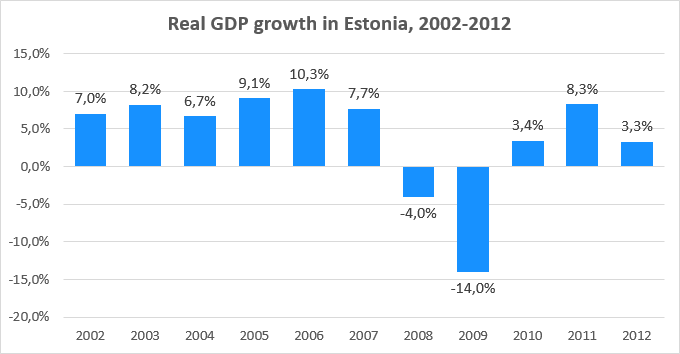
The 2008 financial crisis had a deep effect on the economy, primarily as a result of an investment and consumption slump, that followed the burst of the real estate market bubble that had been building up. In December 2008, Estonia became a donor country to the IMF-led rescue package for Latvia. In response to the crisis, the Ansip government opted for fiscal consolidation and retrenchment by maintaining fiscal discipline and a balanced budget in combination with austerity packages: The government increased taxes, and reduced public spending by slashing expenditures and public salaries across the board.
After a long period of very high growth of GDP, the GDP of Estonia decreased. In the first quarter 2008, GDP grew only 0.1%, and then decreased: negative growth was −1.4% in the 2nd quarter, a little over −3% (on a year-to-year basis) in the 3rd quarter, and −9.4% in the 4th quarter of that year.
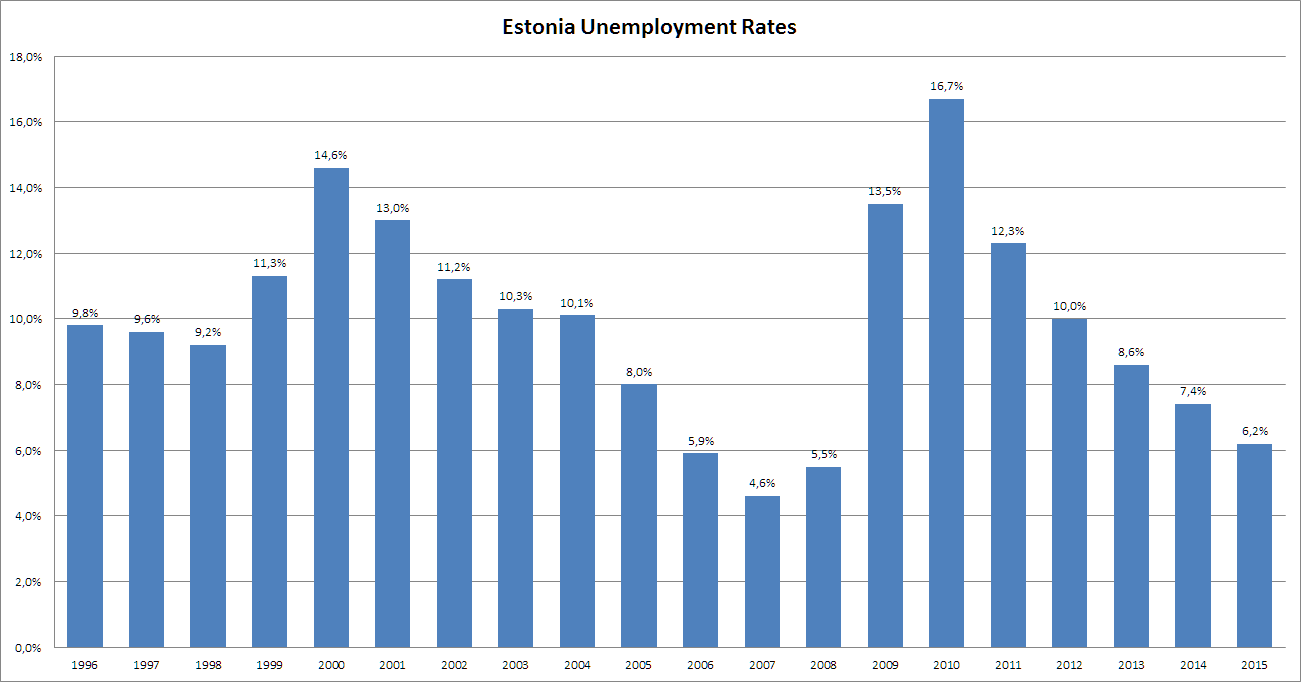
The government made a supplementary negative budget, which was passed by the Riigikogu. The revenue of the budget was decreased for 2008 by EEK 6.1 billion and the expenditure by EEK 3.2 billion. A current account-deficit was extant, but began to shrink in late 2008. In 2009, the economy further contracted by 15% in the first quarter. Low domestic and foreign demand depressed the economy's overall output. The economy's 34% industrial production drop was the sharpest decrease in industrial production in the European Union. Estonia was one of the five worst-performing economies in the world in terms of annual growth, and had one of the highest rates of unemployment in the EU, which rose from 4% in May 2008 to 16% in May 2009.
In July 2009, the value-added tax was increased from 18% to 20%. The recorded budget deficit for 2009 was just 1.7% of GDP. The result was, that Estonia was one of only five EU countries in 2009 that met the Maastricht criteria for debt and deficit, and had the third-lowest deficit after Luxembourg and Sweden; Estonia did not ask for support from the IMF. Despite the third-largest drop in GDP, the country had the lowest budget deficit and lowest public debt among Central and Eastern European countries. In 2009, the Estonian economy began to rebound, and economic growth resumed in the second half of 2010. The country's unemployment rate dropped significantly to pre-recession levels. To top it off, Estonia was granted permission in 2010 to join the eurozone in 2011.
Joining the euro
Before joining the eurozone, the Estonian kroon had been pegged to the euro at a rate of 15.64664 EEK to one euro; before then, the kroon was pegged to the German mark at approximately 8 EEK to 1 DEM.
The design of Estonian euro coins was finalized in late 2004. Estonia's journey towards the euro took longer than originally projected, owing to the inflation rate continually being above the required 3% before 2010, which prevented the country from fulfilling the entry criteria. The country originally planned to adopt the euro on 1 January 2007 and officially changed its target date twice: first to 1 January 2008, and later to 1 January 2011.
On 12 May 2010, the European Commission announced that Estonia had met all criteria to join the eurozone. On 8 June 2010, EU finance ministers. In July 2010, Estonia received the final approval from ECOFIN to adopt the euro onwards from 1 January 2011; on that date Estonia became the 17th eurozone member state and circulated alongside the kroon until 14 January 2011. With that, Estonia became one of the first post-Soviet states to join the eurozone.
In August 2011, Standard & Poor's raised Estonia's credit rating from A to AA-. Among various factors, S&P cited as contributing to its decision was confidence in Estonia's ability to "sustain strong economic growth." Estonia's GDP growth rate in 2011 was above 8%, despite having negative population growth.
The Estonian economy was hit by the COVID-19 recession before bouncing back with an 8.6% rise in GDP in 2021, this was followed by the economic effect of the Russian invasion of Ukraine in February 2022 resulting in a fall in GDP of 1.3% in 2022 and high inflation which hit 24% before falling to single digits in 2023.
The economy today
"Since reestablishing independence, Estonia has styled itself as the gateway between East and West and pursued economic reform and integration with the West." Estonia's market reforms put it among the economic leaders in the former COMECON area. A balanced budget, almost non-existent public debt, flat-rate income tax, free trade regime, adoption of the euro, competitive commercial banking sector, hospitable environment for foreign investment, innovative e-Services and mobile-based services are hallmarks of Estonia's free-market-based economy.
The privatisation of state-owned firms is virtually complete, with only the port and main power plants remaining in government hands. The constitution requires a balanced budget, and the protection afforded by Estonia's intellectual property laws is similar to that of the EU. Near-ideal conditions for the banking sector exist. Foreigners are not restricted from buying bank shares or acquiring majority holdings.
In 2013, the average monthly gross wage in Estonia was €980 (US$1,330). This figure has grown consistently to €2,213 (US$2,573) as of June 2025.
Estonia offers unique tax conditions for businesses, where the tax on undistributed profits is 0%. This allows companies that reinvest their profits into development to avoid tax obligations and allocate more funds for growth and expansion. In 2024, Estonia holds the first place in the International Tax Competitiveness Index and on a permanent basis is taking top positions in the Economic Freedom Index (8th place) and in the Ease of Doing Business Index (18th place).
Projections and circular economy
In 2011, according to projections made by CEPII by 2050, Estonia could become the most productive country in the EU, after Luxembourg, and so join the top five most productive nations in the world.
According to the Ministry of Environment, Estonia committed to developing a circular economy strategic document and action plan by 2021. In March 2020, the Estonian Circular Economy Industries Association, specified that Estonia should consider the new European Green Deal and principles of circular economy when making investments to recover the economy after Covid.
Employment participation
Estonia has around 600,000 employees, yet the country has a shortage of skilled labor, and since skill shortages are experienced everywhere in Europe, the government has increased working visa quota for non-EEA citizens, although it has nevertheless been criticized for being inadequate for addressing the shortages.
The late-2000s recession in the world, the near-concurrent local property bust with changes in Estonian legislation to increase labour market flexibility (making it easier for companies to lay off workers) saw Estonia's unemployment rate shoot up to 18.8% throughout the duration of the crisis, then stabilise to 13.8% by summer 2011, as the economy recovered on the basis of strong exports. Internal consumption, and therefore imports, plummeted; and cuts were made in public finances. Some of the reduction in unemployment has been attributed to some Estonians' emigrating for employment to Finland, the UK, Australia, and elsewhere.
After the recession, the unemployment rate went lower, and throughout 2015 and 2016, the rate stayed near the levels that preceded the economic downturn, staying at just above 6%. In 2020-2023 the unemployment rate moved around between 5.2% and 7.7%.
Sectors
Tallinn has emerged as the country's financial center. According to Invest in Estonia, advantages of Estonian financial sector are unbureaucratic cooperation between companies and authorities, and relative abundance of educated people although young educated Estonians tend to emigrate to western Europe for greater income. The largest banks are Swedbank, SEB Pank, and Nordea. Several IPOs have been made recently on the Tallinn Stock Exchange, a member OMX system.
The Estonian service sector employs over 60% of workforce. Estonia has a strong information technology (IT) sector, partly due to the Tiigrihüpe project undertaken in mid-1990s, and has been mentioned as the most "wired" and advanced country in Europe in the terms of e-government.
Farming, which had been forcibly collectivized for decades until the transition era of 1990–1992, has become privatized and more efficient, and the total farming area has increased in the period following Estonia's restoration of independence. The share of agriculture in the gross domestic product decreased from 15% to 3.3% during 1991–2000, while employment in agriculture decreased from 15% to 5.2%.{{cite press release |access-date = 11 August 2011 |archive-date = 8 August 2014 |archive-url = https://web.archive.org/web/20140808045815/http://www.stat.ee/18533 |url-status = dead
The mining industry makes up 1% of the GDP. Mined commodities include oil shale, peat, and industrial minerals, such as clays, limestone, sand and gravel. Soviets created badly polluting industry in the early 1950s, concentrated in the north-east of the country. Socialist economy and military areas left the country highly polluted, and mainly because of oil shale industry in Ida-Virumaa, sulfur dioxide emissions per person are almost as high as in the Czech Republic. The coastal seawater is polluted in certain locations, mainly the east. The government is looking for ways to reduce pollution further. In 2000, the emissions were 80% smaller than in 1980, and the amount of unpurified wastewater discharged to water bodies was 95% smaller than in 1980.
Estonian productivity is experiencing rapid growth, and consequently wages are also rising quickly, with a rise in private consumption of about 8% in 2005. According to Estonian Institute of Economic Research, the largest contributors to GDP growth in 2005 were processing industry, financial intermediation, retailing and wholesale trade, transport and communications.
Agriculture
Estonia produced in 2018:
- 450 thousand tons of wheat;
- 347 thousand tons of barley;
- 113 thousand tons of rapeseed;
- 88 thousand tons of potato;
- 78 thousand tons of oat;
- 53 thousand tons of pea;
- 29 thousand tons of rye;
In addition to smaller productions of other agricultural products.
Largest companies by revenue
| Company | last=Oja | first=Tõnis | title=POSTIMEHE ETTEVÕTETE TOP 100. Ülikiire inflatsioon andis ettevõtetele tiivad | language=et | publisher=Postimees | url=https://majandus.postimees.ee/7894519/postimehe-ettevotete-top-100-ulikiire-inflatsioon-andis-suurettevotetele-tiivad | access-date=30 October 2023}} |
|---|---|---|---|---|---|---|---|
| Eesti Energia | 2218.2 | ||||||
| Bolt Technology | 1263.8 | ||||||
| Eesti Gaas | 1012.6 | ||||||
| Orlen Eesti | 958.0 | ||||||
| Tallinna Kaubamaja | 862.8 | ||||||
| Tallink Grupp | 771.4 | ||||||
| Tavid | 738.8 | ||||||
| Olerex | 637.7 | ||||||
| Alexela | 620.4 | ||||||
| Graanul Invest | 589.9 |
Largest companies by profit
| Company | Profit |
|---|---|
| (EUR millions) | |
| Eesti Energia | 215.7 |
| Swedbank | 206.7 |
| State Forest Management Centre | 138.4 |
| Luminor Pank | 124.7 |
| SEB Pank | 115.9 |
| Graanul Invest | 111.6 |
| Eesti Gaas | 95.2 |
| Baltic Maritime Logistics Group | 73.3 |
| LHV Group | 61.4 |
| Telia Eesti | 54.0 |
In 2022, the sector with the highest number of companies registered in Estonia is Services with 144,514 companies followed by Finance, Insurance, and Real Estate and Retail Trade with 47,001 and 26,635 companies respectively.
Infrastructure
Main article: Transport in Estonia

Railway transport dominates the cargo sector, comprising 70% of all carried goods, domestic and international. Road transport is the one that prevails in the passenger sector, accounting for over 90% of all transported passengers. 5 major cargo ports offer easy navigational access, deep waters, and good ice conditions. There are 12 airports and 1 heliport in Estonia. Lennart Meri Tallinn Airport is the largest airport in Estonia, with 1,73 million passengers and 22,764 tons of cargo (annual cargo growth 119.7%) in 2007. International flight companies such as SAS, Finnair, Lufthansa, EasyJet, and Nordic Aviation Group provide direct flights to 27 destinations.
Approximately 7.5% of the country's workforce is employed in transportation and the sector contributes over 10% of GDP. Estonia is getting much business from traffic between European Union and Russia, especially oil cargo through Estonian ports. Transit trade's share of GDP is disputed, but many agree that Russia's increased hostility is decreasing the share.
Instead of coal, electricity is generated by burning oil shale, with largest stations in Narva. Oil shale supplies around 70% of the country's primary energy. Other energy sources are natural gas imported from Russia, wood, motor fuels, and fuel oils.
Wind power in Estonia amounts to 58.1 megawatts, whilst roughly 399 megawatts worth of projects are currently being developed. Estonian energy liberalization is lagging far behind the Nordic energy market. During the accession negotiations with the EU, Estonia agreed that at least 35% of the market are opened before 2009 and all of non-household market, which totals around 77% of consumption, before 2013. Estonia is concerned that Russia could use energy markets to bully it. In 2009, the government considered granting permits to nuclear power companies, and there were plans for a shared nuclear facility with Latvia and Lithuania. Those plans were shelved after the Fukushima Daiichi nuclear disaster in March 2011.
Estonia has high Internet penetration, and connections are available throughout most of the country.
Trade
| Country | Export | Import |
|---|---|---|
| Finland | 17% | 15% |
| Latvia | 12% | 11% |
| Sweden | 9% | 8% |
| Lithuania | 8% | 10% |
| Germany | 7% | 12% |
| Netherlands | 4% | 6% |
Estonia exports electrical equipment (14% of all exports annually), wood and wooden articles (11% of all exports annually), food and agricultural products (11% of all exports annually), mineral products (10% of all exports annually), and transport equipment (10% of all exports annually). Estonia imports electrical and transport equipment (26% of all imports annually, 13% each), mineral products (12% of all imports annually), food and agricultural products (11% of all imports annually), machinery and mechanical appliances (10% of all imports annually).
Natural resources
| Resource | Location | Reserves |
|---|---|---|
| Oil shale | north-east | 1,137,700,000 mln t |
| Sea mud (medical) | south | 1,356,400,000 mln t |
| Construction sand | across the country | 166,700,000 mln m3 |
| Construction gravel | north | 32,800,000 mln m3 |
| Lake mud (medical) | across the country | 1,133,300 mln t |
| Lake mud (fertilizer) | east | 170,900 t |
| Ceramic clay | across the country | 10,600,000 mln m3 |
| Ceramsid clay (for gravel) | across the country | 2,600,000 mln m3 |
| Technological dolomite | west | 16,600,000 mln m3 |
| Technological limestone | north | 13,800,000 mln m3 |
| Decoration dolomite | west | 2,900,000 mln m3 |
| Construction dolomite | west | 32,900,000 mln m3 |
| Blue clay | across the country | 2,044,000 mln t |
| Granite | across the country | 1,245,100,000 mln m3 |
| Peat | across the country | 230,300,000 mln t |
| Construction limestone | north | 110,300,000 mln m3 |
| Limestone cement | north | 9,400,000 mln m3 |
| Clay cement | north | 15,6000,000 mln m3 |
| Graptolitic argillite | north | 64,000,000,000 mln t |
| Wood | across the country | 15,6000,000 mln m3 |
| Technological sand | north | 3,300,000 mln m3 |
| Lake lime | north and south | 808,000 t |
| Phosphorite | north | over 350,000,000 mln t (estimated) |
| Subsoil | across the country | 21,1 km3 |
Data
The following table shows the main economic indicators in 1993–2018.
| Year | GDP | ||||||
|---|---|---|---|---|---|---|---|
| (in Bil. US$ PPP) | GDP per capita | ||||||
| (in US$ PPP) | GDP | GDP growth | |||||
| (real) | Inflation rate | ||||||
| (in Percent) | Unemployment | ||||||
| (in Percent) | Government debt | ||||||
| (in % of GDP) | |||||||
| 1993 | 11.2 | 7,338 | 1.8 | n/a | 6.5% | n/a | |
| 1994 | 11.3 | 2.5 | n/a | ||||
| 1995 | 11.7 | 8,022 | 3.9 | 2.2% | 29.0% | 9.6% | 9% |
| 1996 | 12.5 | 4.8 | |||||
| 1997 | 14.4 | 5.2 | |||||
| 1998 | 15.2 | 5.6 | |||||
| 1999 | 15.3 | 5.7 | |||||
| 2000 | 17.3 | 12,113 | 5.7 | 10.6% | 3.9% | 14.6% | 5% |
| 2001 | 18.8 | 6.3 | |||||
| 2002 | 20.3 | 7.4 | |||||
| 2003 | 22.3 | 9.9 | |||||
| 2004 | 24.5 | 12.2 | |||||
| 2005 | 27.7 | 19,765 | 14.1 | 9.4% | 4.1% | 8.0% | 5% |
| 2006 | 31.3 | 22,600 | 17.1 | 10.3% | 4.4% | 5.9% | 4% |
| 2007 | 34.6 | 25,144 | 22.5 | 7.7% | 6.7% | 4.6% | 4% |
| 2008 | 33.4 | 24,328 | 24.4 | −5.4% | 10.6% | 5.5% | 4% |
| 2009 | 28.7 | 20,946 | 19.7 | −14.7% | 0.2% | 13.5% | 7% |
| 2010 | 29.8 | 21,721 | 19.6 | 2.3% | 2.7% | 16.7% | 7% |
| 2011 | 32.6 | 23,919 | 23.2 | 7.6% | 5.1% | 13.2% | 6% |
| 2012 | 34.4 | 25,494 | 23.0 | 4.3% | 4.2% | 10.0% | 10% |
| 2013 | 36.2 | 26,508 | 25.1 | 1.9% | 3.2% | 8.6% | 10% |
| 2014 | 38.1 | 27,856 | 26.6 | 2.9% | 0.5% | 7.4% | 11% |
| 2015 | 38.4 | 28,685 | 22.9 | 1.7% | 0.1% | 6.2% | 10% |
| 2016 | 41.2 | 29,684 | 24.1 | 2.1% | 0.9% | 6.8% | 9% |
| 2017 | 44.7 | 31,750 | 26.9 | 4.9% | 3.7% | 5.8% | 9% |
| 2018 | 47.5 | 30.6 | |||||
| 2019 | 50.3 | 31.3 |
Gross domestic product per capita by county.
| GDP per capita, euros | County | 2023 |
|---|---|---|
| Whole country | 27,868.5 | |
| Harju county | 36,709.5 | |
| ..Tallinn | 41,916.7 | |
| Hiiu county | 18,034.7 | |
| Ida-Viru county | 19,678.1 | |
| Jõgeva county | 16,973.3 | |
| Järva county | 19,483.0 | |
| Lääne county | 16,022.8 | |
| Lääne-Viru county | 18,277.6 | |
| Põlva county | 14,623.7 | |
| Pärnu county | 18,889.2 | |
| Rapla county | 15,946.1 | |
| Saare county | 17,084.9 | |
| Tartu county | 27,021.8 | |
| ..Tartu city | 32,183.3 | |
| Valga county | 14,592.1 | |
| Viljandi county | 19,320.5 | |
| Võru county | 16,664.2 |
References
References
- "Groups and Aggregates Information". [[International Monetary Fund]].
- "World Bank Country and Lending Groups". [[World Bank]].
- "Population on 1 January". [[Eurostat]].
- "World Economic Outlook database: April 2024". [[International Monetary Fund]].
- (30 January 2024). "Corruption Perceptions Index".
- "The World Factbook". [[Central Intelligence Agency]].
- "At-risk-of-poverty rate". Statistics Estonia.
- "People at risk of poverty or social exclusion". [[Eurostat]].
- "Gini coefficient of equivalised disposable income – EU-SILC survey". [[World Bank]].
- (6 May 2025). "Human Development Report 2025". [[United Nations Development Programme]].
- "Labor force, total – Estonia". [[World Bank]].
- "Employment rate by sex, age group 20-64". [[Eurostat]].
- "Unemployment by sex and age – monthly average". [[Eurostat]].
- "Unemployment rate by age group". [[OECD]].
- (9 February 2024). "Foreign trade decreased significantly in 2023". Statistics Estonia.
- "Euro area and EU27 government deficit both at 0.6% of GDP". Eurostat.
- "Archived copy".
- "Archived copy".
- "Scope affirms the Republic of Estonia's A+ rating with Stable Outlook". Scope Ratings.
- (April 2011). "World Economic and Financial Surveys / World Economic Outlook". [[International Monetary Fund]].
- "Kuidas läheb Soome majandusel? | SEB".
- "GDP per capita (current US$)". [[World Bank]].
- "History of Estonia". Britannica.
- Maddison, Angus. (2006). "The world economy". OECD Publishing.
- (16 March 2024). "The Spread of the Flat Tax in Eastern Europe: A Comparative Study". Eastern European Economics.
- Laar, Mart. (7 August 2007). "The Estonian Economic Miracle". [[The Heritage Foundation]].
- (1993). "Estonia: The Transition to a Market Economy". World Bank.
- (2011). "Estonia: A Giant of the Baltics". International Monetary Fund.
- Tubalkain-Trell, Marge. (9 June 2009). "Estonian Economy Fell 15.1 pct in Q1". Baltic Business News.
- (15 May 2008). "Government approves supplementary budget for 2008". [[Ministry of Finance (Estonia).
- Mardiste, David. (9 June 2009). "Estonian Economy Contracts Sharply in First Quarter".
- Tubalkain-Trell, Marge. (12 June 2009). "Estonian Industrial Production Fell Most in EU". Baltic Business News.
- (2009). "Country Comparison – National product real growth rate". CIA.
- Zumbrun, Joshua. (2009-07-08). "In Pictures: The World's Hardest-Hit Economies".
- Tubalkain-Trell, Marge. (18 June 2009). "MPs approve plan to increase VAT rate to 20 pct". Baltic Business News.
- (August 2011). "Why Did Estonia Choose Fiscal Retrenchment after the 2008 Crisis?". Journal of Public Policy.
- (2019). "Töötuse määr". Statistics Estonia.
- (2011-07-11). "The Estonian euro coin". [[Bank of Estonia]].
- (2019). "Tarbijahinnaindeksi muutus". Statistics Estonia.
- (25 May 2007). "Alcohol and tobacco tax to rise in Estonia next year". [[Helsingin Sanomat]].
- (12 May 2010). "Estonia ready for euro". [[European Commission]].
- [http://www.actionforex.com/analysis/daily-forex-fundamentals/estonia-to-join-euro-1-january-2011-20100608115064/ Estonia to Join Euro 1 January 2011] {{webarchive. link. (11 June 2010)
- Mardiste, David. (1 January 2011). "Estonia joins crisis-hit euro club". [[Reuters]].
- Ummelas, Ott. (9 August 2011). "Estonia's Rating Raised to AA- by S&P on Economic Growth, Strong Finances". [[Bloomberg L.P..
- "Unemployment in Europe (monthly)". [[Google Public Data Explorer]].
- "GDP Growth Rate". Google Public Data.
- (1 March 2022). "Economic growth will slow".
- (30 September 2022). "Eurostat: Inflation in Estonia 24.2 percent in September".
- "Estonia (03/04)".
- Andmevara, AS. (February 24, 1918). "The Constitution of the Republic of Estonia–Riigi Teataja".
- World Intellectual Property Organization. (2022). "Intellectual property statistical country profile: Estonia". European Climate, Infrastructure and Environment Executive Agency.
- "Estonia".
- (October 15, 2020). "Protecting Intellectual Property".
- (30 September 2013). "Most requested statistics". [[Statistics Estonia]].
- "Average monthly gross wages and salaries {{!}} Statistikaamet".
- "Company Registration in Estonia {{!}} Your Quick Start in the EU".
- Firma, Eesti. "Company Formation in Estonia {{!}} Start a Business in the EU".
- "CEPII Country Profiles: Estonia".
- (February 2012). "The Great Shift: Macroeconomic projections for the world economy at the 2050 horizon". [[Centre d'Etudes Prospectives et d'Informations Internationales.
- (5 July 2019). "Creating a strategy and action plan for circular economy in Estonia". ringmajandus.envir.ee.
- (5 July 2019). "Ringmajanduse strateegia koostamise metoodika väljatöötamine". ringmajandus.envir.ee.
- (2020). "ESTONIAN CIRCULAR ECONOMY INDUSTRIES ASSOCIATION: ESTONIA SHOULD CONSIDER THE GREEN DEAL AND PRINCIPLES OF CIRCULAR ECONOMY WHEN MAKING INVESTMENTS TO RECOVER THE ECONOMY". EESTI PAKENDIRINGLUS.
- (14 July 2011). "Estonian exceptionalism". [[The Economist]].
- Tammaru, Tiit. (April 2012). "Social Impact of Emigration and Rural-Urban Migration in Central and Eastern Europe".
- "Most requested statistics". Statistics Estonia.
- "Estonia Unemployment Rate".
- (21 August 2007). "Hackers Take Down the Most Wired Country in Europe".
- "Government of Estonia homepage". [[Government of Estonia]].
- Laansalu, Ants. (9 October 2009). "Crisis in agriculture in the 1990s". [[Estonica]].
- Kuo, Chin S.. (2001). "The Mineral Industries of Estonia, Latvia, and Lithuania". U.S. Geological Survey Mineral Resources Program.
- Estonian Environment Information Centre. (8 October 2016). "Pollution load". [[UNEP/GRID-Arendal]] – Central & Eastern Europe, Caucasus, and Central Asia.
- (17 May 2005). "Environment – current issues (section)". [[University of Missouri–St. Louis]].
- Estonian Institute of Economic Research. (November 2006). "Top Estonian Enterprises 2006". Enterprise Estonia.
- "Estonia production in 2018, by FAO".
- Oja, Tõnis. "POSTIMEHE ETTEVÕTETE TOP 100. Ülikiire inflatsioon andis ettevõtetele tiivad". Postimees.
- "Industry Breakdown of Companies in Estonia".
- link. (7 July 2007 , Invest in Estonia)
- Purju, Alari. (29 February 2008). "Transit trade through Estonia: problems and developments". [[University of Turku]], [[Pan-European Institute]].
- Tubalkain-Trell, Marge. (19 June 2008). "Estonian businessman: Estonian transit will struggle another 10 years". Baltic Business News.
- (2004). "Countries: Estonia". Baltic Wind Energy Association.
- (September 2006). "Energy Security of Estonia in the Context of the Energy Policy of the European Union". Estonian Foreign Policy Institute.
- (18 February 2009). "Latvia, Estonia push for Baltic nuclear plant". Spacedaily.com.
- "Foreign trade decreased significantly in 2023". [[Statistikaamet]].
- "Maavarad". [[University of Tartu]].
- (January 2018). "Report for Selected Countries and Subjects". [[International Monetary Fund]].
- "RAA0050: Gross domestic product by county (ESA 2010)".
This article was imported from Wikipedia and is available under the Creative Commons Attribution-ShareAlike 4.0 License. Content has been adapted to SurfDoc format. Original contributors can be found on the article history page.
Ask Mako anything about Economy of Estonia — get instant answers, deeper analysis, and related topics.
Research with MakoFree with your Surf account
Create a free account to save articles, ask Mako questions, and organize your research.
Sign up freeThis content may have been generated or modified by AI. CloudSurf Software LLC is not responsible for the accuracy, completeness, or reliability of AI-generated content. Always verify important information from primary sources.
Report