From Surf Wiki (app.surf) — the open knowledge base
Economic sector
Economical term
Economical term


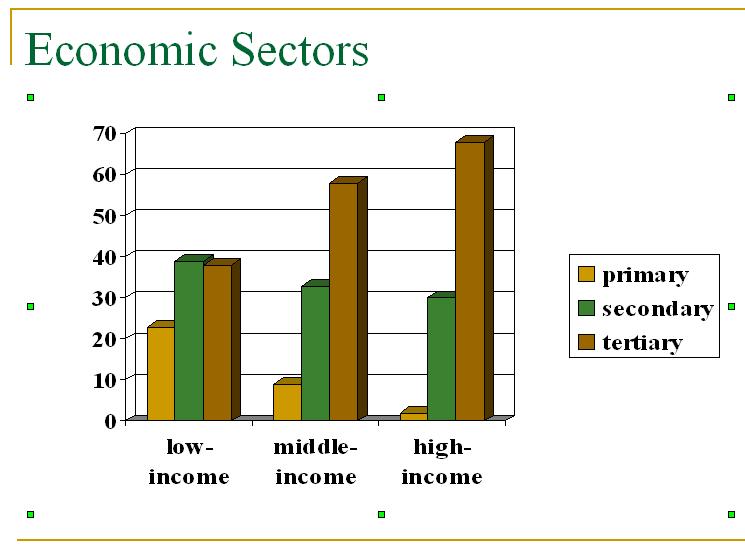
An economic sector is a part of an economy that includes similar economic activities and industries. One classical breakdown of economic activity distinguishes three sectors:
- Primary: involves the retrieval and production of raw materials, such as corn, coal, wood or iron. Miners, farmers and fishermen are all workers in the primary sector.
- Secondary: involves the transformation of raw materials or intermediate goods into goods, as in steel into cars, or textiles into clothing. Builders and dressmakers work in the secondary sector.
- Tertiary: involves the supplying of services to consumers and businesses, such as babysitting, cinemas or banking. Shopkeepers and accountants work in the tertiary sector.
In the 20th century, economists began to suggest that traditional tertiary services could be further distinguished from "quaternary" and quinary service sectors. Economic activity in the hypothetical quaternary sector comprises information- and knowledge-based services, while quinary services include industries related to human services and hospitality.{{cite web | access-date =20 April 2012 | archive-date =19 November 2016 | archive-url =https://web.archive.org/web/20161119173743/http://geography.about.com/od/urbaneconomicgeography/a/sectorseconomy.htm | url-status =dead
Economic theories divide economic sectors further into economic industries.
Historic evolution
An economy may include several sectors that evolved in successive phases:
- The ancient economy built mainly on the basis of subsistence farming.
- The Industrial Revolution lessened the role of subsistence farming, converting land-use to more extensive and monocultural forms of agriculture over the last three centuries. Economic growth took place mostly in the mining, construction and manufacturing industries.
- In the economies of modern consumer societies, services, finance, and technology—the knowledge economy—play an increasingly significant role.
Even in modern times, developing countries tend to rely more on the first two sectors, in contrast to developed countries.
By ownership
An economy can also be divided along different lines:
- Public sector or state sector
- Private sector or privately run businesses
- Voluntary sector
References
References
- Zoltan Kenessey. "Public private and tertiary and Quaternary Sectors of the Economy". The Review of Income and Wealth.
This article was imported from Wikipedia and is available under the Creative Commons Attribution-ShareAlike 4.0 License. Content has been adapted to SurfDoc format. Original contributors can be found on the article history page.
Ask Mako anything about Economic sector — get instant answers, deeper analysis, and related topics.
Research with MakoFree with your Surf account
Create a free account to save articles, ask Mako questions, and organize your research.
Sign up freeThis content may have been generated or modified by AI. CloudSurf Software LLC is not responsible for the accuracy, completeness, or reliability of AI-generated content. Always verify important information from primary sources.
Report