From Surf Wiki (app.surf) — the open knowledge base
Echidna
Family of mammals

Family of mammals
T. aculeatus
Genus Zaglossus
Z. attenboroughi
Z. bruijnii
Z. bartoni
Genus †Megalibgwilia
†M. owenii
†M. robusta
Genus †Murrayglossus
†M. hacketti Echidnas (), sometimes known as spiny anteaters, monotremes (egg-laying mammals) belonging to the family Tachyglossidae , living in Australia and New Guinea. The four extant species of echidnas and the platypus are the only living mammals that lay eggs and the only surviving members of the order Monotremata. The diet of some species consists of ants and termites, but they are not closely related to the American true anteaters or to hedgehogs. Their young are called puggles.
Echidnas evolved between 20 and 50 million years ago and descend from an amphibious, platypus-like monotreme.
Etymology
Echidnas are possibly named after Echidna, a creature from Greek mythology who was half-woman, half-snake, as the animal was perceived to have qualities of both mammals and reptiles. An alternative explanation is a confusion with .
A synonym for the echidna, in a mid-19th century British Encyclopaedia, is, “hedgehog of the Colonists at Sidney [sic]”.
Physical characteristics
Echidnas are medium-sized, solitary mammals covered with coarse hair and spines. The spines are modified hairs and are made of keratin, the same fibrous protein that makes up fur, claws, nails, and horn sheaths in animals.
Superficially, they resemble the anteaters of South America and other spiny mammals such as hedgehogs and porcupines. They are usually black or brown in coloration. There have been several reports of albino echidnas with pink eyes and white spines. This is similar to the platypus, which has 40,000 electroreceptors on its bill, but the long-beaked echidna has only 2,000, while the short-beaked echidna, which lives in a drier environment, has no more than 400 at the tip of its snout.
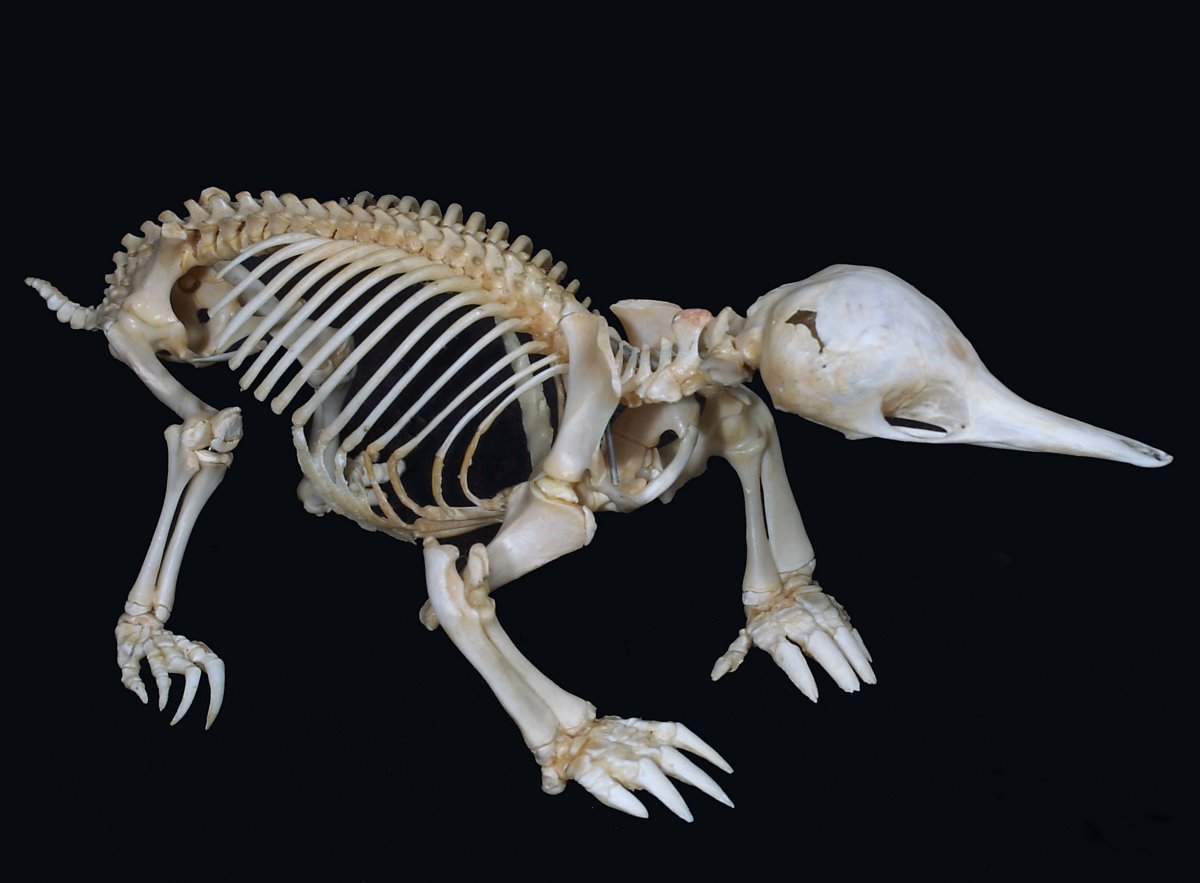
Echidnas have short, strong limbs with large claws, and are powerful diggers. Their hind claws are elongated and curved backwards to aid in digging. Echidnas have tiny mouths and toothless jaws, and feed by tearing open soft logs, anthills and the like, and licking off prey with their long, sticky tongues. The ears are slits on the sides of their heads under the spines. The external ear is created by a large cartilaginous funnel, deep in the muscle. At 33 °C (91.4 °F), echidnas also possess the second-lowest active body temperature of all mammals, behind the platypus.
Despite their appearance, echidnas are capable swimmers, as they evolved from platypus-like ancestors. When swimming, they expose their snout and some of their spines, and are known to journey to water to bathe.
The first European drawing of an echidna was made in Adventure Bay, Tasmania by 's third lieutenant George Tobin during William Bligh's second breadfruit voyage.
Diet
The short-beaked echidna's diet consists mostly of ants and termites, while the Zaglossus (long-beaked) species typically eat worms and insect larvae. Echidnas' faeces are 7 cm long and are cylindrical in shape; they are usually broken and unrounded, and composed largely of dirt and ant-hill material.
Habitat
Echidnas do not tolerate extreme temperatures; they shelter from harsh weather in caves and rock crevices. Echidnas are found in forests and woodlands, hiding under vegetation, roots or piles of debris. They sometimes use the burrows (both abandoned and in use) of animals such as rabbits and wombats. Individual echidnas have large, mutually overlapping territories.
Anatomy
Echidnas and platypuses are the only egg-laying mammals, the monotremes. The average lifespan of an echidna in the wild is estimated at 14–16 years. Fully grown females can weigh about 4.5 kg, the males 33% larger, at about 6 kg. Though the internal reproductive organs differ, both sexes possess an identical single cloaca opening for urination, defecation, and mating.
Male echidnas have non-venomous spurs on the hind feet, similar to the venomous male platypus.
Due to their low metabolism and accompanying stress resistance, echidnas are long-lived for their size; the longest recorded lifespan for a captive echidna is 50 years, with anecdotal accounts of wild individuals reaching 45 years.
The echidna's brain is half neocortex, compared to 80% of a human brain. Contrary to previous research, the echidna does enter REM sleep, but only in a comfortable temperature around 25 °C (77 °F). At lower or higher temperatures of 15 °C (59 °F) and 28 °C (82 °F), REM sleep is suppressed.
Reproduction
The female lays a single soft-shelled, leathery egg 22 days after mating, and deposits it directly into her pouch. An egg weighs 1.5 to and is about 1.4 cm long. While hatching, the baby echidna opens the leather shell with a reptile-like egg tooth. Hatching takes place after 10 days of gestation; the young echidna, called a puggle, born larval and fetus-like, then sucks milk from the pores of the two milk patches (monotremes have no teats) and remains in the pouch for 45 to 55 days, During mating, the heads on one side "shut down" and do not grow in size; the other two are used to release semen into the female's two-branched reproductive tract. Each time it copulates, it uses the pair of heads opposite those it used the previous time. These may be used to induce ovulation in the female. It is a challenge to study the echidna in its natural habitat, and they show no interest in mating while in captivity. Prior to 2007, no one had ever seen an echidna ejaculate. There have been previous attempts, trying to force the echidna to ejaculate through the use of electrically stimulated ejaculation in order to obtain semen samples but this has only resulted in the penis swelling. Breeding season begins in late June and extends through September. During mating season, a female may be followed by a line or "train" of up to ten males, the youngest trailing last, and some males switching between lines.
Threats
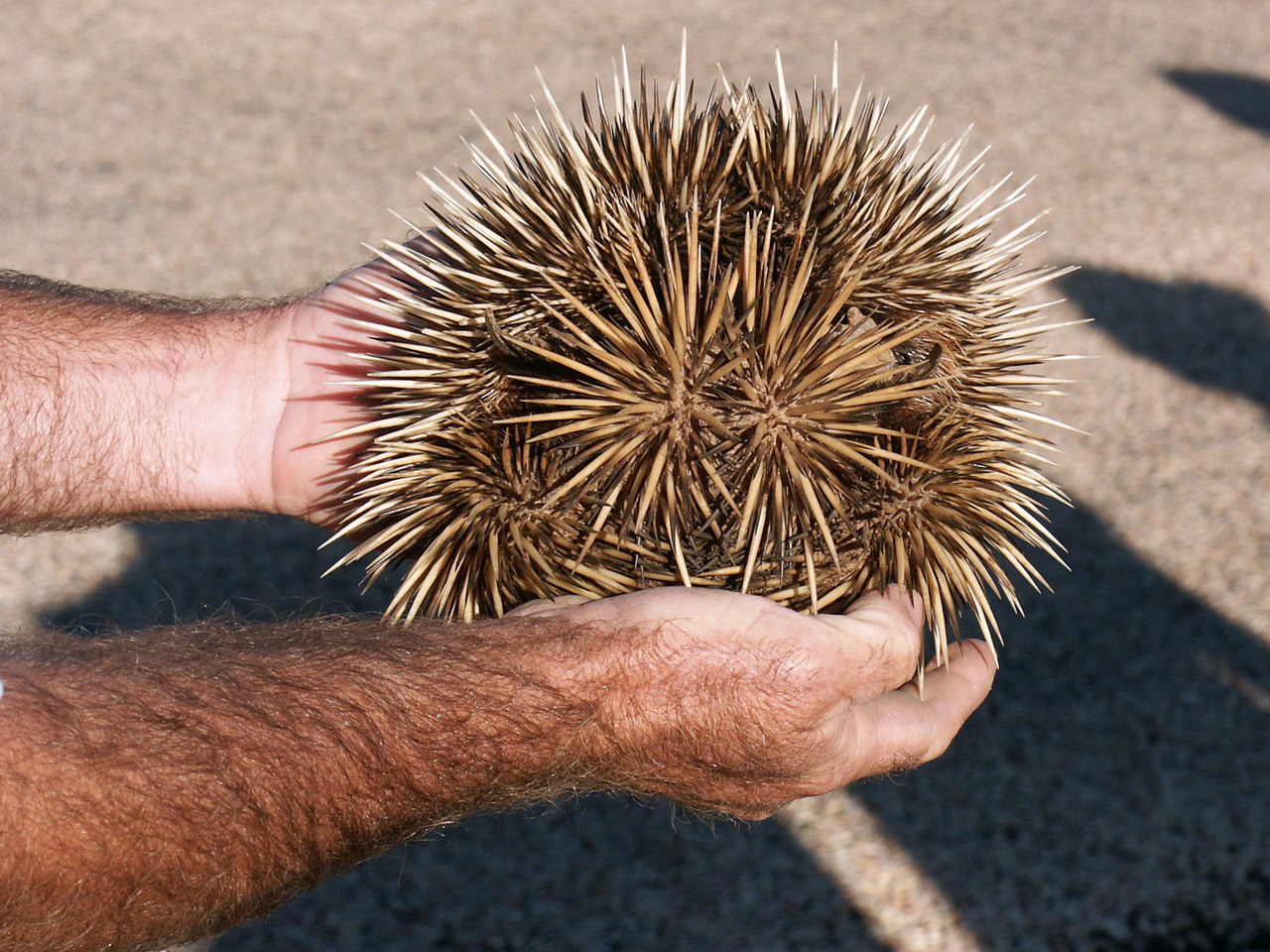
Echidnas are very timid. When frightened, they attempt to partially bury themselves and curl into a ball similar to a hedgehog. Strong front arms allow echidnas to dig in and hold fast against a predator pulling them from the hole.
Their many predators include feral cats, foxes, domestic dogs, and goannas. Snakes pose a large threat when they slither into echidna burrows and prey on the spineless young puggles.
They are easily stressed and injured by handling. Some ways to help echidnas include picking up litter, causing less pollution, planting vegetation for shelter, supervising pets, reporting hurt echidnas, and leaving them undisturbed.
In June 2024, scientists reported a first-of-its-kind encounter when they witnessed a tiger shark regurgitating a whole echidna off the coast of an island near Australia. Sharks are known to eat a wide range of animals, and occasionally objects, according to a news release by the researchers from James Cook University in North Queensland who also noted that sharks had previously been observed eating rocks for no apparent reason.
Evolution
The divergence between oviparous (egg-laying) and viviparous (offspring develop internally) mammals is believed to date to the Triassic period. Most findings from genetics studies (especially of nuclear genes) are in agreement with the palaeontological dating, but some other evidence, like mitochondrial DNA, give slightly different dates.
Molecular clock data suggest echidnas split from platypuses between 19 and 48 million years ago, so that platypus-like fossils dating back to over 112.5 million years ago represent basal forms, rather than close relatives of the modern platypus. This would imply that echidnas evolved from water-foraging ancestors that returned to land living, which put them in competition with marsupials. Although extant monotremes lack adult teeth (platypuses have teeth only as juveniles), many extinct monotreme species have been identified based on the morphology of their teeth. Of the eight genes involved in tooth development, four have been lost in both platypus and echidna, indicating that the loss of teeth occurred before the echidna-platypus split.
Further evidence of water-foraging ancestors can be found in some of the echidna's anatomy, including hydrodynamic streamlining, dorsally projecting hind limbs acting as rudders, and locomotion founded on hypertrophied humeral long-axis rotation, which provides an efficient swimming stroke.
Oviparous reproduction in monotremes may give them an advantage over marsupials in some environments. Their observed adaptive radiation contradicts the assumption that monotremes are frozen in morphological and molecular evolution.
It has been suggested that echidnas originally evolved in New Guinea when it was isolated from Australia and from marsupials. This would explain their rarity in the fossil record, their abundance in present times in New Guinea, and their original adaptation to terrestrial niches, presumably without competition from marsupials.
Taxonomy
|}}
Echidnas are a small clade with two extant genera and four species. The genus Zaglossus includes three extant and two fossil species, with only one extant species from the genus Tachyglossus.
''Zaglossus''
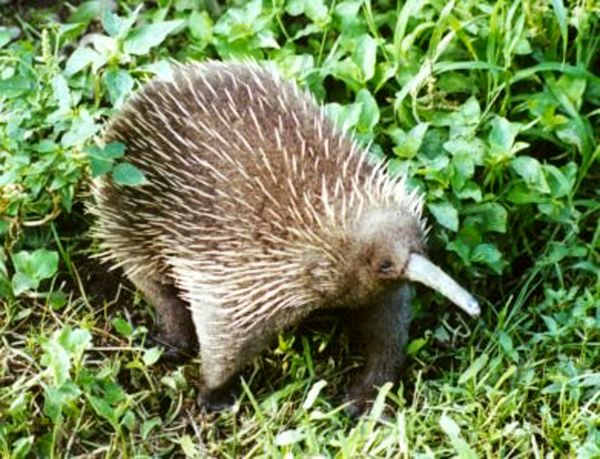
The three living Zaglossus species are endemic to New Guinea. They are rare and are hunted for food. They forage in leaf litter on the forest floor, eating earthworms and insects. The species are
- Western long-beaked echidna (Z. bruijni), of the highland forests;
- Sir David's long-beaked echidna (Z. attenboroughi), discovered by Western science in 1961 (described in 1998) and preferring a still higher habitat;
- Eastern long-beaked echidna (Z. bartoni), of which four distinct subspecies have been identified.
''Tachyglossus''
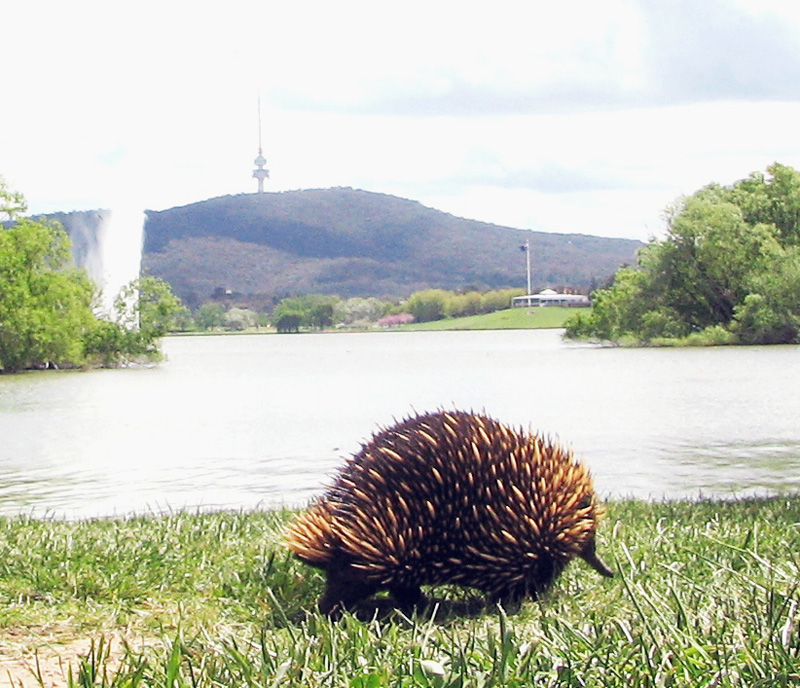
The short-beaked echidna (Tachyglossus aculeatus) is found in southern, southeast and northeast New Guinea, and also occurs in almost all Australian environments, from the snow-clad Australian Alps to the deep deserts of the Outback, essentially anywhere ants and termites are available. It is smaller than the Zaglossus species, and it has longer hair.
Despite the similar dietary habits and methods of consumption to those of an anteater, there is no evidence supporting the idea that echidna-like monotremes have been myrmecophagous (ant or termite-eating) since the Cretaceous. The fossil evidence of invertebrate-feeding bandicoots and rat-kangaroos, from around the time of the platypus–echidna divergence and pre-dating Tachyglossus, show evidence that echidnas expanded into new ecospace despite competition from marsupials.
Additionally, extinct echidnas continue to be described by taxonomists;
''Megalibgwilia''
The genus Megalibgwilia is known only from fossils:
- M. owenii from Late Pleistocene sites in Australia;
- M. robusta from Pliocene sites in Australia.
''Murrayglossus''
The genus Murrayglossus is known only from fossils:
- M. hacketti (previously classified in the genus Zaglossus) from Pleistocene of Western Australia.
As food
The Kunwinjku people of Western Arnhem Land (Australia) call the echidna ngarrbek, and regard it as a prized food and "good medicine". The echidna is hunted at night, gutted, and filled with hot stones and mandak (Persoonia falcata) leaves. According to Larrakia elders Una Thompson and Stephanie Thompson Nganjmirra, once captured, an echidna is carried attached to the wrist like a thick bangle.
In popular culture
- The echidna appears on the reverse of the Australian five-cent coin.
- An echidna named Millie was one of the three official mascots for the 2000 Summer Olympics in Sydney.
- The Sonic the Hedgehog franchise features a range of anthropomorphic animals, one of the most prominent being Knuckles the Echidna.
Notes
References
--
Bibliography
References
- . ["Spines and Quills"](https://animaldiversity.org/collections/spinesquills/). *University of Michigan*.
- "echidna".
- (1848). "The National Encyclopaedia of Useful Knowledge". Charles Knight.
- (2005). "Electroreception". Springer New York.
- "Short-beaked Echidna". Department of Primary Industries, Parks, Water, and Environment.
- "George Tobin journal and sketches on HMS Providence, 1791-1793, with additional material to 1831".
- Carritt, Rachel. "Echidnas: Helping them in the wild". NSW National Parks and Wildlife Service.
- Griffiths, Mervyn. (1978). "The biology of the monotremes". Academic Press.
- Dunbar, R.I.M.. (1993). "Coevolution of neocortical size, group size and language in humans". Behavioral and Brain Sciences.
- Dunbar, R.I.M.. "The Social Brain Hypothesis".
- "Echidnas". Wildcare Australia.
- O'Neil, Dennis. [http://anthro.palomar.edu/animal/echidna_reproduction.htm "Echidna Reproduction"] {{Webarchive. link. (30 April 2015 12 February 2011. Retrieved on 17 June 2015.)
- (11 August 2012). "Monotremes and marsupials: Comparative models to better understand the function of milk". Journal of Biosciences.
- (18 November 2016). "Taronga Zoo welcomes elusive puggles". ABC News.
- thumb. A short-beaked echidna building a defensive burrow in [[French Island National Park]] (43 seconds)]]{{anchor. MatingMale echidnas have a four-headed penis.Grützner, F., B. Nixon, and R. C. Jones. "[https://www.researchgate.net/profile/Russell_Jones6/publication/23233860_Reproductive_Biology_in_Egg-Laying_Mammals/links/09e415129f89e4a467000000.pdf Reproductive biology in egg-laying mammals]." Sexual Development 2.3 (2008): 115–127.
- (2007). "One-Sided Ejaculation of Echidna Sperm Bundles". The American Naturalist.
- (18 August 2008). "Medicine of Australian Mammals". Csiro Publishing.
- (1993). "Asdell's Patterns of Mammalian Reproduction: A Compendium of Species-specific Data". Cornell University Press.
- Orie, Amarachi. (2024-06-06). "Shark regurgitates whole echidna in shocking first sighting".
- (2008). "The oldest platypus and its bearing on divergence timing of the platypus and echidna clades". Proc. Natl. Acad. Sci. U.S.A..
- Musser AM. (2003). "Review of the monotreme fossil record and comparison of palaeontological and molecular data". Comp. Biochem. Physiol. A.
- (2022). "A review of monotreme (Monotremata) evolution". Alcheringa: An Australasian Journal of Palaeontology.
- (2019). "Inferring the mammal tree: Species-level sets of phylogenies for questions in ecology, evolution and conservation". PLOS Biol.
- (2019). "DR_on4phylosCompared_linear_richCol_justScale_ownColors_withTips_80in". PLOS Biology.
- (2023-11-10). "First-ever images prove 'lost echidna' not extinct". BBC News.
- (2025). "Attenborough's echidna rediscovered by combining Indigenous knowledge with camera-trapping". npj Biodiversity.
- (2010). "Reply to Camens: How recently did modern monotremes diversify?". Proc. Natl. Acad. Sci. U.S.A..
- (2022). "A review of monotreme (Monotremata) evolution". Alcheringa: An Australasian Journal of Palaeontology.
- "ngarrbek". Bininj Kunwok Regional Language Centre.
- Goodfellow, D.. (1993). "Fauna of Kakadu and the Top End". Wakefield Press.
- "mandak". Bininj Kunwok Regional Language Centre.
- (8 January 2016). "Royal Australian Mint: 5 cents".
- [https://olympics.com/en/olympic-games/sydney-2000/mascot Sydney 2000: The Mascot – Olympics.com.] Retrieved 4 June 2022.
- Simon, Matt. (19 June 2015). "Absurd Creature of the Week: Forget the Platypus. The Echidna Is the True Champ of Weird".
- "Short-Beaked Echidna, ''Tachyglossus aculeatus''". Park & Wildlife Service Tasmania.
- Stewart, Doug. (April–May 2003). "The Enigma of the Echidna". National Wildlife.
- (2006). "Echidna: extraordinary egg-laying mammal". CSIRO.
- (7 July 2010). "Electroreception in fish, amphibians and monotremes". Map of Life.
- "''Zaglossus bruijni''". AnimalInfo.org.
- "Short-beaked echidna (''Tachyglossus aculeatus'')". Arkive.org.
- Gill, Victoria. (19 November 2012). "Are these animals too 'ugly' to be saved?". BBC News.
- Cason, M.. (2009). "''Tachyglossus aculeatus''". Animal Diversity.
- (March 2000). "The echidna manifests typical characteristics of rapid eye movement sleep". [[Neuroscience Letters.
- Shultz, N.. (26 October 2007). "Exhibitionist spiny anteater reveals bizarre penis". [[New Scientist]].
- (October 2009). "Molecules, morphology, and ecology indicate a recent, amphibious ancestry for echidnas". Proc. Natl. Acad. Sci. U.S.A..
- (1998). "A revision of the genus ''Zaglossus'' (Monotremata, Tachyglossidae), with description of new species and subspecies". Mammalia.
- {{MSW3 Groves
This article was imported from Wikipedia and is available under the Creative Commons Attribution-ShareAlike 4.0 License. Content has been adapted to SurfDoc format. Original contributors can be found on the article history page.
Ask Mako anything about Echidna — get instant answers, deeper analysis, and related topics.
Research with MakoFree with your Surf account
Create a free account to save articles, ask Mako questions, and organize your research.
Sign up freeThis content may have been generated or modified by AI. CloudSurf Software LLC is not responsible for the accuracy, completeness, or reliability of AI-generated content. Always verify important information from primary sources.
Report