From Surf Wiki (app.surf) — the open knowledge base
Ebensburg, Pennsylvania
Borough in Pennsylvania, US

Borough in Pennsylvania, US
| Field | Value | |
|---|---|---|
| official_name | Ebensburg, Pennsylvania | |
| settlement_type | Borough | |
| motto | Crossroads of Cambria | |
| <!-- images and maps -----------> | image_skyline | Cambria County Courthouse - Ebensburg, PA.jpg |
| image_caption | The Cambria County Courthouse in Ebensburg | |
| image_flag | Flag of Ebensburg, Pennsylvania.png | |
| image_seal | Seal_of_Ebensburg,_Pennsylvania.png | |
| pushpin_map | Pennsylvania | |
| pushpin_label | Ebensburg | |
| pushpin_label_position | top | |
| pushpin_mapsize | ||
| subdivision_type | Country | |
| subdivision_name | United States | |
| subdivision_type1 | State | |
| subdivision_name1 | Pennsylvania | |
| subdivision_type2 | County | |
| subdivision_name2 | Cambria | |
| government_type | Borough council | |
| leader_title | Mayor | |
| leader_name | Randy Datsko | |
| established_title | Settled | |
| established_date | 1796 | |
| established_title1 | Incorporated | |
| established_date1 | 1825 | |
| unit_pref | Imperial | |
| area_footnotes | ||
| area_total_km2 | 4.46 | |
| area_land_km2 | 4.37 | |
| area_water_km2 | 0.08 | |
| area_total_sq_mi | 1.72 | |
| area_land_sq_mi | 1.69 | |
| area_water_sq_mi | 0.03 | |
| population_as_of | 2020 | |
| population_footnotes | ||
| population_total | 3404 | |
| population_density_km2 | 778.57 | |
| population_density_sq_mi | 2016.59 | |
| timezone | Eastern (EST) | |
| utc_offset | -5 | |
| timezone_DST | EDT | |
| utc_offset_DST | -4 | |
| coordinates | ||
| elevation_footnotes | ||
| elevation_ft | 2152 | |
| postal_code_type | ZIP code | |
| postal_code | 15931 | |
| area_code | 814 | |
| website | ||
| blank_name | FIPS code | |
| blank_info | 42-22144 | |
| blank1_name | GNIS feature ID | |
| blank1_info | 1215018 | |
| image_map | File:Cambria County Pennsylvania Incorporated and Unincorporated areas Ebensburg Highlighted.svg | |
| map_caption | Location of Ebensburg in Cambria County, Pennsylvania. |
The Borough of Ebensburg is a borough and the county seat of Cambria County in the U.S. state of Pennsylvania. It is located 25 mi west of Altoona and surrounded by Cambria Township. It is situated in the Allegheny Mountains at about 2140 ft above sea level. Ebensburg is located in a rich bituminous coal region. In the past, sawmills, tanneries, wool mills, and a foundry operated there. The number of residents in 1900 was 1,574, and in 1910, 1,978. The population was 3,351 at the 2010 census. It is part of the Johnstown, Pennsylvania Metropolitan Statistical Area.
Ending in Ebensburg is the Ghost Town Trail, a rail trail established in 1991 on the right-of-way of the former Ebensburg and Black Lick Railroad. Also of note, next to the old Cambria County Jail, is the Veterans Park of Cambria County honoring the men from Cambria County who fought in the Revolutionary War, War of 1812, Mexican-American War, Civil War, and the Spanish-American War.
History
Lloyd offered land to the government in exchange for Ebensburg becoming the county seat, which the government accepted. A nearby settlement by the name of Beula, Pennsylvania, had sprouted just to the west of the town, with its own intentions of becoming the county seat. With the decision made, Beula faded into obscurity. All that remains is its old cemetery.
Ebensburg was described in the 1940 Pennsylvania guide as being:{{Blockquote
According to the book Cambria County Pioneers (1910), a General William Rudolph Smith, son of William Rudolph Smith, and referred to as "Captain" by residents, lived in the town of Ebensburg, Pennsylvania in the 1840s. He raised a Company of men known as the Cambria Guards who would serve in the Mexican–American War, but Smith could not go. He was "universally accepted as an authority in literary matters and upon historical subjects particularly he was a veritable encyclopedia. His literary style was forcible, direct, and elegant."
The Company he raised would embark to the South in January 1847, becoming Company D of the Second Regiment of Pennsylvania Volunteers, called the Highlanders and had "a very pleasant trip" on their way to New Orleans. They did not see combat until August that year as smallpox put the company in quarantine. Shortly after their release, they saw heavy combat at Contreras, Churubusco, and Chapultepec. Following this they were encamped at a Monastery until 1848 when they returned to Ebensburg.
Because of its location, Ebensburg became the crossroads of roads heading north and south and east to west. Some of the highest traffic passed through here during the gold rush in the West of the late 1840s, and beyond.
Because of those travelers to the West, an apartment building situated on the corner of Phaney and East High Streets in town was known as "The California House." It operated for years as an inn and tavern, and housed thousands of travelers heading west to find their fortunes. A young local boy called William J. Wherry joined a caravan west. He wrote detailed accounts of his journey in the form of letters to his sister, and claimed to have crossed 600 miles of plains alone on his way to California.
However, as transport evolved, the railroad became a popular and efficient mode of transportation. Railroads were popular in the nearby town of Cresson, but no main line of railroad ran through Ebensburg. But in 1862, a branch called the "Ebensburg Cresson Rail Road" was built into Ebensburg. Observers said that although Ebensburg was "industrious and sophisticated in character," it was not going to be an industrial town given its location and geography.
Ebensburg had some connections to the Underground Railroad before the war. Abraham A. Barker was involved in the national Abolitionist movement before arriving in Ebensburg. He moved to town in 1856 to try to profit from its lucrative lumber industry.
Barker lived in a log structure on the Northwestern corner of Locust and High Streets. Prior to the Civil War, he assisted a slave brought to him from Bedford on his escape to freedom. The fugitive stayed in his house overnight and was taken a few miles out of Ebensburg the next morning by being hidden under a buffalo robe on a sled. According to many townsfolk, Barker was close friends with Abraham Lincoln. He had attended the Chicago Convention of 1860 to nominate Lincoln for the presidency. Barker was later elected to Congress.
Civil War
During the Civil War, men from Ebensburg served in the 133rd Pennsylvania Volunteer Infantry (particularly companies A, B and F). They fought in Allabach's brigade (Humphreys' 3rd Division) at Fredericksburg and Chancellorsville. In the Battle of Fredericksburg on December 13, 1862, the 133rd participated in the final charge on Marye's Heights, suffering heavy losses. As well, Company A – known as the Cambria Guards – of the 11th Pennsylvania Reserves hailed from Ebensburg and surrounding towns in Cambria County. This company was about 80 men strong, and its captain was Robert Litzinger of Ebensburg. The 11th Pennsylvania Reserves saw action at the Battle of South Mountain, The Battle of Antietam, and the Battle of Gettysburg. Particularly on the second day's fight at Gettysburg, the 11th participated in a counter-assault down the face of Little Round Top into The Wheatfield to drive out Confederates.
Two Ebensburg men received the Medal of Honor in the Civil War: Thomas Evans of Company D, and James Snedden from Company E of the 54th Pennsylvania. Evans "wrested the colors from a color bearer of a Tennessee regiment [sic], sending the color bearer to the rear." Evans is buried at Bethel Cemetery in Ebensburg.
Postwar prosperity
In the years following the Civil War, Ebensburg flourished, and became a prosperous town. The wealthy built grand homes to flank the streets, their lavish carriages rolled down the roads, and local gentleman formed a debate club that met regularly in lounges in the town.
The mountain town, high in the Alleghenies, attracted Pittsburgh socialites who flocked here to escape the dirty, loud and sickly streets of the industrial city. Locals realized the town's allure; entrepreneurs wrote promotional pamphlets extolling the town's "many days of bright sunshine, its pure artesian well water, its health giving atmosphere, its splendid surroundings - absolutely free from smoke and dust... the town is remarkably free from the ills which plague so many localities." This promise of healthy life in the peaks of Ebensburg lured many who could afford so-called "summer cottages" -some were built to a scale akin to mansions. The first wave of tourism was housed in newly built, prominent hotels in grandiose Victorian style that had been developed across town.
The Maple Park Springs Hotel sat on a hill in the Northwest corner of town, on a tract of land known as "Lloyds Grove." Altoona musician J.W. Leman wrote the "Maple Park March Two-Step" for the hotel. Wealthier townspeople started building their own Victorian homes, and the socialites began to arrive with funds to claim their own slivers of mountain paradise.
Among the new buildings was Ormsby Lodge, owned by the Phillips Family. Built in 1889 by Duncan Phillips, a prominent art collector, the lodge was an 18-room Eastlake style, Victorian "cottage" built on the former Belmont Tract of land. Artist Marjorie Acker Phillips, wife of Duncan Phillips, typically summered with her family at the Ormsby estate.
Another summer cottage was the Bissel Home, which was designed by architect Stanford White, who also designed Madison Square Garden.
David Park of Pittsburgh bought the Maple Park Springs Hotel and built his own mansion in town. The Johnstown Democrat wrote of the town around this time "that delightful village" of Ebensburg "In many respects is more attractive than Cresson... and it may be truthfully added that its complement of pretty girls is alone enough to give it enviable fame."
Residents and visitors' enjoyment was interrupted in 1889 when they heard news that the city of Johnstown to the south was devastated by a deadly flood after an earthen dam had failed.

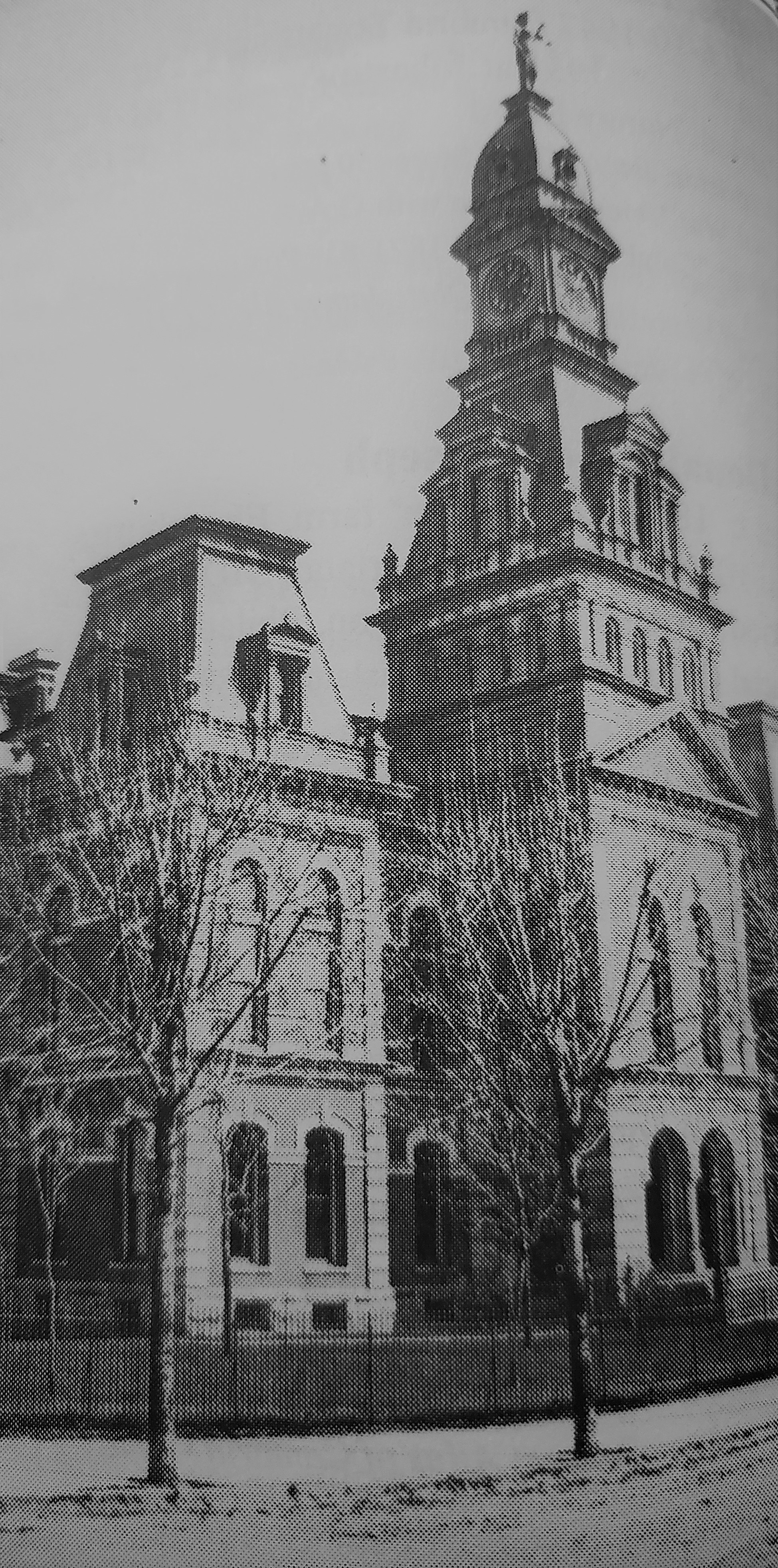
In February 1915 most of downtown Ebensburg was burned down
"by fire which broke out in the pool room of the Mountain House. Every building in the block from the Mountain House to the county court house was destroyed. The loss is estimated between $250,000 and $300,000. The court house was not damaged although the buildings adjoining were destroyed. Fire companies from many northern Cambria towns were summoned to assist the Ebensburg company. The Johnstown city fire department also went to the scene. The buildings destroyed include the fine building of the Cambria Savings and company, several hotels, a livery barn, a bank building and a number of small office buildings. The telephone communications were cut off. The buildings destroyed were thirteen in number. A cigarette dropped in the poolroom the night previous is believed to have started the fire."
According to The Indiana Progress, "Several buildings were dynamited to prevent the spread of the flames." The lowest cost estimate of losses was $250,000; the equivalent in 2020 of $6,402,920.79.
Despite the fire, a number of historic homes and buildings survived. Townspeople recognized the value of these and defined an historic district, identifying which buildings were of quality that contributed to its fabric. In 2019 the significance of The Ebensburg Historic District was recognized when it was added to the National Register of Historic Places. The District is bounded roughly by Highland Avenue and West, Sugar, and Triumph streets.
Art
Impressionist painter Marjorie Acker Phillips, who had a summer home in Ebensburg known as the Ormsby Lodge, is thought to have drawn inspiration from the nearby countryside for many of her paintings.
Education
It is in the Central Cambria School District..
In the borough of Ebensburg, there are three public and two private schools. The two private schools are Bishop Carroll High School and Holy Name Elementary. The public schools are Cambria High School, Central Cambria Middle School, and Cambria Elementary. The fourth school of the Central Cambria School District is located about 5 mi west of the borough, off US Route 22. At the collegiate level, the Pennsylvania Highland Community College has one of their satellite sites about 2 mi southwest of the center of town, also off Route 22.
Geography
Ebensburg is located in the center of Cambria County at (40.486388, -78.725461).
Three U.S. highways pass through and intersect around Ebensburg: U.S. Route 22 runs along the southern border of the borough, leading east 18 mi to Hollidaysburg, south of Altoona, and west 72 mi to Pittsburgh. U.S. Route 219 bypasses the borough to the west, with access from two exits (U.S. 22 and U.S. 422). US 219 leads north 58 mi to DuBois and south 41 mi to Somerset. Finally, the western portion of U.S. Route 422 begins at US 219 on the west side of Ebensburg and leads west 26 mi to the borough of Indiana. Johnstown, the largest city in Cambria County, is 22 mi to the southwest via US 219 and Pennsylvania Route 56.
According to the United States Census Bureau, the borough of Ebensburg has a total area of 4.4 km2, of which 4.3 km2 is land and 0.1 km2, or 2.13%, is water.
Climate
|Jan record high F = 67 |Feb record high F = 75 |Mar record high F = 83 |Apr record high F = 89 |May record high F = 90 |Jun record high F = 92 |Jul record high F = 99 |Aug record high F = 94 |Sep record high F = 91 |Oct record high F = 85 |Nov record high F = 78 |Dec record high F = 71 |year record high F = 99 |Jan record low F = −28 |Feb record low F = −22 |Mar record low F = -16 |Apr record low F = 3 |May record low F = 20 |Jun record low F = 28 |Jul record low F = 35 |Aug record low F = 30 |Sep record low F = 23 |Oct record low F = 12 |Nov record low F = 0 |Dec record low F = −20 |year record low F = -28
Demographics
As of the census of 2010, there were 3,351 people and 1,612 households within the borough. The population density was 1,971.2 PD/sqmi. There were 1,742 housing units at an average density of 1,024.7 /sqmi. The racial make-up of the borough was 98.27% White, 0.48% African American, 0.69% Asian, 0.12% Native American, 0.01% from other races, and 0.36% from two or more races. Hispanic or Latino of any race were 0.48% of the population.
There were 1,612 households, out of which 22.7% had children under the age of 18 living with them, 48.3% were married couples living together, 9.1% had a female householder with no husband present, and 39.3% were non-families. 35.3% of all households were made up of individuals, and 17.3% had someone living alone who was 65 years of age or older. The average household size was 2.23 and the average family size was 2.90.
In the borough the population was spread out, with 19.2% under the age of 18, 1.9% from 18 to 19, 6.4% from 20 to 24, 12.9% from 25 to 34, 17.4% from 35 to 49, 21.7% from 50 to 64, and 20.5% who were 65 years of age or older. The median age was 42 years. The population was 46.55% male, and 53.45% female.
Law and government
Borough Officials
| Position | Official | Party |
|---|---|---|
| Mayor | Randy Datsko | Democrat |
| Tax Collector | Charlene Remillard | Democrat |
| Borough Manager | Kelly Cook |
Council
| Position | Official | Party |
|---|---|---|
| President | Doug Tusing | Republican |
| Vice President | Cecilia Houser | Republican |
| Councilor | Dave Kuhar | Democrat |
| Councilor | Mike Murphy | Democrat |
| Councilor | Theresa Jacoby | Republican |
| Councilor | Jeffrey Ball | Democrat |
| Councilor | Robert Miller | Republican |
State Senate
| District | Senator | Party |
|---|---|---|
| Pennsylvania's 35th Senatorial District | Wayne Langerholc | Republican |
State House of Representatives
| District | Representative | Party |
|---|---|---|
| 72 | Frank Burns | Democrat |
Notable buildings
- A.W. Buck House
- Cambria County Courthouse
- Cambria County Jail
- Ormsby Lodge
- Philip Noon House
Notable people
- Abraham A. Barker, a congressman, abolitionist, and conductor on the Underground Railroad.
- Alan Baylock, jazz composer, band leader, chief arranger, US Air Force Airmen of Note
- Jack Darragh (1866–1939), baseball player
- Webster Davis (1861–1923), mayor of Kansas City, Missouri and Assistant Secretary of the Interior
- Ronald Duman (1954–2020), psychiatry professor and director of pharmacology
- Alvin Evans (1845–1906), congressman
- Bill Hartack (1932–2007), Hall of Fame jockey
- James Russell Leech (1888–1952), congressman
- Carol Scott (1949–2005), television producer and director
- Harriet B. Jones (1856–1943), physician and member of the West Virginia House of Delegates
- Harve Tibbott (1885–1969), congressman
- Samuel D. Pryce (1841–1923), Businessman, author, and Civil War officer
- William Pryce (1932–2006), U.S. Ambassador to Honduras
References
References
- "ArcGIS REST Services Directory". United States Census Bureau.
- {{GNIS. 1215018
- "Find a County". National Association of Counties.
- "Geographic Identifiers: 2010 Demographic Profile Data (G001): Ebensburg borough, Pennsylvania". U.S. Census Bureau, American Factfinder.
- "Ghost Town Trail General Info". Indiana County Parks & Trails.
- (July 2, 2019). "Ebensburg War Memorial".
- Penatzer, Daniel. (June 10, 2018). "VETERANS PARK OF CAMBRIA COUNTY". Cambria Memory Project.
- "Profile for Ebensburg, Pennsylvania". [[ePodunk]].
- Federal Writers' Project. (1940). "Pennsylvania: A Guide to the Keystone State". Oxford University Press.
- Swank, James Moore. (1910). "Cambria County Pioneers". Alan, Lane & Scott.
- Swank, James Moore. (1910). "Cambria County Pioneers". Alan, Lane & Scott.
- Huber, Dave. (1996). "Historic Ebensburg: The Pioneers". Mountaineer Herald.
- "133rd Pennsylvania Volunteers, Company C Muster Roll".
- "Civil War Index - 133rd Pennsylvania Infantry".
- Gibbs, Joseph. "Three Years in the Bloody Eleventh: The Campaigns of a Pennsylvania Reserves Regiment".
- (1891). "Official Records of the War of Rebellion".
- Huber, Dave. (1997). "Historic Ebensburg". Mountaineer Herald.
- Beitler, Sue. "Ebensburg, PA Destructive Fire Throughout Town, Feb 1915".
- (1915-02-24). "Ebensburg has Costly Fire". The Indiana Weekly Messenger.
- (February 24, 1915). "EBENSBURG HAS $250,000 FIRE.". The Indiana Progress.
- {{NRISref
- "Ebensburg added to National Register of Historical Places". WJAC Staff.
- "Collection". The Winterthur Library.
- Miller, Eric. "The Country Home of Mega-Collector Duncan Phillips". Urban Antiques.
- Geography Division. (January 14, 2021). "2020 Census - School District Reference Map: Cambria County, PA". [[U.S. Census Bureau]].
- (February 12, 2011). "US Gazetteer files: 2010, 2000, and 1990". [[United States Census Bureau]].
- "NowData – NOAA Online Weather Data". National Oceanic and Atmospheric Administration.
- "Station: Ebensburg Sewage PLT, PA". National Oceanic and Atmospheric Administration.
- "Census of Population and Housing". U.S. Census Bureau.
- "U.S. Census website". [[United States Census Bureau]].
- "Incorporated Places and Minor Civil Divisions Datasets: Subcounty Resident Population Estimates: April 1, 2010 to July 1, 2012". U.S. Census Bureau.
- "Census Population API". United States Census Bureau.
- (August 23, 2019). "Alanbaylock.com". [[Gloria Douglas]].
This article was imported from Wikipedia and is available under the Creative Commons Attribution-ShareAlike 4.0 License. Content has been adapted to SurfDoc format. Original contributors can be found on the article history page.
Ask Mako anything about Ebensburg, Pennsylvania — get instant answers, deeper analysis, and related topics.
Research with MakoFree with your Surf account
Create a free account to save articles, ask Mako questions, and organize your research.
Sign up freeThis content may have been generated or modified by AI. CloudSurf Software LLC is not responsible for the accuracy, completeness, or reliability of AI-generated content. Always verify important information from primary sources.
Report