From Surf Wiki (app.surf) — the open knowledge base
Ebenopsis ebano
Species of legume
Species of legume
Acacia flexicaulis Benth.
Chloroleucon ebano (Berland.) L.Rico
Mimosa ebano Berland.
Pithecellobium ebano (Berland.) C.H.Müll.
Pithecellobium flexicaule (Benth.) J.M.Coult.
Zygia flexicaulis (Benth.) Sudw.
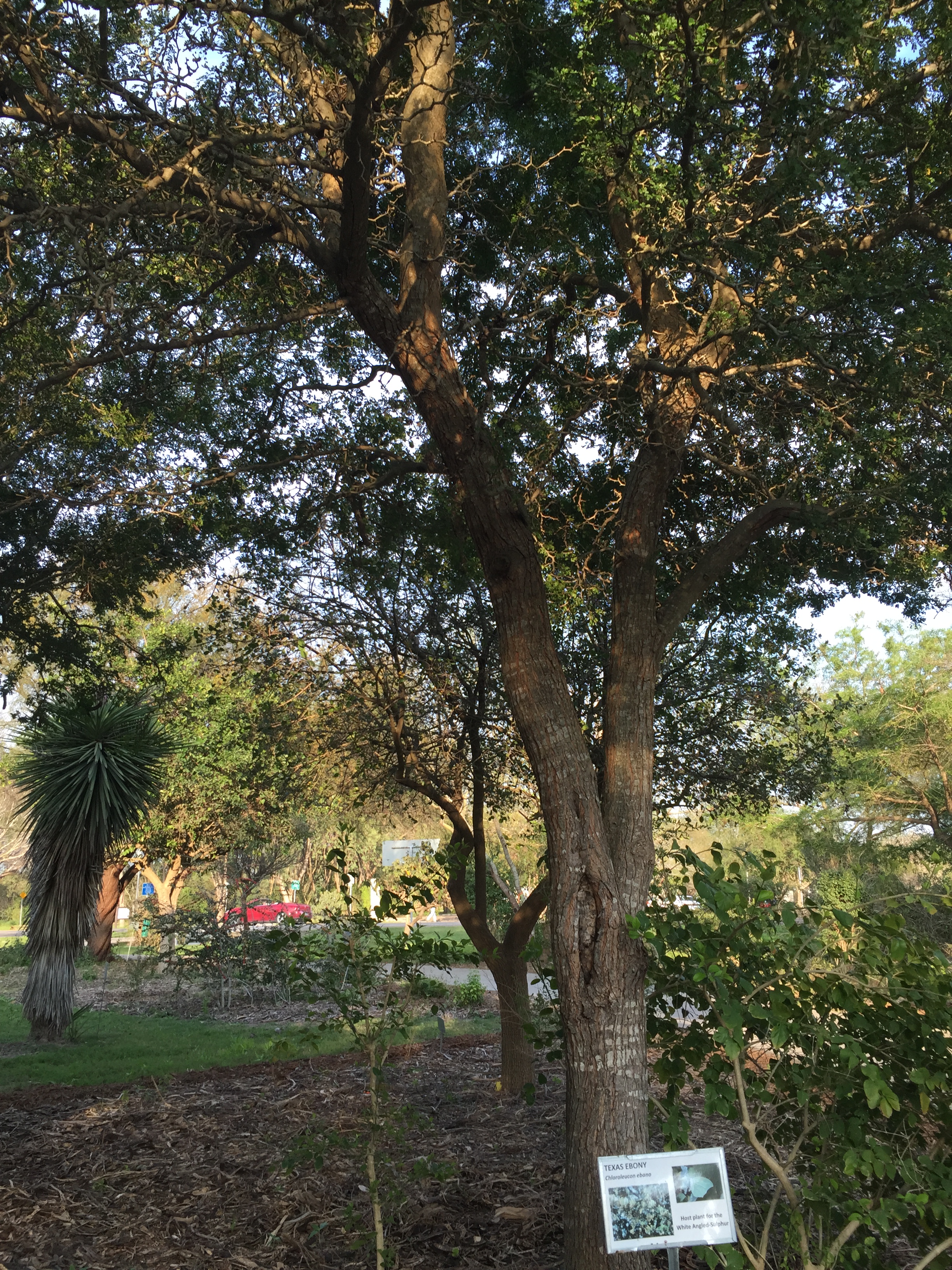
Ebenopsis ebano is a species of flowering plant in the family Fabaceae, that is native to the coastal plain of southern Texas in the United States and eastern Mexico. It is commonly known as Texas ebony or ebano (in Spanish).
Description
Texas ebony is a small, evergreen tree that reaches a height of 7.6 - and a crown width of 1.8 -.
Habitat and range
The range of E. ebano stretches from Laredo and Corpus Christi, Texas south through the states of Tamaulipas, Nuevo León, San Luis Potosí, Veracruz, Campeche, and Yucatán in Mexico. It can be found in the Tamaulipan matorral, Tamaulipan mezquital, Veracruz dry forests, and Yucatán dry forests ecoregions. Its habitat extends from sea level to 1000 m, averages 20 to in temperature, and receives a mean of 900 mm of annual rainfall.
Uses
Texas ebony is cultivated in xeriscaping for its dense foliage and fragrant flowers. It is also used in bonsai.
Ecology
Ebenopsis ebano is a host plant for the caterpillars of the coyote cloudywing (Achalarus toxeus) and Sphingicampa blanchardi. The seedpods host the bean weevils Stator beali and S. limbatus. Despite the native range of Texas ebony overlapping with that of the latter, S. limbatus only feeds upon it in locales where it is grown as an ornamental and is not native. E. ebano is also a preferred host of the epiphyte Bailey's ball moss (Tillandsia baileyi).
References
References
- Contu, S.. (2012). "''Ebenopsis ebano''".
- {{GRIN
- "''Ebenopsis ebano'' (Texas Ebony)". Lady Bird Johnson Wildflower Center.
- Irish, Mary. (2008). "Trees and Shrubs for the Southwest: Woody Plants for Arid Gardens". Timber Press.
- "''Ebenopsis ebano'' (Berl.) Barneby & Grimes Texas ebony". United States Department of Agriculture.
- "''Ebenopsis ebano'' (Berl.) Britton et Rose". [[CONAFOR]].
- García Pérez, Jaime F.. (2007). "Germinación y establecimiento de plantas nativas del matorral tamaulipeco y una especie introducida en un gradiente de elevación". Madera y Bosques.
- Lentz, David Lewis. (2000). "Imperfect Balance: Landscape Transformations in the Precolumbian Americas". Columbia University Press.
- Beletsky, Les. (2006). "Southern Mexico: the Cancún Region, Yucatán Peninsula, Oaxaca, Chiapas, and Tabasco". Interlink Books.
- Miller, George Oxford. (2007-03-15). "Landscaping with Native Plants of the Southwest". MBI Publishing Company.
- Mahler, Robert. (2008). "Growing Bonsai Indoors". Brooklyn Botanic Garden.
- "Coyote Cloudywing ''Achalarus toxeus'' (Plötz, 1882)".
- "''Sphingicampa blanchardi''".
- Fox, Charles W.. (2006). "Colonization of a new host by a seed-feeding beetle: Genetic variation, maternal experience, and the effect of an alternate host". Annales Zoologici Fennici.
- Sill, Sue. (May 2009). "''Tillandsia baileyi'' rose - Texas's Disappearing Native Air-Plant". Native Plant Project.
This article was imported from Wikipedia and is available under the Creative Commons Attribution-ShareAlike 4.0 License. Content has been adapted to SurfDoc format. Original contributors can be found on the article history page.
Ask Mako anything about Ebenopsis ebano — get instant answers, deeper analysis, and related topics.
Research with MakoFree with your Surf account
Create a free account to save articles, ask Mako questions, and organize your research.
Sign up freeThis content may have been generated or modified by AI. CloudSurf Software LLC is not responsible for the accuracy, completeness, or reliability of AI-generated content. Always verify important information from primary sources.
Report