From Surf Wiki (app.surf) — the open knowledge base
Eastville Stadium
Former greyhound racing venue in England
.jpg)
Former greyhound racing venue in England
| Field | Value |
|---|---|
| image | Eastville Stadium - geograph.org.uk - 2102658.jpg |
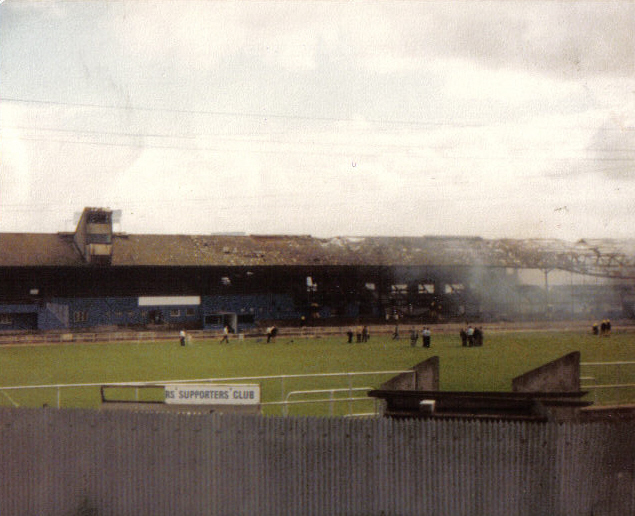
| caption | Eastville Stadium in 1986 |
| name | Eastville Stadium |
| location_town | Bristol |
| location_country | England |
| coordinates | |
| client | Bristol Rovers F.C. |
| completion_date | 1897 |
| date_demolished | 1998 |
| Bristol
Eastville Stadium, also known as Bristol Stadium and Bristol Stadium – Eastville, was a stadium in Eastville, a northern suburb of the English city of Bristol.
Constructed in 1897, it was the home of Bristol Rovers F.C., the Bristol Bulldogs speedway team and was also a greyhound racing venue. During 1986 it was also the home of the short-lived Bristol Bombers American football team.
Football
History
Rovers played their home games at Eastville (nicknamed "The Ville") until forced to leave by financial difficulties in 1986. Rovers then spent a decade at Twerton Park in Bath before returning to the city to play at the Memorial Stadium where they remain to this day. The record attendance was 39,462.
Bristol Rovers have never played in the top flight of English football. The highest level of football which Eastville Stadium hosted was in the Football League Second Division.
Built near to a gas holder, the constant smell of town gas in the air gave rise to the name used for Bristol Rovers fans of "The Gas" or "Gasheads". The nickname "The Gas" began as a derogatory nickname used by Bristol City fans, however Rovers fans now refer to themselves as Gasheads as a badge of honour. The number 12 squad shirt has been officially allocated to "Gasheads" by the club in honour of the crowd being the 12th man.
Another unique feature of Eastville was the flower beds behind each goal.
Tote End
The Tote End or simply the Tote was a large section of covered terracing behind one of the goals. Originally built in 1935, the Tote End terrace was built following the curve of the greyhound racing track. It had a small covered section in the South-West corner.
The Totaliser clocks mounted first on the back of the terrace and then after a larger roof was added in 1961 to cover most of the terrace, on the roof fascia, gave it its name.
With a boisterous and intimidating atmosphere, largely due to it being a favoured spot for the more vociferous Rovers supporters, and given the nature of football in Britain in the 1970s, it became notoriously linked with bovver boys and hooliganism – a period documented by the book Bovver by Chris Brown.
Shortly after Rovers left Eastville in 1986, the Tote End was bulldozed.
Speedway
In 1977 the Newport Wasps speedway team relocated to Bristol as the Bristol Bulldogs and remarkably the speedway track was placed on top of the greyhound circuit and then dug up again every meeting. The speedway only ran for two seasons in the British League before the team withdrew, and speedway has never been run in the city since.
Greyhound racing
Opening
Racing started on Saturday 16 June 1928 becoming the second track in Bristol to open after Knowle Stadium. The first ever winner was a greyhound called Vivacious who collected £20 for his connections.
History

The totalisator system was introduced in 1932 securing the future of the stadium, this was in contrast to the football club who were in financial difficulties. During 1939 Bristol Rovers F.C negotiated a sale price to the Bristol Greyhound Company, albeit by the chairman, who carried out the deal without the knowledge of his fellow directors. Eastville changed hands for £12,000 and the first General Manager was Lieutenant-Colonel Forsdike who was to become secretary of the National Greyhound Racing Club.
The Golden Crest competition was introduced in 1937 and became one of the most important races in the provincial calendar. In 1945 Shannon Shore recorded an impressive win by ten lengths in a new track record for 500 yards; the black dog was timed at 28.76secs during the Golden Crest final. A second major competition was introduced in 1946 and this was the Western Two Year Old Produce Stakes.
In 1947 Oxford Stadium owner Leslie Calcutt was appointed as Director of Bristol Greyhound Racing Association Ltd, a move that would eventually result in Bristol taking over Oxford. The company also acquired Swindon Stadium in 1952 and would be known as Bristol Stadium Ltd following the death of Leslie Calcutt.
Eastville became one of the first circuits to abandon grass in 1968, becoming sand based, many tracks would follow suit over the next decade. After selling Oxford Stadium to the council Ian Stevens became General Manager at Eastville in 1975 and in 1980 the track became one of eight tracks to be awarded Bookmakers Afternoon Greyhound Service (BAGS) contracts resulting in a steady income stream. The track suffered a serious fire in August 1980 with the majority of the south stand destroyed causing more than £1 million worth of damage. As a result of the fire the track closed for two months for repairs to be made.
When trainer Henry Kibble retired his son Terry took over the kennels and provided Eastville with its first English Greyhound Derby finalist in 1991 with Dempsey Duke. The greyhound also won the Blue Riband, East Anglian Derby and Reading Masters.
Closure
The company now known as the BS Group sold Eastville for development, plans were announced for a new Bristol greyhound stadium but never came to fruition. The stadium closed on 27 October 1997 with the entire greyhound operation moving to sister track Swindon. The site became an IKEA superstore.
Competitions
- Western Two Year Old Produce Stakes
- Golden Crest
Track records
Pre-metric
| Distance | ||||||||||
|---|---|---|---|---|---|---|---|---|---|---|
| yards | Greyhound | Time (sec) | Date | Notes | ||||||
| 500 | Shannon Shore | 28.76 | 1945 | Golden Crest final | ||||||
| 500 | Shannon Shore | 28.66 | 1946 | Golden Crest semi-final | ||||||
| 500 | Rimmells Black | 28.65 | 13 August 1947 | Golden Crest semi-final | ||||||
| 500 | Flintfield Grosvenor | 28.50 | 1950 | |||||||
| 500 | Kensington Perfection | 28.29 | 3 August 1953 | Western Produce Stakes final | ||||||
| 500 | Discretions | 27.85 | 1968 | |||||||
| 525 | Wise Carey | 29.95 | 15 June 1938 | |||||||
| 525 | url=https://www.britishnewspaperarchive.co.uk/viewer/bl/0000513/19380829/075/0009 | title=Glen Ranger sets up new track record | work=Western Daily Press | date=29 August 1938 | via=British Newspaper Archive | url-access=subscription | access-date=28 September 2024}} | 29.94 | 27 August 1938 | Golden Crest heats |
| 525 | Glen Ranger | 29.69 | 27 August 1938 | Golden Crest heats | ||||||
| 525 | Glen Ranger | 29.64 | 3 September 1938 | Golden Crest semi finals | ||||||
| 525 | Fealeside Bridge | 29.39 | 15 September 1962 | |||||||
| 525 | Paddles Son | 26 June 1965 | ||||||||
| 525 | Moonlight Chase | 23 April 1966 | ||||||||
| 600 | Model Dasher | 35.11 | 1950 | |||||||
| 700 | Shaggy Lass | 40.61 | 10 June 1946 | |||||||
| 730 | Je Vendral | 42.30 | 1970 | |||||||
| 730 | Peasedown Marvel | 42.30 | 1970 | =track record | ||||||
| 730 | Nobodys Pick | 42.29 | 1972 | |||||||
| 745 | Watch Kern | 42.74 | 11 July 1962 | |||||||
| 932 | Hops Pal | 54.80 | 1972 | |||||||
| 957 | Ramsfort Venture | 56.58 | 19 September 1964 | |||||||
| 500 H | Red Nuxer | 29.21 | 21 April 1945 | |||||||
| 525 H | Paddles Son | 30.48 | 26 June 1965 |
Post-metric
| Distance | ||||
|---|---|---|---|---|
| metres | Greyhound | Time (sec) | Date | Notes |
| 266 | Damiens Slave | 16.30 | 29 November 1986 | |
| 266 | Rapid Mover | 16.26 | 1988 | |
| 270 | Wheres The Limo | 16.24 | 19 February 1992 | |
| 410 | Fizzy Stuff | 25.80 | 1988 | |
| 460 | Peasedown Dollar | 28.67 | 13 April 1991 | |
| 460 | Wolf Man | 27.82 | 11 June 1994 | |
| 470 | Rolstone Silk | 28.05 | 25 October 1979 | |
| 470 | Mollifrend Slave | 28.66 | 4 May 1991 | |
| 470 | Manorland | 28.49 | 4 May 1991 | |
| 610 | Proud Operator | 39.33 | 1988 | |
| 610 | Among the Gold | 39.19 | 1989 | |
| 620 | Airmount Flash | 38.29 | 15 February 1993 | |
| 665 | First Name Bart | 41.30 | 25 September 1993 | |
| 670 | Rolstone Silk | 41.39 | 18 June 1981 | |
| 680 | Ice Cool Blonde | 42.75 | 11 May 1991 | |
| 680 | Fawn Peral | 42.28 | 15 June 1991 | |
| 855 | Decoy Lynx | 53.72 | 13 August 1994 | |
| 874 | Keem Princess | 54.59 | 16 August 1980 | |
| 874 | Lilac Wonder | 54.54 | 17 August 1991 | |
| 1015 | Mossfield Scotty | 66.29 | 15 October 1992 | |
| 470 H | Sharp Look Out | 29.53 | 1988 | |
| 470 H | Faoides Country | 29.08 | 20 July 1991 |
Important dates
- 1897 – Bristol Rovers first appearance at Eastville
- 1921 – Bristol Rovers purchase the stadium.
- 1924 – The mostly wooden south stand was built.
- 1935 – The Tote End was constructed.
- 1940 – The stadium is sold to the Bristol Greyhound Company.
- 1952 – First Commentary Broadcast to the Bristol Hospitals by the Bristol Hospital Broadcasting Service. 23 August v Shrewsbury Town: Rovers won 2–1.
- 1959 – The North Stand opened, and floodlights installed.
- 1960 – Highest recorded attendance for a Rovers match. 38,472 v Preston North End in the FA Cup 4th Round, 30 January.
- 1961 – A roof and new terracing installed at the Tote End.
- 1969 – M32 motorway opened.
- 1977 – Motorcycle speedway introduced to the ground.
- 1980 – South Stand fire in August.
- 1986 – Bristol Rovers play their last game at Eastville.
- 1997 – Last Greyhound meeting
- 1998 – Eastville stadium demolished.
Notes
References
- [http://www.britballnow.co.uk The UK and Ireland American Football results service] Alltime UK History – Club Database
- "Archived copy".
- Barnes, Julia. (1988). "Daily Mirror Greyhound Fact File". Ringpress Books.
- Genders, Roy. (1975). "The Greyhound and Racing Greyhound". Page Brothers (Norwich).
- Genders, Roy. (1981). "The Encyclopedia of Greyhound Racing". Pelham Books Ltd.
- Genders, Roy. (1990). "NGRC book of Greyhound Racing". Pelham Books Ltd.
- "Monthly Greyhound Star (Remember When 1980) October edition". Greyhound Star.
- Barnes/Sellers, Julia/John. (1992). "Ladbrokes Greyhound Fact File". Ringpress Books.
- (29 August 1938). "Glen Ranger sets up new track record". Western Daily Press.
This article was imported from Wikipedia and is available under the Creative Commons Attribution-ShareAlike 4.0 License. Content has been adapted to SurfDoc format. Original contributors can be found on the article history page.
Ask Mako anything about Eastville Stadium — get instant answers, deeper analysis, and related topics.
Research with MakoFree with your Surf account
Create a free account to save articles, ask Mako questions, and organize your research.
Sign up freeThis content may have been generated or modified by AI. CloudSurf Software LLC is not responsible for the accuracy, completeness, or reliability of AI-generated content. Always verify important information from primary sources.
Report