From Surf Wiki (app.surf) — the open knowledge base
Eastern Orthodoxy in Europe
Christian demonation on the continent
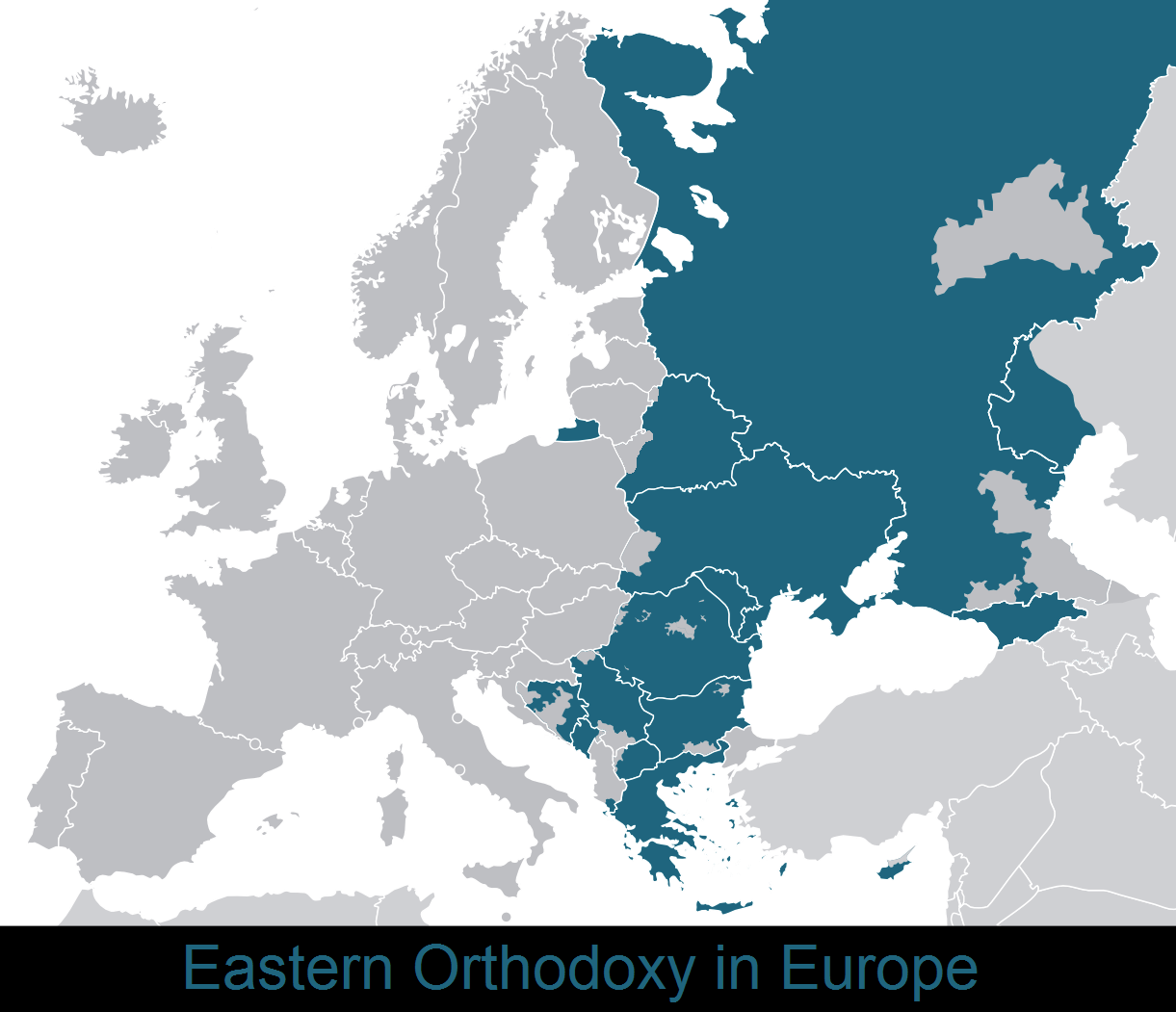
Christian demonation on the continent

Eastern Orthodoxy constitutes the second largest Christian denomination in Europe. Eastern Orthodox Christians are predominantly present in Eastern and Southeastern Europe, and they are also significantly represented in diaspora throughout the Continent. The term "Eastern Orthodox Europe" is informally used to describe the predominantly Eastern Orthodox countries of Bosnia, Belarus, Bulgaria, Cyprus, Georgia, Greece, Moldova, Montenegro, North Macedonia, Romania, Russia, Serbia and Ukraine.
History
Almost all of Eastern Orthodox Europe became part of communist states after World War II, either through direct annexation by the USSR or indirect Soviet dominance through satellite states.
Eastern Orthodoxy in Orthodox majority countries
- Eastern Orthodoxy in Moldova, 97.0% (2017 census)
- Eastern Orthodoxy in Greece, 90%
- Eastern Orthodoxy in Serbia, 84.6% (2011 census)
- Eastern Orthodoxy in Georgia, 83.4% (2014 census)
- Eastern Orthodoxy in Romania, 81.0% (2015 census)
- Eastern Orthodoxy in Russia, 79% ()
- Eastern Orthodoxy in Bulgaria, 77% (2011 census)
- Eastern Orthodoxy in Cyprus, 73.2% ()
- Eastern Orthodoxy in Belarus, 73% (2011 census)
- Eastern Orthodoxy in Montenegro, 72.1% (2011 census)
- Eastern Orthodoxy in North Macedonia, 69.6% ()
- Eastern Orthodoxy in Ukraine, 67.3% ()
Eastern Orthodoxy in non-Orthodox majority countries
- Eastern Orthodoxy in Bosnia and Herzegovina, 31.0% (2013 census)
- Eastern Orthodoxy in Latvia, 19.4% (2011 census)
- Eastern Orthodoxy in Estonia, 16.15% (2011 census)
- Eastern Orthodoxy in Austria, 8.8% (2018 census)
- Eastern Orthodoxy in Albania, 8% (2023 census)
- Eastern Orthodoxy in Lithuania, 4.9% (2011 census)
- Eastern Orthodoxy in Croatia, 4.44% (2011 census)
- Eastern Orthodoxy in Italy, 3.5%
- Eastern Orthodoxy in Germany, 2.4%
- Eastern Orthodoxy in Slovenia, 2.3% (2002 census)
- Eastern Orthodoxy in Spain, 2.2% (by Wikipedia)
- Eastern Orthodoxy in Poland, 1.5% (by Wikipedia)
- Eastern Orthodoxy in the Republic of Ireland, 1.3% (2017)
- Eastern Orthodoxy in Finland, 1.09% (2020 census)
- Eastern Orthodoxy in Slovakia, 0.9% (2011 census)
- Eastern Orthodoxy in Norway, 0.22% (2012)
- Eastern Orthodoxy in Armenia, 0.2% (2022 census)
- Eastern Orthodoxy in Hungary, 0.1% (2011 census)
References
Sources
References
- (18 December 2008). "The Cambridge Companion to Orthodox Christian Theology". Cambridge University Press.
- (10 May 2017). "Religious Belief and National Belonging in Central and Eastern Europe". Pew Research Center.
- "2011 Census of Population, Households and Dwellings in the Republic of Serbia". Statistical Office of the Republic of Serbia.
- (28 April 2016). "საქართველოს მოსახლეობის საყოველთაო აღწერის საბოლოო შედეგები". National Statistics Office of Georgia.
- "Culte recunoscute oficial în România". Secretariatul de Stat pentru Culte.
- "NSI".
- [http://www.globalreligiousfutures.org/countries/cyprus/religious_demography#/?affiliations_religion_id=0&affiliations_year=2010 Pew Research Center's Religion & Public Life Project: Cyprus]. [[Pew Research Center]]. 2010.
- [http://www.mfa.gov.by/upload/pdf/religion_eng.pdf Religion and denominations in the Republic of Belarus by the Commissioner on Religions and Nationalities of the Republic of Belarus from November 2011]
- "Census of Population, Households and Dwellings in Montenegro 2011". Monstat.
- "Strategies of symbolic nation-building in West Balkan states: intents and results (completed) - Department of Literature, Area Studies and European Languages".
- {{citation. link. (22 April 2018). [[Razumkov Center]] in collaboration with the All-Ukrainian Council of Churches
- "Bosnia and Herzegovina".
- "Tieslietu ministrijā iesniegtie reliģisko organizāciju pārskati par darbību 2011. gadā".
- (22 October 2002). "Statistical database: Population Census 2000 – Religious affiliation". [[Statistics Estonia]].
- (13 September 2018). "In Österreich leben mehr Orthodoxe als Muslime".
- (28 June 2024). "Religious belief data/ What are the results of the 2023 Census".
- "Ethnicity, mother tongue and religion".
- Gesellschaft Orthodoxe Medien e.V. im Auftrag der Orthodoxen Bischofskonferenz in Deutschland (Hrsg.): ''Orthodoxer Liturgischer Kalender 2017.'', 18. Jahrgang, 2016, S. III: ''In Deutschland können wir begründeten Hochrechnungen [zufolge] inzwischen von einer Zahl von bald an die zwei Millionen orthodoxer Christen ausgehen, die immer mehr in die hiesige Gesellschaft hineinwachsen und sich in ihr verwurzeln.''
- "Belonging to a religious community by age and sex, 2000-2020". Government.
- (2011). "Table 14 Population by religion". Statistical Office of the SR.
- (2022). "Republic of Armenia Census". Statistical Committee - Republic of Armenia.
- "1.26 Population by religion and sex, 1930–1949, 2001". Hungarian Central Statistical Office.
This article was imported from Wikipedia and is available under the Creative Commons Attribution-ShareAlike 4.0 License. Content has been adapted to SurfDoc format. Original contributors can be found on the article history page.
Ask Mako anything about Eastern Orthodoxy in Europe — get instant answers, deeper analysis, and related topics.
Research with MakoFree with your Surf account
Create a free account to save articles, ask Mako questions, and organize your research.
Sign up freeThis content may have been generated or modified by AI. CloudSurf Software LLC is not responsible for the accuracy, completeness, or reliability of AI-generated content. Always verify important information from primary sources.
Report