From Surf Wiki (app.surf) — the open knowledge base
East Germany national football team
1952–1990 men's football team

1952–1990 men's football team
| Field | Value |
|---|---|
| Name | East Germany |
| date | 1952–1990 |
| Badge | East Germany national football team logo.svg |
| Badge_size | 150px |
| FIFA Trigramme | GDR |
| Nickname | "Weltmeister der Freundschaftsspiele" (World champion in friendly games) |
| Association | Deutscher Fußball-Verband der DDR |
| Confederation | UEFA (Europe) |
| Home Stadium | Zentralstadion, Leipzig |
| Most caps | Joachim Streich (98) |
| Top scorer | Joachim Streich (53) |
| pattern_la2 | _whiteborder |
| pattern_b2 | _DDR_h |
| pattern_ra2 | _whiteborder |
| leftarm2 | 0000FF |
| rightarm2 | 0000FF |
| shorts2 | FFFFFF |
| socks2 | 0000FF |
| pattern_la1 | _borderonwhite |
| pattern_b1 | _DDR_a |
| pattern_ra1 | _borderonwhite |
| leftarm1 | 0000FF |
| body1 | 0C1C8C |
| rightarm1 | 0000FF |
| shorts1 | 0000FF |
| socks1 | FFFFFF |
| First game | 3–0 |
| (Warsaw, Poland; 21 September 1952) | |
| Last game | 0–2 |
| (Brussels, Belgium; 12 September 1990) | |
| Largest win | 1–12 |
| (Colombo, Ceylon; 12 January 1964) | |
| Largest loss | Unofficial |
| 5–0 | |
| (Hungary; 18 May 1952) | |
| Official | |
| 3–0 | |
| (Warsaw, Poland; 21 September 1952) | |
| 4–1 | |
| (Cardiff, Wales; 25 September 1957) | |
| 1–4 | |
| (Leipzig, East Germany; 27 October 1957) | |
| 3–0 | |
| (Accra, Ghana; 23 February 1964) | |
| 3–0 | |
| (Naples, Italy; 22 November 1969) | |
| 3–0 | |
| (Antwerp, Belgium; 18 April 1973) | |
| 3–0 | |
| (Glasgow, Scotland; 30 October 1974) | |
| 3–0 | |
| (Rotterdam, Netherlands; 15 November 1978) | |
| 3–0 | |
| (Budapest, Hungary; 28 March 1979) | |
| 3–0 | |
| (Goiânia, Brazil; 8 April 1986) | |
| 3–0 | |
| (Montevideo, Uruguay; 29 January 1985) | |
| 4–1 | |
| (Copenhagen, Denmark; 8 May 1985) | |
| 3–0 | |
| (Kiev, Soviet Union; 26 April 1989) | |
| 3–0 | |
| (Vienna, Austria; 15 November 1989) | |
| 3–0 | |
| (Kuwait City, Kuwait; 24 January 1990) | |
| World cup apps | 1 |
| World cup first | 1974 |
| World cup best | Second group stage (1974) |
| Regional name | European Championship |
(Warsaw, Poland; 21 September 1952) (Brussels, Belgium; 12 September 1990) (Colombo, Ceylon; 12 January 1964) 5–0 (Hungary; 18 May 1952) Official 3–0 (Warsaw, Poland; 21 September 1952) 4–1 (Cardiff, Wales; 25 September 1957) 1–4 (Leipzig, East Germany; 27 October 1957) 3–0 (Accra, Ghana; 23 February 1964) 3–0 (Naples, Italy; 22 November 1969) 3–0 (Antwerp, Belgium; 18 April 1973) 3–0 (Glasgow, Scotland; 30 October 1974) 3–0 (Rotterdam, Netherlands; 15 November 1978) 3–0 (Budapest, Hungary; 28 March 1979) 3–0 (Goiânia, Brazil; 8 April 1986) 3–0 (Montevideo, Uruguay; 29 January 1985) 4–1 (Copenhagen, Denmark; 8 May 1985) 3–0 (Kiev, Soviet Union; 26 April 1989) 3–0 (Vienna, Austria; 15 November 1989) 3–0 (Kuwait City, Kuwait; 24 January 1990)
The East Germany national football team, recognised as Germany DR by FIFA, represented East Germany in men's international football, playing as one of three post-war German teams, along with Saarland and West Germany.
East Germany qualified for the World Cup once, doing so in 1974, and after German reunification in 1990, the Deutscher Fußball Verband der DDR (DFV, ), and with it the East German team, joined the Deutscher Fußball Bund (DFB) and the West Germany national football team that had just won the World Cup.
History
In 1949, before East Germany (GDR) was founded and while regular private clubs were still banned under Soviet occupation, efforts were made to play football anyway. Helmut Schön coached selections of Saxony and the Soviet occupation zone before moving to the West. On 6 February 1951, the GDR applied for FIFA membership, which was protested against by the German Football Association, which was already a full member. FIFA accepted the GDR association (later called DFV) on 6 October 1951 as a provisional member and on 24 July 1952 as a full member.
The first international game, not competitive but rather a display of goodwill, took place on 21 September 1952 against Poland in Warsaw, losing 3–0 in front of a crowd of 35,000. The first home game was on 14 June 1953 against Bulgaria, a 0–0 draw in front of a crowd of 55,000 at Heinz-Steyer-Stadion in Dresden. Only three days later, the Uprising of 1953 in East Germany would have prevented the permitted assembly of that many Germans. On 8 May 1954 games resumed, with a 1–0 loss against Romania. The East Germans had not even considered entering the World Cup which was won by the West Germans two months later. This caused much euphoria not only in the West, and the GDR tried to counter this by abandoning their policy of presenting a group of politically reliable socialist role models of their "new German state"; instead, players were selected purely according to ability. The GDR entered the qualification for the WC 1958 and were hosts to Wales on 19 May 1957 at the Zentralstadion in Leipzig. 500,000 tickets were requested, and officially 100,000 were admitted, but 120,000 in the crowded house witnessed a 2–1 victory.
East Germany qualified for one major tournament in its history, the 1974 World Cup. That tournament was staged in West Germany, and both German teams were drawn in the same group in the first round. With successful games against Chile and Australia, both German teams had qualified early for the second round, with the inter-German game determining first and second in the group. Despite this lack of pressure to succeed, the match on 22 June 1974 in Hamburg was politically and emotionally charged. East Germany beat West Germany 1–0, thanks to a goal by Jürgen Sparwasser. The GDR lost to Brazil and the Netherlands, but secured 3rd place in a final game draw with Argentina. On the other hand, the DFB team changed its line-up after the loss and went on to win all games in the other second round group B, against Yugoslavia, Sweden, and Poland, and the World title against the Netherlands.
East Germany nearly secured qualification for the 1990 World Cup, needing only a draw versus Austria in Vienna in their final group match on 15 November 1989 to achieve a place in Italy. Toni Polster scored three times as Austria won 3–0 and advanced to the finals instead.
The GDR took part in the draw for the qualification for the European Championship 1992 and was drawn in Group 5 together with the FRG, Belgium, Wales, and Luxembourg. On 3 October 1990 Germany was re-unified and with them their football teams. The scheduled matches of the East German team were canceled, except for two matches. The match against Belgium was converted into a friendly match on 12 September 1990, in Brussels. It was the last match played by the East Germany national team and ended with a 2–0 victory for them. The match between East and West Germany remained and was scheduled to be played on 14 November 1990, to celebrate the unification of Germany. Due to riots by East German spectators, it was canceled.
Millions of East Germans had moved to the West before the Berlin Wall was erected in 1961, and some escaped in successful Republikflucht attempts also afterward. All East Germans were automatically entitled to receive a West German passport, but players who had caps for the DFV, like Norbert Nachtweih and Jürgen Pahl who fled in October 1976 at a U21 match in Turkey, were ineligible for international competition for the DFB due to FIFA rules.
Shortly after reunification, players who had played for the East German team were allowed by FIFA to be eligible for the now un-rivaled German team of the DFB. A total of eight players were capped for both East Germany and unified Germany, among them Matthias Sammer and Ulf Kirsten.
Olympic football
Main article: East Germany Olympic football team
East Germany achieved significantly greater success in Olympic football than the amateur teams fielded by the Western NOC of Germany due to using its elite players from the top domestic league. In 1956, 1960, and 1964 both states had sent a United Team of Germany. For 1964, the East German side had beaten their Western counterparts in order to be selected. They went on to win the Bronze for Germany. As GDR, they won Bronze in 1972 in Munich, Gold in 1976, and silver medal in 1980 in Moscow.
East vs. West
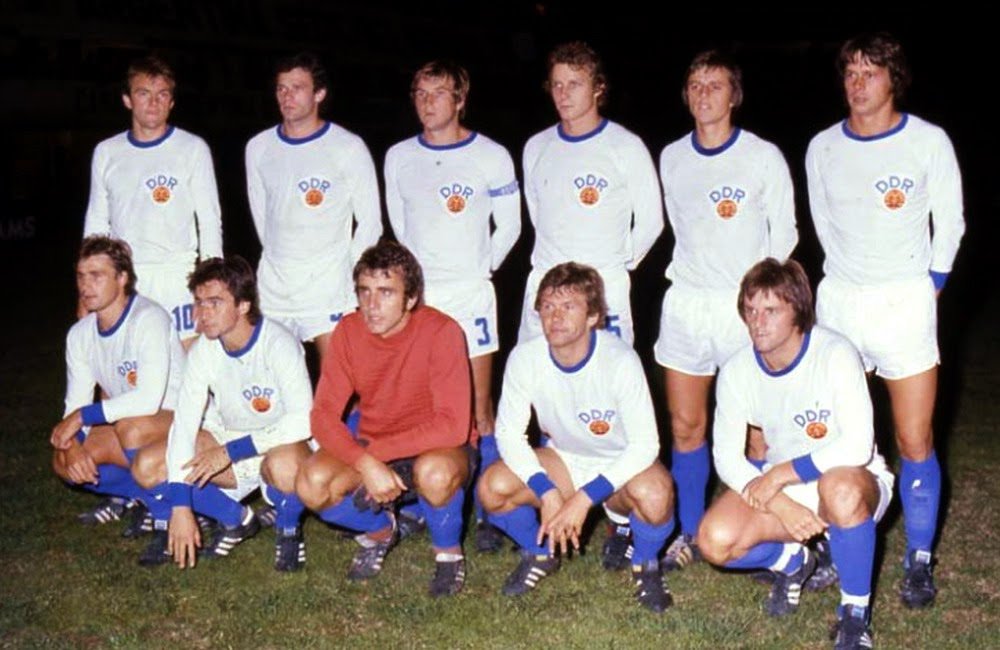
Over the years of their separate existence, the GDR and FRG played each other only a handful of times. The only meeting with professionals from the West was at the 1974 World Cup, which East Germany won 1–0. Three other games were played in Olympic Football where only players with amateur status could represent West Germany, like a young Uli Hoeneß who delayed his pro career in 1972. In the inter-German qualification prior to the 1964 Olympic Games, the two played a two-legged preliminary round tie, the GDR advancing to represent Germany as they won their home leg 3–0, while the FRG won the return 2–1. In the 1972 Olympic Games, the GDR and FRG, having qualified from their first round groups, met in the second round, with the GDR winning 3–2.

The draw for 1992 UEFA European Football Championship qualifying took place on 2 February 1990, with East Germany drawn in Group 5 along with Belgium, Wales, Luxembourg – and West Germany. By 23 August that year, the East German parliament confirmed reunification for 3 October. The planning for the opening fixture away to Belgium on 12 September was too far along to be canceled, so it was played as a friendly. It was also planned to play East Germany's home fixture against West Germany, scheduled for 21 November 1990 in Leipzig, as a friendly to celebrate the unification of the DFB and DFV, but the game was canceled due to rioting in East German stadia.
Competitive record
FIFA World Cup
Main article: East Germany at the FIFA World Cup
Champions Runners-up Third place Fourth place
| FIFA World Cup finals record | Qualification record | Year | Round | Position | Pld | W | D | L | GF | GA | Squad | Pos | Pld | W | D | L | GF | GA | Total | Second group stage | 1/10 | 6 | 2 | 2 | 2 | 5 | 5 | — | – | 47 | 22 | 8 | 17 | 87 | 65 | ||||||||||
|---|---|---|---|---|---|---|---|---|---|---|---|---|---|---|---|---|---|---|---|---|---|---|---|---|---|---|---|---|---|---|---|---|---|---|---|---|---|---|---|---|---|---|---|---|---|
| Uruguay 1930 | Part of Germany/Germany Germany | Part of Germany/Germany Germany | |||||||||||||||||||||||||||||||||||||||||||
| Italy 1934 | |||||||||||||||||||||||||||||||||||||||||||||
| France 1938 | |||||||||||||||||||||||||||||||||||||||||||||
| Brazil 1950 | Not a FIFA member | Not a FIFA member | |||||||||||||||||||||||||||||||||||||||||||
| Switzerland 1954 | Did not enter | Did not enter | |||||||||||||||||||||||||||||||||||||||||||
| Sweden 1958 | Did not qualify | 3rd | 4 | 1 | 0 | 3 | 5 | 12 | |||||||||||||||||||||||||||||||||||||
| Chile 1962 | 3rd | 3 | 0 | 1 | 2 | 3 | 6 | ||||||||||||||||||||||||||||||||||||||
| England 1966 | 2nd | 4 | 1 | 2 | 1 | 5 | 5 | ||||||||||||||||||||||||||||||||||||||
| Mexico 1970 | 2nd | 4 | 2 | 1 | 1 | 7 | 7 | ||||||||||||||||||||||||||||||||||||||
| West Germany 1974 | Quarter-finals | 6th | 6 | 2 | 2 | 2 | 5 | 5 | Squad | 1st | 6 | 5 | 0 | 1 | 18 | 3 | |||||||||||||||||||||||||||||
| Argentina 1978 | Did not qualify | 2nd | 6 | 3 | 3 | 0 | 15 | 4 | |||||||||||||||||||||||||||||||||||||
| Spain 1982 | 2nd | 4 | 2 | 0 | 2 | 9 | 6 | ||||||||||||||||||||||||||||||||||||||
| Mexico 1986 | 3rd | 8 | 5 | 0 | 3 | 16 | 9 | ||||||||||||||||||||||||||||||||||||||
| Italy 1990 | 4th | 8 | 3 | 1 | 4 | 9 | 13 |
UEFA European Championship
| UEFA European Championship record | Qualifying record | Year | Round | Position | Pld | W | D | L | GF | GA | Pos | Pld | W | D | L | GF | GA | Total | 0/9 | – | 44 | 20 | 10 | 14 | 76 | 57 | ||||||||||||||||
|---|---|---|---|---|---|---|---|---|---|---|---|---|---|---|---|---|---|---|---|---|---|---|---|---|---|---|---|---|---|---|---|---|---|---|---|---|---|---|---|---|---|---|
| France 1960 | Did not qualify | FR | 2 | 0 | 0 | 2 | 2 | 5 | ||||||||||||||||||||||||||||||||||
| Francoist Spain 1964 | Ro16 | 4 | 1 | 2 | 1 | 7 | 7 | |||||||||||||||||||||||||||||||||||
| Italy 1968 | 2nd | 6 | 3 | 1 | 2 | 10 | 10 | |||||||||||||||||||||||||||||||||||
| Belgium 1972 | 3rd | 6 | 3 | 1 | 2 | 11 | 6 | |||||||||||||||||||||||||||||||||||
| Yugoslavia 1976 | 2nd | 6 | 2 | 3 | 1 | 8 | 7 | |||||||||||||||||||||||||||||||||||
| Italy 1980 | 3rd | 6 | 5 | 1 | 2 | 18 | 11 | |||||||||||||||||||||||||||||||||||
| France 1984 | 3rd | 6 | 2 | 1 | 3 | 7 | 7 | |||||||||||||||||||||||||||||||||||
| West Germany 1988 | 2nd | 8 | 4 | 2 | 1 | 13 | 4 | |||||||||||||||||||||||||||||||||||
| Sweden 1992 | Withdrew from qualification | Withdrew from qualification |
Olympic Games
Main article: East Germany Olympic football team
| Olympic Games record | Qualification record | Year | Round | Position | GP | W | D* | L | GF | GA | Squad | GP | W | D | L | GF | GA | Total | 1 Gold medal | 4/10 | 24 | 16 | 4 | 4 | 57 | 17 | — | 33 | 21 | 8 | 4 | 59 | 22 | — |
|---|---|---|---|---|---|---|---|---|---|---|---|---|---|---|---|---|---|---|---|---|---|---|---|---|---|---|---|---|---|---|---|---|---|---|
| Finland 1952 | Did not enter | Did not enter | — | |||||||||||||||||||||||||||||||
| Australia 1956 | Withdrew | Withdrew | 1956 | |||||||||||||||||||||||||||||||
| Italy 1960 | Did not qualify | 2 | 1 | 0 | 1 | 1 | 4 | 1960 | ||||||||||||||||||||||||||
| Japan 1964 | Bronze medal | 3rd | 6 | 4 | 1 | 1 | 12 | 4 | Squad | 7 | 4 | 2 | 1 | 14 | 6 | 1964 | ||||||||||||||||||
| Mexico 1968 | Did not qualify | 6 | 5 | 0 | 1 | 16 | 6 | 1968 | ||||||||||||||||||||||||||
| West Germany 1972 | Bronze medal | 3rd | 7 | 4 | 1 | 2 | 23 | 9 | Squad | 4 | 3 | 1 | 0 | 7 | 0 | 1972 | ||||||||||||||||||
| Canada 1976 | Gold medal | 1st | 5 | 4 | 1 | 0 | 10 | 2 | Squad | 6 | 4 | 2 | 0 | 9 | 1 | 1976 | ||||||||||||||||||
| Soviet Union 1980 | Silver medal | 2nd | 6 | 4 | 1 | 1 | 12 | 2 | Squad | Qualified as defending champions | 1980 | |||||||||||||||||||||||
| United States 1984 | Withdrew | Withdrew | 1984 | |||||||||||||||||||||||||||||||
| South Korea 1988 | Did not qualify | 8 | 4 | 3 | 1 | 12 | 5 | 1988 |
Player records
Main article: List of East Germany international footballers

| # | Player | Caps | Goals | Career |
|---|---|---|---|---|
| 1 | Joachim Streich | 98 | 53 | 1969–1984 |
| 2 | Hans-Jürgen Dörner | 96 | 8 | 1969–1985 |
| 3 | Jürgen Croy | 86 | 0 | 1967–1981 |
| 4 | Konrad Weise | 78 | 1 | 1970–1981 |
| 5 | Eberhard Vogel | 69 | 24 | 1962–1976 |
| 6 | Ronald Kreer | 65 | 2 | 1982–1989 |
| 7 | Bernd Bransch | 64 | 3 | 1967–1976 |
| 8 | Peter Ducke | 63 | 15 | 1960–1975 |
| 9 | Martin Hoffmann | 62 | 15 | 1973–1981 |
| 10 | Gerd Kische | 59 | 0 | 1971–1980 |
| Lothar Kurbjuweit | 59 | 3 | 1970–1981 | |
| Matthias Liebers | 59 | 3 | 1980–1988 |
| # | Player | Goals | Caps | Ratio | Career |
|---|---|---|---|---|---|
| 1 | Joachim Streich | 53 | 98 | 1969–1984 | |
| 2 | Eberhard Vogel | 24 | 69 | 1962–1976 | |
| 3 | Hans-Jürgen Kreische | 22 | 46 | 1968–1975 | |
| 4 | Rainer Ernst | 20 | 56 | 1981–1990 | |
| 5 | Henning Frenzel | 19 | 54 | 1961–1974 | |
| 6 | Jürgen Nöldner | 16 | 29 | 1960–1969 | |
| Andreas Thom | 16 | 51 | 1984–1990 | ||
| 8 | Martin Hoffmann | 15 | 62 | 1973–1981 | |
| Peter Ducke | 15 | 63 | 1960–1975 | ||
| 10 | Jürgen Sparwasser | 14 | 48 | 1969–1977 | |
| Ulf Kirsten | 14 | 49 | 1985–1990 |
Players with caps for both East Germany and unified Germany
The rules of FIFA prevented players who had caps for the DFV team from playing for the DFB team before the unification of DFB and DFV in 1990. The numbers are from the website of the DFB.
| Player | East Germany | Unified Germany | Overall | Caps | Goals | Caps | Goals | Caps | Goals |
|---|---|---|---|---|---|---|---|---|---|
| Ulf Kirsten | 49 | 14 | 51 | 20 | 100 | 34 | |||
| Matthias Sammer | 23 | 6 | 51 | 8 | 74 | 14 | |||
| Andreas Thom | 51 | 16 | 10 | 2 | 61 | 18 | |||
| Thomas Doll | 29 | 7 | 18 | 1 | 47 | 8 | |||
| Dariusz Wosz | 7 | 0 | 17 | 1 | 24 | 1 | |||
| Olaf Marschall | 4 | 0 | 13 | 3 | 17 | 3 | |||
| Heiko Scholz | 7 | 0 | 1 | 0 | 8 | 0 | |||
| Dirk Schuster | 4 | 0 | 3 | 0 | 7 | 0 |
Coaches
- 1952–1953 West Germany Willi Oelgardt
- 1954 East Germany Hans Siegert
- 1955–1957 Hungary János Gyarmati
- 1958–1959 East Germany Fritz Gödicke
- 1959–1961 East Germany Heinz Krügel
- 1961–1967 Hungary Károly Sós
- 1967–1969 East Germany Harald Seeger
- 1970–1981 East Germany Georg Buschner
- 1982–1983 East Germany Rudolf Krause
- 1983–1988 East Germany Bernd Stange
- 1988–1989 East Germany Manfred Zapf
- 1989–1990 East Germany Eduard Geyer
Honours
Major competitions
- Olympic Games
- Gold medal (1): 1976
- Silver medal (1): 1980
- Bronze medal (2): 1964, 1972
Friendly
- Small Club World Cup
- Champions (1): 1975
Summary
| Competition | Total | Total | 1 | 1 | 2 | 4 |
|---|---|---|---|---|---|---|
| FIFA World Cup | 0 | 0 | 0 | 0 | ||
| Olympic Games | 1 | 1 | 2 | 4 | ||
| UEFA European Championship | 0 | 0 | 0 | 0 |
Notes
References
References
- (2008). "Chronik des deutschen Fußballs: die Spiele der Nationalmannschaften von 1908 bis heute". wissenmedia Verlag.
- Wiederstein, Wolfgang. (14 November 2009). "'Ein Spiel, das wir nicht gewinnen konnten'". [[Die Presse]].
- "East Germany - International Results 1952-1990". The Rec.Sport.Soccer Statistics Foundation.
- (2011-10-03). "Oct. 3, 1990 {{!}} East and West Germany United After 45 Years".
- Mansel, Tim. (28 December 2015). "The East German team that refused to die". BBC News.
- "East Germany - Record International Players".
This article was imported from Wikipedia and is available under the Creative Commons Attribution-ShareAlike 4.0 License. Content has been adapted to SurfDoc format. Original contributors can be found on the article history page.
Ask Mako anything about East Germany national football team — get instant answers, deeper analysis, and related topics.
Research with MakoFree with your Surf account
Create a free account to save articles, ask Mako questions, and organize your research.
Sign up freeThis content may have been generated or modified by AI. CloudSurf Software LLC is not responsible for the accuracy, completeness, or reliability of AI-generated content. Always verify important information from primary sources.
Report