From Surf Wiki (app.surf) — the open knowledge base
Earthquake-resistant structures
Structures designed to protect buildings from earthquakes

Structures designed to protect buildings from earthquakes
Earthquake-resistant or aseismic structures are designed to protect buildings to some or greater extent from earthquakes. While no structure can be entirely impervious to earthquake damage, the goal of earthquake engineering is to erect structures that fare better during seismic activity than their conventional counterparts. According to building codes, earthquake-resistant structures are intended to withstand the largest earthquake of a certain probability that is likely to occur at their location. This means the loss of life should be minimized by preventing collapse of the buildings for rare earthquakes while the loss of the functionality should be limited for more frequent ones.
To combat earthquake destruction, the only method available to ancient architects was to build their landmark structures to last, often by making them excessively stiff and strong.
Currently, there are several design philosophies in earthquake engineering, making use of experimental results, computer simulations and observations from past earthquakes to offer the required performance for the seismic threat at the site of interest. These range from appropriately sizing the structure to be strong and ductile enough to survive the shaking with an acceptable damage, to equipping it with base isolation or using structural vibration control technologies to minimize any forces and deformations. While the former is the method typically applied in most earthquake-resistant structures, important facilities, landmarks and cultural heritage buildings use the more advanced (and expensive) techniques of isolation or control to survive strong shaking with minimal damage. Examples of such applications are the Cathedral of Our Lady of the Angels and the Acropolis Museum.
Trends and projects
Some of the new trends and/or projects in the field of earthquake engineering structures are presented.
Building materials
Based on studies in New Zealand, relating to 2011 Christchurch earthquakes, precast concrete designed and installed in accordance with modern codes performed well. According to the Earthquake Engineering Research Institute, precast panel buildings had good durability during the earthquake in Armenia, compared to precast frame-panels.
Earthquake shelter
One Japanese construction company has developed a six-foot cubical shelter, presented as an alternative to earthquake-proofing an entire building.
Concurrent shake-table testing
Concurrent shake-table testing of two or more building models is a vivid, persuasive and effective way to validate earthquake engineering solutions experimentally.
Thus, two wooden houses built before adoption of the 1981 Japanese Building Code were moved to E-Defense for testing. One house was reinforced to enhance its seismic resistance, while the other one was not. These two models were set on E-Defense platform and tested simultaneously.
Combined vibration control solution
In October 2004 Architectural Resources Group (ARG) was contracted by Nabih Youssef & Associates, Structural Engineers, to provide services regarding a historic resource assessment of the building due to a proposed seismic retrofit.
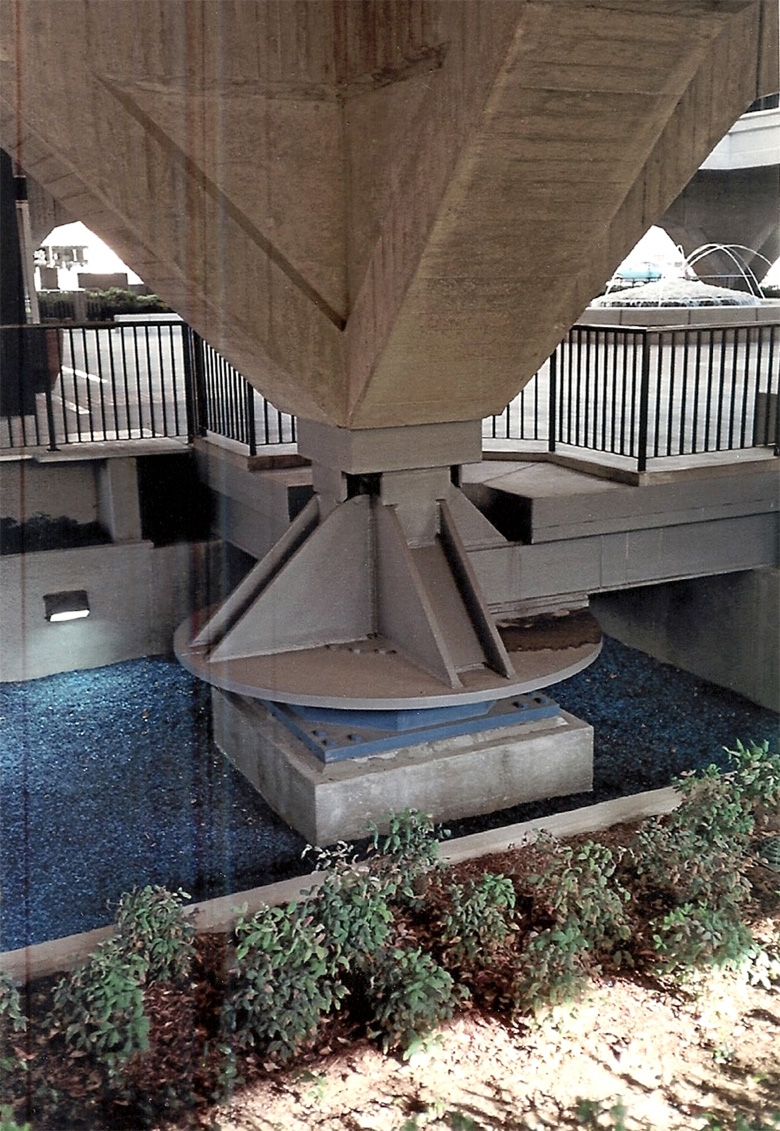
In 2008, the Municipal Services Building of the City of Glendale, California was seismically retrofitted using an innovative combined vibration control solution: the existing elevated building foundation of the building was put on high damping rubber bearings.
Steel plate walls system
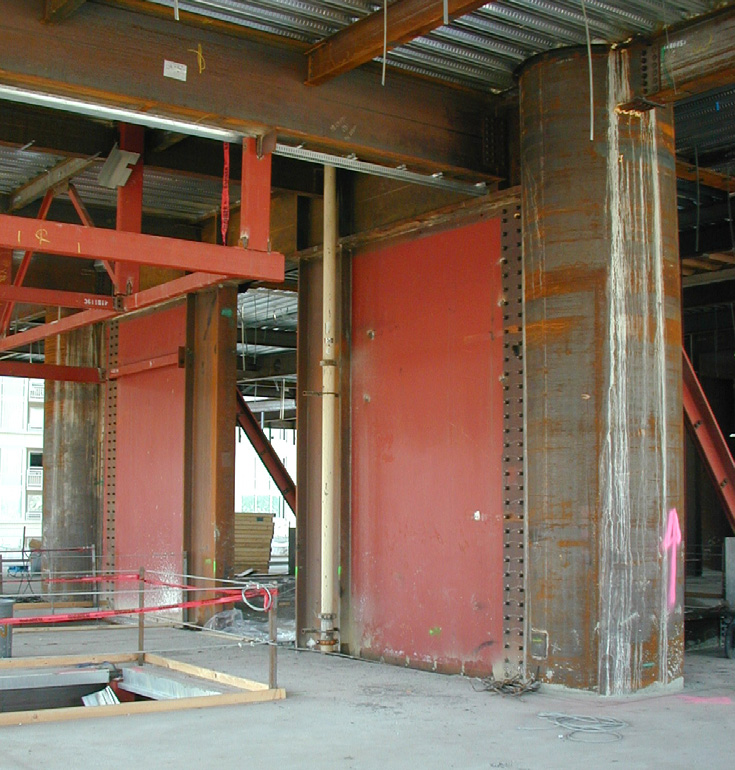
SPSW behavior is analogous to a vertical plate girder cantilevered from its base. Similar to plate girders, the SPSW system optimizes component performance by taking advantage of the post-buckling behavior of the steel infill panels.
The Ritz-Carlton/JW Marriott hotel building, a part of the LA Live development in Los Angeles, California, is the first building in Los Angeles that uses an advanced steel plate shear wall system to resist the lateral loads of strong earthquakes and winds.
Kashiwazaki–Kariwa Nuclear Power Plant upgrade
The Kashiwazaki–Kariwa Nuclear Power Plant, the largest nuclear generating station in the world by net electrical power rating, happened to be near the epicenter of the strongest Mw 6.6 July 2007 Chūetsu offshore earthquake. This initiated an extended shutdown for structural inspection which indicated that a greater earthquake-proofing was needed before operation could be resumed.
On May 9, 2009, one unit (Unit 7) was restarted, after the seismic upgrades. The test run had to continue for 50 days. The plant had been completely shut down for almost 22 months following the earthquake.
Seismic test of seven-story building
A destructive earthquake struck a lone, wooden condominium in Japan. The experiment was webcast live on July 14, 2009, to yield insight on how to make wooden structures stronger and better able to withstand major earthquakes.
The Miki shake at the Hyogo Earthquake Engineering Research Center is the capstone experiment of the four-year NEESWood project, which receives its primary support from the U.S. National Science Foundation Network for Earthquake Engineering Simulation (NEES) Program.
"NEESWood aims to develop a new seismic design philosophy that will provide the necessary mechanisms to safely increase the height of wood-frame structures in active seismic zones of the United States, as well as mitigate earthquake damage to low-rise wood-frame structures," said Rosowsky, Department of Civil Engineering at Texas A&M University. This philosophy is based on the application of seismic damping systems for wooden buildings. The systems, which can be installed inside the walls of most wooden buildings, include strong metal frame, bracing and dampers filled with viscous fluid.
Superframe earthquake proof structure
The proposed system is composed of core walls, hat beams incorporated into the top-level, outer columns, and viscous dampers vertically installed between the tips of the hat beams and the outer columns. During an earthquake, the hat beams and outer columns act as outriggers and reduce the overturning moment in the core, and the installed dampers also reduce the moment and the lateral deflection of the structure. This innovative system can eliminate inner beams and inner columns on each floor, and thereby provide buildings with column-free floor space even in highly seismic regions.
Earthquake architecture
The term 'seismic architecture' or 'earthquake architecture' was first introduced in 1985 by Robert Reitherman. The phrase "earthquake architecture" is used to describe a degree of architectural expression of earthquake resistance or implication of architectural configuration, form or style in earthquake resistance. It is also used to describe buildings in which seismic design considerations impacted its architecture. It may be considered a new aesthetic approach in designing structures in seismic prone areas.
History
An article in Scientific American from May 1884, "Buildings that Resist Earthquakes" described early engineering efforts such as Shōsōin.
Before building codes were improved, door frames were regarded as the most reinforced element of buildings and the safest place to be under during an earthquake. This is no longer general advice, despite a common misconception to the contrary.
References
References
- Seismology Committee. (1999). "Recommended Lateral Force Requirements and Commentary". Structural Engineers Association of California.
- "Precast New Zealand Inc: Precast concrete and seismic issues".
- "Precast concrete panel building damage, comparing the performance of precast frame-panel (collapsed in foreground) and precast panel buildings (standing in background)". Earthquake Engineering Research Institute.
- "Earthquake shelter with bed support and canopy".
- "Japan, U.S. To Collaborate on Disaster Prevention Research | All American Patriots: Politics, economy, health, environment, energy and technology".
- neesit. (17 November 2007). "Shaking Table Test on Conventional Wooden House (1)".
- (February 2024). "Planning Division – City of Glendale, CA".
- Kharrazi, M.H.K., 2005, "Rational Method for Analysis and Design of Steel Plate Walls," Ph.D. Dissertation, University of British Columbia, Vancouver, Canada,
- Reitherman, Robert. (2012). "Earthquakes and Engineers: An International History". ASCE Press.
- (31 July 2007). "Profits shaken at Tepco". World Nuclear News.
- Asahi.com. [http://www.asahi.com/english/Herald-asahi/TKY200707180144.html Quake exposes nuke-plant danger]. July 18, 2007.
- (12 October 2007). "Rensselaer Polytechnic Institute News & Events".
- (26 September 2025). "Home – Standing Strong: 2009 NEESWood Capstone Test". National Science Foundation.
- "A Survey on concepts of design and executing of Superframe RC Earthquake proof Structures" (2016) by Kiarash Khodabakhshi {{ISBN. 9783668208704
- "Seismic Design of a Super Frame". Kajima Corporation.
- Reitherman, Robert. (August 2–3, 1985). "Ten Principles of Nonstructural Seismic Design".
- Llunji, Mentor. (2016). "Seismic Architecture – The architecture of earthquake resistant structures". Msproject.
- (1884-05-31). "Scientific American". Munn & Company.
- "Earthquake {{!}} Personal Cover/Barriers: Do Not Use a Doorway".
- Canon, Gabrielle. (April 6, 2024). "Don't stand in the door frame: what to do in an earthquake". The Guardian.
This article was imported from Wikipedia and is available under the Creative Commons Attribution-ShareAlike 4.0 License. Content has been adapted to SurfDoc format. Original contributors can be found on the article history page.
Ask Mako anything about Earthquake-resistant structures — get instant answers, deeper analysis, and related topics.
Research with MakoFree with your Surf account
Create a free account to save articles, ask Mako questions, and organize your research.
Sign up freeThis content may have been generated or modified by AI. CloudSurf Software LLC is not responsible for the accuracy, completeness, or reliability of AI-generated content. Always verify important information from primary sources.
Report