From Surf Wiki (app.surf) — the open knowledge base
Early life of Augustus
Early life of the Roman emperor
.jpg)
Early life of the Roman emperor
| Field | Value | |
|---|---|---|
| name | Gaius Octavius Thurinus | |
| succession | Emperor of the Roman Empire | |
| image | GaiusOctavius.jpg | |
| caption | An idealized Roman sculpted portrait of young Octavius as a teenager, possibly produced posthumously or when he was much older, now located in the Vatican Museums | |
| reign | 16 January 27 BC – 19 August AD 14 | |
| successor | Tiberius, stepson by third wife, son-in-law, and adoptive son | |
| spouse | 1) Claudia ?–40 BC | |
| 2) Scribonia 40 BC–38 BC | ||
| 3) Livia Drusilla 25 BC to AD 14 | ||
| issue | {{plainlist | |
| royal house | Julio-Claudian | |
| father | Gaius Octavius; | |
| adopted by Julius Caesar | ||
| mother | Atia | |
| birth_date | 23 September 63 BC | |
| birth_place | Rome, Roman Republic | |
| death_date | 19 August 14 AD | |
| death_place | Nola, Italy, Roman Empire | |
| place of burial | Mausoleum of Augustus |
- Scribonia 40 BC–38 BC
- Livia Drusilla 25 BC to AD 14
- Julia the Elder
- Gaius Caesar (adopted)
- Lucius Caesar (adopted)
- Tiberius (adopted)
- Agrippa Postumus (adopted)}} adopted by Julius Caesar
The early life of Augustus, the first Roman emperor, began at his birth in Rome on September 23, 63 BC, and is considered to have ended around the assassination of dictator Julius Caesar, Augustus's great-uncle and adoptive father, on 15 March 44 BC. Born as Gaius Octavius, in his early childhood he was raised by his father, also named Gaius Octavius, and his mother Atia, but after his father's death he was raised in part by his stepfather Lucius Marcius Philippus and his grandmother Julia. In his youth he was provided an education in Greek and Latin rhetoric, mathematics, and philosophy.
Caesar helped to foster Octavius's early career, after the latter donned the toga virilis at age 15 to mark his coming of age as an adult citizen. Caesar had Octavius elected to the College of Pontiffs, ride in his chariot during a triumph, and accompany him on a military campaign in Hispania. Caesar named Octavius as his primary heir in his will, but was assassinated on the Ides of March in 44 BC while Octavius was studying and undergoing military training at Apollonia in Illyria. Afterwards, Octavius sailed back to Italy to claim his inheritance as the rightful heir to Caesar, and is labeled by historians at this stage with the name Octavian. Ultimately victorious after a series of civil wars, he would eventually be named Augustus by the Roman Senate in 27 BC, an event that traditionally marks the end of the Roman Republic and beginning of the Roman Empire.
Childhood and education
Main article: Augustus
Birth
Augustus was born Gaius Octavius in Rome on 23 September 63 BC. The historians Anne-Marie Lewis and Karl Galinsky explain how there is scholarly debate surrounding Octavius's precise date of birth. Evidence that it had occurred on 22 September is based on statements by historians such as Suetonius and Velleius Paterculus, though Cassius Dio affirms that it occurred on 23 September, and confusion also stems from the transition of using the early Republican Roman calendar to using the Julian Calendar during Octavius's lifetime. Most Roman histories gloss over the childhood of Octavius. Some details about his upbringing from his now-lost autobiography were preserved by Suetonius. However, the majority of information is preserved in a biography composed by Nicolaus of Damascus around 20 BC. This biography has only partially survived in 10th-century Byzantine excerpts.
Family and ancestry
Octavius was a member of the respectable, but undistinguished, equestrian Octavii family through his father, also named Gaius Octavius. The younger Octavius was also the great-nephew of Julius Caesar through his mother Atia. Octavius had two older siblings: a half sister, Octavia Major, from his father's first marriage, and a full sister, Octavia Minor. His paternal family was from the Volscian town of Velitrae (modern Velletri), approximately 40 km south-east of the city. He was born at Ox Head, a small property on the Palatine Hill, very close to the Roman Forum. For at least a portion of his childhood he was raised in his family's hometown of Velitrae.
Octavius's paternal great-grandfather Octavius was a military tribune in Sicily during the Second Punic War. His grandfather was a banker. However, the family entered into the senatorial ranks with Octavius's father the elder Octavius as its novus homo. The elder Octavius's entrance into the Senate came when he was appointed quaestor. He ascended the Cursus honorum as quaestor , aedile , and praetor in 61 BC, before being made proconsular governor of Macedonia, where he was proclaimed imperator for victories against the Thracian Bessi on its frontiers.
In his childhood, Octavius may have received the cognomen "Thurinus" to commemorate his father's victory at Thurii over a rebellious band of slaves who had been followers of Spartacus. Later, after he had taken the name of Caesar, his rival Mark Antony referred to him as Thurinus in order to belittle him. However, Antony did so by insinuating that Octavius's great-grandfather was a mere plebeian rope-maker at Thurii, a dismissive insult based on social class.
Tutelage and coming of age
The elder Octavius proved himself a capable administrator in Macedonia. Upon returning to Italy, before he could stand for the consulship, he suddenly died in Nola in 59 BC, or in 58 BC, when Octavius was only four or five years old. In 58 BC Octavius's mother Atia married a former governor of Syria, Lucius Marcius Philippus. Philippus came from a leading family in Rome and was elected consul in 56 BC. According to Galinsky, as Octavius's stepfather, Philippus likely served as a role model in how to delicately navigate troubled political waters while preserving his personal wealth. It is also likely that Octavius was partly raised by his grandmother, Julia, the sister of Julius Caesar. When Julia died in 52 or 51 BC, Octavius delivered her funeral oration, his first major public appearance. Historian Patricia Southern adds that such a move carried political connotations for Octavius:
Historian Adrian Goldsworthy concurs about the political importance of the eulogy. However, he insists that it was delivered in 51 BC when Octavius was 12 years old. He also does not mention the political context that includes Gaius Marius.
Octavius was educated in reading, writing, arithmetic, and the Greek language by a Greek slave tutor named Sphaerus, who Octavius later freed from slavery and honored with a state funeral in 40 BC. Galinsky claims that Octavius was educated by Sphaerus in the household of Lucius Marcius Philippus, whereas Goldsworthy claims Octavius was educated by Sphaerus in the household of Atia's parents. As a teenager he studied philosophy under the tutelage of Areios of Alexandria and Athenodorus of Tarsus, Latin rhetoric under Marcus Epidius, and Greek rhetoric under Apollodorus of Pergamon. In 48 or 47 BC Octavius donned the toga virilis ('toga of manhood'). Southern explains the discrepancy among primary sources for the age in which Octavius was allowed to wear the toga virilis:
Galinsky claims that Octavius's coming of age ceremony for wearing the toga virilis was in 48 BC, as opposed to Southern, who claims it occurred during 47 BC. Goldsworthy also says that Octavius exchanged his toga praetexta for the toga virilis on 18 October 47 BC. However, he clarifies that "Octavius was a few weeks past his sixteenth birthday", not 15 years old per Southern.
Early career
Main article: Augustus
Caesar's patronage and will
In 63 BC Julius Caesar became pontifex maximus, head of the College of Pontiffs, allowing him to build political clout and eventually form the so-called 'first triumvirate' with the statesmen Pompey and Marcus Licinius Crassus in 60 BC. This informal alliance, which superseded but did not suspend Rome's constitution, had fallen apart by the time Caesar crossed the Rubicon on 11 January 49 BC and initiated a protracted civil war. Southern asserts that "the so-called 'first Triumvirate'" formed in 60/59 BC between Caesar, Pompey, and Crassus was not a term that they would have recognized in their own day, and was only an informal alliance. Southern insists that it is a "convenient modern term" made analogous to the later legally sanctioned and so-called 'second triumvirate' formed by Octavian, Antony and Lepidus.
At the request of Caesar, to fill a priesthood position left vacant by Lucius Domitius Ahenobarbus (after he was killed at the Battle of Pharsalus), Julius Caesar requested that Octavius should be elected to the College of Pontiffs in Rome, being accepted in 47 BC. The following year he was put in charge of the Greek games that were staged in honor of the Temple of Venus Genetrix, built by Julius Caesar. In late 47 BC, Octavius wished to join Caesar's staff for his campaign in Africa but gave way when his mother Atia protested over his poor health. Treating him as a son, Caesar had Octavius proceed next to his chariot during his triumph celebrating the campaign, and had him awarded with military decorations as if he had been present for it. In 46 BC, Atia consented for Octavius to join Caesar in Hispania, where he planned to fight the lingering forces of Pompey, Caesar's late enemy, but Octavius fell ill and was unable to travel. In 45 BC Octavius finally traveled to Hispania to join Caesar's camp during the fight against the forces of Gnaeus Pompeius Magnus the Younger (son of Pompey), convincing his mother Atia not to join him there despite her worries about his fragile physical health. The cause of Octavius's perennial health problems is not clear. Goldsworthy speculates that Augustus's later serious illness suffered in 23 BC may have been feigned or psychosomatic, and if real, both he and Southern have suggested a liver abscess.

Caesar deposited a new will with the Vestal Virgins. Julius Caesar returned to Rome from Hispania in October 45 BC, but first he drafted his will while staying at his villa in Labici just outside of Rome. It was here where he named Octavius as the prime beneficiary and his principal heir on 13 September 45 BC. Goldsworthy provides a different date for Julius Caesar drafting his will, writing that it took place on 15 September 45 BC.
Debate over the office of ''magister equitum''
It is alleged that Caesar had nominated Octavius to serve as Master of the Horse (Caesar’s chief lieutenant) for the year 43 BC, thus making Octavius the number-two man in the state at the age of 19. However, a recently discovered inscription proves that Octavius was not appointed magister equitum, in contradiction to the theory formed by Theodor Mommsen. The title may stem from conflation in Greek between the magister equitum and praefectus urbi. Historian H. Gesche disagreed with Walter Schmitthenner on the issue. Schmitthenner argued that 16-year-old Octavius was too young to serve as magister equitum, and that this was conflated with his role as praefectus urbi during the Feriae Latinae festivities. Gesche, with whom Ernst Badian agreed, argued that Octavius's appointment to the office of magister equitum was described plainly enough in Latin by Pliny the Elder, and thus he did not seem to confuse the terminology translated into Greek. Southern argues that Octavius being a relative political nobody in Rome shortly after Caesar's assassination undercuts the idea that he had ever served in the prestigious office of magister equitum.
Training in Apollonia and assassination of Caesar
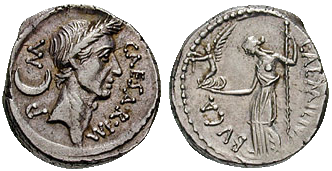
Hoping to continue Octavius’s education, at the end of 45 BC Caesar sent him, along with his friends Agrippa, Gaius Maecenas, and Quintus Salvidienus Rufus, to Apollonia, Illyria across the Adriatic Sea from Italy. There, Octavius learned not only academics and self-control but military doctrine and tactics as well. Caesar, however, had more than just education in mind for Octavius. He had sent several legions to nearby Macedonia in preparation for an upcoming war with the Parthian Empire. The war with the Parthians never came during the lifetime of Caesar. In 44 BC, Octavius was still studying and undergoing military training at Apollonia when Julius Caesar was made Rome's first dictator perpetuo ('dictator in perpetuity') in February. Caesar was then assassinated on the Ides of March (15 March) by senators who were aligned against him politically.
Rejecting the advice of some army officers to take refuge with his troops in Macedonia, Octavius sailed to Italy to claim his inheritance and mantle as Caesar's rightful heir. It was then made public that Caesar had adopted Octavius as his son and main heir. In response, Octavius changed his name to Gaius Julius Caesar Octavianus and accepted his inheritance outlined in the will. To avoid confusion, modern scholars commonly refer to him at this point as Octavian (Latin: Octavianus). However, he called himself "Caesar", which is the name his contemporaries used, though some such as Cicero and his stepfather Philippus called him Octavianus.
Family tree of the Octavii Rufi
Notes
References
Sources
Ancient sources
-
- White, Horace (1913–14). Loeb Classical Library – via LacusCurtius.
-
- Shipley, Frederick W. (1924). Loeb Classical Library – via LacusCurtius.
-
- Shackleton-Bailey, D. R. (1999). Loeb Classical Library. 4 volumes.
-
- Cary, Earnest (1914–27). Loeb Classical Library – via LacusCurtius.
-
- Lendering, Jona. (2003). Livius.org.
- Schlesinger, Alfred C. (1959). Loeb Classical Library.
-
- Hall, Clayton M. (1923). Northampton – via CSUN.edu. .
-
- Rolfe, J. C. (1913–14). Loeb Classical Library – via LacusCurtius
-
- Jackson, J. (1931–37). Loeb Classical Library – via LacusCurtius
-
- Shipley, Frederick W. (1924). Loeb Classical Library – via LacusCurtius.
Modern sources
References
- {{harvnb. Goldsworthy. 2014. Eck. Takács. 2007. Richardson. 2012. Broughton. 1952. la. imperator), 595 (index entry). Broughton cites the {{lang. la. elogium for Octavius, {{ILS inscription. 47, throughout.
- Gesche, H.. (1973). "Hat Caesar den Octavian zum Magister equitum designiert? (Ein Beitrag zur Beurteilung der Adoption Octavians durch Caesar)". Historia.
This article was imported from Wikipedia and is available under the Creative Commons Attribution-ShareAlike 4.0 License. Content has been adapted to SurfDoc format. Original contributors can be found on the article history page.
Ask Mako anything about Early life of Augustus — get instant answers, deeper analysis, and related topics.
Research with MakoFree with your Surf account
Create a free account to save articles, ask Mako questions, and organize your research.
Sign up freeThis content may have been generated or modified by AI. CloudSurf Software LLC is not responsible for the accuracy, completeness, or reliability of AI-generated content. Always verify important information from primary sources.
Report