From Surf Wiki (app.surf) — the open knowledge base
E (mathematical constant)
2.71828…, base of natural logarithms
2.71828…, base of natural logarithms
| Field | Value | |
|---|---|---|
| name | Euler's number | |
| symbol | e | |
| type | Transcendental | |
| approximation | 2.71828... | |
| discovery_date | 1685 | |
| discovery_person | Jacob Bernoulli | |
| discovery_work | Quæstiones nonnullæ de usuris, cum solutione problematis de sorte alearum, propositi in Ephem. Gall. A. 1685 | |
| named_after | {{flatlist |
- Leonhard Euler
- John Napier
The number e is a mathematical constant, approximately equal to 2.71828, that is the base of the natural logarithm and exponential function. It is sometimes called Euler's number, after the Swiss mathematician Leonhard Euler, though this can invite confusion with Euler numbers, or with Euler's constant, a different constant typically denoted \gamma. Alternatively, e can be called Napier's constant after John Napier. The Swiss mathematician Jacob Bernoulli discovered the constant while studying compound interest.
The number e is of great importance in mathematics, alongside 0, 1, , and i. All five appear in one formulation of Euler's identity e^{i\pi}+1=0 and play important and recurring roles across mathematics. e is irrational, meaning that it cannot be represented as a ratio of integers. Moreover, like the constant , it is transcendental, meaning that it is not a root of any non-zero polynomial with rational coefficients. To 30 decimal places, the value of e is: |
Definitions
The number e is the limit \lim_{n\to \infty}\left(1+\frac 1n\right)^n, an expression that arises in the computation of compound interest.
It is the sum of the infinite series e = \sum\limits_{n = 0}^{\infty} \frac{1}{n!} = 1 + \frac{1}{1} + \frac{1}{1\cdot 2} + \frac{1}{1\cdot 2\cdot 3} + \cdots.
It is the unique positive number a such that the graph of the function has a slope of 1 at .
One has e=\exp(1), where \exp is the (natural) exponential function, the unique function that equals its own derivative and satisfies the equation \exp(0)=1. Therefore, e is also the base of the natural logarithm, the inverse of the natural exponential function.
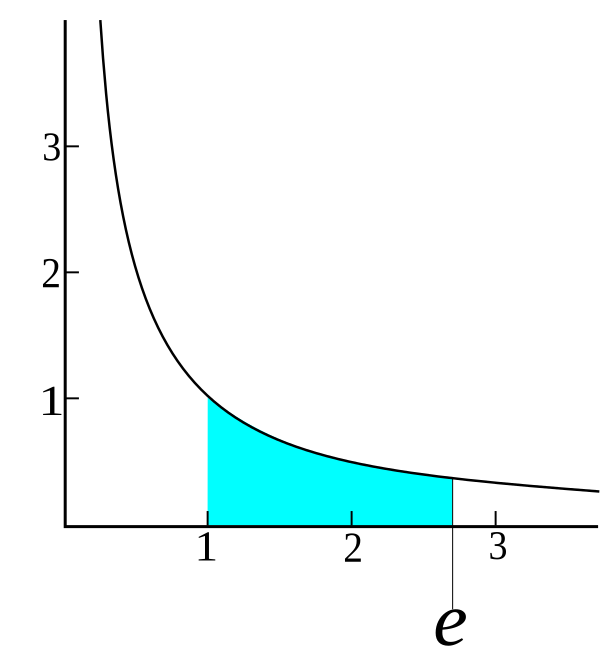
The number e can also be characterized in terms of an integral: \int_1^e \frac {dx}x =1.
For other characterizations, see .
History
The first references to this constant were published in 1618 in the table of an appendix of a work on logarithms by John Napier. However, this did not contain the constant itself, but simply a list of logarithms to the base e. It is assumed that the table was written by William Oughtred. In 1661, Christiaan Huygens studied how to compute logarithms by geometrical methods and calculated a quantity that, in retrospect, is the base-10 logarithm of e, but he did not recognize e itself as a quantity of interest.
The constant itself was introduced by Jacob Bernoulli in 1683, for solving the problem of continuous compounding of interest. In his solution, the constant e occurs as the limit \lim_{n\to \infty} \left( 1 + \frac{1}{n} \right)^n, where n represents the number of intervals in a year on which the compound interest is evaluated (for example, n=12 for monthly compounding).
The first symbol used for this constant was the letter b by Gottfried Leibniz in letters to Christiaan Huygens in 1690 and 1691.
Leonhard Euler started to use the letter e for the constant in 1727 or 1728, in an unpublished paper on explosive forces in cannons, and in a letter to Christian Goldbach on 25 November 1731. The first appearance of e in a printed publication was in Euler's Mechanica (1736). It is unknown why Euler chose the letter e. Although some researchers used the letter c in the subsequent years, the letter e was more common and eventually became standard.
Euler proved that e is the sum of the infinite series e = \sum_{n = 0}^\infty \frac{1}{n!} = \frac{1}{0!} + \frac{1}{1!} + \frac{1}{2!} + \frac{1}{3!} + \frac{1}{4!} + \cdots , where n! is the factorial of n. The equivalence of the two characterizations using the limit and the infinite series can be proved via the binomial theorem.
Applications
Compound interest

Jacob Bernoulli discovered this constant in 1683, while studying a question about compound interest:
If the interest is credited twice in the year, the interest rate for each 6 months will be 50%, so the initial $1 is multiplied by 1.5 twice, yielding at the end of the year. Compounding quarterly yields , and compounding monthly yields . If there are n compounding intervals, the interest for each interval will be 100%/n and the value at the end of the year will be $1.00 × (1 + 1/n)n.
Bernoulli noticed that this sequence approaches a limit (the force of interest) with larger n and, thus, smaller compounding intervals. Compounding weekly () yields $2.692596..., while compounding daily () yields $2.714567... (approximately two cents more). The limit as n grows large is the number that came to be known as e. That is, with continuous compounding, the account value will reach $2.718281828... More generally, an account that starts at $1 and offers an annual interest rate of R will, after t years, yield e**Rt dollars with continuous compounding. Here, R is the decimal equivalent of the rate of interest expressed as a percentage, so for 5% interest, .{{cite book | author-link = Larry Gonick
Bernoulli trials

The number e itself also has applications in probability theory, in a way that is not obviously related to exponential growth. Suppose that a gambler plays a slot machine that pays out with a probability of one in n and plays it n times. As n increases, the probability that gambler will lose all n bets approaches 1/e, which is approximately 36.79%. For , this is already 1/2.789509... (approximately 35.85%).
This is an example of a Bernoulli trial process. Each time the gambler plays the slots, there is a one in n chance of winning. Playing n times is modeled by the binomial distribution, which is closely related to the binomial theorem and Pascal's triangle. The probability of winning k times out of n trials is: :\Pr[k~\mathrm{wins~of}~n] = \binom{n}{k} \left(\frac{1}{n}\right)^k\left(1 - \frac{1}{n}\right)^{n-k}.
In particular, the probability of winning zero times () is :\Pr[0~\mathrm{wins~of}~n] = \left(1 - \frac{1}{n}\right)^{n}.
The limit of the above expression, as n tends to infinity, is precisely 1/e.
Exponential growth and decay
Exponential growth is a process that increases quantity over time at an ever-increasing rate. It occurs when the instantaneous rate of change (that is, the derivative) of a quantity with respect to time is proportional to the quantity itself. Described as a function, a quantity undergoing exponential growth is an exponential function of time, that is, the variable representing time is the exponent (in contrast to other types of growth, such as quadratic growth). If the constant of proportionality is negative, then the quantity decreases over time, and is said to be undergoing exponential decay instead. The law of exponential growth can be written in different but mathematically equivalent forms, by using a different base, for which the number e is a common and convenient choice: x(t) = x_0\cdot e^{kt} = x_0\cdot e^{t/\tau}. Here, x_0 denotes the initial value of the quantity x, k is the growth constant, and \tau is the time it takes the quantity to grow by a factor of e.
Standard normal distribution
Main article: Normal distribution
The normal distribution with zero mean and unit standard deviation is known as the standard normal distribution, given by the probability density function \phi(x) = \frac{1}{\sqrt{2\pi}} e^{-\frac{1}{2} x^2}.
The constraint of unit standard deviation (and thus also unit variance) results in the in the exponent, and the constraint of unit total area under the curve \phi(x) results in the factor \textstyle 1/\sqrt{2\pi}. This function is symmetric around , where it attains its maximum value \textstyle 1/\sqrt{2\pi}, and has inflection points at .
Derangements
Main article: Derangement
Another application of e, also discovered in part by Jacob Bernoulli along with Pierre Remond de Montmort, is in the problem of derangements, also known as the hat check problem: n guests are invited to a party and, at the door, the guests all check their hats with the butler, who in turn places the hats into n boxes, each labelled with the name of one guest. But the butler has not asked the identities of the guests, and so puts the hats into boxes selected at random. The problem of de Montmort is to find the probability that none of the hats gets put into the right box. This probability, denoted by p_n!, is:
:p_n = 1 - \frac{1}{1!} + \frac{1}{2!} - \frac{1}{3!} + \cdots + \frac{(-1)^n}{n!} = \sum_{k = 0}^n \frac{(-1)^k}{k!}.
As n tends to infinity, p**n approaches 1/e. Furthermore, the number of ways the hats can be placed into the boxes so that none of the hats are in the right box is n!/e, rounded to the nearest integer, for every positive n.
Optimal planning problems
The maximum value of \sqrt[x]{x} occurs at x = e. Equivalently, for any value of the base b 1, it is the case that the maximum value of x^{-1}\log_b x occurs at x = e (Steiner's problem, discussed below).
This is useful in the problem of a stick of length L that is broken into n equal parts. The value of n that maximizes the product of the lengths is then either :n = \left\lfloor \frac{L}{e} \right\rfloor or \left\lceil \frac{L}{e} \right\rceil.
The quantity x^{-1}\log_b x is also a measure of information gleaned from an event occurring with probability 1/x (approximately 36.8% when x=e), so that essentially the same optimal division appears in optimal planning problems like the secretary problem.
Asymptotics
The number e occurs naturally in connection with many problems involving asymptotics. An example is Stirling's formula for the asymptotics of the factorial function, in which both the numbers e and appear: n! \sim \sqrt{2\pi n} \left(\frac{n}{e}\right)^n.
As a consequence, e = \lim_{n\to\infty} \frac{n}{\sqrt[n]{n!}} .
Properties
Calculus


The principal motivation for introducing the number e, particularly in calculus, is to perform differential and integral calculus with exponential functions and logarithms. A general exponential has a derivative, given by a limit:
:\begin{align} \frac{d}{dx}a^x &= \lim_{h\to 0}\frac{a^{x+h} - a^x}{h} = \lim_{h\to 0}\frac{a^x a^h - a^x}{h} \ &= a^x \cdot \left(\lim_{h\to 0}\frac{a^h - 1}{h}\right). \end{align}
The parenthesized limit on the right is independent of the variable x. Its value turns out to be the logarithm of a to base e. Thus, when the value of a is set to e, this limit is equal to 1, and so one arrives at the following simple identity: :\frac{d}{dx}e^x = e^x.
Consequently, the exponential function with base e is particularly suited to doing calculus. Choosing e (as opposed to some other number) as the base of the exponential function makes calculations involving the derivatives much simpler.
Another motivation comes from considering the derivative of the base-a logarithm (i.e., loga x), for x 0:
:\begin{align} \frac{d}{dx}\log_a x &= \lim_{h\to 0}\frac{\log_a(x + h) - \log_a(x)}{h} \ &= \lim_{h\to 0}\frac{\log_a(1 + h/x)}{x\cdot h/x} \ &= \frac{1}{x}\log_a\left(\lim_{u\to 0}(1 + u)^\frac{1}{u}\right) \ &= \frac{1}{x}\log_a e, \end{align}
where the substitution was made. The base-a logarithm of e is 1, if a equals e. So symbolically, :\frac{d}{dx}\log_e x = \frac{1}{x}.
The logarithm with this special base is called the natural logarithm, and is usually denoted as ln; it behaves well under differentiation since there is no undetermined limit to carry through the calculations.
Thus, there are two ways of selecting such special numbers a. One way is to set the derivative of the exponential function a**x equal to a**x, and solve for a. The other way is to set the derivative of the base a logarithm to 1/x and solve for a. In each case, one arrives at a convenient choice of base for doing calculus. It turns out that these two solutions for a are actually the same: the number e.

The Taylor series for the exponential function can be deduced from the facts that the exponential function is its own derivative and that it equals 1 when evaluated at 0: e^x = \sum_{n=0}^\infty \frac{x^n}{n!}. Setting x = 1 recovers the definition of e as the sum of an infinite series.
The natural logarithm function can be defined as the integral from 1 to x of 1/t, and the exponential function can then be defined as the inverse function of the natural logarithm. The number e is the value of the exponential function evaluated at x = 1, or equivalently, the number whose natural logarithm is 1. It follows that e is the unique positive real number such that \int_1^e \frac{1}{t} , dt = 1.
Because e**x is the unique function (up to multiplication by a constant K) that is equal to its own derivative,
\frac{d}{dx}Ke^x = Ke^x,
it is therefore its own antiderivative as well:
\int Ke^x,dx = Ke^x + C .
Equivalently, the family of functions
y(x) = Ke^x
where K is any real or complex number, is the full solution to the differential equation
y' = y .
Inequalities
The number e is the unique real number such that \left(1 + \frac{1}{x}\right)^x for all positive x.
Also, we have the inequality e^x \ge x + 1 for all real x, with equality if and only if . Furthermore, e is the unique base of the exponential for which the inequality a**x ≥ x + 1 holds for all x. This is a limiting case of Bernoulli's inequality.
Exponential-like functions

Steiner's problem asks to find the global maximum for the function
f(x) = x^\frac{1}{x} .
This maximum occurs precisely at . (One can check that the derivative of ln f(x) is zero only for this value of x.)
Similarly, is where the global minimum occurs for the function
f(x) = x^x .
The infinite tetration
: x^{x^{x^{\cdot^{\cdot^{\cdot}}}}} or {^\infty}x
converges if and only if x ∈ [(1/e)e, e1/e] ≈ [0.06599, 1.4447], shown by a theorem of Leonhard Euler.
Number theory
The real number e is irrational. Euler proved this by showing that its simple continued fraction expansion does not terminate. (See also Fourier's proof that e is irrational.)
Furthermore, by the Lindemann–Weierstrass theorem, e is transcendental, meaning that it is not a solution of any non-zero polynomial equation with rational coefficients. It was the first number to be proved transcendental without having been specifically constructed for this purpose (compare with Liouville number); the proof was given by Charles Hermite in 1873. The number e is one of only a few transcendental numbers for which the exact irrationality exponent is known (given by \mu(e)=2).
An unsolved problem thus far is the question of whether or not the numbers e and π are algebraically independent. This would be resolved by Schanuel's conjecture – a currently unproven generalization of the Lindemann–Weierstrass theorem.
It is conjectured that e is normal, meaning that when e is expressed in any base the possible digits in that base are uniformly distributed (occur with equal probability in any sequence of given length).{{cite book|author-link=Davar Khoshnevisan |last=Khoshnevisan |first=Davar |chapter=Normal numbers are normal |year=2006 |title=Clay Mathematics Institute Annual Report 2006 |publisher=Clay Mathematics Institute |pages=15, 27–31 |chapter-url=http://www.claymath.org/library/annual_report/ar2006/06report_normalnumbers.pdf
In algebraic geometry, a period is a number that can be expressed as an integral of an algebraic function over an algebraic domain. The constant is a period, but it is conjectured that e is not.
Complex numbers
The exponential function e**x may be written as a Taylor series
e^{x} = 1 + {x \over 1!} + {x^{2} \over 2!} + {x^{3} \over 3!} + \cdots = \sum_{n=0}^{\infty} \frac{x^n}{n!}.
Because this series is convergent for every complex value of x, it is commonly used to extend the definition of e**x to the complex numbers. This, with the Taylor series for sin and cos x, allows one to derive Euler's formula:
e^{ix} = \cos x + i\sin x ,
which holds for every complex x. The special case with is Euler's identity:
e^{i\pi} + 1 = 0 , which is considered to be an exemplar of mathematical beauty as it shows a profound connection between the most fundamental numbers in mathematics. In addition, it is directly used in a proof that is transcendental, which implies the impossibility of squaring the circle. Moreover, the identity implies that, in the principal branch of the logarithm,
\ln (-1) = i\pi .
Furthermore, using the laws for exponentiation,
(\cos x + i\sin x)^n = \left(e^{ix}\right)^n = e^{inx} = \cos nx + i \sin nx
for any integer n, which is de Moivre's formula.
The expressions of \sin(x) and \cos(x) in terms of the exponential function can be deduced from the Taylor series: \cos x = \frac{e^{ix} + e^{-ix}}{2} , \qquad \sin x = \frac{e^{ix} - e^{-ix}}{2i}.
The expression \cos x + i \sin x is sometimes abbreviated as \mathrm{cis}(x).
Entropy
The constant e plays a distinguished role in the theory of entropy in probability theory and ergodic theory. The basic idea is to consider a partition of a probability space into a finite number of measurable sets, \xi = (A_1,\cdots, A_k), the entropy of which is the expected information gained regarding the probability distribution by performing a random sample (or "experiment"). The entropy of the partition is H(\xi) = -\sum_{i=1}^k p(A_i)\ln p(A_i). The function f(x) = -x\ln x is thus of fundamental importance, representing the amount of entropy contributed by a particular element of the partition, x=p(A_i). This function is maximized when x=1/e. What this means, concretely, is that the entropy contribution of the particular event A_i is maximized when p(A_i)=1/e; outcomes that are either too likely or too rare contribute less to the total entropy.
Representations
Main article: List of representations of e
The number e can be represented in a variety of ways: as an infinite series, an infinite product, a continued fraction, or a limit of a sequence. In addition to the limit and the series given above, there is also the simple continued fraction
: e = [2; 1, 2, 1, 1, 4, 1, 1, 6, 1, ..., 1, 2n, 1, ...],
which written out looks like
:e = 2 + \cfrac{1} {1 + \cfrac{1} {2 + \cfrac{1} {1 + \cfrac{1} {1 + \cfrac{1} {4 + \cfrac{1} {1 + \cfrac{1} {1 + \ddots} } } } } } } .
The following infinite product evaluates to e: e = \frac{2}{1} \left(\frac{4}{3}\right)^{1/2} \left(\frac{6 \cdot 8}{5 \cdot 7}\right)^{1/4} \left(\frac{10 \cdot 12 \cdot 14 \cdot 16}{9 \cdot 11 \cdot 13 \cdot 15}\right)^{1/8} \cdots.
Many other series, sequence, continued fraction, and infinite product representations of e have been proved.
Stochastic representations
In addition to exact analytical expressions for representation of e, there are stochastic techniques for estimating e. One such approach begins with an infinite sequence of independent random variables X1, X2..., drawn from the uniform distribution on [0, 1]. Let V be the least number n such that the sum of the first n observations exceeds 1:
:V = \min\left{ n \mid X_1 + X_2 + \cdots + X_n 1 \right}.
Then the expected value of V is e: .
Known digits
The number of known digits of e has increased substantially since the introduction of the computer, due both to increasing performance of computers and to algorithmic improvements.
| Date | Decimal digits | Computation performed by | ||
|---|---|---|---|---|
| 1690 | ||||
| 1714 | ||||
| 1748 | ||||
| 1853 | ||||
| 1871 | ||||
| 1884 | ||||
| 1949 | ||||
| 1961 | ||||
| 1981 |
Since around 2010, the proliferation of modern high-speed desktop computers has made it feasible for amateurs to compute trillions of digits of e within acceptable amounts of time. On December 24, 2023, a record-setting calculation was made by Jordan Ranous, giving e to 35,000,000,000,000 digits.{{cite web
Computing the digits
One way to compute the digits of e is with the series e=\sum_{k=0}^\infty \frac{1}{k!}.
A faster method involves two recursive functions p(a,b) and q(a,b). The functions are defined as \binom{p(a,b)}{q(a,b)}= \begin{cases} \binom{1}{b}, & \text{if }b=a+1\text{,} \ \binom{p(a,m)q(m,b)+p(m,b)}{q(a,m)q(m,b)}, & \text{otherwise, where }m=\lfloor(a+b)/2\rfloor .\end{cases}
The expression 1+\frac{p(0,n)}{q(0,n)} produces the nth partial sum of the series above. This method uses binary splitting to compute e with fewer single-digit arithmetic operations and thus reduced bit complexity. Combining this with fast Fourier transform-based methods of multiplying integers makes computing the digits very fast.
In computer culture
During the emergence of internet culture, individuals and organizations sometimes paid homage to the number e.
In an early example, the computer scientist Donald Knuth let the version numbers of his program Metafont approach e. The versions are 2, 2.7, 2.71, 2.718, and so forth.{{Cite journal | author-link= Donald Knuth | access-date= 2017-02-17
In another instance, the IPO filing for Google in 2004, rather than a typical round-number amount of money, the company announced its intention to raise 2,718,281,828 USD, which is e billion dollars rounded to the nearest dollar.
Google was also responsible for a billboard that appeared in the heart of Silicon Valley, and later in Cambridge, Massachusetts; Seattle, Washington; and Austin, Texas. It read "{first 10-digit prime found in consecutive digits of e}.com". The first 10-digit prime in e is 7427466391, which starts at the 99th digit.{{cite web | access-date= 2007-06-09 | archive-date= 2010-09-23 | archive-url= https://web.archive.org/web/20100923111259/http://mkaz.com/math/google-billboard/ | url-status= dead Solving this second problem finally led to a Google Labs webpage where the visitor was invited to submit a résumé.{{cite news | access-date= 2007-06-09
The last release of the official Python 2 interpreter has version number 2.7.18, a reference to e.
In computing
In scientific computing, the constant e is often hard-coded. For example, the Python standard library includes math.e = 2.718281828459045, a floating-point approximation of e. Despite this, it is generally more numerically stable and efficient to use the built-in exponential function—such as math.exp(x) in Python—rather than computing e^x via pow(e, x), even when x is an integer.
Most implementations of the exponential function use range reduction, lookup tables, and polynomial or rational approximations (such as Padé approximants or Taylor expansions) to achieve accurate results across a wide range of inputs. In contrast, general-purpose exponentiation functions—like pow—may involve additional intermediate computations, such as logarithms and multiplications, and may accumulate more rounding error, particularly when e is used in floating-point form.
At very high precision, methods based on elliptic functions and fast convergence of the AGM and Newton's method can be used to compute the exponential function.{{cite journal
Tools such as y-cruncher are optimized for computing many digits of individual constants like e, and use the Taylor series for e because it converges very rapidly, especially when combined with various optimizations. In particular, the method of binary splitting applies to computing the series for e, as opposed to the series for \exp(x), because the summands in the former series are simple rational numbers. This allows the complexity of computing n digits of e to be reduced to O(n\log^2n), asymptotically the same as AGM methods, but much cheaper in practice.
References
References
- Weisstein, Eric W.. "e".
- (2009). "The Math Book: From Pythagoras to the 57th Dimension, 250 Milestones in the History of Mathematics". Sterling Publishing Company.
- (September 2001). "The number {{mvar".
- Sawyer, W. W.. (1961). "Mathematician's Delight". Penguin.
- (2018). "Euler's Pioneering Equation: The most beautiful theorem in mathematics". Oxford University Press.
- (2004). "Pi: A Biography of the World's Most Mysterious Number". Prometheus Books.
- {{Cite OEIS. A001113. Decimal expansion of {{mvar. e
- {{dlmf
- Bruins, E. M.. (1983). "The Computation of Logarithms by Huygens". Constructive Function Theory.
- Jacob Bernoulli considered the problem of continuous compounding of interest, which led to a series expression for {{mvar. 2½''a'' & minus quam {{math. 3''a''." ( … which our series [a geometric series] is larger [than]. … if {{math. 2½''a'' and less than {{math. 3''a''.) If {{math. ''a'' × ''e'', so {{math. 2.5 < ''e'' < 3. (** The reference is to a problem which Jacob Bernoulli posed and which appears in the ''Journal des Sçavans'' of 1685 at the bottom of [http://gallica.bnf.fr/ark:/12148/bpt6k56536t/f307.image.langEN page 314.])
- (1991). "A History of Mathematics". Wiley.
- Leibniz, Gottfried Wilhelm. (2003). "Sämliche Schriften Und Briefe".
- Euler, ''[https://scholarlycommons.pacific.edu/euler-works/853/ Meditatio in experimenta explosione tormentorum nuper instituta]''. {{lang. la. Scribatur pro numero cujus logarithmus est unitas, e, qui est 2,7182817… (English: Written for the number of which the logarithm has the unit, e, that is 2,7182817...")
- Lettre XV. Euler à Goldbach, dated November 25, 1731 in: P.H. Fuss, ed., ''Correspondance Mathématique et Physique de Quelques Célèbres Géomètres du XVIIIeme Siècle'' … (Mathematical and physical correspondence of some famous geometers of the 18th century), vol. 1, (St. Petersburg, Russia: 1843), pp. 56–60, see especially [https://books.google.com/books?id=gf1OEXIQQgsC&pg=PA58 p. 58.] From p. 58: ''" … ( e denotat hic numerum, cujus logarithmus hyperbolicus est = 1), … "'' ( … (e denotes that number whose hyperbolic [i.e., natural] logarithm is equal to 1) … )
- Remmert, Reinhold. (1991). "Theory of Complex Functions". [[Springer-Verlag]].
- e denotat numerum, cuius logarithmus hyperbolicus est 1.'' (So it [i.e., {{mvar. e denotes the number whose hyperbolic [i.e., natural] logarithm is 1.)
- Calinger, Ronald. (2016). "Leonhard Euler: Mathematical Genius in the Enlightenment". Princeton University Press.
- "Earliest Uses of Symbols for Constants". University of St. Andrews, Scotland.
- Rudin, Walter. (1976). "Principles of Mathematical Analysis". McGraw–Hill.
- Kardar, Mehran. (2007). "Statistical Physics of Particles". [[Cambridge University Press]].
- (2023). "College Algebra 2e". OpenStax.
- (1997). "Introduction to Probability". American Mathematical Society.
- Knuth, Donald. (1997). "The Art of Computer Programming". Addison-Wesley.
- Steven Finch. (2003). "Mathematical constants". Cambridge University Press.
- Gbur, Greg. (2011). "Mathematical Methods for Optical Physics and Engineering". Cambridge University Press.
- Kline, M.. (1998). "Calculus: An intuitive and physical approach". Dover Publications.
- (2023). "Calculus, volume 2". OpenStax.
- (2023). "Calculus, volume 2". OpenStax.
- (1965). "100 Great Problems of Elementary Mathematics". Dover.
- A standard calculus exercise using the [[mean value theorem]]; see for example Apostol (1967) ''Calculus'', § 6.17.41.
- {{Cite OEIS. A073230. Decimal expansion of (1/e)^e
- {{Cite OEIS. A073229. Decimal expansion of e^(1/e)
- Euler, L. "De serie Lambertina Plurimisque eius insignibus proprietatibus." ''Acta Acad. Scient. Petropol. 2'', 29–51, 1783. Reprinted in Euler, L. ''Opera Omnia, Series Prima, Vol. 6: Commentationes Algebraicae''. Leipzig, Germany: Teubner, pp. 350–369, 1921. ([http://math.dartmouth.edu/~euler/docs/originals/E532.pdf facsimile])
- Knoebel, R. Arthur. (1981). "Exponentials Reiterated". The American Mathematical Monthly.
- Anderson, Joel. (2004). "Iterated Exponentials". The American Mathematical Monthly.
- Sandifer, Ed. (Feb 2006). "How Euler Did It: Who proved {{mvar". MAA Online.
- Gelfond, A. O.. (2015). ["Transcendental and Algebraic Numbers"]({{Google books). [[Dover Publications]].
- Weisstein, Eric W.. "Irrationality Measure".
- (2014). "Transcendental Numbers". Springer.
- Waldschmidt, Michel. (2021). "Schanuel's Conjecture: algebraic independence of transcendental numbers".
- (2001). "Periods".
- (1927-01-02). "A Course Of Modern Analysis: An Introduction to the General Theory of Infinite Processes and of Analytic Functions; with an Account of the Principal Transcendental Functions". [[Cambridge University Press]].
- (1995). "Mathematics for Physicists". Dover.
- (2020). "The Transcendence of π and the Squaring of the Circle".
- Hines, Robert. "e is transcendental".
- (2010). "The Mathematics That Every Secondary School Math Teacher Needs to Know". Routledge.
- Walters. (1982). "Introduction to ergodic theory". Springer.
- [[Leonhard Euler. Euler]] was the first showed that {{mvar. e can be represented as a continued fraction.
- Hofstadter, D.R.. (1995). "Fluid Concepts and Creative Analogies: Computer Models of the Fundamental Mechanisms of Thought". Basic Books.
- {{Cite OEIS. A003417. Continued fraction for e
- Russell, K.G.. (February 1991). "Estimating the Value of e by Simulation". The American Statistician.
- Dinov, ID (2007) ''[http://wiki.stat.ucla.edu/socr/index.php/SOCR_EduMaterials_Activities_LawOfLargeNumbers#Estimating_e_using_SOCR_simulation Estimating e using SOCR simulation] {{Webarchive. link. (2020-03-15 '', SOCR Hands-on Activities (retrieved December 26, 2007).)
- Sebah, P. and Gourdon, X.; [http://numbers.computation.free.fr/Constants/E/e.html The constant {{mvar. e and its computation]
- Gourdon, X.; [http://numbers.computation.free.fr/Constants/PiProgram/computations.html Reported large computations with PiFast]
- Roger Cotes (1714) "Logometria," ''Philosophical Transactions of the Royal Society of London'', '''29''' (338) : 5–45; [https://archive.today/20140410203227/http://babel.hathitrust.org/cgi/pt?id=ucm.5324351035;view=2up;seq=16 see especially the bottom of page 10.] From page 10: ''"Porro eadem ratio est inter 2,718281828459 &c et 1, … "'' (Furthermore, by the same means, the ratio is between 2.718281828459… and 1, … )
- Leonhard Euler, ''Introductio in Analysin Infinitorum'' (Lausanne, Switzerland: Marc Michel Bousquet & Co., 1748), volume 1, [https://archive.org/details/bub_gb_jQ1bAAAAQAAJ/page/n115 page 90.]
- William Shanks, ''Contributions to Mathematics'', ... (London, England: G. Bell, 1853), [https://books.google.com/books?id=d-9ZAAAAcAAJ&pg=PA89 page 89.]
- e, {{math. log''e'' 2, {{math. log''e'' 3, {{math. log''e'' 5, and {{math. log''e'' 10, also on the numerical value of {{mvar. M the modulus of the common system of logarithms, all to 205 decimals,"] ''Proceedings of the Royal Society of London'', '''20''' : 27–29.
- J. Marcus Boorman (October 1884) [https://books.google.com/books?id=mG8yAQAAMAAJ&pg=PA204 "Computation of the Naperian base,"] ''Mathematical Magazine'', '''1''' (12) : 204–205.
- (1962). "Calculation of Pi to 100,000 Decimals". Mathematics of Computation.
- Wozniak, Steve. (June 1981). "The Impossible Dream: Computing {{mvar". McGraw-Hill.
- Finch, Steven R.. (2005). "Mathematical constants". Cambridge Univ. Press.
- (June 2017). "Being the King Kong of algorithmic culture is a tough job after all: Google's regimes of justification and the meanings of Glass". Convergence: The International Journal of Research into New Media Technologies.
- "First 10-digit prime found in consecutive digits of {{math".
- [http://explorepdx.com/firsten.html The first 10-digit prime in {{math. e] {{Webarchive. link. (2021-04-11 . Explore Portland Community. Retrieved on 2020-12-09.)
- Peterson, Benjamin. (20 April 2020). "Python 2.7.18, the end of an era".
- "math — Mathematical functions".
- (2024). "Fast Multiple Precision \exp(x) with Precomputations". IEEE.
- Goldberg, David. (March 1991). "What Every Computer Scientist Should Know About Floating-Point Arithmetic". ACM Computing Surveys.
- Alexander Yee. (2023). "Formulas and algorithms".
- (2025). "Some notes on internal implementation". Wolfram Language Documentation.
This article was imported from Wikipedia and is available under the Creative Commons Attribution-ShareAlike 4.0 License. Content has been adapted to SurfDoc format. Original contributors can be found on the article history page.
Ask Mako anything about E (mathematical constant) — get instant answers, deeper analysis, and related topics.
Research with MakoFree with your Surf account
Create a free account to save articles, ask Mako questions, and organize your research.
Sign up freeThis content may have been generated or modified by AI. CloudSurf Software LLC is not responsible for the accuracy, completeness, or reliability of AI-generated content. Always verify important information from primary sources.
Report