From Surf Wiki (app.surf) — the open knowledge base
Dybbuk
Malicious possessing spirit in Jewish religion
Malicious possessing spirit in Jewish religion
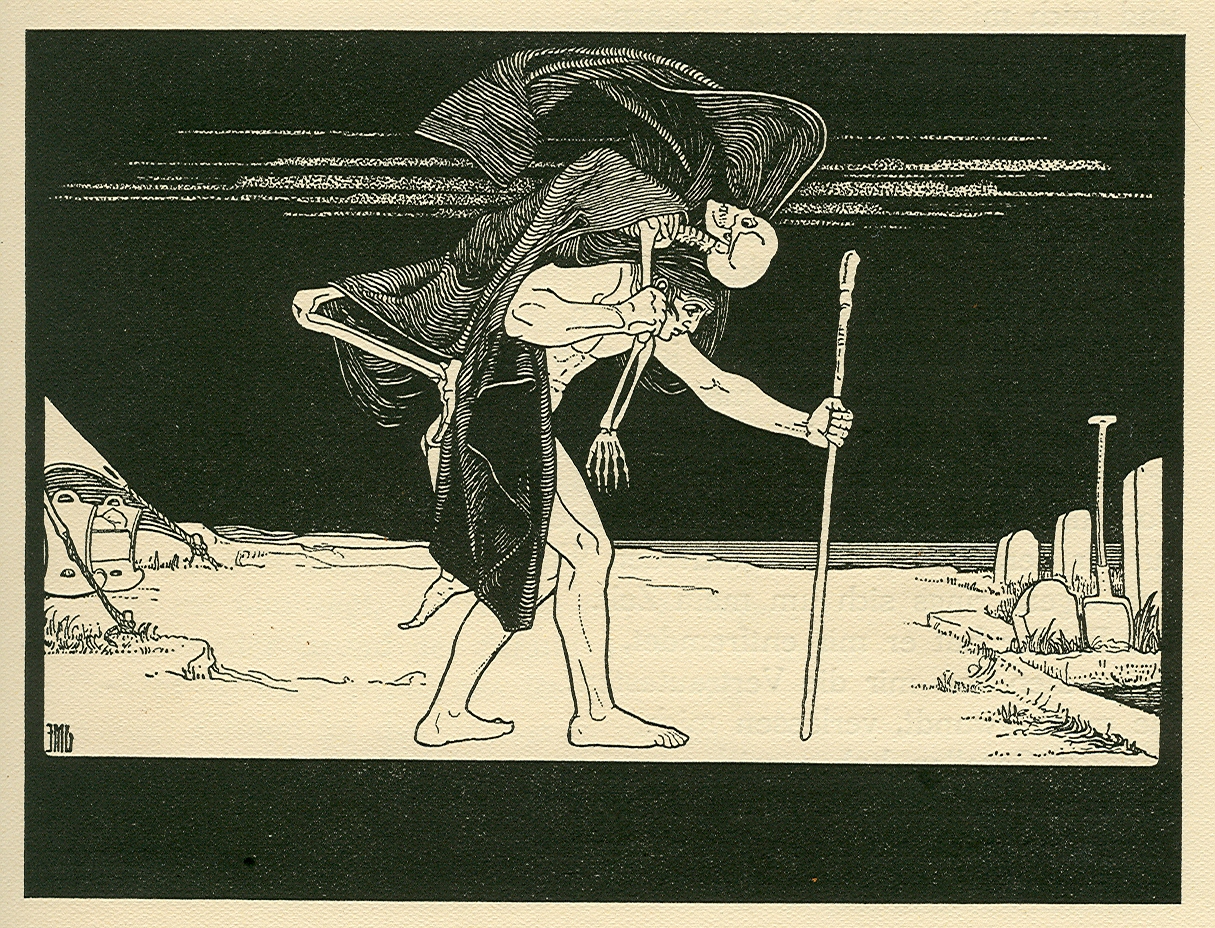
In Jewish mythology, a dybbuk (; , from the Hebrew verb dāḇaq, meaning 'adhere' or 'cling') is a malicious possessing spirit believed to be the dislocated soul of a dead person. It supposedly leaves the host body once it has accomplished its goal, sometimes after being exorcised.
Etymology
Dybbuk comes from the Hebrew word dibūq, meaning 'a case of attachment', which is a nominal form derived from the verb dāḇaq 'to adhere' or 'cling'.
History
The term first appears in a number of 16th-century writings. However, it was ignored by mainstream scholarship until S. An-sky's 1920 play The Dybbuk popularised the concept in literary circles. Earlier accounts of possession, such as that given by Josephus, were of demonic possession rather than that of ghosts. These accounts advocated orthodoxy among the populace as a preventative measure. Michał Waszyński's 1937 film The Dybbuk, based on the Yiddish play by S. An-sky, is considered one of the classics of Yiddish filmmaking.
Rabbi Yoel Teitelbaum, the Satmar rebbe (1887–1979), is reported to have supposedly advised an individual said to be possessed to consult a psychiatrist.
Traditionally, dybbuks tended to be male spirits. According to Hayyim ben Joseph Vital, women could not become dybbuks because their souls did not participate in gilgul. Sometimes these spirits were said to possess women on the eve of their weddings, typically in a sexual fashion by entering the women through their vaginas, which is seen in An-sky's play. However, men and boys could be possessed as well.
In psychological literature, the dybbuk has been described as a hysterical syndrome.
Expulsion
In traditional Jewish communities, the concept of the dybbuk served as a socially acceptable way of expressing unacceptable urges, including sexual ones. Within Jewish mysticism and folklore, particularly in Kabbalistic traditions, protective practices were also used to ward off these malevolent spirits. One such practice involves affixing a mezuzah—a piece of parchment inscribed with specific Torah verses—to the doorposts of a home. While the mezuzah primarily serves as a reminder of faith and adherence to God's commandments, it is also viewed as a protective amulet against harmful spirits, including dybbuks. The Zohar, a foundational Kabbalistic text, suggests that a properly affixed mezuzah can prevent such entities from entering a home. Additionally, Jewish folklore includes accounts where neglected or improperly maintained mezuzot were believed to make homes susceptible to dybbuk possession. These perspectives emphasize the mezuzah's dual role in Jewish life: as both a symbol of faith and a spiritual safeguard.
Dybbuk in popular culture
- The novel Satan in Goray by Isaac Bashevis Singer, which portrays the appearance of a dybbuk in the fictional Jewish town of Goray, serves as an early literary version of the well-known motif in Jewish mythology.
- The film A Serious Man (2009), directed by Joel and Ethan Coen, starts with a preamble about a dybbuk who visits a poor family living in a stetl. The dybbuk in the film may or may not be a rabbi who is either alive or dead. After being stabbed by the wife of the man who encountered the rabbi and invited him for a meal, the dybbuk walks out of their house and disappears into the snowy night. Whether he was or was not a dybbuk remains unanswered.
- The film The Possession (2012), directed by Ole Bornedal, is a supernatural horror film centered around the concept of a dybbuk. The story follows a young girl who becomes increasingly possessed by an evil spirit after discovering an antique dybbuk box at a yard sale.
- The Polish film Demon is typically interpreted as a story about dybbuk possession.
- The young adult novel The City Beautiful (2021) by Aden Polydoros features a gay teenager possessed by a dybbuk in 19th century Chicago.
- The novella To Clutch a Razor (2025) by Veronica Roth features a chapter in which a young woman found wandering in the woods is possessed by a dybbuk.
References
References
- Trachtenberg, Joshua. "Jewish Magic and Superstition". [[University of Pennsylvania Press]].
- Avner Falk. (1996). "A Psychoanalytic History of the Jews". Fairleigh Dickinson Univ Press.
- "[[Encyclopædia Britannica]]".
- Gershom Scholem. "Dibbuk".
- See [https://books.google.com/books?id=EZCgpaTgLm0C&dq=%22qittul%22+pattern&pg=PA187 A. Sáenz-Badillos & J. Elwolde, ''A History of the Hebrew Language'', 1996, p. 187] on the ''qiṭṭūl'' pattern.
- [https://books.google.com/books?id=CF1C84xHeucC&dq=dybbuk&pg=PA41 ''Spirit Possession in Judaism: Cases and Contexts from the Middle Ages to the Present, by Matt Goldish'', p. 41, Wayne State University Press, 2003]
- [https://books.google.com/books?id=60iVk1p8Y9IC&dq=dybbuk&pg=PA229 ''Tree of Souls:The Mythology of Judaism'', by Howard Schwartz, pp. 229–230, Oxford University Press, 2004]
- "The Dybbuk". [[The National Center for Jewish Film]].
- Faierstein, Morris M.. (2017). "The Dybbuk: The Origins and History of a Concept". Purdue University Press.
- Levin, Sala. (28 October 2021). "Jewish Word: Dybbuk".
- (1989). "Dybbuk-Possession as a hysterical symptom: Psychodynamic and socio-cultural factors". Israel Journal of Psychiatry and Related Science.
- Falk, Avner. (1996). "A Psychoanalytic History of the Jews". Fairleigh Dickinson Univ Press.
- "The Protective Power of Mezuzah".
- "Dybbuk Shmibbuk".
This article was imported from Wikipedia and is available under the Creative Commons Attribution-ShareAlike 4.0 License. Content has been adapted to SurfDoc format. Original contributors can be found on the article history page.
Ask Mako anything about Dybbuk — get instant answers, deeper analysis, and related topics.
Research with MakoFree with your Surf account
Create a free account to save articles, ask Mako questions, and organize your research.
Sign up freeThis content may have been generated or modified by AI. CloudSurf Software LLC is not responsible for the accuracy, completeness, or reliability of AI-generated content. Always verify important information from primary sources.
Report