From Surf Wiki (app.surf) — the open knowledge base
Dvapara Yuga
Third of four yugas (ages) in Hindu cosmology
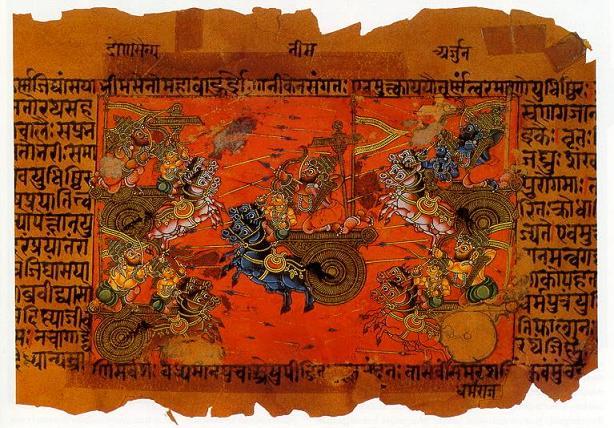
Third of four yugas (ages) in Hindu cosmology
Dvapara Yuga (IAST: Dvāpara-yuga) (Devanagari: द्वापर युग), in Hinduism, is the third and third-best of the four yugas (world ages) in a Yuga Cycle, preceded by Treta Yuga and followed by Kali Yuga. Dvapara Yuga lasts for 864,000 years (2,400 divine years).
According to the Puranas, this yuga ended when Krishna returned to his eternal abode of Vaikuntha. There are only two pillars of religion during the Dvapara Yuga: compassion and truthfulness. Vishnu assumes the colour yellow and the Vedas are categorized into four parts: Rig Veda, Sama Veda, Yajur Veda and Atharva Veda.
Etymology
Yuga (), in this context, means "an age of the world", where its archaic spelling is yug, with other forms of yugam, , and yuge, derived from yuj (), believed to be derived from yeug- (Proto-Indo-European: 'to join or unite').
Dvapara () is a sandhi of the two words dva (lit. two) and apara (lit. after) . Therefore Dvapara Yuga means "the age after the two", i.e. the third age. As per Bhagavata, During this age the Dharma bull, which symbolizes morality, stands on two legs; () and ().
Dvapara Yuga is described in the Mahabharata, Manusmriti, Surya Siddhanta, Vishnu Smriti, and various Puranas.
Duration and structure
Hindu texts describe four yugas (world ages) in a Yuga Cycle, where, starting in order from the first age of Krita (Satya) Yuga, each yuga's length decreases by one-fourth (25%), giving proportions of 4:3:2:1. Each yuga is described as having a main period ( yuga proper) preceded by its (dawn) and followed by its (dusk), where each twilight (dawn/dusk) lasts for one-tenth (10%) of its main period. Lengths are given in divine years (years of the gods), each lasting for 360 solar (human) years.
Dvapara Yuga, the third age in a cycle, lasts for 864,000 years (2,400 divine years), where its main period lasts for 720,000 years (2,000 divine years) and its two twilights each lasts for 72,000 years (200 divine years). The current cycle's Dvapara Yuga has the following dates based on Kali Yuga, the fourth and present age, starting in 3102BCE:
| Part | Start (– End) | Length | Dvapara-yuga-sandhya (dawn) | Dvapara-yuga (proper) | Dvapara-yuga-sandhyamsa (dusk) |
|---|---|---|---|---|---|
| 867,102BCE | 72,000 (200) | ||||
| 795,102BCE | 720,000 (2,000) | ||||
| 75,102–3102BCE | 72,000 (200) | ||||
| Years: 864,000 solar (2,400 divine) |
Mahabharata, Book 12 (Shanti Parva), Ch. 231:
Manusmriti, Ch. 1:
Surya Siddhanta, Ch. 1:
Characteristics
All people in the Dvapara Yuga are desirous of achievement of the scriptural dharma that is prescribed to each class, valiant, courageous and competitive by nature and are engaged only in penance and charity. They are kingly and pleasure-seeking. In this era, the divine intellect ceases to exist, and it is therefore seldom that anyone is wholly truthful. As a result of this life of deceit, people are plagued by ailments, diseases and various types of desires. After suffering from these ailments, people realize their misdeeds and perform penance. Some also organize yajnas (sacred fire rituals) for material benefits as well as for divinity.
Explanatory notes
References
References
- {{Dictionary.com. yuga
- {{Dictionary.com. dvapara yuga
- {{IAST. Bhāgavata Purāṇa 12.2.29-33
- "*yeug-".
- (1974). "Purāṇam". All-India Kasiraja Trust..
- (September 1936). "Kalivarjya (actions forbidden in the Kali Age)". [[The Asiatic Society of Mumbai.
- (2011). "Atlantis and the Cycles of Time: Prophecies, Traditions, and Occult Revelations". [[Inner Traditions]].
- Merriam-Webster. (1999). "Merriam-Webster's Encyclopedia of World Religions". [[Merriam-Webster.
- (2010). "Units of Measurement: Past, Present and Future. International System of Units". [[Springer Publishing.
- (1903). "A Prose English Translation of The Mahabharata (Translated Literally from the Original Sanskrit text)". Elysium Press.
- (1886). "The Laws of Manu: translated with extracts from seven commentaries". [[Oxford University Press]].
- (1935). "Translation of the Surya-Siddhanta, A Text-Book of Hindu Astronomy; With notes and an appendix". [[University of Calcutta]].
This article was imported from Wikipedia and is available under the Creative Commons Attribution-ShareAlike 4.0 License. Content has been adapted to SurfDoc format. Original contributors can be found on the article history page.
Ask Mako anything about Dvapara Yuga — get instant answers, deeper analysis, and related topics.
Research with MakoFree with your Surf account
Create a free account to save articles, ask Mako questions, and organize your research.
Sign up freeThis content may have been generated or modified by AI. CloudSurf Software LLC is not responsible for the accuracy, completeness, or reliability of AI-generated content. Always verify important information from primary sources.
Report