From Surf Wiki (app.surf) — the open knowledge base
Dushasana
One of the Kauravas in the epic Mahabharata
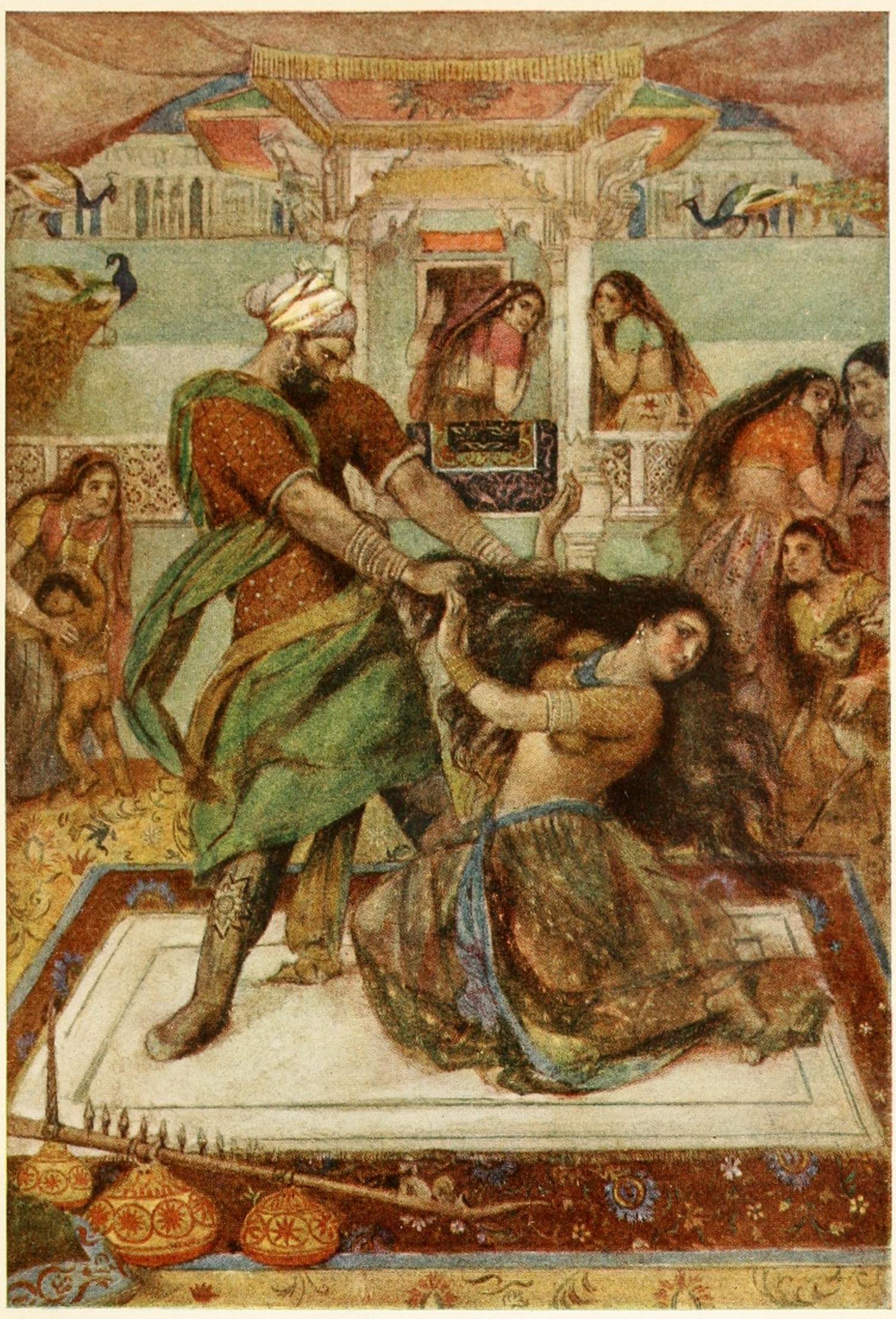
One of the Kauravas in the epic Mahabharata
| Field | Value | |
|---|---|---|
| info-hdr | Information | |
| alt | Dushasana | |
| image | File:Disrobing of Draupadi by M V Dhurandhar (cropped).jpg | |
| caption | Dushasana disrobing Draupadi, painting by M. V. Dhurandhar | |
| family | ||
| children | Drumasena (son) | |
| relatives | {{ubl | Pandavas (paternal half-cousins) |
| info-hdr = Information |Shakuni (maternal uncle)|Uluka (maternal cousin)}} Dushasana (), also spelled Duhshasana, Dussasana or Duhsasana, is a prominent character in the ancient Hindu epic Mahabharata. He is the second eldest of the hundred Kaurava brothers, born to King Dhritarashtra and Queen Gandhari of the Kuru dynasty. As the younger brother and close confidant of Duryodhana, the chief antagonist of the epic, Dushasana plays a significant role in many key events leading up to and during the Kurukshetra War.
Dushasana is best known for his active involvement in the humiliation of Draupadi, the wife of the Pandavas, during the infamous dice game episode, where he dragged her in the royal court and unsuccessfully attempted to disrobe her. His actions earn him the wrath of Draupadi and the Pandavas, particularly Bhima, who vows to kill Dushasana—a vow that is ultimately fulfilled during the war by tearing apart his chest.
Etymology
His name derives from the Sanskrit words duḥ- "hard" and śāsana "rule"; thus duḥśāsana means "[one who is] hard to rule."
Birth and early life
When Dhritarashtra's queen Gandhari's pregnancy continued for an unusually long time, she beat her womb in frustration and out of jealousy towards Kunti, the wife of Pandu, who had just given birth to Yudhishthira (the eldest of the five Pandava brothers). At this, a hardened mass of grey-coloured flesh emerged from her womb. Gandhari was devastated and called upon Vyasa, the great sage who had prophesied she would give birth to one hundred sons, to redeem his words.
Vyasa divided the ball of flesh into one hundred and one equal pieces, each piece no bigger than a thumb. He put them in pots of milk, which were sealed and buried in the earth for two years. At the end of the second year, the first pot was opened and Duryodhana emerged. Within a period of one month all the other 99 sons and single daughter of Dhritarashtra were born. Dushasana was the second after Duryodhana.
Dushasana was devoted to his older brother Duryodhana. He (along with Duryodhana and Shakuni) was very closely involved in the various schemes and plots to kill the Pandavas.
Draupadi's humiliation
Kurukshetra war and death


On the first day of war, Dushasana was the first one to shot the first arrow. He fought a fierce battle with Nakula and later with Yudhishthira and was defeated by them. On the second day of war, Dushasana killed Nakula's bodyguards. An angry Nakula defeated and nearly killed Dushasana in a sword fight. On the 10th day of war, Dushasana attacked and injured Shikhandi in order to save Bhishma. On the 13th day of war, Dushasana was among the powerful warriors who brutally murdered Abhimanyu. Abhimanyu badly injured Dushasana. Later, his son Drumasena killed Abhimanyu. On the 14th day, Dushasana tried to stop Arjuna from reaching to Jayadratha but was defeated by him in a small archery duel. During the night war, Dushasana defeated and killed Virata's bodyguards. On the 16th day of the Kurukshetra War, Dushasana killed Magadha's minister Vrihanta. On the 17th day, Bhima fought with Dushasana in a mace war and beat him. When Dushasana was unable to fight Bhima uprooted both the arms of Dushasana. Then he took out his armour, tore his chest using his bare hands and killed Dushasana. Dushasana's death was the most brutal death in the entire epic. To fulfill his oath, Bhima drank the blood from Dushasana's open chest. The soldiers who witnessed this brutal scene fainted, thinking of Bhima as a monster. All the Kaurava supporting warriors were highly disturbed by this scene.
Though not attested in the Mahabharata, according to folk narratives, Bhima washed Draupadi's hair with Dushasana's blood as a symbolic revenge for her humiliation.
References
References
- John Dowson. (1888). "A Classical Dictionary of Hindu Mythology and Religion, Geography, History, and Literature". Trubner & Co..
- "The Mahabharata, Book 1: Adi Parva: Sambhava Parva: Section CXV".
- (2006-08-02). "The Clothes of Draupadi".
- "The Mahabharata, Book 8: Karna Parva: Section 83".
- Ernest, Phillip. “TRUE LIES - BHĪMA’S VOWS AND THE REVISION OF MEMORY IN THE ‘MAHĀBHĀRATA’S’ CODE.” Annals of the Bhandarkar Oriental Research Institute, vol. 87, 2006, pp. 273–82. JSTOR, http://www.jstor.org/stable/41692062. Accessed 4 Nov. 2024.
This article was imported from Wikipedia and is available under the Creative Commons Attribution-ShareAlike 4.0 License. Content has been adapted to SurfDoc format. Original contributors can be found on the article history page.
Ask Mako anything about Dushasana — get instant answers, deeper analysis, and related topics.
Research with MakoFree with your Surf account
Create a free account to save articles, ask Mako questions, and organize your research.
Sign up freeThis content may have been generated or modified by AI. CloudSurf Software LLC is not responsible for the accuracy, completeness, or reliability of AI-generated content. Always verify important information from primary sources.
Report