From Surf Wiki (app.surf) — the open knowledge base
Dusack
| Field | Value |
|---|---|
| name | Dusack, Tessak, Dussägge |
| image | Tessak_type_F_NF.2010-0624.jpg |
| image_size | 300 |
| caption | Tessak – Norway, 16th century |
| origin | German Lands |
| type | Sabre |
| is_bladed | yes |
| production_date | 1560s |
| variants | Hilt Typology A - H |
| part_length | 25-38 in |
| blade_type | curved (occasionally straight) |
| hilt_type | thumb ring, half basket, "Sinclair hilt" |
A dusack or dussack (also dusägge and variants, from Czech tesák "cleaver; hunting sword", lit. "fang") is a single-edged sword of the cutlass or sabre type, in use as a side arm in Germany and the Habsburg monarchy during the 16th to 17th centuries, as well as a practice weapon based on this weapon used in early modern German fencing.
Military sidearm
The Czech term entered German usage in the Hussite Wars, after the sidearm used by the Hussites. In the late 16th century, Dusägge could refer to a type of weapon combining a sabre blade with the hilt of a sidesword (the German Degen), also known as Säbel auf Teutsch gefasst ("sabre fitted in the German manner"). The Dusägge in this sense was used as a military sidearm; e.g. in 1579, Styria records delivery of some 700 Dusäggen by local bladesmiths, besides payment of 40 Dusäggen delivered from Passau, as part of the preparation for the war against the Turks under Archduke Charles II.
The German sabre together with the name tessak was adopted in Norway. A closely related weapon is the schnepf or Swiss sabre used in Early Modern Switzerland.
Practice weapon
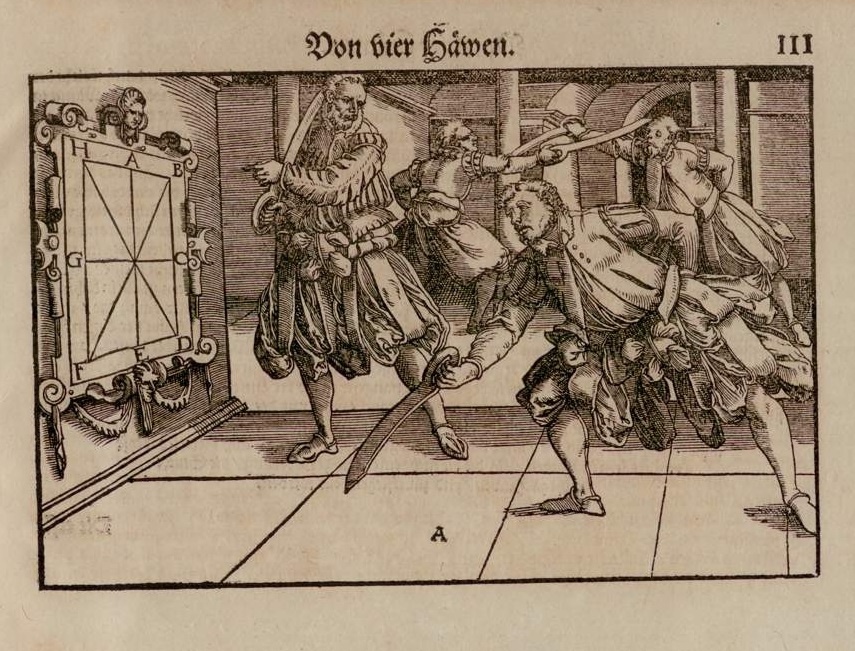
Joachim Meyer in 1570 depicts the Dusäck as the practice weapon with broad, curving blade and a simple oval grip. The dussack represented a short, single-edged weapon in a training environment. As usage of the dussack became more widespread, various schools turned use of the dussack into a sport as opposed to training for a real weapon.
Practice dussacks had a short, thick, single-edged blade measuring between 25-38 in long. A dussack was usually made of wood. Additionally there is a single reference to dussacks also being made from leather, and there are a small number of simple metal dussacken known to survive. The dussack was gently curved and brought to a point at the tip. The dussack often lacked a hilt. Instead, the handgrip was merely a hole cut inside of the blade; without a pommel or upper guard, it looked something like a large hole for gripping scissors.
Egerton Castle claimed that dussacks were used by the French Navy up through the 19th century.
No wooden (or leather) practice dussacks are known to have survived; unsurprising given the perishable nature of these dussacks, and only woodcuts and training manuals from the period document their existence.
References
References
- in [[Early Modern High German]] variously spelled ''dusack, dusäck, dussack, dysack, tesak, tuseckn, thuseckn, disackn, dusägge, dusegge, dusegg''
- Charles John Ffoulkes, ''The Armourer and His Craft from the XIth to the XVIth Century'', Courier Corporation, 1912, [https://books.google.com/books?id=F-CHHCk2ybsC&pg=PA159 p. 159].
- [http://www.waffensammlung-beck.ch/waffe2.html "Säbel, 'Dusägge', Deutsch Ende 16. Jahrhundert"], Waffensammlung Beck, Inv-Nr.:Be 10.
- [[Claude Blair]], "The Early Basket Hilt in Britain" in: ''Scottish Weapons and Fortifications'' (ed. David H. Caldwell, 1981)
- Amberger, J. Christoph. (2000). "The secret history of the sword: adventures in ancient martial arts". Multi-Media Book.
- Amberger (2000), p. 222.
- Castle (1885), p.247.
This article was imported from Wikipedia and is available under the Creative Commons Attribution-ShareAlike 4.0 License. Content has been adapted to SurfDoc format. Original contributors can be found on the article history page.
Ask Mako anything about Dusack — get instant answers, deeper analysis, and related topics.
Research with MakoFree with your Surf account
Create a free account to save articles, ask Mako questions, and organize your research.
Sign up freeThis content may have been generated or modified by AI. CloudSurf Software LLC is not responsible for the accuracy, completeness, or reliability of AI-generated content. Always verify important information from primary sources.
Report