From Surf Wiki (app.surf) — the open knowledge base
Dunbar High School (Washington, D.C.)
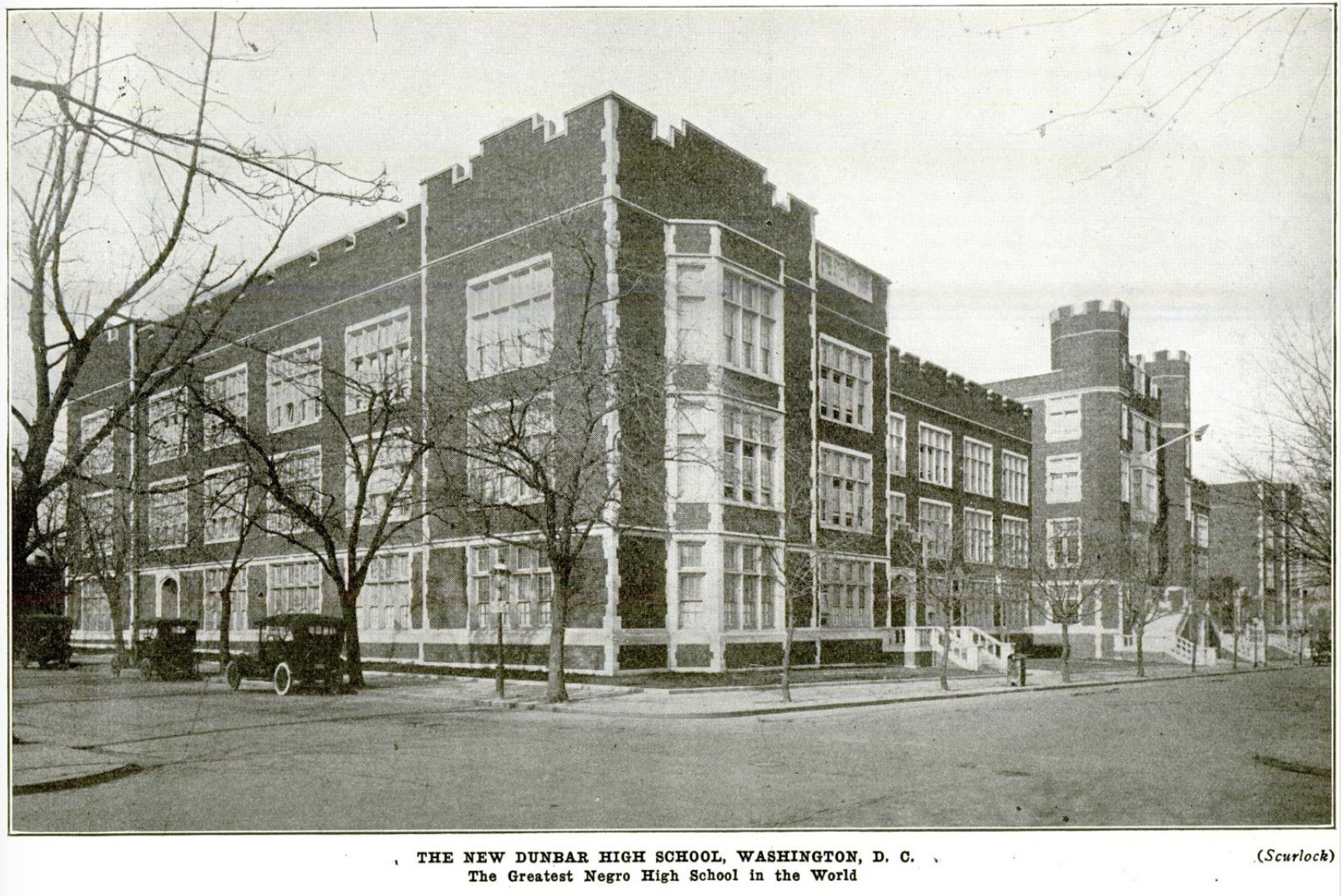
| Field | Value |
|---|---|
| name | Dunbar High School |
| image | Dunbar High School DC (new building).jpg |
| address | 101 N Street NW |
| city | Washington, D.C. |
| zipcode | 20001 |
| country | United States |
| coordinates | |
| former_name | Preparatory High School for Colored Youth |
| schooltype | Public high school |
| established | |
| founder | |
| status | Open |
| school_board | District of Columbia State Board of Education |
| district | District of Columbia Public Schools |
| us_nces_district_id | |
| school_code | DC-001-467 |
| ceeb | 090055 |
| us_nces_school_id | |
| principal | Nadine Smith |
| faculty | 42 |
| grades | 9 to 12 |
| enrollment | 666 |
| enrollment_as_of | 2020–2021 |
| grade9 | 222 |
| grade10 | 173 |
| grade11 | 115 |
| grade12 | 156 |
| ratio | 15.86 |
| campus_type | Urban |
| colors | Black and crimson |
| athletics_conference | DCIAA |
| nickname | Crimson Tide |
| USNWR_ranking | 13,394–17,857 |
| communities | Ward 5 |
| website |
Paul Laurence Dunbar High School is a historically Black public secondary school located in Washington, D.C. The school was America's first public high school for Black students.
The school is located in the Truxton Circle neighborhood of Northwest Washington, two blocks from the intersection of New Jersey and New York avenues. Dunbar, which serves grades 9 through 12, is a part of the District of Columbia Public Schools.
From the early 20th century to the 1950s, Dunbar became known as the classical academic high school for Black students in segregated public schools. As all public school teachers were federal civil servants, the school's teachers received pay equal to white teachers in other schools in the district. It attracted high-quality faculty, many with advanced degrees, including doctorates. Parents sent their children to the school from across the city because of its high standards. Many of its alumni graduated from top-quality colleges and universities and gained professional degrees. An early principal was Mary Jane Patterson.
History
The school was founded in 1870 by William Syphax, President of the Board of Trustees for Colored Schools, as the Preparatory High School for Colored Youth. The school was started at the Fifteenth Street Presbyterian Church. From 1891 to 1916, it became known as M Street High School. The school was America's first public high school for Black students. When its location was changed from M Street, the school was renamed in 1916 for the noted African-American poet, Paul Laurence Dunbar, who died in 1906.
As the city established other high schools, it designated Dunbar as its academic high school, with other schools providing more vocational or technical training. Dunbar was known for its excellent academics, enough so that some Black parents moved to Washington specifically so their children could attend it. All the public school teachers were federal employees, and Dunbar's faculty was paid well by the standards of the time, earning parity pay with Washington's white school teachers. The school boasted many graduates who went on to higher education and a generally successful student body.
Dunbar's original 1916 building, designed by architect Snowden Ashford, was demolished in 1977 and subsequently rebuilt; the resulting building was in turn demolished and rebuilt in 2013.
In the 21st century, Dunbar is similar to Paul Laurence Dunbar High School in Baltimore, Maryland and Fort Worth, Texas, as all three schools have a majority African-American student body and are of major importance to the local African-American community. All three schools are also highly regarded for their athletic programs within their respective school district in football, basketball, and track. There is also a Paul Laurence Dunbar High School in Lexington, Kentucky.
One of Dunbar's first principals in Washington, D.C., was the first Black graduate of Harvard College. Almost all the teachers had graduate degrees, and several earned PhDs. By the 1950s, Dunbar High School sent 80 percent of its students to college.
According to economist Thomas Sowell's 2015 appraisal, this all changed after the landmark United States Supreme Court Case Brown v. Board of Education that ruled for integration of public schools:
"For Washington, the end of racial segregation led to a political compromise, in which all schools became neighborhood schools. Dunbar, which had been accepting outstanding Black students from anywhere in the city, could now accept only students from the rough ghetto neighborhood in which it was located. Virtually overnight, Dunbar became a typical ghetto school. As unmotivated, unruly and disruptive students flooded in, Dunbar teachers began moving out and many retired. More than 80 years of academic excellence simply vanished into thin air."
Since its inception, the school has graduated many well-known figures of the 20th century, including Sterling Brown, H. Naylor Fitzhugh, Nannie Helen Burroughs, Charles R. Drew, William H. Hastie, Charles Hamilton Houston, Robert Heberton Terrell, Benjamin O. Davis Sr., Jean Toomer, Paul Capel, III, Robert C. Weaver, and James E. Bowman. Its illustrious faculty included Anna Julia Cooper, Kelly Miller, Mary Church Terrell, A. A. Birch Jr., Carter G. Woodson, and Julia Evangeline Brooks, who was also a graduate of the school. Cooper was also an early principal, as were Richard Greener, Mary Jane Patterson, and Robert Heberton Terrell. An unusual number of teachers and principals held Ph.D. degrees, including historian Carter G. Woodson, the second African American to earn a PhD from Harvard (after W. E. B. Du Bois) and the father of 'Black History Month'.
Until 1954, Fairfax County, Virginia, had no secondary schools for Black students. Dunbar and several other District of Columbia public schools accepted Black students from the county before that time.
Admissions
Chinatown is among the areas in the school's attendance area.
Student body
Dunbar has about 650 students.
- 98% are African American
- 1% are Hispanic American
- Less than 1% are Asian American
- Less than 1% are Native American
- Less than 1% are European American
Approximately 46% of students qualified for free or reduced lunch.
Pacific Islander
| Black | Hispanic | Two or More Races | Native Hawaiian/ |
|---|---|---|---|
| 635 | 26 | 3 | 1 |
Feeder patterns
Feeder elementary schools include:
- J. F. Cook
- Emery
- Langdon
- Terrel
- Webb
- Wheatley
- Young
Feeder middle schools include:
- Browne
Feeder K-8 schools include:
- Walker-Jones Education Center
Notable alumni
Artists and entertainers
- Ernest Anderson, actor
- Elizabeth Catlett, a prominent sculptor and artist
- George Faison, a Tony and Emmy Award-winning choreographer, dancer and producer
- Rex Goreleigh, painter, arts educator
- May Miller, playwright
- Billy Taylor, jazz pianist
- George Walker (composer), first African American to win the Pulitzer Prize for Music
- Vantile Whitfield, influential arts administrator and theater director
Athletes
- Arrelious Benn, NFL wide receiver for the Jacksonville Jaguars
- Nate Bussey, NFL linebacker in the NFL and CFL
- Josh Cribbs, NFL player
- Vernon Davis, NFL tight end for the Washington Redskins
- Vontae Davis, retired NFL cornerback who played for the Miami Dolphins, Indianapolis Colts, and Buffalo Bills
- John Duren (1976), NBA player and 19th overall pick in the 1980 NBA Draft by the Utah Jazz
- Cornelius Greene, All-American and first African American quarterback to start at Ohio State University
- Anthony Jones (1981), former basketball player for Georgetown Univ and UNLV. Jones was selected in the first round by the Washington Bullets in the 1986 NBA Draft. Also played for the Spurs, Bulls, and Mavericks
- Wil Jones, a record-setting basketball player at American University and head basketball coach of University of the District of Columbia National Champions, Division II, 1982.
- Tre Kelley, former basketball player for the University of South Carolina
- Bernard Robinson, retired NBA player
- Craig Shelton (1976), retired NBA player
- Michael Smith (1990), NBA Smith was selected by the Sacramento Kings in the second round of the 1994 NBA draft. He played for the Kings, Vancouver Grizzlies, and Washington Wizards.
Government
- [[File:Eleanor K. Holmes entry in Dunbar 1955 yearbook.jpg|thumb|Eleanor Holmes Norton in 1955 yearbook]]Mary Burke Washington (1944), economist and government official
- Wesley A. Brown, first African-American graduate of the US Naval Academy
- Frederic E. Davison, first African-American major general in the army
- Edward Brooke, first African American to be elected by popular vote to the United States Senate
- Lawrence Chambers, first African-American graduate of the U.S. Naval Academy to reach the rank of admiral
- Walter Fauntroy, first delegate to the U.S. House of Representatives from the District of Columbia's at-large congressional district{{cite news | access-date=2008-07-28 | archive-date=October 15, 2012 | archive-url=https://web.archive.org/web/20121015075415/http://pqasb.pqarchiver.com/washingtonpost_historical/access/144589292.html?FMT=ABS | url-status=dead
- Vincent C. Gray, former chairman of the Council of the District of Columbia and mayor of Washington D.C.
- Floretta Dukes McKenzie (1952), Superintendent of D.C. Public Schools
- Eleanor Holmes Norton (1955), Delegate to Congress
- Clarence M. Pendleton Jr., chairman of the United States Commission on Civil Rights from 1981 until his death in 1988
- Inez Smith Reid, judge of the District of Columbia Court of Appeals
- Antoinette Scott, nurse and soldier who is the first female from Washington, D.C., to receive the Purple Heart. DC
- Annice M. Wagner, judge of the District of Columbia Court of Appeals
Scholars and professionals
.png)
- James E. Bowman, scientist, physician, pathologist, studied G6PD and Sickle cell disease
- Sterling Allen Brown, professor, poet
- Allison Davis (1920), anthropologist, educator, scholar; first African American to hold full faculty position at a major white institution, namely, University of Chicago
- John Aubrey Davis Sr. Civil rights activist, head academic researcher on Brown v. The Board of Education, New Negro Alliance co-founder and political science professor
- Enid Cook de Rodaniche, virologist and bacteriologist. She was the Chief of the Public Health Laboratory at the Instituto Conmemorativo Gorgas in Panama City, Panama.
- Charles R. Drew (1922), discovered blood plasma and was the first black surgeon to serve as an examiner on the American Board of Surgery
- H. Naylor Fitzhugh, credited with creating the concept of target marketing
- Evelyn Boyd Granville, second African-American woman to receive a Ph.D. in mathematics from an American university
- Roland Jefferson, first African American botanist employed by the United States National Arboretum
- Dolores Kendrick, second Poet Laureate of the District of Columbia
- Mary Kenner, inventor; holder of the largest number of patents awarded to a black woman
- Colbert I. King, Pulitzer Prize-winning The Washington Post columnist
- Edna Burke Jackson, first African American woman to teach at Woodrow Wilson High School
- Oscar James Cooper, co-founder of Omega Psi Phi Fraternity Inc.
- William Montague Cobb, physical anthropologist, anatomist, and educator. The first African-American Ph.D. in anthropology, He was also the first African-American President of the National Association for the Advancement of Colored People
- Yvonne Seon professor and Unitarian Universalist minister.
Criminals
- Rayful Edmond, drug kingpin
Notable faculty
- Mary Jane Patterson, first African American woman to receive a BA degree
- G. David Houston, former professor of English at Howard University
- Jane Eleanor Datcher, first African American woman to earn an advanced degree from Cornell University
- Ernest Everett Just, zoologist and honorary founder of Omega Psi Phi fraternity
- Carter G. Woodson, father of Negro History Week, later Black History Month
- Vernon Davis, former National Football League tight end for the San Francisco 49ers, Denver Broncos, and Washington Redskins
References
References
- [https://geonames.usgs.gov/pls/gnispublic/f?p=gnispq:3:::NO::P3_FID:530900 GNIS entry] for Dunbar Senior High School; [[USGS]]; December 31, 1981.
- "K–12 School Code Search". College Board.
- (2021). "Dunbar High School". U.S. News & World Report L.P..
- "Black Excellence—the case of Dunbar High School".
- Terrell, Mary Church. (July 1917). "History of the High School for Negroes in Washington". [[The Journal of Negro History]].
- (2013). "First Class: The Legacy of Dunbar, America's First Black Public High School". Chicago Review Press.
- Flynn, Katherine. (December 21, 2016). "America's First African-American Public High School Is Remaking Itself".
- Sowell, Thomas. (October 4, 2016). "Dunbar High School after 100 Years". Creators Syndicate.
- (July 29, 2013). "In Nation's First Black Public High School, A Blueprint For Reform". NPR.
- "[http://www.fcps.edu/LutherJacksonMS/history.html History] {{Webarchive. link. (August 3, 2016." Luther Jackson Middle School. Retrieved on June 4, 2016.)
- "[http://theses.lib.vt.edu/theses/available/etd-10202005-102820/ A History of Luther P. Jackson High School: A Report of a Case Study on the Development of a Black High School]" (thesis abstract). [[Virginia Tech]]. Retrieved on June 4, 2016.
- Hoffer, Audrey. (2019-09-19). "In fast-changing Chinatown, a struggle to preserve traditions amid development". [[Washington Post]].
- "Explore Dunbar High School in Washington, DC".
- Cripps, Thomas. (1993-05-20). "Making Movies Black: The Hollywood Message Movie from World War II to the Civil Rights Era". Oxford University Press.
- (3 April 2012). "Elizabeth Catlett, pioneering D.C.-born artist, dies at 96". The Washington Post.
- (14 November 1983). "Washington's 'Wiz'". The Washington Post.
- (1977). "New York City WPA Art". NYC WPA Artists.
- (10 February 1995). "Washington Poet, Playwright May Miller Sullivan Dies at 96". The Washington Post.
- (April 26, 2019). "Dr. Billy Taylor, Jazz Pianist, Dies". JazzTimes.
- [https://newmusicusa.org/nmbx/george-walker-concise-and-precise/ "George Walker in conversation with Frank J. Oteri"], Oteri.
- Shinhoster Lamb, Yvonne. (January 23, 2005). "Arts Administrator, Playwright Vantile Whitfield Dies". The Washington Post.
- (23 November 2006). "Different Paths, Same End". The Washington Post.
- (October 18, 2016). "Dunbar High football alumni ruled the NFL in Week 6". The Washington Post.
- (2 April 1986). "After the Fast Breaks Come the Tough Breaks". The Washington Post.
- (7 November 2014). "Cornelius Green Ohio State's 1st black QB has DC roots". USA Today High School Sports.
- (13 November 1980). "Dunbar's Mr. Jones: Crimson Tide's Ticket To Basketball Heaven". The Washington Post.
- Schudel, Matt (March 14, 2014). [https://www.washingtonpost.com/local/obituaries/wil-jones-flamboyant-udc-basketball-coach-dies-at-75/2014/03/15/30c4623c-ac53-11e3-af5f-4c56b834c4bf_story.html "Wil Jones, flamboyant UDC basketball coach, dies at 75"] ''[[The Washington Post]]''. Retrieved January 11, 2021.
- (March 29, 2007). "Dunbar grad Kelley takes national honor". The Washington Times.
- (14 March 1999). "Dunbar Hangs On To Wear the Crown". The Washington Post.
- (October 30, 2014). "Throwback Thursday: Oct. 30, 1989, when Dunbar's Michael Smith picked Providence". The Washington Post.
- Bernstein, Adam. (December 5, 2014). "Mary Washington, government official and widow of former D.C. mayor, dies at 88". [[The Washington Post]].
- (25 May 2012). "Wesley A. Brown, first black Naval Academy graduate, dies at 85". The Washington Post.
- (January 30, 1990). "Army Maj. Gen. Frederic Davison Dies at 82". The Washington Post.
- (3 January 2015). "Edward W. Brooke III, 95, Senate Pioneer, Is Dead". The New York Times.
- (August 20, 2013). "D.C.'s Dunbar High, America's First Black Public High School". The Kojo Nnamdi Show.
- (March 26, 2018). "Honoring Rear Admiral Lawrence Cleveland ''Larry'' Chambers". United States House of Representatives.
- (1 May 2004). "The Decision That Changed Everything {{!}} Washingtonian (DC)". Washingtonian.
- (6 June 1988). "Clarence M. Pendleton, 57, Dies; Head of Civil Rights Commission". The New York Times.
- (May 22, 1995). "Nominations of Inez Smith Reid, Linda Kay Davis, Ronna Lee Beck, and Eric Tyson Washington: Hearing Before the Committee on Governmental Affairs, United States Senate, One Hundred Fourth Congress". U.S. Government Printing Office.
- (30 March 2016). "D.C. woman given unique award for service in Iraq". WTOP.
- (July 11, 2005). "Commending District of Columbia Court of Appeals Chief Judge Annice Wagner". United States House of Representatives.
- (February 28, 2011). "Obituaries of note: James E. Bowman, Dave Hill, Richard W. Mallary, Leonard Dillon". The Washington Post.
- "About Sterling A. Brown". Academy of American Poets.
- (7 August 2018). "Charting a Course". South Side Weekly.
- "W. Allison Davis '24 and John A. Davis '33".
- (21 December 2002). "John Aubrey Davis Sr.". The Washington Post.
- (May 17, 2020). "El Gorgas, un laboratorio que no duerme".
- (April 6, 2020). "The untimely death of his sister from the flu inspired this D.C. doctor to greatness". The Washington Post.
- (July 29, 1992). "H. Naylor Fitzhugh Dies". The Washington Post.
- (May 1, 2014). "Happy 90th Birthday, Evelyn Boyd Granville!". Scientific American Blog Network.
- Kelly, John. (2012-03-20). "For retired botanist, cherry blossoms never lost their charm". Washington Post.
- Melton, Sarah. (April 28, 2017). "D.C.'s Poet Laureate Still Finds Inspiration In Her Native City". [[WAMU]].
- Walker, Ezekiel J.. (November 9, 2022). "Even as a former florist, inventor Mary Kenner never got her flowers". [[The Black Wall Street Times]].
- [https://www.washingtonpost.com/wp-dyn/content/article/2010/12/17/AR2010121704743.html Colbert I. King - "Dunbar High School's sad descent into hard times"], ''The Washington Post'']
- Fatsis, Stefan. (2020-12-28). "The complicated racial history of the high school D.C. is renaming". The Washington Post.
- (1999). "African-American pioneers in anthropology". University of Illinois Press.
- Erickson, Paul A.. (February 2000). "Cobb, William Montague (1904-1990), physical anthropologist and anatomist". Oxford University Press.
- (2 November 1989). "COURTING RAYFUL EDMOND". The Washington Post.
This article was imported from Wikipedia and is available under the Creative Commons Attribution-ShareAlike 4.0 License. Content has been adapted to SurfDoc format. Original contributors can be found on the article history page.
Ask Mako anything about Dunbar High School (Washington, D.C.) — get instant answers, deeper analysis, and related topics.
Research with MakoFree with your Surf account
Create a free account to save articles, ask Mako questions, and organize your research.
Sign up freeThis content may have been generated or modified by AI. CloudSurf Software LLC is not responsible for the accuracy, completeness, or reliability of AI-generated content. Always verify important information from primary sources.
Report