From Surf Wiki (app.surf) — the open knowledge base
Duke of Normandy
Medieval ruler of the Duchy of Normandy

Medieval ruler of the Duchy of Normandy
| Field | Value |
|---|---|
| name | Duke of Normandy |
| image | Blason_Duché_de_Normandie.svg |
| image_size | 135 |
| caption | Coat of arms of Normandy |
| first_holder | Rollo |
| creation_date | 911 |
In the Middle Ages, the duke of Normandy was the ruler of the Duchy of Normandy. The duchy arose out of a grant of land to the Viking leader Rollo by the French king Charles the Simple in 911. In 924 and again in 933, Normandy was expanded by royal grant. Rollo's male-line descendants continued to rule it until 1135, and cognatic descendants ruled it until 1204. In 1202 the French king Philip II declared Normandy a forfeited fief and by 1204 his army had conquered it (with the exception of the Channel Islands). It remained a French royal province thereafter, still called the Duchy of Normandy, but only occasionally granted to a duke of the royal house as an appanage.
Despite both the 13th century loss of mainland Normandy, the renunciation of the title by Henry III of England in the Treaty of Paris (1259), and the extinction of the duchy itself in modern-day France, the monarch of the United Kingdom is regardless still often informally referred to by the title "Duke of Normandy". This is the title used whether the monarch is a king or a queen.
History of the title
There is no record of Rollo holding or using any title. His son and grandson, Duke William I and Duke Richard I, used the titles "count" (Latin comes or consul) and "prince" (princeps). Prior to 1066, the most common title of the ruler of Normandy was "Count of Normandy" (comes Normanniae) or "Count of the Normans" (comes Normannorum). The title Count of Rouen (comes Rotomagensis) was never used in any official document, but it was used of William I and his son by the anonymous author of a lament (planctus) on his death. Defying Norman pretensions to the ducal title, Adhemar de Chabannes was still referring to the Norman ruler as "Count of Rouen" as late as the 1020s. In the 12th century, the Icelandic historian Ari Thorgilsson in his Landnámabók referred to Rollo as Ruðu jarl (earl of Rouen), the only attested form in Old Norse, although too late to be evidence for 10th-century practice. The late 11th-century Norman historian William of Poitiers used the title "Count of Rouen" for the Norman rulers down to Richard II. According to David C. Douglas, the title "Count of Rouen" (comes Rotomagensis) was never used in any official document. Charters are usually a source of information about titles, but none exist for Normandy in the middle of the tenth century.
The first official recorded use of the title duke (dux) is in an act in favour of the Abbey of Fécamp in 1006 by Richard II, Duke of Normandy. Earlier, the writer Richer of Reims had called Richard I a dux pyratorum, but which only means "leader of pirates" and was not a title. During the reign of Richard II, the French king's chancery began to call the Norman ruler "Duke of the Normans" (dux Normannorum) for the first time. but it did not supplant dux Normannorum until the Angevin period (1144–1204), at a time when Norman identity was fading.
Richard I experimented with the title "marquis" (marchio) as early as 966, when it was also used in a diploma of King Lothair. Richard II occasionally used it, but he seems to have preferred the title duke. It is his preference for the ducal title in his own charters that has led historians to believe that it was the chosen title of the Norman rulers. Certainly it was not granted to them by the French king. In the twelfth century, the Abbey of Fécamp spread the legend that it had been granted to Richard II by Pope Benedict VIII (ruled 1012–24). The French chancery did not regularly employ it until after 1204, when the duchy had been seized by the crown and Normandy lost its autonomy and its native rulers.
The actual reason for the adoption of a higher title than that of count was that the rulers of Normandy began to grant the comital title to members of their own family. The creation of Norman counts subject to the ruler of Normandy necessitated the latter taking a higher title. The same process was at work in other principalities of France in the eleventh century, as the comital title came into wider use and thus depreciated. The Normans nevertheless kept the title of count for the ducal family and no non-family member was granted a county until Helias of Saint-Saëns was made Count of Arques by Henry I in 1106.
From 1066, when William II conquered England, becoming King William I, the title Duke of Normandy was often held by the King of England. In 1087, William died and the title passed to his eldest son, Robert Curthose, while his second surviving son, William Rufus, inherited England. In 1096, Robert mortgaged Normandy to William, who was succeeded by another brother, Henry I, in 1100. In 1106, Henry conquered Normandy. It remained with the King of England down to 1144, when, during the civil war known as the Anarchy, it was conquered by Geoffrey Plantagenet, the Count of Anjou. Geoffrey's son, Henry II, inherited Normandy (1150) and then England (1154), reuniting the two titles. In 1202, King Philip II of France, as feudal suzerain, declared Normandy forfeit and by 1204 his armies had conquered it (with the exception of the Channel Islands). Henry III finally renounced the English claim in the Treaty of Paris (1259).
Thereafter, the continental part of the duchy formed an integral part of the French royal demesne. The kings of the House of Valois started a tradition of granting the title to their heirs apparent. The title was granted four times (1332, 1350, 1465, 1785) between the French conquest of Normandy and the dissolution of the French monarchy in 1792. The French Revolution brought an end to the Duchy of Normandy as a political entity, by then a province of France, and it was replaced by several départements.
List of dukes of Normandy (911–1204)
[[House of Normandy]] (911–1135)
| Portrait | Name | Reign | Marriage(s) | Relation to predecessor(s) | Other titles | |
|---|---|---|---|---|---|---|
| [[File:RolloA.jpg | 200x200px]] | Rollo | 911–928 | (1) Poppa of Bayeux | Granted by the Treaty of Saint-Clair-sur-Epte | No official title(s). |
| [[File:WilliamLongsword.png | 200x200px]] | William I | 927–17 December 942 | (1) Sprota | Son of Rollo | |
| [[File:Richard_the_Fearless_of_Normandy.png | 200x200px]] | Richard I | 17 December 942 – 20 November 996 | (1) Emma of Paris | Son of William I | Called Count of Normandy in primary sources |
| [[File:Richard the Good of Normandy.png | 200x200px]] | Richard II | 996–1026 | (1) Judith of Brittany | Son of Richard I | |
| [[File:Richard III of Normandy.png | 200x200px]] | Richard III | 28 August 1026 – 6 August 1027 | never married | Son of Richard II | |
| [[File:Robert the Magnificent of Normandy.png | 200x200px]] | Robert I | 1027–1035 | never married | Brother of Richard III | |
| [[File:William the Conqueror Illumination.png | 200x200px]] | William II | – 9 September 1087 | Matilda of Flanders | Son of Robert I | King of England |
| [[File:Robert Curthose - MS Royal 14 B VI.png | 217x217px]] | Robert II | 9 September 1087 – 1106 | Sybilla of Conversano | Oldest son of William II | |
| [[File:Beauclerc1.jpg | 200x200px]] | Henry I | 1106 – 1 December 1135 | (1) Matilda of Scotland | Brother of Robert II | King of England |
| [[File:Guillaume Flan.jpg | 200x200px]] | William (III) | 1106–1128 | (1) Sibylla of Anjou | Eldest son of Robert Curthose | Count of Flanders |
[[House of Blois]] (1135–1144)
| Portrait | Name | Reign | Marriage(s) | Relationship with predecessor(s) | Other titles |
|---|---|---|---|---|---|
| [[File:Stephen - MS Royal 14 B VI.png | 200x200px]] | Stephen | 1135–1144 | Matilda I, Countess of Boulogne | |
| five children | Grandson of William II through Adela of Normandy | King of England |
[[House of Plantagenet]] (1144–1204)
| Portrait | Name | Reign | Marriage(s) | Relationship with predecessor(s) | Other titles | Other Details |
|---|---|---|---|---|---|---|
| [[File:Geoffrey of Anjou Monument Cropped.png | 200x200px]] | Geoffrey | ||||
| the Handsome | ||||||
| (Geffrai le Biau) | 1144–1150 | Matilda of England | ||||
| three children | Son-in-law of Henry I | Count of Anjou | Conquered Normandy from Stephen I. | |||
| [[File:Henry Curtmantle Illumination.png | 200x200px]] | Henry II | ||||
| Curtmantle | ||||||
| (Henri Court-manté) | 1150 – 6 July 1189 | Eleanor of Aquitaine | ||||
| eight children | Son of Geoffrey | King of England | ||||
| Henry II named his son, Henry the Young King (1155–1183), as co-ruler with him but this was a Norman custom of designating an heir, and the younger Henry did not outlive his father and rule in his own right, so he is not counted as a duke on lists of dukes. | ||||||
| [[File:Richard the Lionheart Illumination.png | 200x200px]] | Richard IV | ||||
| the Lionheart | ||||||
| (R'chard le Quor de Lion) | 3 September 1189 – 6 April 1199 | Berengaria of Navarre | ||||
| no issue | Son of Henry II | King of England | ||||
| [[File:John Lackland Illumination.png | 200x200px]] | John | ||||
| Lackland | ||||||
| (Jean sans Terre) | 1199 – 1204 | (1) Isabella, Countess of Gloucester | Brother of Richard IV | King of England | ||
| Lord of Ireland | Lost mainland Normandy in 1204 |
French province (1204–1792)
In 1204, the King of France confiscated the continental part of the Duchy of Normandy (the Channel Islands remaining under English control) and subsumed it into the crown lands of France. Thereafter, the ducal title was held by several French princes.
In 1332, King Philip VI gave the Duchy in appanage to his son John, who became king John II of France in 1350. He in turn gave the Duchy in appanage to his son Charles, who became king Charles V of France in 1364. In 1465, Louis XI, under constraint, gave the Duchy to his brother Charles de Valois, Duke of Berry. Charles was unable to hold the Duchy and in 1466 it was again subsumed into the crown lands and remained a permanent part of them. The title was conferred on a few junior members of the French royal family before the abolition of the French monarchy in 1792.
- John (son of King Philip VI, later King John II of France), 1332–1350.
- Charles (son of John II of France, later King Charles V of France), 1350–1364
- Charles (brother of Louis XI of France, also Duke of Berry), 1465–1466
- James, Duke of York, later King James II of England. On 31 December 1660, a few months after the restoration of Charles II to the thrones of England and Scotland, King Louis XIV proclaimed Charles's younger brother, James, Duke of York, "Duke of Normandy". This was probably done as a political gesture of support.
- Louis-Charles (son of Louis XVI, later Dauphin 1789–1791 and titular King Louis XVII 1792–1795), 1785–1792.
Modern usage
In the Channel Islands, the British monarch is known informally as the "Duke of Normandy", irrespective of whether or not the holder is male (Queen Elizabeth II, for instance, was known by this title). The Channel Islands are the last remaining part of the former Duchy of Normandy to remain under the rule of the British monarch. Although the English monarchy relinquished claims to continental Normandy and other French claims in 1259 (in the Treaty of Paris), the Channel Islands (except for Chausey under French sovereignty) remain Crown dependencies of the British throne.
However, the king is customarily referred to as "The Duke of Normandy", the title used by the islanders, especially during their loyal toast, where they say, "The Duke of Normandy, our King", or "The King, our Duke", "L'Rouai, nouotre Duc" or "L'Roué, note Du" in Norman (Jèrriais and Guernésiais respectively), or "Le Roi, notre Duc" in Standard French, rather than simply "The King", as is the practice in the United Kingdom.
The title 'Duke of Normandy' is not used in formal government publications, and, as a matter of Channel Islands law, does not exist.
Statue
A statue of the first seven dukes was erected in Falaise in Normandy in the 19th century. It depicts William the Conqueror, the Duke of Normandy and later King of England, on a horse, and is surrounded by statues of his six predecessors.
File:Statue d'Dgilliaume lé Contchéthant à Falaise 01.jpg|Statue of William the Conqueror in Falaise (surrounded by six other Dukes of Normandy)
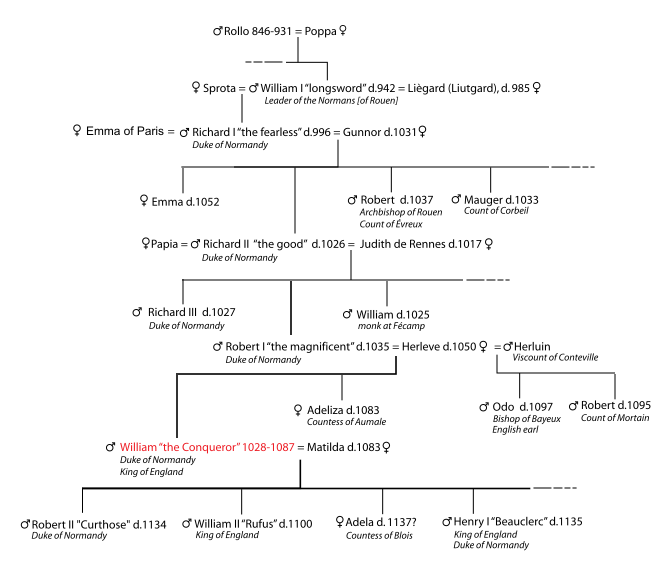
Family trees
References
References
- "The historical background and the 'Lands of the Normans'". University of Sheffield.
- [[Marjorie Chibnall]], ''The Normans'' (Blackwell, 2006), pp. 15–16. According to her, "it is even doubtful if Rollo had any title."
- David Crouch, ''The Image of Aristocracy in Britain, 1000–1300'' (Taylor and Francis, 1992), pp. 40–41.
- Foley, Liam. (2021-12-17). "December 17, 942: Death of William I Longsword of Normandy".
- David C. Douglas, "The Earliest Norman Counts", ''The English Historical Review'', 61, 240 (1946): 129–56.
- David C. Douglas, "The Earliest Norman Counts", ''The English Historical Review'', 61, 240 (1946):130
- Elizabeth van Houts (ed.), ''The Normans in Europe'' (Manchester University Press, 2000), p. 41, n. 58.
- As late as the reign of [[William the Conqueror
- Nick Webber, ''The Evolution of Norman Identity, 911–1154'' (Boydell Press, 2005), p. 178.
- David Crouch, ''The Normans: The History of a Dynasty'' (Hambledon Continuum, 2002), p. 19.
- David C. Douglas, "The Earliest Norman Counts", ''The English Historical Review'', 61, 240 (1946):130
- [[Alison Weir. Weir, Alison]] (1996). 258. ''Britain's Royal Families: The Complete Genealogy''. Revised Edition. Random House, London. {{ISBN. 0-7126-7448-9.
- "Crown Dependencies". The Royal Household.
- Robert. (2012-06-08). "The Queen … "Our Duke"".
- "The Channel Islands".
- Team, Bailiwick Express News. (2022-09-12). "FOCUS: Why is the King our Duc?".
- Matthews, Paul. (1999). "Lé Rouai, Nouot' Duc". Jersey and Guernsey Law Review.
- {{Base Mérimée. PA14000067. Statue de Guillaume le Conquérant
This article was imported from Wikipedia and is available under the Creative Commons Attribution-ShareAlike 4.0 License. Content has been adapted to SurfDoc format. Original contributors can be found on the article history page.
Ask Mako anything about Duke of Normandy — get instant answers, deeper analysis, and related topics.
Research with MakoFree with your Surf account
Create a free account to save articles, ask Mako questions, and organize your research.
Sign up freeThis content may have been generated or modified by AI. CloudSurf Software LLC is not responsible for the accuracy, completeness, or reliability of AI-generated content. Always verify important information from primary sources.
Report