From Surf Wiki (app.surf) — the open knowledge base
Ductus arteriosus
Fetal blood vessel bypassing the lungs
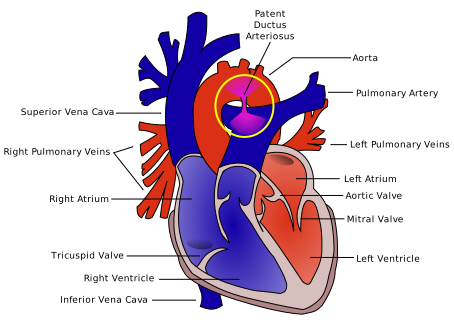
Fetal blood vessel bypassing the lungs
| Field | Value |
|---|---|
| Name | Ductus arteriosus |
| Latin | ductus arteriosus |
| Image | Gray502.png |
| Caption | The fetal circulatory system, with the ductus arteriosus visible at upper right. |
| BranchFrom | Pulmonary artery |
| BranchTo | Descending aorta |
| Vein | Ductus venosus |
| Precursor | Aortic arch 6 |
| System | Fetal circulation |
The ductus arteriosus, also called the ductus Botalli, named after the Italian physiologist Leonardo Botallo, is a blood vessel in the developing fetus connecting the trunk of the pulmonary artery to the proximal descending aorta. It allows most of the blood from the right ventricle to bypass the fetus's fluid-filled non-functioning lungs. Upon closure at birth, it becomes the ligamentum arteriosum.
Development and structure
The ductus arteriosus is formed from the left 6th aortic arch during embryonic development and attaches to the final part of the aortic arch (the isthmus of aorta) and the first part of the pulmonary artery.
Disorder: patent ductus arteriosus
Main article: Patent ductus arteriosus
Consequences
Failure of the ductus arteriosus to close after birth results in a condition called patent ductus arteriosus, which results in the abnormal flow of blood from the aorta to the pulmonary artery: a left-to-right shunt. If left uncorrected, this usually leads to pulmonary hypertension followed by right ventricular heart failure, as well as possible cardiac arrhythmias.
Role of prostaglandins
The "E" series of prostaglandins are responsible for maintaining the openness of the ductus arteriosus (by dilation of vascular smooth muscle) throughout the fetal period. Prostaglandin E2 (PGE2), produced by both the placenta and the DA itself, is the most potent of the E prostaglandins, but prostaglandin E1 (PGE1) also has a role in keeping the DA open. PGE1 and PGE2 keep the ductus arteriosus open via involvement of specific PGE-sensitive receptors (such as EP4 and EP2). EP4 is the major receptor associated with PGE2-induced dilation of the DA and can be found across the DA in smooth muscle cells. Immediately after birth, the levels of both PGE2 and the EP4 receptors reduce significantly, allowing for closure of the DA and establishment of normal postnatal circulation.
Role of non-steroidal anti-inflammatory drugs
Ductus arteriosus closure may be induced by administration of nonsteroidal anti-inflammatory drugs (NSAIDs), which inhibit prostaglandin production. In this case, exogenous PDE2 can be administered to reverse the effects of the NSAIDs and maintain the patency of the DA for the remainder of the pregnancy.
Incidence
A patent ductus arteriosus affects approximately 4% of infants with Down syndrome (DS). A failure to thrive is a very common sign of this condition.
Maintaining patency
In some types of congenital heart defect (e.g., transposition of the great arteries), prostaglandins may be administered to maintain the DA open, allowing for the continual circulation and oxygenation of blood, until surgery can be performed.
Other animals
Ductus arteriosus evolved with the lung in the ancestors of the lungfish as a connection between the pulmonary arteries and dorsal aorta. During embryonic development, reptiles, birds, and mammals all have either one or two paired ductus arteriosi that provide a fetal shunt of blood away from the lungs.
References
References
- (2013-03-01). "Clarification of the identity of the mammalian fifth pharyngeal arch artery". Clinical Anatomy.
- Monvadi B. Srichai. (2007). "Computed tomography and magnetic resonance of the thorax". Wolters Kluwer/Lippincott Williams & Wilkins.
- (1978). "Prostaglandins in Patent Ductus Arteriosus". The Lancet.
- Olley, P.M.. (1981). "Prostaglandins and the Ductus Arteriosus". Annual Review of Medicine.
- (2001). "Characterization of PGE2 receptors in fetal and newborn lamb ductus arteriosus". Am. J. Physiol. Heart Circ. Physiol..
- Gruzdeva, A. (March 2012). "PGE2 through the EP4 receptor controls smooth muscle gene expression patterns in the ductus arteriosus critical for remodeling at birth.". Prostaglandins and Other Lipid Mediators.
- Anonucci, R. (2012). "Use of non-steroidal anti-inflammatory drugs in pregnancy:impact on the fetus and newborn". Current Drug Metabolism.
- Pritchard & Korf. "''Medical Genetics at a Glance''". Blackwell Publishing. 2010. p63.
- "Congenital heart defects: Prostaglandins and prostaglandin inhibitors.". My Health Alberta.
- Dzialowski, Edward M.. (2018). "Comparative physiology of the ductus arteriosus among vertebrates". Seminars in Perinatology.
This article was imported from Wikipedia and is available under the Creative Commons Attribution-ShareAlike 4.0 License. Content has been adapted to SurfDoc format. Original contributors can be found on the article history page.
Ask Mako anything about Ductus arteriosus — get instant answers, deeper analysis, and related topics.
Research with MakoFree with your Surf account
Create a free account to save articles, ask Mako questions, and organize your research.
Sign up freeThis content may have been generated or modified by AI. CloudSurf Software LLC is not responsible for the accuracy, completeness, or reliability of AI-generated content. Always verify important information from primary sources.
Report