From Surf Wiki (app.surf) — the open knowledge base
Ducati
Italian motorcycle manufacturer

Italian motorcycle manufacturer
| Field | Value | |
|---|---|---|
| name | Ducati Motor Holding S.p.A | |
| logo | Ducati red logo.svg | |
| logo_size | 170px | |
| type | Subsidiary | |
| founders | {{Plainlist | |
| defunct | ||
| area_served | Worldwide | |
| key_people | Claudio Domenicali (CEO) | |
| industry | Motorcycle manufacturing | |
| products | Motorcycles | |
| production | 61,562 units (2022) | |
| revenue | €731 million (2016) | |
| owner | Audi AG | |
| (part of the Volkswagen Group) | ||
| parent | Automobili Lamborghini S.p.A. | |
| divisions | Ducati Corse | |
| homepage | ||
| footnotes | ||
| image | Ducati-headquarters.jpg | |
| foundation | ||
| location_city | Bologna | |
| location_country | Italy |
- Antonio Cavalieri Ducati
- Adriano Cavalieri Ducati
- Bruno Cavalieri Ducati (part of the Volkswagen Group)
Ducati Motor Holding S.p.A () is an Italian motorcycle manufacturing company headquartered in Bologna, Italy.
History
Main article: Ducati (company)
A month after the official liberation of Italy in 1944, SIATA announced its intention to sell this engine, called the "Cucciolo" (Italian for "puppy," in reference to the distinctive exhaust sound) to the public.
The first Cucciolos were available alone, to be mounted on standard bicycles, by the buyer; however, businessmen soon bought the little engines in quantity, and offered complete motorized-bicycle units for sale.
In 1950, after more than 200,000 Cucciolos had been sold, in collaboration with SIATA, the Ducati firm offered its own Cucciolo-based motorcycle.
This first Ducati motorcycle was a 48 cc bike weighing 98 lb, with a top speed of 40 mph, and had a 15 mm giving just under 200 mpgus.
Ducati soon dropped the Cucciolo name in favor of "55M" and "65TL".


When the market moved toward larger motorcycles, Ducati management decided to respond, making an impression at an early-1952 Milan show, introducing their 65TS cycle and Cruiser (a four-stroke motor scooter).
Despite being described as the most interesting new machine at the 1952 show, the Cruiser was not a great success, and only a few thousand were made over a two-year period before the model ceased production.
In the 1960s, Ducati earned its place in motorcycling history by producing the fastest 250 cc road bike then available, the Mach 1.
In the 1960s and 1970s, Ducati produced a wide range of small two-stroke bikes, mainly sub-100 cc capacities.

Leadership
- Antonio, Adriano, Marcello, and Bruno Cavalieri Ducati (1926–1953)
- Giuseppe Montano (1953–1973)
- Cristiano de Eccher (1973–1978)
- Claudio and Gianfranco Castiglioni (1985–1996)
- Federico Minoli (1997–2000 and 2003–2007)
- Carlo Di Biagio (2000–2003)
- Gabriele Del Torchio (2007–2013)
- Claudio Domenicali (2013–present)
Product history
1950s
Main article: Ducati singles
The first 4 stroke Single was the Ducati 60.
1960s
Main article: Ducati singles
In addition to manufacturing two-wheelers, Ducati also assembled Triumph Heralds for sale in the Italian market in their Borgo Panigale plant beginning in early 1963.
1970s
Main article: Ducati L-twin engine
In 1973, Ducati commemorated its 1972 win at the Imola 200 with the production model green frame Ducati 750 SuperSport.
Ducati also targeted the offroad market with the two-stroke Regolarità 125, building 3,486 models from 1975 to 1979, but the bike was not successful.
In 1975, the company introduced the 860 GT, designed by noted car stylist Giorgetto Giugiaro. Its angular lines were unique, but raised handlebars made for an uncomfortable seating position at high speeds and also caused steering issues. The 860GT's angular styling was a sales disaster, and it was hurriedly re-designed for the 1976 season with a more rounded fuel tank.
In 1975 Ducati offered hand-built production racers, the 'square case' 750SS and later 900SS models, built in limited numbers. Sales of the 900SS proved so strong, and sales of the 860GT/GTE/GTS so weak, that production of the 900SS was ramped up, and it became Ducati's #1 selling model.
1980s
Main article: Ducati Desmoquattro engine
Ducati's liquid-cooled, multi-valve 90° V-twins, made from 1985 on, are known as Desmoquattro ("desmodromic valve four"). These include the 851, 916 and 996, 999 and a few predecessors and derivatives.
Main article: Ducati Paso

The Ducati Paso was introduced in 1986 with the Paso 750, followed in 1989 with the Paso 906. The final version came in 1991 with the 907IE (Iniezione Elettronica), now without the name "Paso". The design was from the hand of Massimo Tamburini, who also designed the Ducati 916 and MV Agusta F4. The Paso was a typical "you love it, you hate it" bike. However, at that time it looked like that all-enclosed bodywork would be the future for all motorcycles. The Paso design was copied for the Moto Morini Dart 400 and Cagiva Freccia 125. Together with Tamburini's Bimota DB1, they were enormously influential in terms of styling.
1990s
In 1993, Miguel Angel Galluzzi introduced the Ducati Monster, a naked bike with exposed trellis and engine. Today the Monster accounts for almost half of the company's worldwide sales. The Monster has undergone the most changes of any motorcycle that Ducati has ever produced.
In 1993, Pierre Terblanche, Massimo Bordi and Claudio Domenicali designed the Ducati Supermono. A 550 cc single-cylinder lightweight "Catalog Racer". Only 67 were built between 1993 and 1997.
In 1994, the company introduced the Ducati 916 model designed by Massimo Tamburini, a water-cooled version that allowed for higher output levels and a striking new bodywork that had aggressive lines, an underseat exhaust, and a single-sided swingarm. Ducati has since ceased production of the 916, supplanting it (and its progeny, the 748, 996 and 998) with the 749 and 999.
2000s
In 2006, the retro-styled Ducati PaulSmart 1000 LE was released, which shared styling cues with the 1973 750 SuperSport (itself a production replica of Paul Smart's 1972 race winning 750 Imola Desmo), as one of a SportClassic series representing the 750 GT, 750 Sport, and 750 SuperSport Ducati motorcycles.
- Monster: 620, 695, 696, 750, 796, 900, S2R, S4R
- Streetfighter S
- ST2, ST3, ST4
- Paul Smart 1000LE and SportClassic variants
- SuperSport 750, 900, 1000
- 748, 749, 848
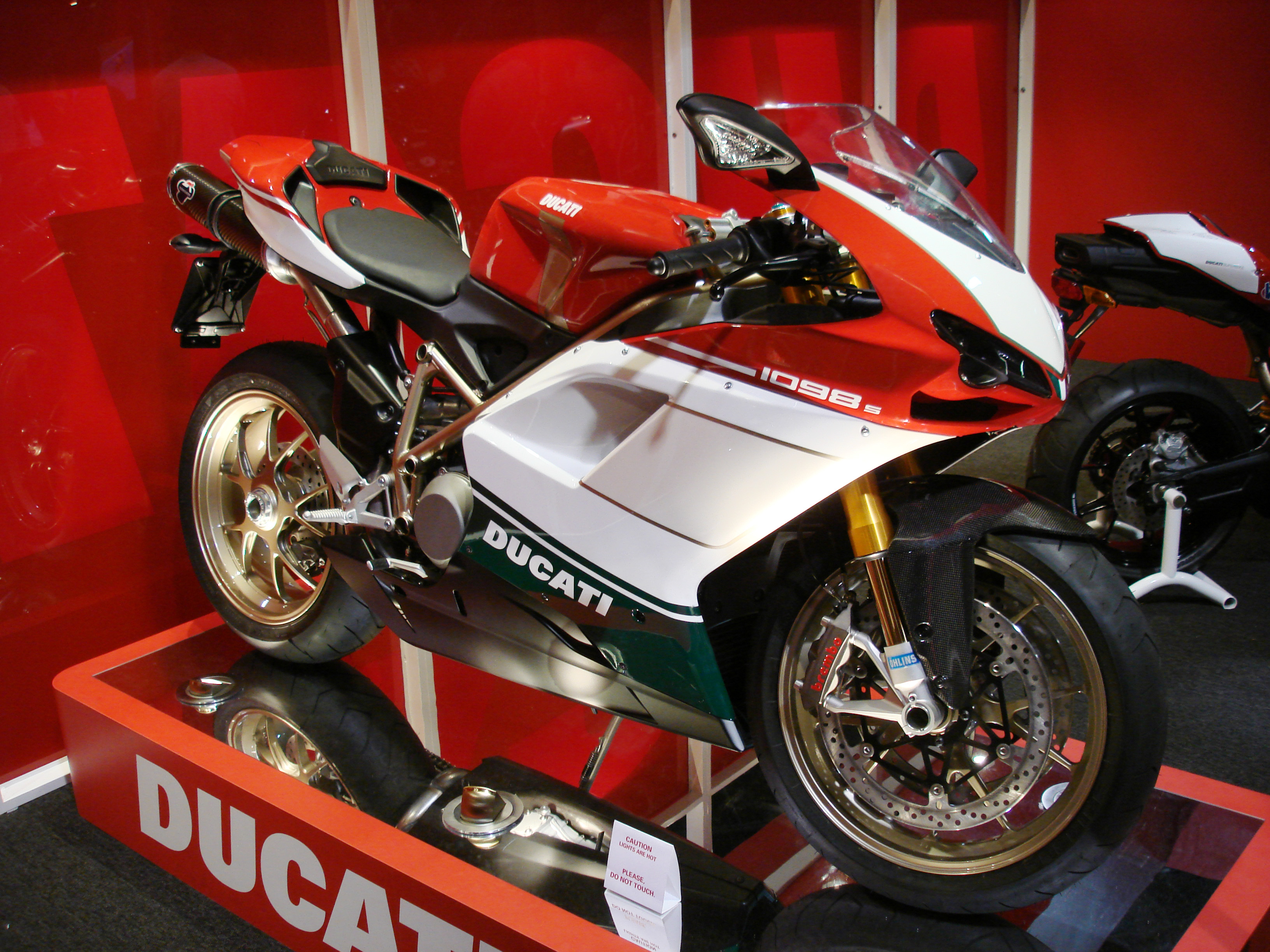
- 996, 998, 999, 1098, 1098S, 1098R, 1198
- Desmosedici RR
.jpg)
Current lineup



; Monster
- Monster
- Monster+
- Monster 821
- Monster 821 Stealth
- Monster 1200
- Monster 1200 S
; Multistrada
- Multistrada 950
- Multistrada 950S
- Multistrada V4
- Multistrada V4 S
- Multistrada V4 S Sport
- Multistrada 1260 Enduro
; Diavel
- Diavel 1260
- Diavel 1260 S
- Diavel 1260 Lamborghini
- XDiavel
- XDiavel S
- XDiavel Black Star
; Panigale
- Panigale 899
- Panigale 959
- Panigale 1199
- Panigale 1299
- Panigale V2
- Panigale V4
- Panigale V4 S
- Panigale V4 SP
- Panigale V4 R
- Superleggera V4
; Streetfighter
- Streetfighter V4
- Streetfighter V4 S
- Streetfighter V2
; SuperSport
- SuperSport
- SuperSport S
; Hypermotard
- Hypermotard 950
- Hypermotard 950 SP
- Hypermotard 950 RVE
; Scrambler
- Scrambler 1100 Pro
- Scrambler 1100 Sport Pro
- Scrambler 1100 Dark Pro
- Scrambler Nightshift
- Scrambler Full Throttle
- Scrambler Café Racer
- Scrambler Desert Sled
- Scrambler Icon
- Scrambler Icon Dark
- Scrambler Sixty2
Product design
Ducati is best known for high-performance motorcycles characterized by large-capacity four-stroke, 90° V-twin engines, with a desmodromic valve design.
Designer
The chief designer of most Ducati motorcycles in the 1950s was Fabio Taglioni (1920–2001).
His designs ranged from the small single-cylinder machines that were successful in the Italian 'street races' to the large-capacity twins of the 1980s.
Taglioni used the Cavallino Rampante (identified with the Ferrari brand) on his Ducati motorbikes. He chose this emblem of courage and daring as a sign of respect and admiration for Francesco Baracca, a World War I fighter pilot who died during an air raid in 1918.
Engine
Ducati has produced several styles of motorcycle engines, including varying the number of cylinders, type of valve actuation and fuel delivery.
Ducati introduced the Pantah in 1979; its engine was updated in the 1990s in the Ducati SuperSport (SS) series. All modern Ducati engines are derivatives of the Pantah, which uses a toothed belt to actuate the engine's valves.
Ducati is best known for its 90° V-twin engine, used on nearly all Ducatis since the 1970s. Ducati brands its engine as "L-twin", emphasizing the 90° V angle, to create product differentiation from competing V-twin motorcycles. As one cylinder is vertical while the other is horizontal, it looks like the letter "L".
Past variations
Ducati has also made other engine types, mostly before the 1970s.
Those engines had one, two, three, or four cylinders; operated by pull rod valves and push rod valves; single, double and triple overhead camshafts; two-stroke and even at one stage manufactured small diesel engines, many were used to power boats, generators, garden machinery and emergency pumps (for example, for fire fighting).
The engines were the IS series from 7 to air-cooled and the larger twin DM series water- and air-cooled. The engines have been found in all parts of the globe. Wisconsin Diesel even assembled and "badge engineered" the engines in the USA. They have also produced outboard motors for marine use.
From the 1960s to the 1990s, the Spanish company MotoTrans licensed Ducati engines and produced motorcycles that, although they incorporated subtle differences, were clearly Ducati-derived. MotoTrans's most notable machine was the 250 cc 24 Horas (Spanish for "24 hours").
Currently, Ducati makes no other engines except for its motorcycles.
Desmodromic valve
Ducati is also famous for using the desmodromic valve system championed by engineer and designer Fabio Taglioni, though the firm has also used engines that use valve springs to close their valves.
Desmodromic valves are closed with a separate, dedicated cam lobe and lifter instead of the conventional valve springs used in most internal combustion engines in consumer vehicles.
This allows the cams to have a more radical profile, thus opening and closing the valves more quickly without the risk of valve-float, which causes a loss of power that is likely when using a "passive" closing mechanism under the same conditions.
On current Ducati motors, except for the Desmosedici and 1199 Panigale, the valves are actuated by a standard valve cam shaft which is rotated by a timing belt driven by the motor directly. The teeth on the belt keep the camshaft drive pulleys indexed.
Past variants
On older Ducati motors, prior to 1986, drive was by solid shaft that transferred to the camshaft through bevel-cut gears. This method of valve actuation was used on many of Ducati's older single-cylinder motorcycles — the shaft tube is visible on the outside of the cylinder.
In the early days, Ducati reserved the desmodromic valve heads for its higher performance bikes and its race bikes. These valves do not suffer from valve float at high engine speeds, thus a desmodromic engine is capable of far higher revolutions than a similarly configured engine with traditional spring-valve heads.
Dry clutches
While most other manufacturers use wet clutches (with the spinning parts bathed in oil) Ducati previously used multiplate dry clutches in many of their motorcycles.
The dry clutch eliminates the power loss from oil viscosity drag on the engine, even though the engagement may not be as smooth as the oil-bath versions, but the clutch plates can wear more rapidly.
Ducati has converted to wet clutches across their current product lines.
Others
Ducati also extensively uses a trellis frame, although Ducati's MotoGP project broke with this tradition by introducing a revolutionary carbon fibre frame for the Ducati Desmosedici GP9.
In 2025, the custom motorcycle brand Bandit9 released a limited-edition version of the Ducati Monster 821 featuring a futuristic design and carbon fiber elements.
Marketing
, Ducati was still pursuing the "win on Sunday, sell on Monday" business model and spending 10% of company revenues, , on its racing business.
Enthusiasts groups
A key part of Ducati's marketing strategy since the 1990s has been fostering a distinct community identity in connection with branding efforts including online communities and local, regional, and national Ducati enthusiast clubs.
In the USA
There are more than 400 Ducati clubs worldwide and 20,000 registered users of the Ducati Owners Club web site and 17,000 subscribers to the racing web site. Enthusiasts and riders are informally referred to in the motorcycling community as Ducatista (singular) or Ducatisti (plural).
In North America there are several Ducati enthusiasts organizations with varying degrees of factory sponsorship, such as the Bay Area Desmo Owners Club (BADOC) located in and around the city of San Francisco, CA. Ducati Riders of Illinois (DRILL) located in Chicago, IL. DESMO, the Ducati Enthusiast Sport Motorcycle Organization, is a North American group affiliated with the factory Desmo Owners Club.
Some groups are focused on vintage Ducatis while several are based primarily or entirely on email discussion lists or web forums.
Merchandising
Ducati has a wide range of accessories, lifestyle products and co-branded merchandise bearing their logos and designs.
The company has a licensing agreement with Tumi Inc., launching a collection of eight co-branded luggage pieces in 2006, sold through both of the brands' retail outlets.
Racing
Main article: Ducati Corse

Ducati rejoined Grand Prix motorcycle racing in , after a 30-year absence.
On 23 September 2007, Casey Stoner clinched his and Ducati's first Grand Prix World Championship. And 15 years later, Francesco Bagnaia became the Italian manufacturer's second-ever MotoGP champion.
Nine-time world champion Valentino Rossi rode for Ducati Corse for and .
| Year | Champion | Motorcycle |
|---|---|---|
| AUS Casey Stoner | Ducati Desmosedici GP7 | |
| ITA Francesco Bagnaia | Ducati Desmosedici GP22 | |
| Ducati Desmosedici GP23 | ||
| ESP Jorge Martín* | Ducati Desmosedici GP24 | |
| ESP Marc Márquez | Ducati Desmosedici GP25 |
Aside from MotoGP, Ducati has also deployed teams in various motorcycle racing competitions.
** Jorge Martín raced in the Ducati satelite team Prima Pramac Racing.*
References
References
- (3 March 2016). "Ducati Group: nel 2015 vendite, fatturato e risultato in crescita". Ducati Motor Holding S.p.A..
- (23 July 2012). "Audi Interim Financial Report 2012". AUDI AG.
- "1968 Ducati Brio 100".
- "Mach 1". ducati.com.
- "DUCATI MOTOR HOLDING SPA, Form 20-F, Annual and Transition Report (foreign private issuer), Filing Date Jun 30, 2004". secdatabase.com.
- "History of the Motorcycle". mecossemi.com.
- Lodi, Livio. (2009). "History of the Ducati Logo: The 1990s and beyond". Ducati Motor Holding S.p.A..
- https://www.roadracingworld.com/news/ducati-ceo-resigns-following-release-of-2002-financial-report/#:~:text=Federico%20Minoli%20was%20Chairman%20and,remained%20Chairman%20of%20the%20Board.
- https://www.just-auto.com/news/italy-carlo-di-biagio-to-become-ceo-of-ducati-motor-holding-spa/#:~:text=%E2%80%9CCarlo%20has%20been%20an%20integral,Cesare%20Fiorucci%20S.p.A.%20in%20Rome.
- https://www.reuters.com/article/instant-article/idUSL215826020070521/
- https://www.autocarpro.in/news/ashok-leylands-domestic-yoy-wholesales-slide-by-12-in-september-2024
- (December 1962). "Le straniere montate in Italia". Editoriale Domus S.p.A..
- Alan Cathcart. (January–February 2011). "Ducati Regolarità 125". Motorcycle Classics.
- Roland Brown. (July–August 2011). "1975 Ducati 860GT". Motorcycle Classics.
- Salvadori, Clement. (7 January 2016). "Retrospective: Ducati 860 GT and GTE: 1974–1975 | Rider Magazine".
- Walker, Mick (2002), Illustrated Ducati Buyer's Guide (3rd ed.), MotorBooks/MBI Publishing Company, p. 148, {{ISBN. 978-0760313091
- "Desmo 2 Valve History". monsta.at.
- "Ducati Official History (The 916)". Ducati Motor Holdings.
- (2009). "Previous Model Years". Ducati Motor Holding SpA.
- (2021). "Monster". Ducati Motor Holding SpA.
- (2021). "Monster". Ducati Motor USA.
- (2021). "Multistrada". Ducati Motor Holding SpA.
- (2021). "Diavel". Ducati Motor Holding SpA.
- (2021). "Panigale". Ducati Motor Holding SpA.
- (2021). "Streetfighter". Ducati Motor Holding SpA.
- (2021). "SuperSport". Ducati Motor Holding SpA.
- (2021). "Hypermotard". Ducati Motor Holding SpA.
- (2021). "Scrambler". Ducati Motor Holding SpA.
- "History of the Two-Valve Twin". Ducati.com.
- "Desmo for Dummies". Ducati.com.
- "Fabio Taglioni: a Legend". ducati.com.
- "What is in an oil". yamaha-motor.ca.
- [https://www.casawi.eu/post/bandit9-custom-ducati-821-limited-edition-motorcycles Bandit9 Custom Ducati 821 Limited Edition Motorcycles – Casawi]
- Boland, Vincent. (12 August 2009). "Ducati cuts production and salaries". [[Financial Times]].
- Radosta, John S.. (5 April 1970). "Auto Manufacturers Keep One Eye on the Track and the Other on Consumer". [[The New York Times]].
- (27–29 June 2001). "EMBARKING ON E-BUSINESS AT DUCATI MOTORCYCLES (ITALY)". Global Co-Operation in the New Millennium The 9th European Conference on Information Systems.
- (2009). "Desmo Owners Club". Ducati Motor Holding.
- "Vintage Ducati Club Homepage".
- Duglin Kennedy, Shirley. (2005). "The Savvy Guide to Motorcycles". Indy Tech Publishing.
- (24 January 2007). "Tumi Time: Tumi+Ducati Collection".
- "2003 Ducati MotoGP Team". ducati.com.
- (2022-11-06). "MotoGP champion Bagnaia: 'I recognised that I had a problem, ups and downs...'".
- Ducati. (15 August 2010). "Rossi to ride for Ducati in 2011 (press release)". MotoGP.com Official Website.
- Fiat Yamaha. (15 August 2010). "Yamaha and Valentino Rossi to part company at end of 2010 (press release)". MotoGP.com Official Website.
- (10 August 2012). "Ducati And Rossi To Part Ways At End Of 2012". Motorbike News.
This article was imported from Wikipedia and is available under the Creative Commons Attribution-ShareAlike 4.0 License. Content has been adapted to SurfDoc format. Original contributors can be found on the article history page.
Ask Mako anything about Ducati — get instant answers, deeper analysis, and related topics.
Research with MakoFree with your Surf account
Create a free account to save articles, ask Mako questions, and organize your research.
Sign up freeThis content may have been generated or modified by AI. CloudSurf Software LLC is not responsible for the accuracy, completeness, or reliability of AI-generated content. Always verify important information from primary sources.
Report