From Surf Wiki (app.surf) — the open knowledge base
Dubrovnik
Coastal city in southern Croatia

Coastal city in southern Croatia
| Field | Value |
|---|---|
| name | Dubrovnik |
| official_name | Grad Dubrovnik |
| City of Dubrovnik | |
| settlement_type | City |
| image_skyline | {{multiple image |
| border | infobox |
| perrow | 1/2/2/2/1 |
| total_width | 260 |
| align | center |
| caption_align | center |
| image1 | The walls of the fortress and View of the old city. panorama.jpg |
| caption1 | Old town of Dubrovnik |
| image2 | Dubrovnik (28).JPG |
| caption2 | Dubrovnik Cathedral |
| image3 | Rector's palace 20180820.jpg |
| caption3 | Rector's Palace |
| image4 | Dubrovnik D81 4055 (38627453362).jpg |
| caption4 | Dubrovnik Walls |
| image5 | Dubrovnik, palazzo sponza 01.JPG |
| caption5 | Sponza Palace |
| image6 | Dubrovnik (20914149644).jpg |
| caption6 | Stradun |
| image_flag | St. Blaise - National Flag of the Ragusan Republic.png |
| flag_size | 135px |
| image_shield | Dubrovnik grb.svg |
| shield_size | 70px |
| nicknames | "Pearl of the Adriatic", "Thesaurum mundi" |
| mapframe | yes |
| mapframe-zoom | 9 |
| mapframe-wikidata | yes |
| mapframe-stroke-width | 1 |
| pushpin_map | Croatia#Europe |
| pushpin_map_caption | The location of Dubrovnik within Croatia |
| coordinates | |
| subdivision_type | Country |
| subdivision_name | Croatia |
| subdivision_type1 | Region |
| subdivision_name1 | Dalmatia |
| subdivision_type2 | County |
| subdivision_name2 | Dubrovnik-Neretva |
| established_title | |
| established_title2 | |
| established_title3 | |
| government_type | Mayor-Council |
| leader_title | Mayor |
| leader_name | Mato Franković (HDZ) |
| leader_title1 | City Council |
| leader_name1 | {{Collapsible list |
| title | 21 members |
| frame_style | border: none; padding: 0; |
| list_style | text-align:left;display:all; |
| 1 | • HDZ (7) |
| 2 | • SJG! – Možemo! (3) |
| 3 | • DDS (3) |
| 4 | • Independent (2) |
| 5 | • Dustra (2) |
| 6 | • SDP (2) |
| 7 | • MOST (1) |
| 8 | • HNS (1) |
| unit_pref | metric |
| area_footnotes | |
| area_total_km2 | 142.6 |
| area_land_km2 | |
| area_urban_km2 | 12.1 |
| elevation_footnotes | |
| elevation_m | 3 |
| population_footnotes | |
| population_as_of | 2021 |
| population_total | 41562 |
| population_density_km2 | auto |
| population_urban | 26922 |
| population_density_urban_km2 | auto |
| population_metro | 65808 |
| population_demonym | Dubrovčanin (hr, male) |
| Dubrovčanka (hr, female) | |
| Dubrovkinja (local, female) | |
| timezone | CET |
| timezone_DST | CEST |
| utc_offset | +1 |
| utc_offset_DST | +2 |
| postal_code_type | Postal code |
| postal_code | HR-20 000 |
| area_code | +385 20 |
| registration_plate | DU |
| blank_name | Patron saint |
| blank_info | Saint Blaise |
| website | |
| footnotes | {{Infobox UNESCO World Heritage Site |
| child | yes |
| official_name | Old City of Dubrovnik |
| criteria | (i)(iii)(iv) |
| ID | 95 |
| year | 1979 |
| area | 96.7 ha |
the city in Croatia
City of Dubrovnik | mapframe-zoom = 9 | mapframe-wikidata = yes | mapframe-stroke-width = 1 Dubrovčanka (hr, female) Dubrovkinja (local, female)
Dubrovnik, historically also known as Ragusa, is a city in southern Dalmatia, Croatia, by the Adriatic Sea. It is one of the most prominent tourist destinations in the Mediterranean, a seaport and the centre of the Dubrovnik-Neretva County. In 2021, its total population was 41,562. Recognizing its outstanding medieval architecture and fortifications, UNESCO inscribed the Old City of Dubrovnik as a World Heritage Site in 1979.
The history of the city probably dates back to the 7th century, when the town known as Ragusa was founded by refugees from Epidaurum (Ragusa Vecchia). It was under protectorate of the Byzantine Empire and later under the sovereignty of the Republic of Venice. Between the 14th and 19th centuries, Dubrovnik ruled itself as a free state. The prosperity of the city was historically based on maritime trade; as the capital of the maritime Republic of Ragusa, it achieved a high level of development, particularly during the 15th and 16th centuries, as it became notable for its wealth and skilled diplomacy. At the same time, Dubrovnik became a cradle of Croatian literature. In his letter to Nikola Nalješković (1564), poet Ivan Vidalić named it "crown of Croatian cities".
The entire city was almost destroyed in a devastating earthquake in 1667. During the Napoleonic Wars, Dubrovnik was occupied by the French Empire forces, and then the Republic of Ragusa was abolished and incorporated into the Napoleonic Kingdom of Italy and later into the Illyrian Provinces of France. In the early 19th to early 20th century, Dubrovnik was part of the Kingdom of Dalmatia within the Austrian Empire. Dubrovnik became part of the Kingdom of Yugoslavia immediately upon its creation, and it was incorporated into its Zeta Banovina in 1929, before becoming part of the Banovina of Croatia upon its creation in 1939. During World War II, it was part of the Axis puppet state Independent State of Croatia, before being reincorporated into Socialist Republic of Croatia in Socialist Federal Republic of Yugoslavia.
In 1991, during the Croatian War of Independence, Dubrovnik was besieged by the Yugoslav People's Army for seven months and suffered significant damage from shelling. After undergoing repair and restoration works in the 1990s and early 2000s, it re-emerged as one of the Mediterranean's top tourist destinations, as well as a popular filming location. Often called "The Queen of Adriatic" Dubrovnik is considered one of the most popular destinations in the Adriatic and in Europe.
Names
The names Dubrovnik and Ragusa co-existed for several centuries. Ragusa, recorded in various forms since at least the 10th century (in Latin, Dalmatian, Italian; in ), remained the official name of the Republic of Ragusa until 1808, and of the city within the Kingdom of Dalmatia until 1918, while Dubrovnik, first recorded in the late 12th century, was in widespread use by the late 16th or early 17th century.
The name Dubrovnik of the Adriatic city is first recorded in the Charter of Ban Kulin (1189). The most common explanation for the origin is from a Proto-Slavic word meaning 'oak', and the term dubrovnik referring to 'oak wood' or 'oak forest', as means 'oakwood', 'forest'.
The historical name Ragusa is recorded in the Greek form Ῥαούσιν (Rhaousin, Latinized Ragusium) in the 10th century. It was recorded in various forms in the medieval period, Rausia, Lavusa, Labusa, Raugia, Rachusa. Various attempts have been made to etymologize the name. Suggestions include derivation from Greek , ῥαγός "grape"; from Greek ῥώξ, ῥωγός "narrow passage"; Greek ῥωγάς "ragged (of rocks)", ῥαγή (ῥαγάς) "fissure"; from the name of the Epirote tribe of the Rhogoi, from an unidentified Illyrian substrate. A connection to the name of Sicilian Ragusa has also been proposed. It has been proposed by V. Orel that the Proto-Albanian *rāguša of Albanian rrush 'grape' is related to Ragusa or the source of the name. Putanec (1993) gives a review of etymological suggestion, and favours an explanation of the name as pre-Greek ("Pelasgian"), from a root cognate to Greek ῥαγή "fissure", with a suffix -ussa also found in the Greek name of Brač, Elaphousa. The name of the city in the native Dalmatian language, now extinct, was Ragusa, as shown by a 1325 letter in Dalmatian. In Albanian, the city was historically referred to as Rush (Rushi), from Latin Ragusium.
The classical explanation of the name is due to Constantine VII's De Administrando Imperio (10th century). According to this account, Ragusa (Ῥαούσιν) is the foundation of the refugees from Epidaurum (Ragusa Vecchia), a Greek city situated some 15 km to the south of Ragusa, when that city was destroyed in the Slavic incursions of the 7th century. The name is explained as a corruption of a Dalmatae/Romance word Lausa, the name of the rocky island on which the city was built (connected by Constantine to Greek λᾶας "rock, stone").
History
Origins
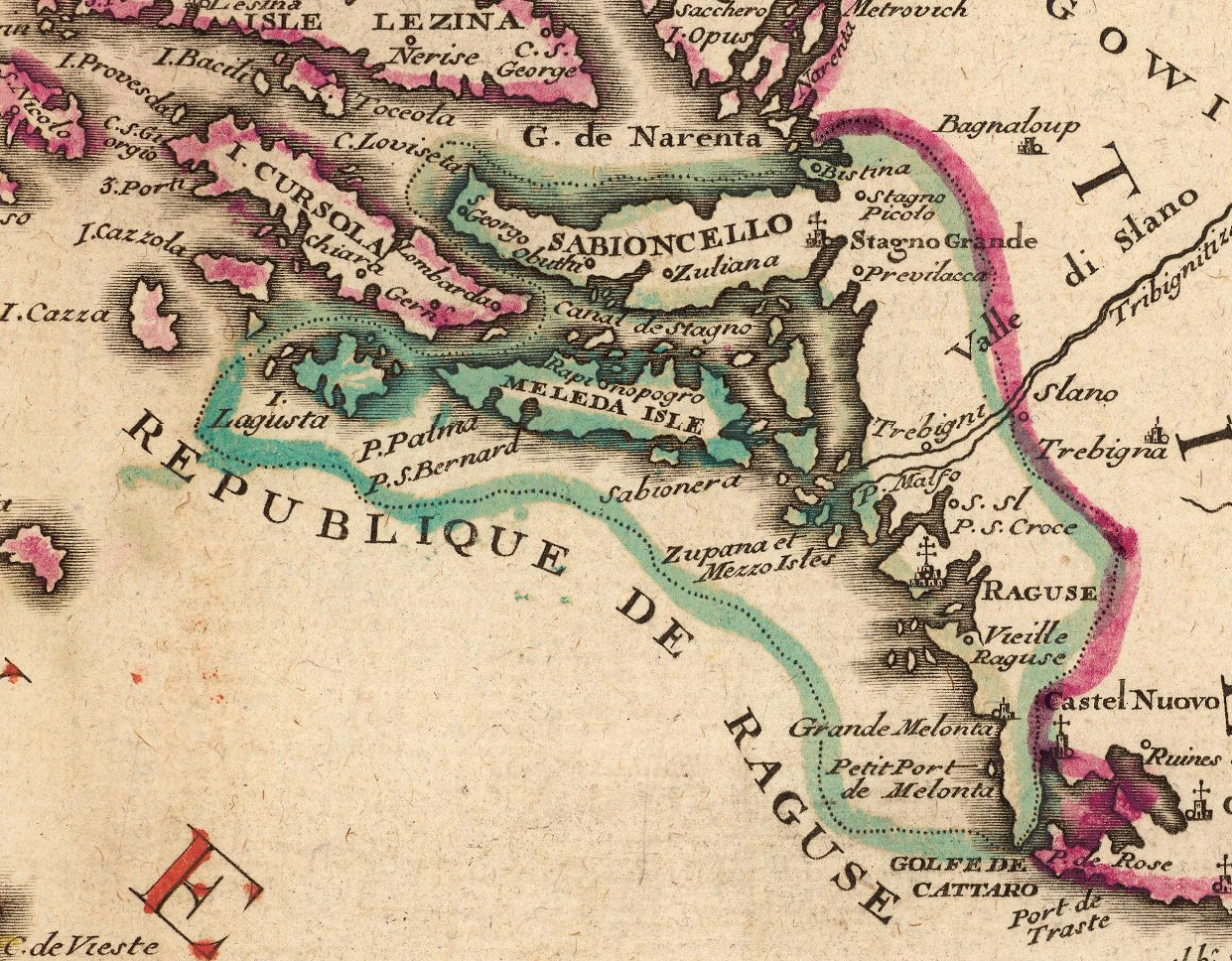
Dubrovnik was inhabited by the Illyrian tribe of Pleraei in ancient times. According to Constantine Porphyrogenitus's De Administrando Imperio ( 950), Ragusa was founded in the 7th century, named after a "rocky island" called Lausa, by refugees from Epidaurum (Ragusa Vecchia), a Roman city situated some 15 km to the south, when that city was destroyed by Slavs fighting with the Avars. It was one of the Dalmatian city-states.
Excavations in 2007 revealed a Byzantine basilica from the 8th century and parts of the city walls. The size of the old basilica clearly indicates that there was quite a large settlement at the time. There is also evidence for the presence of a settlement in the pre-Christian era, most notably the finding of ancient coins from the 3rd and 2nd century BC, as well as archeological fragments from the 1st century BC in the area of the old City port.
Antun Ničetić, in his 1996 book Povijest dubrovačke luke ("History of the Port of Dubrovnik"), expounds the theory that Dubrovnik was established by Greek sailors, as a station halfway between the two Greek settlements of Budva and Korčula, 95 nmi apart from each of them.
Republic of Ragusa
Main article: Republic of Ragusa

_(cropped).jpg)
After the fall of the Ostrogothic Kingdom, the town came under the protection of the Byzantine Empire. In the 12th and 13th centuries, Dubrovnik grew into an oligarchic republic. After the Crusades, Dubrovnik came under the sovereignty of Venice (1205–1358), which would give its institutions to the Dalmatian city. In 1240 Ragusa purchased the island of Lastovo from Stefan Uroš I, king of Serbia, who had rights over the island as ruler of parts of Zachlumia. After a fire destroyed most of the city on the night of August 16, 1296, a new urban plan was developed. By the Peace Treaty of Zadar in 1358, Dubrovnik achieved relative independence as a vassal-state of the Kingdom of Hungary.
Between the 14th century and 1808, Dubrovnik ruled itself as a free state, although it was a tributary from 1382 to 1804 of the Ottoman Empire and paid an annual tribute to its sultan. The Republic reached its peak in the 15th and 16th centuries, when its thalassocracy rivalled that of the Republic of Venice and other Italian maritime republics.
There are also signs of a long established Albanian population in the Ragusan hinterlands since at least the Medieval period. And a Ragusan document dating to 1285 states: "I heard a voice crying in the mountains in Albanian" (Audivi unam vocem clamantem in monte in lingua albanesca).
For centuries, Dubrovnik was an ally of Ancona, the other Adriatic maritime republic rival of Venice, which was itself the Ottoman Empire's chief rival for control of the Adriatic. This alliance enabled the two towns set on opposite sides of the Adriatic to resist attempts by the Venetians to make the Adriatic a "Venetian Bay", also controlling directly or indirectly all the Adriatic ports. Ancona and Dubrovnik developed an alternative trade route to the Venetian (Venice–Austria–Germany): starting in Dubrovnik it went on to Ancona, through Florence and ended in Flanders. Ragusa was an important base for the traffic of the Balkan slave trade, from which slaves were transported from the Balkans across the Adriatic Sea to the Aegean Sea, from which they were sold on to either slavery in Spain in the West or slavery in Egypt in the South.
The Republic of Ragusa received its own Statutes as early as 1272, which, among other things, codified Roman practice and local customs. The Statutes included prescriptions for town planning and the regulation of quarantine (for sanitary reasons).
The Republic was an early adopter of what are now regarded as modern laws and institutions: a medical service was introduced in 1301, with the first pharmacy, still operating to this day, being opened in 1317. An almshouse was opened in 1347, and the first quarantine hospital (Lazarete) was established in 1377. Slave trading (Balkan slave trade) was abolished in 1418, and an orphanage opened in 1432. A 20 km water supply system, instead of a cistern, was constructed in 1438 by the Neapolitan architect and engineer Onofrio della Cava. He completed the aqueduct with two public fountains. He also built a number of mills along one of its branches.
The city was ruled by the local aristocracy which was of Latin-Dalmatian extraction and formed two city councils. As usual for the time, they maintained a strict system of social classes. The republic abolished the slave trade early in the 15th century and valued liberty highly. The city successfully balanced its sovereignty between the interests of Venice and the Ottoman Empire for centuries.
Latin was originally used in official documents of the Republic. Italian came to use in the early 15th century. A variant of the Dalmatian language was among the spoken ones, and was influenced by Croatian and Italian. The presence of Croatian in everyday speech increased in the late 13th century, and in literary works in the mid-15th century. In the coming decades, Dubrovnik became a cradle of Croatian literature.
The economic wealth of the Republic was partially the result of the land it developed, but especially of seafaring trade. With the help of skilled diplomacy, Dubrovnik merchants travelled lands freely and the city had a huge fleet of merchant ships (known as argosy) that travelled all over the world. From these travels they founded some settlements, from India (cf. Ragusan trade with India) to America, and brought parts of their culture and flora home with them. One of its keys to success was not conquering, but trading and sailing under a white flag with the word (freedom) prominently featured on it. The flag was adopted when slave trading was abolished in 1418.
In search of Indian spices and textiles, merchants from Dubrovnik arrived in Goa, India, and settled in what is now called Gandauli. The people of Dubrovnik arrived in the Portuguese colony of Goa between 1530 and 1535, and after that they founded their own colony, Sao Braz, named after the patron saint of Dubrovnik, St. Blaise. The church was built around 1563 and was a replica of the original church of St. Blaise in Dubrovnik. About 12,000 inhabitants lived in São Braz and was a thriving colony until the 1570s when trade between Croats and Indians declined.
Many Conversos, Jews from Spain and Portugal who converted to Christianity, were attracted to the city. In May 1544, a ship landed there filled exclusively with Portuguese refugees, as Balthasar de Faria reported to King John. During this time one of the most famous cannon and bell founders of his time worked in the city: Ivan Rabljanin (also known as Magister Johannes Baptista Arbensis de la Tolle). By 1571 Dubrovnik had sold its protection over some Christian settlements in other parts of the Ottoman Empire to France and Venice. At that time there was also a colony of Dubrovnik in Fes in Morocco. The bishop of Dubrovnik was a Cardinal protector in 1571, at that time there were only 16 other countries which had Cardinal protectors.
Dubrovnik was a tributary state of the Ottoman Empire at one time. From this, they gained benefits such as access to the Black Sea, paid less customs duties (they however needed to make tribute payments) and had the diplomatic support of the Turks in trade disputes against the Venetians. This status also allowed increased trade with the inland regions through the Balkan overland trade which made merchants from Dubrovnik to build up a strong network unequaled with other Christian states.

The Republic gradually declined due to a combination of a Mediterranean shipping crisis and the catastrophic earthquake of 1667 that killed over 5,000 citizens, levelled most of the public buildings and, consequently, negatively affected the well-being of the Republic. In 1699, the Republic was forced to sell two mainland patches of its territory to the Ottomans in order to avoid being caught in the clash with advancing Venetian forces. Today this strip of land belongs to Bosnia and Herzegovina and is that country's only direct access to the Adriatic. A highlight of Dubrovnik's diplomacy was the involvement in the American Revolution.
Early modern period
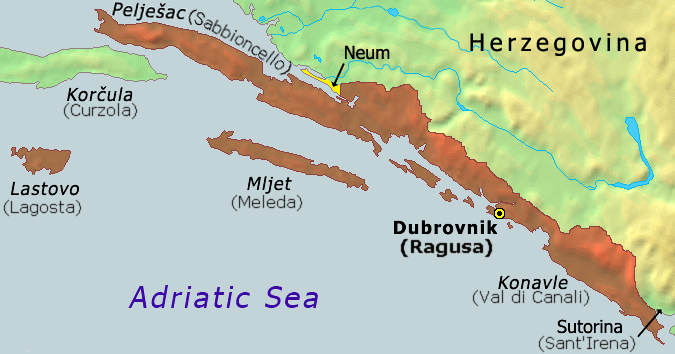
On 27 May 1806, the forces of the Empire of France occupied the neutral Republic of Ragusa. Upon entering Ragusan territory without permission and approaching the capital, the French General Jacques Lauriston demanded that his troops be allowed to rest and be provided with food and drink in the city before continuing on to take possession of their holdings in the Bay of Kotor. However, this was a deception because as soon as they entered the city, they proceeded to occupy it in the name of Napoleon. Almost immediately after the beginning of the French occupation, Russian and Montenegrin troops entered Ragusan territory and began fighting the French army, raiding and pillaging everything along the way and culminating in a siege of the occupied city during which 3,000 cannonballs fell on it. In 1808 Marshal Marmont issued a proclamation abolishing the Republic of Ragusa and amalgamating its territory into the French Empire's client state, the Napoleonic Kingdom of Italy. Marmont claimed the newly created title of "Duke of Ragusa" (Duc de Raguse) and in 1810 Ragusa, together with Istria and Dalmatia, went to the newly created French Illyrian Provinces.

After seven years of French occupation, encouraged by the desertion of French soldiers after the failed invasion of Russia and the reentry of Austria in the war, all the social classes of the Ragusan people rose up in a general insurrection, led by the patricians, against the Napoleonic invaders. On 18 June 1813, together with British forces they forced the surrender of the French garrison of the island of Šipan, soon also the heavily fortified town of Ston and the island of Lopud, after which the insurrection spread throughout the mainland, starting with Konavle. They then laid siege to the occupied city, helped by the British Royal Navy, who had enjoyed unopposed domination over the Adriatic sea, under the command of Captain William Hoste, with his ships HMS Bacchante and . Soon the population inside the city joined the insurrection. The Austrian Empire sent a force under General Todor Milutinović offering to help their Ragusan allies. However, as was soon shown, their intention was to in fact replace the French occupation of Ragusa with their own. Seducing one of the temporary governors of the Republic, Biagio Bernardo Caboga, with promises of power and influence (which were later cut short and who died in ignominy, branded as a traitor by his people), they managed to convince him that the gate to the east was to be kept closed to the Ragusan forces and to let the Austrian forces enter the City from the west, without any Ragusan soldiers, once the French garrison of 500 troops under General Joseph de Montrichard had surrendered.
After this, the Flag of Saint Blaise was flown alongside the Austrian and British colors, but only for two days because, on 30 January, General Milutinović ordered Mayor Sabo Giorgi to lower it. Overwhelmed by a feeling of deep patriotic pride, Giorgi, the last Rector of the Republic, refused to do so "for the masses had hoisted it". Subsequent events proved that Austria took every possible opportunity to invade the entire coast of the eastern Adriatic, from Venice to Kotor. The Austrians did everything in their power to eliminate the Ragusa issue at the Congress of Vienna. Ragusan representative Miho Bona, elected at the last meeting of the Major Council, was denied participation in the Congress, while Milutinović, prior to the final agreement of the allies, assumed complete control of the city.
Regardless of the fact that the government of the Ragusan Republic never signed any capitulation nor relinquished its sovereignty, which according to the rules of Klemens von Metternich that Austria adopted for the Vienna Congress should have meant that the Republic would be restored, the Austrian Empire managed to convince the other allies to allow it to keep the territory of the Republic. While many smaller and less significant cities and former countries were permitted an audience, that right was refused to the representative of the Ragusan Republic. All of this was in blatant contradiction to the solemn treaties that the Austrian Emperors signed with the Republic: the first on 20 August 1684, in which Leopold I promises and guarantees inviolate liberty ("inviolatam libertatem") to the Republic, and the second in 1772, in which the Empress Maria Theresa promises protection and respect of the inviolability of the freedom and territory of the Republic.
Languages

The official language until 1472 was Latin. As a consequence of the increasing migration of Slavic population from inland Dalmatia, the language spoken by much of the population was Croatian, typically referred to in Dubrovnik's historical documents simply as "Slavic". To oppose the demographic change due to increased Slavic immigration from the Balkans, the native Romance population of Ragusa, which made up the oligarchic government of the Republic, tried to prohibit the use of any Slavic languages in official councils. Archeologists have also discovered medieval Glagolitic tablets near Dubrovnik, such as the inscription of Župa Dubrovačka, indicating that the Glagolitic script was also likely once used in the city.
The Italian language as spoken in the republic was heavily influenced by the Venetian language and the Tuscan dialect. Italian took root among the Dalmatian-speaking merchant upper classes, as a result of Venetian influence which strengthened the original Latin element of the population.
On 14 July 1284 in Ragusa, the Albanian language was attested for the first time in history when a crime witness testified: "I heard a voice crying on the mountain in the Albanian language" (Latin: Audivi unam vocem, clamantem in monte in lingua albanesca).
Austrian rule
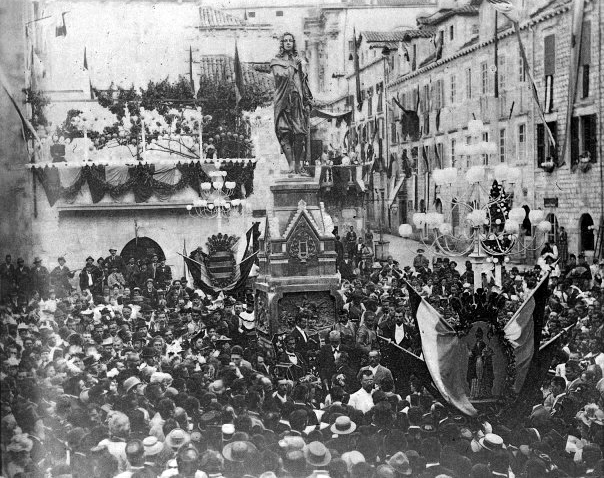

When the Habsburg Empire annexed these provinces after the 1815 Congress of Vienna, the new authorities implemented a bureaucratic administration, established the Kingdom of Dalmatia, which had its own Sabor (Diet) or Parliament which is the oldest Croatian political institution based in the city of Zadar, and political parties such as the Autonomist Party and the People's Party. They introduced a series of modifications intended to slowly centralise the bureaucratic, tax, religious, educational, and trade structure. These steps largely failed, despite the intention of wanting to stimulate the economy. Once the personal, political and economic damage of the Napoleonic Wars had been overcome, new movements began to form in the region, calling for a political reorganisation of the Adriatic along national lines.
The combination of these two forces—a flawed Habsburg administrative system and new national movement claiming ethnicity as the founding block toward a community—posed a particularly perplexing problem: Dalmatia was a province ruled by the German-speaking Habsburg monarchy, with bilingual (Croatian- and Italian-speaking) elites that dominated the general population consisting of a Slavic Catholic majority, as well as a Slavic Orthodox minority.
In 1815, the former Dubrovnik government (its noble assembly) met for the last time in Ljetnikovac in Mokošica. Once again, extreme measures were taken to re-establish the Republic, but it was all in vain. After the fall of the Republic most of the aristocracy was recognised by the Austrian Empire.
In 1832, Baron Šišmundo Getaldić-Gundulić (Sigismondo Ghetaldi-Gondola) (1795–1860) was elected Mayor of Dubrovnik, serving for 13 years; the Austrian government granted him the title of "Baron".
Count Rafael Pucić (Raffaele Pozza) (1828–1890) was elected for first time Podestà of Dubrovnik in the year 1869 after this was re-elected in 1872, 1875, 1882, 1884) and elected twice into the Dalmatian Council, 1870, 1876. The victory of the Nationalists in Split in 1882 strongly affected in the areas of Korčula and Dubrovnik. It was greeted by the mayor (podestà) of Dubrovnik Rafael Pucić, the National Reading Club of Dubrovnik, the Workers Association of Dubrovnik and the review "Slovinac" as well as by the communities of Kuna and Orebić, the latter one getting the nationalist government even before Split.
.jpg)
In 1901, the narrow-gauge (760 mm) railway line was opened primarily to connect the port city of Dubrovnik with the interior of Bosnia and Herzegovina and further into Europe. The line was operational from 1901 to 1976.
In 1905, the Committee for establishing electric tram service, headed by Luko Bunić was established. Other members of the Committee were Ivo Papi, Miho Papi, Artur Saraka, Mato Šarić, Antun Pugliesi, Mato Gracić, Ivo Degiulli, Ernest Katić and Antun Milić. The tram service in Dubrovnik existed from 1910 to 1970.
Pero Čingrija (1837–1921), one of the leaders of the People's Party in Dalmatia, played the main role in the merger of the People's Party and the Party of Right into a single Croatian Party in 1905.
Yugoslav period (1918–1991)

With the fall of Austria-Hungary in 1918, the city was incorporated into the new Kingdom of Serbs, Croats, and Slovenes (later renamed to Kingdom of Yugoslavia). Dubrovnik became one of the 33 oblasts of the Kingdom. When Yugoslavia was divided among nine banovinas in 1929, the city became part of the Zeta Banovina. In 1939, Dubrovnik became part of the newly created Banovina of Croatia.
During the World War II in Yugoslavia, Dubrovnik became part of the Axis puppet state, Independent State of Croatia (NDH), occupied by the Italian Army first, and by the German Army after 8 September 1943. There were clashes between Italian and German troops in Dubrovnik when the Germans took over. In October 1944, Yugoslav Partisans liberated Dubrovnik, arresting more than 300 citizens and executing 53 without trial; this event came to be known, after the small island on which it occurred, as the Daksa executions. Communist leadership during the next several years continued political prosecutions, which culminated on 12 April 1947 with the capture and imprisonment of more than 90 citizens of Dubrovnik. After the war the remaining members of Dalmatian Italians of Dubrovnik left Yugoslavia towards Italy (Istrian-Dalmatian exodus).
Under communism Dubrovnik became part of SR Croatia within SFR Yugoslavia. After the World War II, the city started to attract crowds of tourists–even more after 1979, when the city joined the UNESCO list of World Heritage Sites. The growth of tourism also led to the decision to demilitarise the Dubrovnik Old Town. The income from tourism was pivotal in the post-war development of the city, including its airport. The Dubrovnik Summer Festival was founded in 1950. The Adriatic Highway (Magistrala) was opened in 1965 after a decade of works, connecting Dubrovnik with Rijeka along the whole coastline, and giving a boost to the tourist development of the Croatian Riviera.
Siege of Dubrovnik and its consequences
Main article: Siege of Dubrovnik
.jpg)
In 1991, Croatia and Slovenia, which at that time were republics within SFR Yugoslavia, declared their independence. The Socialist Republic of Croatia was renamed as the Republic of Croatia.
Despite the demilitarisation of the Old Town in early 1970s in an attempt to prevent it from ever becoming a casualty of war, following Croatia's independence in 1991, Yugoslav People's Army (JNA)–by then composed primarily of Serbs–attacked the city. The new Croatian government set up a military outpost in the city itself. Montenegro–led by President Momir Bulatović and Prime Minister Milo Đukanović, who came to power in the Anti-bureaucratic revolution and were allied to Slobodan Milošević in Serbia–declared that Dubrovnik should not remain in Croatia. At the time most residents of Dubrovnik had come to identify as Croatian, with Serbs accounting for 6.8 percent of the population.
On 1 October 1991, Dubrovnik was attacked by the JNA resulting in a siege that lasted for seven months. The heaviest artillery attack was on 6 December with 19 people killed and 60 wounded. The number of casualties in the conflict, according to the Croatian Red Cross, was 114 killed civilians, among them poet Milan Milišić. Foreign newspapers were criticised for placing heavier attention on the damage suffered by the Old Town than on human casualties. Nonetheless, the artillery attacks on Dubrovnik damaged 56% of its buildings to some degree, as the historic walled city, a UNESCO World Heritage Site, sustained 650 hits by artillery rounds. The Croatian Army lifted the siege in May 1992, and liberated Dubrovnik's surroundings by the end of October, but the danger of sudden attacks by the JNA lasted for another three years.
Following the end of the war, damage caused by the shelling of the Old Town was repaired. Adhering to UNESCO guidelines, repairs were performed in the original style. Most of the reconstruction work was done between 1995 and 1999. The inflicted damage can be seen on a chart near the city gate, showing all artillery hits during the siege, and is clearly visible from high points around the city in the form of the more brightly coloured new roofs.
The International Criminal Tribunal for the former Yugoslavia (ICTY) issued indictments for JNA generals and officers involved in the bombing. General Pavle Strugar, who coordinated the attack on the city, was sentenced to a seven-and-a-half-year prison term by the tribunal for his role in the attack.
Post-war Dubrovnik in Republic of Croatia

The 1996 Croatia USAF CT-43 crash, near Dubrovnik Airport, killed everyone on a United States Air Force jet, including United States Secretary of Commerce Ron Brown, The New York Times Frankfurt Bureau chief Nathaniel C. Nash, and 33 other people.
In October 2023, Dubrovnik joined the European Network of Saint James Way Paths, with a 147-kilometer pilgrimage route "Camino Dubrovnik-Međugorje", expected to be open to visitors in May 2024.
Geography
Dubrovnik is located in the southern tip of the Dalmatia region of Croatia in the Adriatic Sea. It is part of the Dubrovnik-Neretva County and borders the municipality of Dubrovačko Primorje to the north, more specifically the Majkovi village.
Islands
Main article: Elaphiti Islands
.jpg)

.jpg)
There are several islands (part of the Elaphiti Islands archipelago) off the coast of Dubrovnik, including from north to south (the islands in bold are larger and populated, and most of the others are uninhabited):
- Olipa
- Tajan
- Mišnjak
- Jakljan
- Šipan
- Crkvina
- Kosmeč
- Ruda
- Lopud
- Koločep
- Daksa
- Grebeni
- Sveti Andrija Another island disputedly part of the Elaphiti Islands is:
- Lokrum
Climate
Dubrovnik has a hot-summer Mediterranean climate (Köppen climate classification: Csa), that is bordering closely on a humid subtropical climate (Köppen climate classification: Cfa). Dubrovnik has hot, muggy, relatively dry summers and mild to cool wet winters. The bora wind blows cold gusts down the Adriatic coast between October and April, and thundery conditions are common year round, even in summer, when they interrupt the warm, sunny days. The air temperatures can slightly vary, depending on the area or region. Typically, in July and August daytime maximum temperatures reach 28 °C, and at night drop to approximately 23 °C. In spring and autumn, maximum temperatures are typically between 20 °C and 28 °C. Dubrovnik has the mildest winters of any Croatian city, with daytime temperatures around 13 °C in the coldest months. Snow in Dubrovnik is very rare.
Since records began in 1961, the highest temperature recorded at the local weather station at an elevation of 52 m was 38.9 C, on 13 August 2025. The coldest temperature was -7.0 C, on 14 January 1968.
| Jan record high C = 18.4 | Feb record high C = 24.1 | Mar record high C = 26.8 | Apr record high C = 30.3 | May record high C = 32.9 | Jun record high C = 37.5 | Jul record high C = 37.9 | Aug record high C = 38.9 | Sep record high C = 34.8 | Oct record high C = 30.5 | Nov record high C = 25.4 | Dec record high C = 20.4 |year record high C = | Jan record low C = -7.0 | Feb record low C = -5.2 | Mar record low C = -4.2 | Apr record low C = 1.6 | May record low C = 5.2 | Jun record low C = 10.0 | Jul record low C = 14.1 | Aug record low C = 14.1 | Sep record low C = 8.5 | Oct record low C = 4.5 | Nov record low C = -1.0 | Dec record low C = -6.0 |year record low C = -7.0 | access-date = 14 January 2016 | archive-url = https://web.archive.org/web/20231017081534/http://meteo.hr/klima_e.php?section=klima_podaci¶m=k1&Grad=dubrovnik | archive-date = 17 October 2023 | access-date = 12 April 2024
| Climate data for Dubrovnik | Month | Jan | Feb | Mar | Apr | May | Jun | Jul | Aug | Sep | Oct | Nov | Dec | Year | Average sea temperature °C (°F) | Mean daily daylight hours | Average Ultraviolet index | Source: Weather Atlas |
|---|---|---|---|---|---|---|---|---|---|---|---|---|---|---|---|---|---|---|
| 14.1 | ||||||||||||||||||
| (57.4) | 14.2 | |||||||||||||||||
| (57.6) | 14.4 | |||||||||||||||||
| (57.9) | 15.6 | |||||||||||||||||
| (60.1) | 18.7 | |||||||||||||||||
| (65.7) | 23.1 | |||||||||||||||||
| (73.6) | 25.5 | |||||||||||||||||
| (77.9) | 25.4 | |||||||||||||||||
| (77.7) | 24.3 | |||||||||||||||||
| (75.7) | 20.7 | |||||||||||||||||
| (69.3) | 18.2 | |||||||||||||||||
| (64.8) | 15.7 | |||||||||||||||||
| (60.3) | 19.2 | |||||||||||||||||
| (66.5) | ||||||||||||||||||
| 9.0 | 11.0 | 12.0 | 13.0 | 15.0 | 15.0 | 15.0 | 14.0 | 12.0 | 11.0 | 10.0 | 9.0 | 12.2 | ||||||
| 1 | 2 | 4 | 5 | 7 | 8 | 9 | 8 | 6 | 4 | 2 | 1 | 4.8 |
Heritage
The annual Dubrovnik Summer Festival is a 45-day-long cultural event with live plays, concerts and games. It has been awarded a Gold International Trophy for Quality (2007) by the Editorial Office in collaboration with the Trade Leaders Club.
The patron saint of the city is Sveti Vlaho (Saint Blaise), whose statues are seen around the city. He has an importance similar to that of St. Mark the Evangelist to Venice. One of the larger churches in the city is named after Saint Blaise. February 3 is the feast of Sveti Vlaho. Every year the city of Dubrovnik celebrates the holiday with Mass, parades, and festivities that last for several days.
The Old Town of Dubrovnik is depicted on the reverse of the Croatian 50 kuna banknote, issued in 1993 and 2002.
The city boasts many old buildings, such as the Arboretum Trsteno, the oldest arboretum in the world, which dates back to before 1492. Also, the third-oldest European pharmacy and the oldest still in operation, having been founded in 1317, is in Dubrovnik, at the Franciscan monastery.
In history, many Conversos (Marranos) were attracted to Dubrovnik, formerly a considerable seaport. In May 1544, a ship landed there filled exclusively with Portuguese refugees, as Balthasar de Faria reported to King John. Another admirer of Dubrovnik, George Bernard Shaw, visited the city in 1929 and said: "If you want to see heaven on earth, come to Dubrovnik."
In the bay of Dubrovnik is the 72 ha wooded island of Lokrum, where according to legend, Richard the Lionheart, King of England, was cast ashore after being shipwrecked in 1192. The island includes a fortress, botanical garden, monastery and naturist beach.
Among the many tourist destinations are a few beaches. Banje, Dubrovnik's main public beach, is home to the Eastwest Beach Club. There is also Copacabana Beach, a stony beach on the Lapad peninsula, named after the popular beach in Rio de Janeiro.
By 2018, the city had to take steps to reduce the excessive number of tourists, especially in the Old Town. One method to moderate the overcrowding was to stagger the arrival/departure times of cruise ships to spread the number of visitors more evenly during the week. In 2023, Dubrovnik's mayor closed the terrace of a bar in Stradun for the nuisance it created for the neighborhood and announced a ban on wheeled luggage in the old town to limit noise on paved streets of the Old Town.
Important monuments

Few of Dubrovnik's Renaissance buildings survived the earthquake of 1667 but enough remained to give an idea of the city's architectural heritage. The finest Renaissance highlight is the Sponza Palace which dates from the 16th century and is currently used to house the National Archives. The Rector's Palace is a Gothic-Renaissance structure that displays finely carved capitals and an ornate staircase. It now houses a museum. Its façade is depicted on the reverse of the Croatian 50 kuna banknote, issued in 1993 and 2002. The St. Saviour Church is another remnant of the Renaissance period, next to the much-visited Franciscan Church and Monastery. The Franciscan monastery's library possesses 30,000 volumes, 216 incunabula, and 1,500 valuable handwritten documents. Exhibits include a 15th-century silver-gilt cross and silver thurible, an 18th-century crucifix from Jerusalem, a martyrology (1541) by Bernardin Gučetić and illuminated psalters.
St Blaise's church was built in the 18th century in honour of Dubrovnik's patron saint. The baroque Dubrovnik Cathedral was built in the 18th century and houses relics of Saint Blaise. The city's Dominican Monastery resembles a fortress on the outside and the interior contains an art museum and a Gothic-Romanesque church. The Dominican monastery has a library with 216 incunabula, illustrated manuscripts, an archive and an art collection.
The Neapolitan architect and engineer Onofrio della Cava completed the aqueduct with two public fountains, both built in 1438. Close to the Pile Gate stands the Big Onofrio's Fountain in the middle of a small square. It may have been inspired by the former Romanesque baptistry of the former cathedral in Bunić Square. The sculptural elements were lost in the earthquake of 1667. Water jets gush out of the mouth of the sixteen mascarons. The Little Onofrio's Fountain stands at the eastern side of the Placa, supplying water to the market place in the Luža Square. The sculptures were made by the Milanese artist Pietro di Martino (who also sculpted the ornaments in the Rector's Palace and made a statue – now lost – for the Franciscan church).

The 31 m Dubrovnik Bell Tower, built in 1444, is one of the symbols of the free city state of Ragusa. It was built by the local architects Grubačević, Utišenović and Radončić. It was rebuilt in 1929 as it had lost its stability through an earthquake and was in danger of falling. The brass face of the clock shows the phases of the moon. Two human figures strike the bell every hour. The tower stands next to the House of the Main Guard, also built in Gothic style. It was the residence of the admiral, commander-in-chief of the army. The Baroque portal was built between 1706 and 1708 by the Venetian architect Marino Gropelli (who also built St Blaise's church).
In 1418, the Republic of Ragusa, as Dubrovnik was then named, erected a statue of Roland (Ital. Orlando) as a symbol of loyalty to Sigismund of Luxembourg (1368–1437), King of Hungary and Croatia (as of 1387), Prince-Elector of Brandenburg (between 1378 and 1388 and again between 1411 and 1415), German King (as of 1411), King of Bohemia (as of 1419) and Emperor of the Holy Roman Empire (as of 1433), who helped by a successful war alliance against Venice to retain Ragusa's independence. It stands in the middle of Luža Square. Roland statues were typical symbols of city autonomy or independence, often erected under Sigismund in his Electorate of Brandenburg. In 1419 the sculptor Bonino of Milano, with the help of local craftsmen, replaced the first Roland with the present Gothic statue. Its forearm was for a long time the unit of measure in Dubrovnik: one ell of Dubrovnik is equal to 51.2 cm.
File:Saint Blaise's Church, Dubrovnik - September 2017.jpg|Saint Blaise's Church File:Saint Ignatius Church, Dubrovnik - September 2017.jpg|Saint Ignatius Church, part of former Jesuit Collegium Ragusinum File:Cathedral of the Assumption, Dubrovnik 05.jpg|Cathedral of the Assumption Sponza Palace, Dubrovnik, Croatia - panoramio - Leszek Drabik.jpg|Sponza Palace and Stradun 2011 Dubrownik, Stary port, mury miejskie i kościół Dominikanów (02).jpg|Old Port, city walls and the Dominican church Clock Tower of Dubrovnik 04.jpg|Dubrovnik Bell Tower
Walls of Dubrovnik

Main article: Walls of Dubrovnik
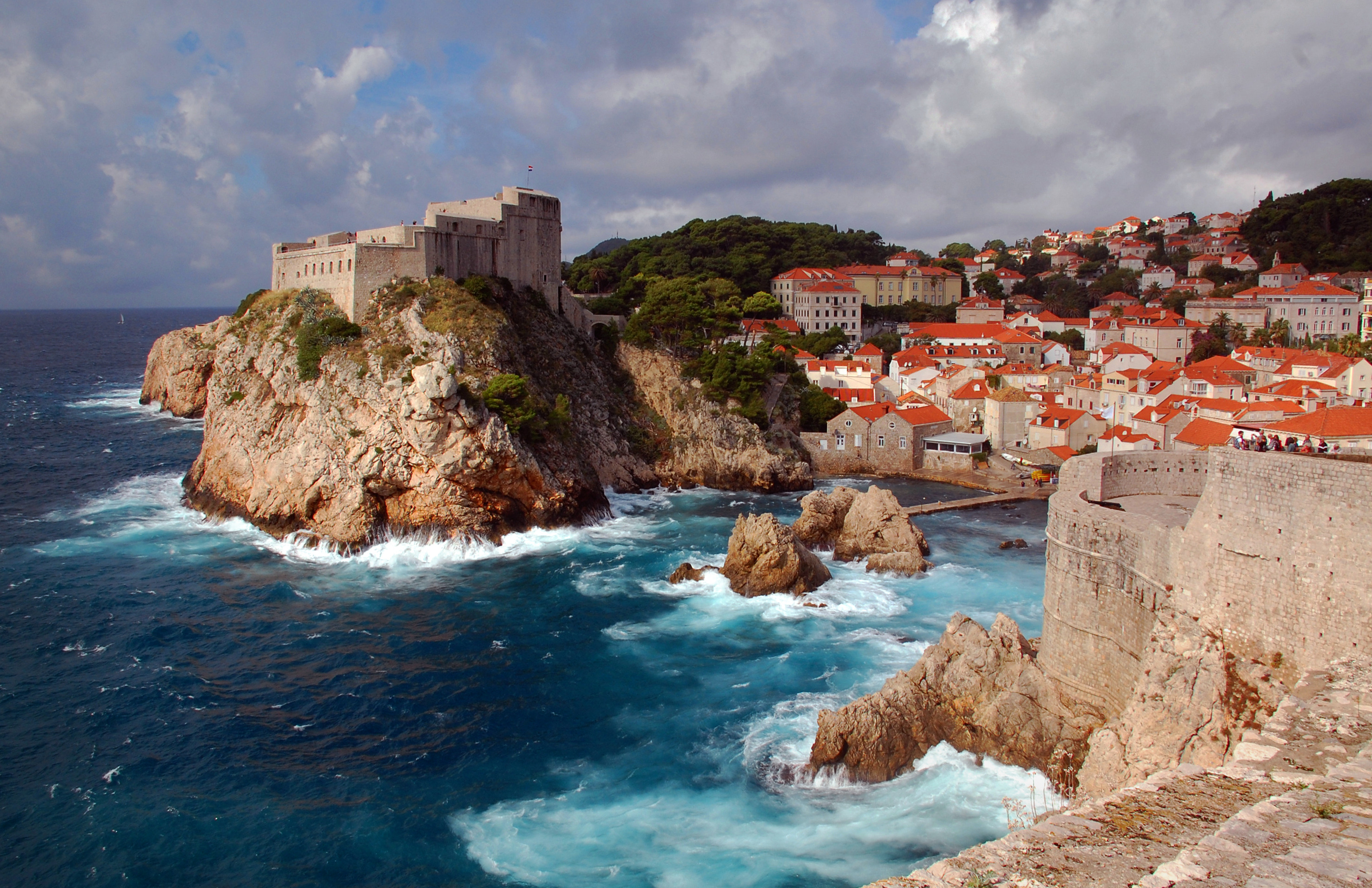
A feature of Dubrovnik is its walls which run almost 2 km around the city. The walls are 4 to(-) thick on the landward side but are much thinner on the seaward side. The system of turrets and towers was intended to protect the vulnerable city. The walls of Dubrovnik have also been a popular filming location for the fictional city of King's Landing in the HBO television series, Game of Thrones.
The walls have been visited by 1.3 million people in 2018.
Demographics
of Dubrovnik |1880 |15666 |1890 |15329 |1900 |17384 |1910 |18396 |1921 |16719 |1931 |20420 |1948 |21778 |1953 |24296 |1961 |27793 |1971 |35628 |1981 |46025 |1991 |51597 |2001 |43770 |2011 |42615 |2021 |41562

The total population of the city is 41,562 (census 2021), in the following settlements:
- Bosanka, population 139
- Brsečine, population 96
- Čajkovica, population 160
- Čajkovići, population 26
- Donje Obuljeno, population 210
- Dubravica, population 37
- Dubrovnik, population 28,434
- Gornje Obuljeno, population 124
- Gromača, population 146
- Kliševo, population 54
- Knežica, population 133
- Koločep, population 163
- Komolac, population 320
- Lopud, population 249
- Lozica, population 146
- Ljubač, population 69
- Mokošica, population 1,924
- Mravinjac, population 88
- Mrčevo, population 90
- Nova Mokošica, population 6,016
- Orašac, population 631
- Osojnik, population 301
- Petrovo Selo, population 23
- Pobrežje, population 118
- Prijevor, population 453
- Rožat, population 340
- Suđurađ, population 207
- Sustjepan, population 323
- Šipanska Luka, population 211
- Šumet, population 176
- Trsteno, population 222
- Zaton, population 985
The population was 42,615 in 2011, down from 49,728 in 1991{{cite web |archive-url=https://web.archive.org/web/20071024083306/http://www.history.com/encyclopedia.do?articleId=207947 |archive-date=2007-10-24 |access-date=2010-02-14 |url-status=dead
In the 2011 census, 90.34% of the population identified as Croat, 3.52% as Bosniak, 2.73% as Serb and 0.4% as Albanian.
Throughout history, there was a significant Italian-speaking community in Dubrovnik. According to the Austrian censuses, there were 331 residents of the central settlement that used Italian as their habitual language (4.6% of the total population) in 1890, and 409 (4.6%) in 1910. The commune as a whole had 356 (3.2%) Italian speakers in 1890, and 486 (3.4%) in 1910. In 2011, only 27 people declared themselves as Italians, corresponding to 0.06% of the total population.
Transport
Airport
Dubrovnik has its own international airport, located approximately 20 km southeast of Dubrovnik city centre, near Čilipi. Dubrovnik Airport is the third busiest airport in Croatia after Zagreb and Split. In 2024, Dubrovnik Airport achieved a record number of arrivals with nearly 3 million tourists. It's the only airport in Croatia that has direct flights with United States, more specifically with Newark Liberty International Airport in New York City, although seasonal service.
Port
Main port in Dubrovnik is located in Gruž and it serves as transport for passenger traffic and tourists. As one of Croatia's most prominent ports, it handles a significant amounts of cruise ships, ferries, private yachts and cargo ships. Dubrovnik Port is connected with others islands and tows including Split, Rijeka, Komiža, Korčula, Sobra, Pomena, Lopud and Bari in Italy. There is a city harbour in old town of Dubrovnik, which connects Dubrovnik with Lokrum island.
Buses
Dubrovnik has a public bus system which connects the airport with the Dubrovnik old main bus station in Gruž. In addition, a network of modern, local buses connects all Dubrovnik neighbourhoods running frequently from dawn to midnight including the Municipality of Župa Dubrovnik, the Municipality of Konavle, the Municipality of Dubrovnik Primorje, the Municipality of Ston and the Municipality of Orebić. However, Dubrovnik, unlike Croatia's other major centres, is not accessible by rail; until 1975 Dubrovnik was connected to Mostar and Sarajevo by a narrow-gauge railway (760 mm) built during the Austro-Hungarian rule of Bosnia. In addition to the railway transit, Dubrovnik had a train system, which was in operation from 1910 to 1970.
Cable car
Dubrovnik has a cable car service from Old town to the top of Srđ mountain. The Dubrovnik Cable Car, known as "žičara" in Croatian, was first constructed in 1969. It was the first cable car in the Adriatic region and initially transported up to 15 people at a time. However, the cable car was severely damaged during the Croatian War of Independence in 1991 and ceased operations. After years of inactivity, the cable car underwent a complete restoration and reopened in 2010, offering modern and improved facilities to visitors.
Highways and roads
The A1 highway, in use between Zagreb and Ploče, is planned to be extended all the way to Dubrovnik. Because the area around the city is disconnected from the rest of Croatian territory, the highway will either cross the Pelješac Bridge whose construction was completed in 2022, or run through Neum in Bosnia and Herzegovina and continue to Dubrovnik.
Education
Dubrovnik has a number of higher educational institutions. These include the University of Dubrovnik, the Libertas University (Dubrovnik International University), Rochester Institute of Technology Croatia (former American College of Management and Technology), a University Centre for Postgraduate Studies of the University of Zagreb, and an Institute of History of the Croatian Academy of Sciences and Arts.
Sports
The city hosted the 2025 World Men's Handball Championship at the new arena, along with the countries Denmark and Norway.
Local football club NK GOŠK Dubrovnik has been playing in the third tier of the Croatian football pyramid for years.
Local waterpolo club VK Jug is among the most successful in Croatian history, with many of its players being members of the Croatia national water polo team.
The local chapter of the HPS is HPD "Orjen", which had 96 members in 1936 under the Đuro Orlić presidency. At the time, it also had a ski section, a caving section and a photography section. Membership fell to 87 in 1937. Membership rose to 90 in 1938.
Twin towns and sister cities
Dubrovnik is twinned with:
- ITA Venice, Italy
- GER Bad Homburg vor der Höhe, Germany
- TUR Beyoğlu, Turkey
- Montenegro Cetinje, Montenegro
- Austria Graz, Austria
- SWE Helsingborg, Sweden
- CRO Imotski, Croatia
- USA Monterey, United States
- ITA Ragusa, Italy
- ITA Ravenna, Italy
- FRA Rueil-Malmaison, France
- China Sanya, China
- BIH Sarajevo, Bosnia and Herzegovina
- ITA Sorrento, Italy
- CRO Vukovar, Croatia
In popular culture

Roger Corman's 1964 war thriller The Secret Invasion is set in Dubrovnik and was filmed on location there. Although the story is fiction the fighting between Italian and German troops depicted at the end is based on fact.
The HBO series Game of Thrones used Dubrovnik as a filming location, representing the cities of King's Landing and Qarth.
Parts of Star Wars: The Last Jedi were filmed in Dubrovnik in March 2016, in which Dubrovnik was used as the setting for the casino city of Canto Bight.
Dubrovnik was one of the European sites used in the Bollywood movie Fan (2016), starring Shah Rukh Khan.
In early 2017, Robin Hood was filmed on locations in Dubrovnik.
In Kander and Ebb's song "Ring Them Bells", the protagonist, Shirley Devore, goes to Dubrovnik to look for a husband and meets her neighbor from New York.
The text-based video game Quarantine Circular is set aboard a ship off the coast of Dubrovnik, and a few references to the city are made throughout the course of the game.
The Dubrovniks were an Australian Independent rock band formed in 1987. Often regarded as a 'Supergroup' due to the band members having played in various established bands such as Hoodoo Gurus, Beasts of Bourbon, and The Scientists. The band chose their name due to two members of the band Roddy Radalj (guitar vocals) and Boris Sujdovik (bass) being born in Dubrovnik.
Gallery

.jpg)
Notable people
- Franco Sacchetti (Ragusa, 1332 – San Miniato, 1400), poet and novelist
- Benedetto Cotrugli (Ragusa, 1416 – L'Aquila, 1469), humanist and economist.
- Bonino de Boninis (Lastovo, Ragusa, 1454 – Treviso, 1528), typographist and bookseller.
- Elio Lampridio Cerva (Ragusa, 1463 – 1520), humanist, poet and lexicographer of Latin language
- Marin Držić (Ragusa, 1508 – Venice, 1567), playwright, poet and dramaturge
- Marino Ghetaldi (Ragusa, 1568 – 1626), mathematician
- Aaron ben David Cohen (Ragusa, ~1580 - 1656), rabbi
- Giorgio Raguseo (Ragusa, 1580 – 1622), philosopher, theologian, and orator
- Rajmund Zamanja (Ragusa, 1587 – 1647), theologist, philosopher and linguist.
- Ivan Gundulić (Ragusa, 1589 – 1638), writer and poet
- Anselmo Banduri (Ragusa, 1671 – Paris, 1743), numismatist and antiquarian
- Ruđer Josip Bošković (Dubrovnik, 1711 – Milan, 1787) physicist, astronomer, mathematician, philosopher, diplomat, poet, theologian
- Mato Vodopić (Dubrovnik, 1816), bishop of Dubrovnik
- Matija Ban (Dubrovnik, 1818), poet, dramatist, and playwright
- Medo Pucić (Dubrovnik, 1821), writer and politician
- Konstantin Vojnović (Dubrovnik, 1832), politician, university professor and rector in the Kingdom of Dalmatia and Kingdom of Croatia-Slavonia of the Habsburg monarchy
- Nicola Primorac (Dubrovnik, 1840), tobacconist, who together with a sailor and a ship's steward sailed the tiny yawl City of Ragusa twice across the Atlantic in 1870 and 1871
- Ivo Vojnović (Dubrovnik, 1857), writer
- Milan Rešetar (Dubrovnik, 1860), philologist
- Trpimir Macan (Dubrovnik, 1935), historian and lexicographer
- Tereza Kesovija (Dubrovnik, 1938), pop-classical-chanson singer
- Dubravka Tomšič Srebotnjak (Dubrovnik, 1940), pianist
- Milo Hrnić (Dubrovnik, 1950 - 2023), pop singer
- Andro Knego (Dubrovnik, 1956), basketball player, Olympic and World champion
- Banu Alkan (Dubrovnik, 1958), female actor
- Dragan Andrić (Dubrovnik, 1962), water polo player, two-time Olympic champion
- Mario Kopić (Dubrovnik, 1965), philosopher
- Nikola Prkačin (Dubrovnik, 1975), basketball player
- Vlado Georgiev (Dubrovnik, 1976), pop singer, composer, and songwriter
- Frano Vićan (Dubrovnik, 1976), water polo player, Olympic, World and European champion
- Emir Spahić (Dubrovnik, 1980), football player
- Miho Bošković (Dubrovnik, 1983), water polo player, Olympic, World and European champion
- Nikša Dobud (Dubrovnik, 1985), water polo player, Olympic and World champion
- Lukša Andrić (Dubrovnik, 1985), basketball player
- Hrvoje Perić (Dubrovnik, 1985), basketball player
- Andro Bušlje (Dubrovnik, 1986), water polo player, Olympic, World and European champion
- Paulo Obradović (Dubrovnik, 1986), water polo player, Olympic and World champion
- Maro Joković (Dubrovnik, 1987), water polo player, Olympic, World and European champion
- Ante Tomić (Dubrovnik, 1987), basketball player
- Andrija Prlainović (Dubrovnik, 1987), water polo player, Olympic, World and European champion
- Sandro Sukno (Dubrovnik, 1990), water polo player, Olympic and World champion
- Elvis Sarić (Dubrovnik, 1990), football player
- Danijal Brković (Dubrovnik, 1991), football player
- Petra Dičak (Dubrovnik, 1995), beach handball player
- Mario Hezonja (Dubrovnik, 1995), basketball player
- Alen Halilović (Dubrovnik, 1996), football player
- Ana Konjuh (Dubrovnik, 1997), tennis player
Acknowledgements
Dubrovnik was included in the Travel + Leisure 25 Most Beautiful Cities in the World list, ranked 18th.
Honorary citizens
Named by Dubrovnik City Council:
- Kathy Wilkes (1991-1992)
- Ivan Supek (1997)
- Pope John Paul II (2003)
- Christopher Patten (2004)
- Stjepan Mesić (2009)
- Ante Gotovina (2012)
- Francesco Cossiga (2023)
Notes
References
Bibliography
References
- Ward, Terry. (2022-12-15). "12 Dreamy End-of-Year Escapes to Start Planning Now". Marriott International.
- {{Cite Q. Q119585703
- {{Croatian Census 2021. S
- [https://hjp.znanje.hr/index.php?show=search_by_id&id=fF9vXRA%3D&keyword=Dubrov%C4%8Danin Dubrovčanin] Hrvatski jezični portal
- "Dùbrōvnīk". Hrvatski jezični portal.
- {{cite EPD. 18. Dubrovnik
- (9 October 2022). "Cultural diversity: Census Information on country of birth, year of arrival, ancestry, language and religion". Australian Bureau of Statistics.
- "Old City of Dubrovnik". United Nations Educational, Scientific, and Cultural Organization.
- Baždar-Paušek, Snježana. (2020). "Dubrovački prirodoslovci u vrhu povijesti znanosti (od 15. do 19. stoljeća)". Ogranak Matice hrvatske u Dubrovniku.
- (2002). "100 Most Beautiful Cities of the World". Rebo International b.v..
- (1890). "Handbook to the Mediterranean - Its Cities, Coasts and Islands". J. Murray.
- (10 December 2014). "Institutions Always 'Mattered': Explaining Prosperity in Mediaeval Ragusa (Dubrovnik)". Palgrave Macmillan.
- (2017). "Bosna". [[Miroslav Krleža Institute of Lexicography]] and House of Marin Držić.
- Putanec, Valentin. (June 1993). "Naziv Labusedum iz 11. st. za grad Dubrovnik". [[Institute of Croatian Language and Linguistics]].
- Bartoli M. G. Il Dalmatico: Resti di un'antica lingua romanza parlata da Veglia a Ragusa e sua collocazione nella Romània appennino-balcanica / A cura di Aldo Duro. Rome: Instituto della Enciclopedia Italiana, 2000. pp. 1—350. (Biblioteca dell'Enciclopedia: lingua e letteratura). {{isbn. 978-6-00-000371-5.
- Mansaku, Seit (1982). Studime Filologjike. Tirana: Qendra e Studimeve Albanologjike. fq. 110
- "Brill's New Pauly Encyclopedia".
- Vinko Foretić. (1980). "Povijest Dubrovnika do 1808, Knjiga Prva". Delo.
- [http://www.unidu.hr/datoteke/172izb/ZBORNIK.pdf ZBORNIK.indd] {{Webarchive. link. (2016-04-01 (2009) {{page needed). (February 2017)
- Nodari, Maja. (January 2017). "Povijesni pregled razvoja područja DNŽ".
- (December 22, 2000). "Arheološki nalazi unutar perimetra povijesne jezgre grada Dubrovnika". Opvscvla Archaeologica.
- Piers Letcher, Robin McKelvie, Jenny McKelvie (2007), ''Dubrovnik, 2nd: The Bradt City Guide'', p. 7, Bradt Travel Guides. {{ISBN. 978-1-84162-191-3
- ''Dubrovnik'', page 25, Volume 581 of Variorum collected studies series, Bariša Krekić, [[Variorum]], 1997. {{ISBN. 978-0-86078-631-3
- Pitcher, Donald Edgar. ''An Historical Geography of the Ottoman Empire'', Leiden: Brill, 1968, p. 70
- [http://www.promacedonia.org/en/nm/kosovo.html Origins: Serbs, Albanians and Vlachs Chapter 2 in Noel Malcolm's Kosovo, a short history (Macmilan, London, 1998, p. 22-40)]
- (2017-01-20). "The Indo-European Languages". Taylor & Francis.
- The Cambridge World History of Slavery: Volume 2, AD 500–AD 1420. (2021). (n.p.): Cambridge University Press. p. 117-120
- (July 1999). "The Croatian Adriatic Tourist Guide". Naprijed, Naklada.
- croatiaweek. (2018-05-27). "The Croats of Goa, India".
- Bačan, Danijel. (2023-06-23). "Was Dubrovnik a Colonial Power?".
- "CROATIANS IN SOUTH AFRICA AND AT GOA IN INDIA, 1508".
- (1997). "An economic and social history of the Ottoman Empire". Cambridge University Press.
- Husebye, Eystein Sverre. [https://books.google.com/books?id=vwK4jhvjHQkC&dq=dubrovnik+earthquake+of+1667&pg=PA86 ''Earthquake Monitoring and Seismic Hazard Mitigation in Balkan Countries'']
- [[Wayne S. Vucinich]] (ed.), ''Dubrovnik and the American Revolution: Francesco Favi's Letters,'' Ragusan Press, 1977.
- Ćosić, Stjepan. (2000). "Dubrovnik Under French Rule (1810–1814)". [[Dubrovnik Annals]].
- J. Fine. (2010-02-05). "When Ethnicity Didn't Matter". University of Michigan Press.
- Villari, Luigi. (1904). "The Republic of Ragusa: an episode of the Turkish conquest". J. M. Dent & Co..
- Marzio, Scaglioni. (1996). "La presenza italiana in Dalmazia, 1866–1943". Facoltà di Scienze politiche – Università degli studi di Milano.
- 978-0-8155-5047-1
- [https://books.google.com/books?id=iLkWAQAAMAAJ ''Zeitschrift für Balkanologie''.] R. Trofenik. 1990. p. 102.
- "A Short History of the Railways in Dalmatia". Helena Bunijevac (Railway Museum, Zagreb).
- Chester, Keith. (2006). "Narrow Gauge Railways of Bosnia-Hercegovina, The". Stenvalls.
- "Tramway in Dubrovnik". [[Croatian Post]].
- "Dvije pobjede don Ive Prodana na izborima za Carevinsko vijeće u Beču".
- Franić, Augustin. "Otpor Hrvatske Mladeži U Dubrovniku 1944–1947".
- E. White and J. Reinisch. (2011). "The Disentanglement of Populations: Migration, Expulsion and Displacement in Postwar Europe, 1944–49". Palgrave Macmillan UK.
- "A Short overview of the history of Dubrovnik".
- "Festival in Focus: Dubrovnik Summer Festival".
- (2015). "The Informal Housing of Privatnici and the Question of Class Two Stories From The Post-Yugoslav Roadside". Revue d'études comparatives Est-Ouest.
- Srđa Pavlović. "Reckoning: The 1991 Siege of Dubrovnik and the Consequences of the 'War for Peace'". [[York University]].
- Pearson, Joseph. (2010). "Dubrovnik's Artistic Patrimony, and its Role in War Reporting (1991)". European History Quarterly.
- (2004). "Chronology for Serbs in Croatia". United Nations High Commissioner for Refugees.
- Bonner, Raymond. (August 17, 1995). "Dubrovnik Finds Hint of Deja Vu in Serbian Artillery". The New York Times.
- "Pregled obnovljenih objekata". Institute for the Restoration of Dubrovnik.
- "Case information sheet: 'Dubrovnik' (IT-01-42) Pavle Strugar". [[International Criminal Tribunal for the former Yugoslavia]].
- Andrew Glass. (2 April 2017). "Ron Brown dies in plane crash, April 3, 1996".
- Thomas, Mark. (17 October 2023). "Dubrovnik Joins European Network of Saint James Way Paths with Camino Dubrovnik-Međugorje Project". The Dubrovnik Times.
- [https://www.koppen-map.com/ Köppen climate classification]
- DHMZ. (2022-07-19). "Najviše izmjerene temperature zraka u Hrvatskoj za razdoblje od kada postoje mjerenja".
- DHMZ. (2022-01-21). "Najniže izmjerene temperature zraka u Hrvatskoj za razdoblje od kada postoje mjerenja".
- "Dubrovnik, Croatia – Monthly weather forecast and Climate data". Weather Atlas.
- (21 October 2007). "DUBROVNIK news".
- (31 January 2015). "50 kuna". [[Croatian National Bank]].
- "Monuments (1 to 5)". Dubrovnik Online.
- "TZ Seget – Dubrovnik". tz-seget.hr.
- Karen Tormé Olson. (2006). "Frommer's Croatia". [[John Wiley & Sons]].
- (15 June 2018). "Has Dubrovnik solved the problem of overcrowding from cruise ships?".
- (6 June 2023). "No more wheel suitcases in Dubrovnik - Newsendip".
- Oliver, Jeanne. "Dubrovnik Sights". Croatia Traveller.
- "Sponza Palace". DubrovnikCity.com.
- "The Rector's Palace". DubrovnikCity.com.
- "The Rector's Palace". Dubrovnik Guide.
- "Franciscan monastery". Dubrovnik Guide.
- "Franciscan Friary, Dubrovnik". Sacred Destinations.
- "Church of St. Blaise, Dubrovnik". Sacred Destinations.
- "Monuments (16 to 20)". Dubrovnik Online.
- "Dominican Friary, Dubrovnik". Sacred Destinations.
- Oliver, Jeanne. "Dominican Monastery". Croatia Traveller.
- "Monuments (21 To 22)". Dubrovnik Online.
- Oliver, Jeanne. "Dubrovnik's Walls". Croatia Traveller.
- {{Croatian Census 2011. S. 19. 0981
- {{Croatian Census 2011. E. 19
- Seton-Watson, Christopher. (1967). "Italy from Liberalism to Fascism, 1870–1925". Methuen & Co.
- Perselli, Guerrino. (1993). "I Censimenti della popolazione dell'Istria, con Fiume e Trieste, e di alcune città della Dalmazia tra il 1850 e il 1936 - CRS".
- (22 August 2016). "Dubrovnik Airport: providing essential tourism support for a region. Croatia Airlines' 3rd base". centreforaviation.com.
- "Letovi za New York krenuli tri tjedna ranije".
- "Dubrovnik Cruise Port".
- "Dubrovnik to Sarajevo 1965". Charlie Lewis.
- "Dubrovnik to Capljina in 1972". Jim Horsford.
- "Trams in Dubrovnik".
- "Dubrovnik cable car".
- (23 August 2018). "The examination of the seabed started". [[China Road and Bridge Corporation]].
- Plaček, Josip. (1936). ""Orjen" — Dubrovnik".
- Plaček, Josip. (1937). "Izvještaj tajnika".
- Plaček, Josip. (1938). "Izvještaj tajnika".
- "Gradovi prijatelji". Dubrovnik.
- (10 September 2012). "The Secret Invasion".
- Shelah, Menachem. (1991). "The Occupation of Dubrovnik by Waffen SS Division 'Prinz Eugen' on 12 September 1943". Mediterranean Historical Review.
- [http://www.jaywaytravel.com/blog/2012/dubrovnik-game-of-thrones/ Dubrovnik in the spotlight] {{Webarchive. link. (2013-03-11 , jaywaytravel.com.)
- (8 March 2016). "[VIDEO] Star Wars Episode VIII Starts Shooting in Dubrovnik this Week". Croatia Week.
- Milekic, Sven. (15 February 2016). "Star Wars Adds Shine to Croatian 'Pearl' Dubrovnik". Balkan Insight.
- Tsering, Lisa. (April 18, 2016). "'Fan': Film Review".
- (29 December 2016). "Take a look around the set of the new Robin Hood movie being filmed in Dubrovnik". [[Nottingham Post]].
- "Ring Them Bells Lyrics".
- Yin-Poole, Wesley. (2018-05-22). "Mike Bithell follows up Subsurface Circular with Quarantine Circular". [[Eurogamer]].
- McFarlane, Ian. (1999). "Whammo Homepage". [[Allen & Unwin]].
- (19 June 2024). "Danijal Brkovic Selected NISA Nation Player of the Week".
- Bauso, Anne Olivia: [https://www.travelandleisure.com/most-beautiful-cities-in-the-world-6931288 25 Most Beautiful Cities in the World] ''travelandleisure.com''. Travel and Leisure. Published January 8, 2023. Access date April 5, 2023.
- [https://www.dubrovnik.hr/gradska-uprava/gradsko-vijece/dobitnici-nagrade-grada-dubrovnika Dobitnici Nagrade Grada Dubrovnika] ''dubrovnik.hr''. City of Dubrovnik official website. Access date April 6, 2023.
- Marijanović Ladašić, Dubravka: [https://dubrovacki.slobodnadalmacija.hr/dubrovnik/vijesti/hrvatska-i-svijet/nadbiskup-zelimir-puljic-i-ratni-gradonacelnik-poljanic-o-francescu-cossigi-bio-je-zaljubljen-u-nas-grad-zvao-je-beograd-pitao-kako-su-mogli-bombardirati-hrvatsku-veneciju-i-poslao-nam-brodom-hranu-i-vodu-1260566 Nadbiskup Želimir Puljić i ratni gradonačelnik Poljanić o Francescu Cossigi: ‘Bio je zaljubljen u naš grad. Zvao je Beograd, pitao ‘kako su mogli bombardirati hrvatsku Veneciju i poslao nam brodom hranu i vodu‘] ''dubrovacki.slobodnadalmacija.hr''. Dubrovački vjesnik. Published 30 January 2023. Access date 30 June 2023.
This article was imported from Wikipedia and is available under the Creative Commons Attribution-ShareAlike 4.0 License. Content has been adapted to SurfDoc format. Original contributors can be found on the article history page.
Ask Mako anything about Dubrovnik — get instant answers, deeper analysis, and related topics.
Research with MakoFree with your Surf account
Create a free account to save articles, ask Mako questions, and organize your research.
Sign up freeThis content may have been generated or modified by AI. CloudSurf Software LLC is not responsible for the accuracy, completeness, or reliability of AI-generated content. Always verify important information from primary sources.
Report