From Surf Wiki (app.surf) — the open knowledge base
Dublin Corporation
Former name of the local authority for the city of Dublin, Ireland (c. 1192–2002)

Former name of the local authority for the city of Dublin, Ireland (c. 1192–2002)
| Field | Value |
|---|---|
| name | Dublin Corporation |
| (formally: The Lord Mayor, Aldermen and Burgesses of the City of Dublin) | |
| native_name | () |
| coa_pic | Coat of Arms of Dublin, Ireland.png |
| coa_caption | Coat of arms of Dublin City: Motto: Obedientia Civium Urbis Felicitas ("The Obedience of the citizens produces a happy city") |
| coa_res | 200px |
| house_type | Local authority |
| established | , reformed 1660–1661 |
| disbanded | (renamed) 1 January 2002 |
| leader1_type | Lord Mayor |
| members | 52 Councillors |
| 24 Aldermen (1661–1840) | |
| houses | Board of Aldermen (1661–1840) |
| Common Council (up to 24 Sheriffs Peers and 96 Commons) (1661–1840) | |
| City Council (52 Councillors) (1840–2001) | |
| meeting_place | The Tholsel (prior to 1791) |
| City Assembly House (1791–1852) | |
| City Hall (1852 onwards) |
(formally: The Lord Mayor, Aldermen and Burgesses of the City of Dublin) 24 Aldermen (1661–1840) Common Council (up to 24 Sheriffs Peers and 96 Commons) (1661–1840) City Council (52 Councillors) (1840–2001) City Assembly House (1791–1852) City Hall (1852 onwards) Dublin Corporation (), known by generations of Dubliners simply as The Corpo, is the former name of the city government and its administrative organisation in Dublin since the 1100s. Significantly re-structured in 1660–1661, even more significantly in 1840, it was modernised on 1 January 2002, as part of a general reform of local government in Ireland, and since then is known as Dublin City Council. This article deals with the history of municipal government in Dublin up to 31 December 2001.
The long form of its name was The Lord Mayor, Aldermen and Burgesses of the City of Dublin.
History
Dublin Corporation was established under the Anglo-Normans in the reign of Henry II of England in the 12th century.
Two-chamber corporation

For centuries it was a two-chamber body, made up of an upper house of 24 aldermen, who elected the Lord Mayor of Dublin from their number, and a lower house, known as the "sheriffs and commons", consisting of up to 48 sheriffs peers (former sheriffs of Dublin city) and 96 representatives of the Guilds of the City of Dublin with 31 of those seats controlled by the Merchants' Guild.
The business of the corporation was transacted at The Tholsel at four quarterly assemblies (Christmas, Easter, Midsummer and Michaelmas) while extraordinary assemblies were held at post assemblies.
19th-century reform
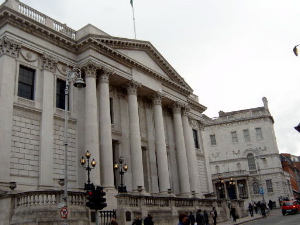
The modern Dublin Corporation was restructured by late 19th-century and 20th-century legislation, particularly, the Municipal Corporations (Ireland) Act 1840, with the elected body reduced to a single chamber Dublin City Council, presided over by the Lord Mayor of Dublin, an office first instituted but not filled by King Charles I and reconstituted following the Restoration of the Crown by King Charles II.
Queen Victoria refused to visit Ireland for a number of years, partly in protest at Dublin Corporation's decision not to congratulate her son, Prince Albert Edward, The Prince of Wales, on both his marriage to Princess Alexandra of Denmark and on the birth of the royal couple's oldest son, Prince Albert Victor.
21st-century change of name
On 1 January 2002, following a major reform of local government which also abolished the 300-year-old title of alderman in the Republic of Ireland and the 700-year-old title of 'town clerk' in Dublin, the name of Dublin Corporation was changed to Dublin City Council, which previously had been used simply to refer to the assembly of elected councillors. The body had full corporate continuity but there were some boundary and other changes.
References
- Report of the Commission on Municipal Corporations in Ireland (1835) Appendix on Dublin: pp.1–116 and pp.117–311
Sources
References
- link. (2016-04-15 , Sean Murphy, ''Dublin Historical Record'', Vol. 38, No. 1 (Dec., 1984), pp. 22–35)
- "Victoria {{!}} Family Tree, Children, Successor, & Facts {{!}} Britannica".
- Dublin, Local Government Act 2001: A local authority shall . . . continue to be a body corporate with perpetual succession and power to sue and be sued in its corporate name and to acquire, hold, manage, maintain and dispose of land or any interest in land / Notwithstanding the repeal of enactments relating to its establishment and constitution, a county council or county borough corporation in being immediately before the establishment day, continues in being but subject to the provisions of this Act applying and having effect. / notwithstanding any change brought about by this Act in the corporate name of any such body or in its corporate status or constitution and the functions vested by any enactment in such body shall, subject to the provisions of this Act, continue to stand so vested / A reference in any other enactment or other document to a local authority (being a local authority which continues to stand established) by its name applying before it was changed under this Act shall be read as a reference to that body as renamed.
This article was imported from Wikipedia and is available under the Creative Commons Attribution-ShareAlike 4.0 License. Content has been adapted to SurfDoc format. Original contributors can be found on the article history page.
Ask Mako anything about Dublin Corporation — get instant answers, deeper analysis, and related topics.
Research with MakoFree with your Surf account
Create a free account to save articles, ask Mako questions, and organize your research.
Sign up freeThis content may have been generated or modified by AI. CloudSurf Software LLC is not responsible for the accuracy, completeness, or reliability of AI-generated content. Always verify important information from primary sources.
Report