From Surf Wiki (app.surf) — the open knowledge base
Duality (order theory)
Term in the mathematical area of order theory
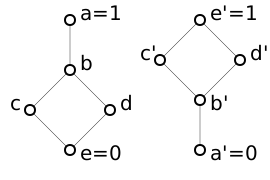
Term in the mathematical area of order theory
In the mathematical area of order theory, every partially ordered set P gives rise to a dual (or opposite) partially ordered set which is often denoted by Pop or P**d. This dual order Pop is defined to be the same set, but with the inverse order, i.e. x ≤ y holds in Pop if and only if y ≤ x holds in P. It is easy to see that this construction, which can be depicted by flipping the Hasse diagram for P upside down, will indeed yield a partially ordered set. In a broader sense, two partially ordered sets are also said to be duals if they are dually isomorphic, i.e. if one poset is order isomorphic to the dual of the other.
The importance of this simple definition stems from the fact that every definition and theorem of order theory can readily be transferred to the dual order. Formally, this is captured by the Duality Principle for ordered sets:
: If a given statement is valid for all partially ordered sets, then its dual statement, obtained by inverting the direction of all order relations and by dualizing all order theoretic definitions involved, is also valid for all partially ordered sets.
If a statement or definition is equivalent to its dual then it is said to be self-dual. Note that the consideration of dual orders is so fundamental that it often occurs implicitly when writing ≥ for the dual order of ≤ without giving any prior definition of this "new" symbol.
Examples
Naturally, there are a great number of examples for concepts that are dual:
- Greatest elements and least elements
- Maximal elements and minimal elements
- Least upper bounds (suprema, ∨) and greatest lower bounds (infima, ∧)
- Upper sets and lower sets
- Ideals and filters
- Closure operators and kernel operators.
Examples of notions which are self-dual include:
- Being a (complete) lattice
- Monotonicity of functions
- Distributivity of lattices, i.e. the lattices for which ∀x,y,z: x ∧ (y ∨ z) = (x ∧ y) ∨ (x ∧ z) holds are exactly those for which the dual statement ∀x,y,z: x ∨ (y ∧ z) = (x ∨ y) ∧ (x ∨ z) holds
- Being a Boolean algebra
- Being an order isomorphism.
Since partial orders are antisymmetric, the only ones that are self-dual are the equivalence relations (but the notion of partial order is self-dual).
References
References
- The quantifiers are essential: for individual elements ''x'', ''y'', ''z'', e.g. the first equation may be violated, but the second may hold; see the [[modular lattice. N5 lattice]] for an example.
This article was imported from Wikipedia and is available under the Creative Commons Attribution-ShareAlike 4.0 License. Content has been adapted to SurfDoc format. Original contributors can be found on the article history page.
Ask Mako anything about Duality (order theory) — get instant answers, deeper analysis, and related topics.
Research with MakoFree with your Surf account
Create a free account to save articles, ask Mako questions, and organize your research.
Sign up freeThis content may have been generated or modified by AI. CloudSurf Software LLC is not responsible for the accuracy, completeness, or reliability of AI-generated content. Always verify important information from primary sources.
Report