From Surf Wiki (app.surf) — the open knowledge base
Dual-purpose gun
Class of naval artillery for engaging both air and surface targets
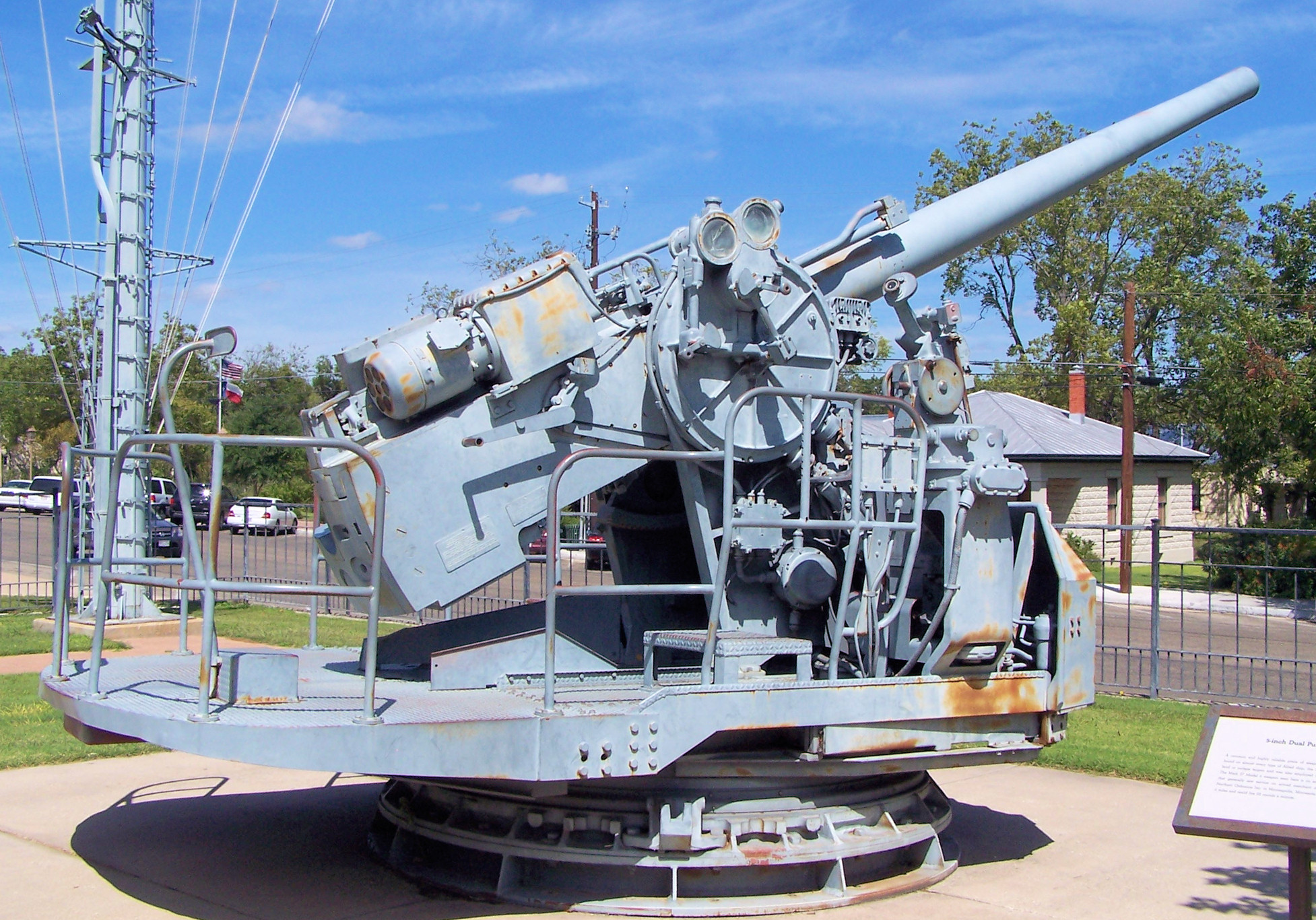
Class of naval artillery for engaging both air and surface targets
A dual-purpose gun is a naval artillery mounting designed to engage both surface and air targets.
Description
Second World War-era capital ships had four classes of artillery: the heavy main battery, intended to engage opposing battleships and cruisers of 305 mm to 457 mm (12 inch to 18 inch); a secondary battery for use against enemy destroyers of 152 mm to 203 mm (6 inch to 8 inch); heavy anti-aircraft guns of 76 mm to 127 mm (3 inch to 5 inch), which could create barrages to knock out airplanes at a distance; finally, light rapid-fire anti-aircraft batteries (A/A) to track and bring down aircraft at close range. The light A/A was dispersed throughout the ship and included both automatic cannons of 20 mm to 40 mm (.787 inch to 1.57 inch) and heavy machine guns of 12.7 mm to 14.5 mm (.50 inch to .58 inch).
During World War II, the US Navy, Royal Navy, the French Navy, and the Imperial Japanese Navy combined the secondary battery with the heavy anti-aircraft guns, creating a dual-purpose secondary battery. They discarded the dedicated, anti-ship secondary batteries altogether, because a battle-line fleet would be screened against cruisers and destroyers most of the time. Also, it was deemed unlikely that a battleship would be simultaneously facing both rushing destroyers and aircraft, and it would take up too much space to have separate types of guns to deal with both threats. Rather, they replaced them with turret-mounted dual-purpose guns that could be used against both aircraft and ships. The space saved from combining the two types of guns added to simplification of supply, increased deck armour coverage, stowage of other equipment, a larger light anti-aircraft battery, and other needs. This arrangement was seen as more efficient, and was deemed adequate to meet anti-surface and anti-aircraft needs under most circumstances.
The Kriegsmarine, in a practice similar to the Italian and Soviet navies, adopted a mixed-calibre secondary battery, with dedicated anti-ship guns, coupled with smaller-calibre heavy anti-aircraft batteries, instead of adopting dual-purpose secondaries like the British or Americans. Both navies were concerned by possible close-range torpedo attacks from enemy (in particular, French) destroyers and torpedo boats, and considered the more powerful, larger calibre anti-ship secondaries a must. The French Navy used a mixed-calibre system, as well, but their secondary battery was dual-purpose. This tended to complicate ammunition supplies and render certain armament useless in some situations.
Dual-purpose guns are designed as a compromise between the heavy main armament of a surface combatant and dedicated anti-aircraft guns. Usually of a mid-range caliber, the gun is heavy enough to prove useful against surface targets including ships, surfaced submarines, and land targets. However, it is compact enough to fit into a mounting capable of good traverse and high elevation, as well as being capable of a high rate of fire, allowing it to successfully engage air targets at all angles. For example, a Royal Navy battleship of the King George V class had sixteen QF Mark I 5.25 in guns that could engage either enemy ships or high level aircraft, as necessary.
Not all dual-purpose guns have high elevation. The determining factor was whether or not the mounting was provided with an anti-aircraft fire control system and a method for setting the time fuze in the A.A. warhead, fired by the gun. Starting with the Tribal class, the Royal Navy introduced a series of destroyer classes that had dual-purpose guns, but in 4.7 inch QF Mark XII, twin CP Mk. XIX and later mountings limited to 40, 50 or 55 degrees elevation, however, the guns were controlled by an A.A. fire control system and the mountings were provided with A.A. shell fuze setters. The USN had developed a similar class of destroyer, the Porter class with eight Mk 12 5-inch/38-caliber (127 mm) guns in four Mark 22 Single Purpose (surface action only) twin mounts, limited to 35 degrees elevation, but with no provision for A.A. fire control and no on-mount fuze setters. The 40-degree elevation did limit the ability of the Tribal class guns to engage dive and high altitude bombers but they were still effective in engaging low altitude, level, and torpedo bombers and could still provide barrage fire over other ships being attacked by dive bombers. Admiral Sir Philip Vian describes the use of 4.7 inch Mark XII guns against aircraft during the 1940 campaign in Norway:"It became clear at once that in an attack from the air in narrow waters flanked by mountains, the cards were held by the aircraft. There was too little sea-room for full freedom of manoeuvre, and the aircraft's approach was screened by the rock walls. As often as not, when they did come into view it was at such an angle that our 4.7-inch guns, whose maximum elevation was only forty degrees, could not reach them...Aandalsnes is approached through the Romsdal Fiord, and lies forty miles from the entrance, off which we arrived on the 24th April. The daylight passage of the convoy and escort through this waterway, speed five knots, on a steady course and with mountains rising steeply either side, presented an alluring invitation to enemy aircraft. Junkers attacks persisted to the end, but the fire of the destroyers, although limited to an elevation of forty degrees, was enough to keep the enemy just too high for their standard of marksmanship. Not a ship received a direct hit, though some were damaged by the splinters from near misses."**
Dual-purpose guns, often abbreviated to DP guns, were originally designed as a secondary armament for large surface ships such as cruisers and battleships to complement their heavy main armaments. Later, such guns began to be added to smaller vessels as their primary gun armament, and with the progression of ship design away from heavy-caliber guns, today nearly all main gun armaments are of dual-purpose nature.
Most modern dual-purpose guns are in the 76 mm to 127 mm (3-inch to 5-inch) medium-caliber range.
In British service the term HA/LA for "High Angle/Low Angle" was used.
List of dual-purpose guns
| Calibre | Weapon name | Country of origin | Period |
|---|---|---|---|
| 40 mm | Bofors 40 mm L/60 gun | 1930s–present | |
| 40 mm | Bofors 40 mm Automatic Gun L/70 | 1940s–present | |
| 57 mm | Finspång 57 mm QF naval gun L/55 model 1889 | Sweden Sweden-Norway | 1890s–present |
| 57 mm | Bofors 57 mm naval gun L/21 model 1916 | 1910s–Cold War | |
| 57 mm | Bofors 57 mm Naval Automatic Gun L/60 | 1952–1990 | |
| 57 mm | Bofors 57 mm Naval Automatic Gun L/70 | 1970–present | |
| 76.2 mm | 76 mm/62 Allargato | 1962–present | |
| 76.2 mm | OTO Melara 76 mm | 1964–present | |
| 76.2 mm | AK-176 | 1976–present | |
| 100 mm | 10 cm/65 Type 98 naval gun | World War II | |
| 100 mm | Type 79 100 mm naval gun | 1973–present | |
| 100 mm | 100 mm naval gun | 1961–present | |
| 100 mm | AK-100 naval gun | 1978–present | |
| 4 in | QF 4 inch Mk V naval gun | 1914–1940s | |
| 4 in | QF 4 inch Mk XVI naval gun | 1936–1950s | |
| 4 in | QF 4 inch Mk XIX naval gun | World War II | |
| 4.45 in | QF 4.5-inch Mk I – V naval gun | 1938–Cold War | |
| 4.45 in | 4.5-inch Mk 8 naval gun | 1972–present | |
| 120 mm | Bofors 120 mm Naval Automatic Gun L/50 | 1952–1985 | |
| 4.7 in | QF 4.7-inch Mk IX & XII | 1928–1970 | |
| 4.7 in | QF 4.7 inch Mark XI gun | 1941–1970 | |
| 127 mm | Otobreda 127mm/54 compact gun | Cold War–present | |
| 127 mm | Otobreda 127mm/64 gun | 2012–present | |
| 127 mm | 12.7 cm/50 Type 3 naval gun | 1928–1966 | |
| 127 mm | 12.7 cm/40 Type 89 naval gun | 1932-1945 | |
| 5 in | 5"/38-caliber gun | 1934–1990s | |
| 5 in | 5"/54-caliber Mk 16 gun | 1945–1993 | |
| 5 in | 5"/54-caliber Mark 42 gun | 1953–present | |
| 5 in | 5"/54-caliber Mk 45 gun | 1971–present | |
| 5 in | 5"/62-caliber Mk 45 gun | 2000–present | |
| 130 mm | Type H/PJ38 130 mm naval gun | 2014–present | |
| 130 mm | Canon de 130 mm Modèle 1932 et 1935 | 1935-1942 | |
| 5.25 in | QF 5.25-inch Mk 1 gun | 1940–1966 | |
| 135 mm | 135mm/45 gun | 1940–1972 | |
| 138.6 mm | Canon de 138 mm Modèle 1929 | 1934–1954 | |
| 6 in | 6"/47-caliber Mk 16 gun | 1937–1992 |
Notes
References
- "5"/38 (12.7 cm) Mark 12".
- Hodges, ''Tribal Class Destroyers'', Almark Publishing Co. Ltd, 1971, {{ISBN. 0-85524-047-4, p.32: Diagram of High Level Bomber Attack: A 240mph target, at 12 thousand feet altitude could expect to be under for fire about 75 seconds, from the time it enters the effective range of the [[HACS]] until it flies to within the minimum range of a 5.25 gun elevated to 70 degrees. A Tribal class destroyer would be able to engage the same target for about 37 seconds.
- Vian, Philip, ''Action This Day'', London, 1960, p.40 and 44.
This article was imported from Wikipedia and is available under the Creative Commons Attribution-ShareAlike 4.0 License. Content has been adapted to SurfDoc format. Original contributors can be found on the article history page.
Ask Mako anything about Dual-purpose gun — get instant answers, deeper analysis, and related topics.
Research with MakoFree with your Surf account
Create a free account to save articles, ask Mako questions, and organize your research.
Sign up freeThis content may have been generated or modified by AI. CloudSurf Software LLC is not responsible for the accuracy, completeness, or reliability of AI-generated content. Always verify important information from primary sources.
Report