From Surf Wiki (app.surf) — the open knowledge base
Dry thunderstorm
Thunderstorm where little to no precipitation reaches the ground

Thunderstorm where little to no precipitation reaches the ground
A dry thunderstorm is a thunderstorm that produces thunder and lightning, but where all or most of its precipitation evaporates before reaching the ground. Dry lightning is lightning occurring in this situation. Both are so common in the American West that the terms for them are sometimes used interchangeably.
Dry thunderstorms occur essentially in dry conditions, and their lightning is a major cause of wildfires. Because of that, the United States National Weather Service, and other agencies around the world, issue forecasts for its likelihood over large areas.
Occurrence
Dry thunderstorms generally occur in deserts or places where the lower layers of the atmosphere usually contain little water vapor. Any precipitation that falls from elevated thunderstorms can be entirely evaporated as it falls through the lower dry layers. They are common during the summer months across much of western North America and other arid areas. The shaft of precipitation that can be seen falling from a cloud without reaching the ground is called "virga".
A thunderstorm does not have to be completely dry to be considered dry; in many areas 0.1 in is the threshold between a "wet" and "dry" thunderstorm.
Hazards
Dry thunderstorms are notable for two reasons: they are the most common natural origin of wildland fires, and they can produce strong gusty surface winds that can fan flames.
Dust storms
Main article: Dust storm
Strong winds often develop around dry thunderstorms as the evaporating precipitation causes significant cooling of the air beneath the storm, which increases its density and thereby its weight relative to the surrounding air. This cool air then descends rapidly and fans out upon impacting the ground, an event often described as a dry microburst. As the gusty winds expand outward from the storm, dry soil and sand are often picked up by the strong winds, creating dust and sand storms known as haboobs.
Fires
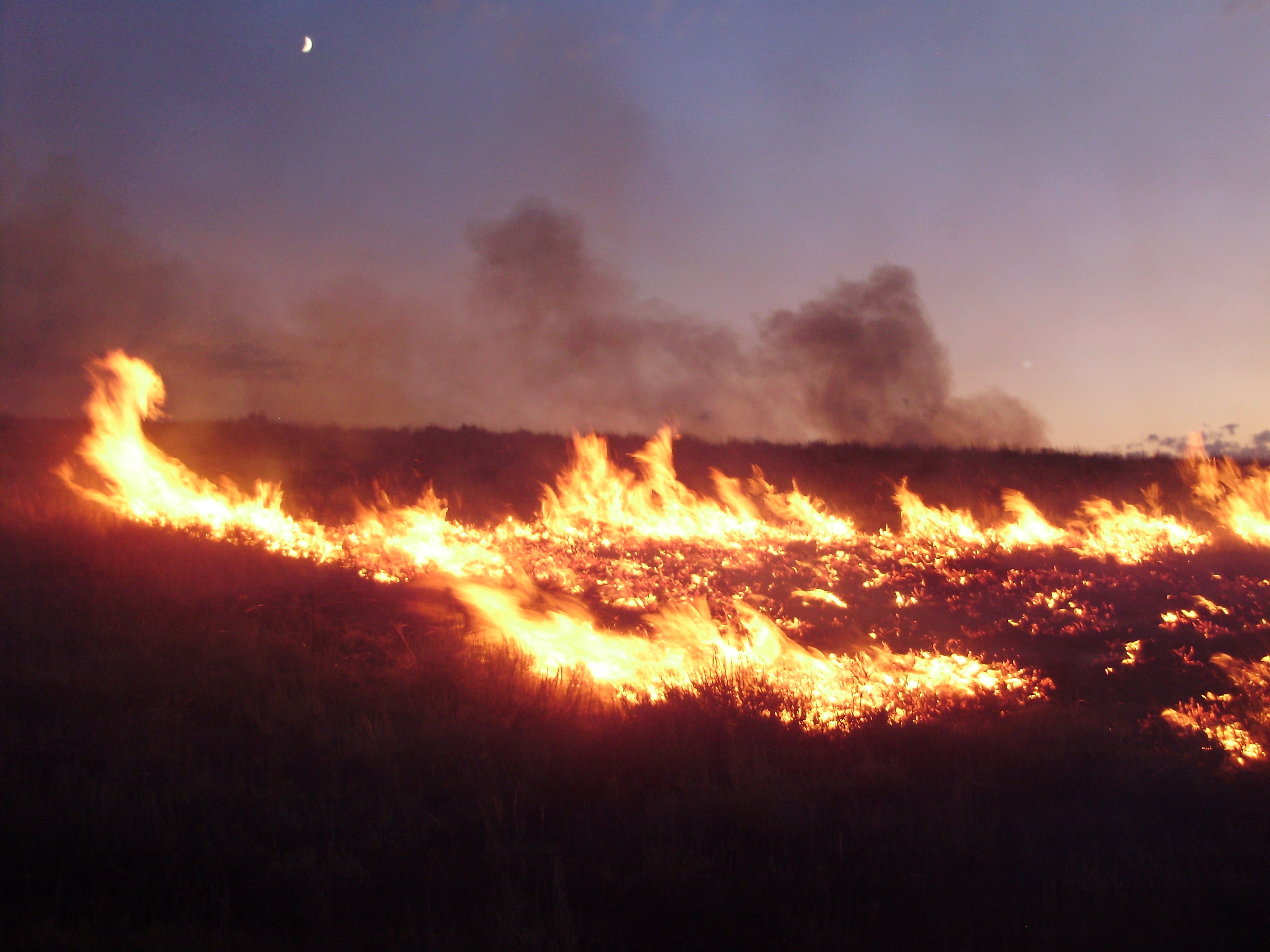
During dry thunderstorms there is little to no rain that could prevent lightning from causing areas with trees or other vegetation to catch fire. Storm winds also fan the fire and firestorm, causing it to spread more quickly.
Pyrocumulonimbus are cumuliform clouds that can form over a large fire and that are particularly dry. When the higher levels of the atmosphere are cooler, and the surface is thus warmed to extreme temperatures due to a wildfire, volcano, or other event, convection will occur, and produce clouds and lightning. They are similar to any cumulus cloud but ingest extra particulates from the fire. This increases the voltage difference between the base and the top of the cloud, helping to produce lightning.
Climate change
Climate change is expected to alter patterns of lightning-ignited wildfires. A key factor in the ignition of these wildfires is the type of lightning, with long-continuing-current (LCC) lightning being particularly significant. The risk of lightning-ignited wildfires is influenced not only by the occurrence of LCC lightning but also by the availability of dry fuel, which is influenced by how much rain has fallen before. Scientists predict, some places will see more LCC lightning and less rain, making it easier for wildfires to start. Areas like Southeastern Asia, South America, Africa, and Australia, along with parts of North America and Europe, could be at higher risk for these lightning-caused wildfires.
References
fr:Orage sec
References
- Albuquerque Office. "Dry thunderstorms". [[National Weather Service]].
- "What Is a Dry Thunderstorm?". weather.[[about.com]].
- (April 19, 2022). "Future increases in lightning ignition efficiency and wildfire occurrence expected from drier fuels in boreal forest ecosystems of western North America". Environmental Research Letters.
- "Dry Lightning". US Forest Service.
- "Frequently Asked Questions About Lightning". NSSL.
- (17 November 2003). "Forecasting Dry Lightning in the Western United States".
- (May 2007). "Model-Generated Predictions of Dry Thunderstorm Potential". Journal of Applied Meteorology and Climatology.
- (1972). "An American Haboob". Bulletin of the American Meteorological Society.
- (2006). "Dry lightning and dry thunderstorms cause the majority of wildfires in the Western US - including California fires.". California Green Solutions.
- "Pyrocumulonimbus". AMS Glossary.
- (2023-02-10). "Variation of lightning-ignited wildfire patterns under climate change". Nature Communications.
This article was imported from Wikipedia and is available under the Creative Commons Attribution-ShareAlike 4.0 License. Content has been adapted to SurfDoc format. Original contributors can be found on the article history page.
Ask Mako anything about Dry thunderstorm — get instant answers, deeper analysis, and related topics.
Research with MakoFree with your Surf account
Create a free account to save articles, ask Mako questions, and organize your research.
Sign up freeThis content may have been generated or modified by AI. CloudSurf Software LLC is not responsible for the accuracy, completeness, or reliability of AI-generated content. Always verify important information from primary sources.
Report