From Surf Wiki (app.surf) — the open knowledge base
Dream Chaser
US reusable automated cargo lifting-body spaceplane
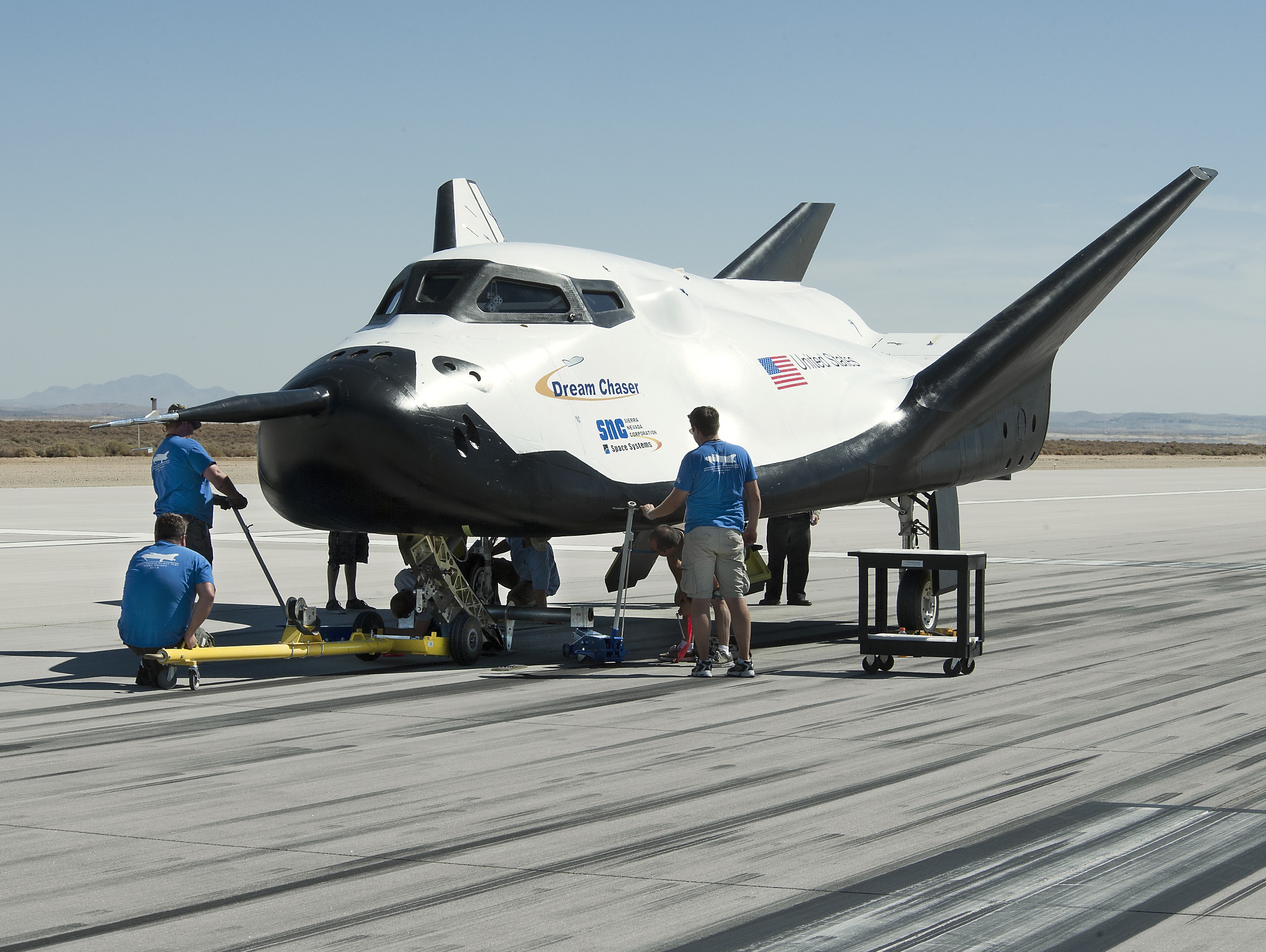
US reusable automated cargo lifting-body spaceplane
| Field | Value | ||||
|---|---|---|---|---|---|
| name | Dream Chaser | ||||
| image | Sierra Space Dream Chaser Spaceplane Documentation Photographs (GRC-2024-C-00116).jpg | ||||
| image_alt | Sierra Space Dream Chaser at NASA’s Neil Armstrong Test Facility in 2024 | ||||
| image_caption | Dream Chaser Tenacity at NASA’s Neil Armstrong Test Facility in 2024 | ||||
| manufacturer | Sierra Space | ||||
| country | United States | ||||
| operator | NASA | ||||
| applications | International Space Station (ISS) resupply | ||||
| spacecraft_type | Robotic cargo vehicle version, also | ||||
| launch_vehicle | Vulcan Centaur | ||||
| payload_capacity | 5000 kg pressurized, | ||||
| {{convert | 500 | kg | lb | abbr | on}} unpressurized |
| crew_capacity | |||||
| orbits | LEO | ||||
| status | Active | ||||
| built | 3 | ||||
| launched | 0 (4 atmospheric tests) | ||||
| operational | 1 | ||||
| lastretired | |||||
| derivedfrom | HL-20 Personnel Launch System | ||||
| flown_with | |||||
| insignia_caption |
the spaceplane
Crewed orbital spaceplane version 500 kg unpressurized
Dream Chaser is an American reusable lifting-body spaceplane developed by Sierra Space. Conceived as a crewed vehicle, it is being developed in a cargo configuration known as the Dream Chaser Cargo System for missions to the International Space Station (ISS) under NASA's Commercial Resupply Services program.
Development of Dream Chaser began in 2004 as a project of SpaceDev, which was acquired by Sierra Nevada Corporation (SNC) in 2008. In 2021, the program was transferred to Sierra Space, a subsidiary spun off from SNC as an independent company.
Dream Chaser is designed for vertical takeoff and horizontal landing, launching atop a Vulcan Centaur rocket and landing on conventional runways. It is capable of carrying both pressurized and unpressurized cargo. A proposed variant for the European Space Agency would launch aboard an Ariane 6 rocket. The first flight of Dream Chaser was originally scheduled for the second flight of Vulcan Centaur but was not ready in time. As of September 2025, the spacecraft's propulsion system and software had not yet been certified by NASA, and the spacecraft's initial mission in late 2026 will no longer dock at the ISS as originally planned.
The Dream Chaser’s design is derived from NASA's HL-20 Personnel Launch System, a lifting-body concept studied in the 1980s and 1990s.
Spacecraft

The Dream Chaser spaceplane is designed to be launched on the top of a typical rocket and land like an airplane on a runway. The design has heritage going back decades. Currently, the Dream Chaser will resupply the ISS with cargo. Per the company's website, a crew version is planned for a later date.
Sierra Space was contracted under CRS-2 to perform resupply missions to the ISS, but in a September 2025 contract change Sierra Space only needs to perform a free flight demonstration, with NASA optionally booking resupply missions.
Propulsion
On-orbit propulsion of the Dream Chaser was originally proposed to be provided by twin hybrid rocket engines capable of repeated starts and throttling. At the time, the SSC's predecessor, the SNC was also developing a similar hybrid rocket for Virgin Galactic's SpaceShipTwo. In May 2014, SNC involvement in the SpaceShipTwo program ended.
After the acquisition of Orbitec LLC in July 2014, Sierra Nevada Corporation announced a major change to the propulsion system. The hybrid rocket engine design was dropped in favor of a cluster of Orbitec's Vortex engines. The new unit would be a pressure-fed three-mode engine. At low- and mid-power regimes it uses monopropellant fuel hydrogen peroxide and in high-power demand, the engine adds injection of RP-1 fuel. This increased thrust will be useful to shorten the de-orbit burn duration of the Dream Chaser.
Thermal protection system
Its thermal protection system (TPS) is made up of silica-based tiles (for most of the belly and upper portion of the heat shield), and a new composite material called Toughened Unipiece Fibrous Reusable Oxidation Resistant Ceramic (TUFROC) to cover the nose and leading edges.
Shooting Star module
In 2019, it was announced that an expendable Shooting Star cargo module would be part of the Dream Chaser cargo system for CRS-2 flights. The module is a 15 ft attachment to Dream Chaser that will allow the spacecraft to carry an additional 10,000 lb of pressurized and unpressurized cargo to ISS. The module supports disposal of unwanted cargo by burning up upon re-entry.
In addition to carrying cargo, the Shooting Star module includes solar panels that supply up to 6 kW of electrical power. It also supplies active and passive thermal management; provides Dream Chaser translation and rotation capability via six mounted thrusters; and supports berthing or docking (in different configurations) to the ISS. Access from ISS to Dream Chaser will involve crew passing through Shooting Star (which supports a shirt-sleeve environment) and through a hatch that separates Shooting Star from Dream Chaser. Sierra Nevada says the module is capable of additional types of missions in LEO or to cis-lunar destinations; they have developed a free-flying variant with additional capabilities.
In July 2020, Sierra Nevada announced a contract with the Defense Innovation Unit (DIU) to use its Shooting Star expendable cargo vehicle as a possible commercial solution for a high-powered uncrewed orbital outpost.
Technology partners
In 2010, the following organizations were named as technology partners for the original passenger Dream Chaser:
- Aerojet – reaction control system technology
- AdamWorks – composites
- Charles Stark Draper Laboratory – guidance, navigation, and control
- Lockheed Martin – airframe construction and human rating of the spaceplane
- MDA – systems engineering
- University of Colorado – human-rating
History

The Dream Chaser design is derived from NASA's HL-20 Personnel Launch System spaceplane concept, which in turn is descended from a series of test vehicles, including the X-20 Dyna-Soar, Northrop M2-F2, Northrop M2-F3, Northrop HL-10, Martin X-24A and X-24B, and Martin X-23 PRIME.
The name "Dream Chaser" had been previously used for two separate space vehicle concepts. The first was planned to be an orbital vehicle based on the HL-20, with the second suborbital vehicle proposed by the Benson Space Company for the purposes of space tourism.
The Dream Chaser was publicly announced on September 20, 2004. In April 2007, SpaceDev announced that it had partnered with the United Launch Alliance to pursue the possibility of using the Atlas V booster rocket as the Dream Chaser's launch vehicle. In June 2007, SpaceDev signed a Space Act agreement with NASA.
On October 21, 2008, SpaceDev with Dream Chaser was acquired by the Sierra Nevada Corporation for US$38 million.
CCDev phase 1
On February 1, 2010, Sierra Nevada Corporation was awarded $20 million in seed money under NASA's Commercial Crew Development (CCDev) phase 1 program for the development of the Dream Chaser. SNC completed the four planned milestones on time, including hybrid rocket test fires and the preliminary structure design. Further initial Dream Chaser tests included the drop test of a 15% scaled version at the NASA Dryden Flight Research Center.
CCDev phase 2
Sierra Nevada proposed Dream Chaser for the CCDev phase 2 solicitation by NASA in October 2010, with an estimated project cost of less than $1 billion. On 18 April 2011, NASA awarded $80 million to Sierra Nevada Corporation for Dream Chaser. Since then, nearly a dozen further milestones have been completed under that Space Act Agreement. Some of these milestones included testing of an improved airfoil fin shape, integrated flight software and hardware, landing gear, a full-scale captive carry flight test, and a Systems Requirement Review (SRR).
By February 2012, Sierra Nevada Corporation stated that it had completed the assembly and delivery of the primary structure of the first Dream Chaser flight test vehicle. With this, SNC completed all 11 of its CCDev milestones that were scheduled up to that point. SNC stated in a press release that it was "on time and on budget."
On May 29, 2012, the Dream Chaser Engineering Test Article (ETA) was lifted by an Erickson Skycrane helicopter in a captive carry test to better determine its aerodynamic properties. In May 2013, the ETA was shipped to the Dryden Flight Research Center in California for a series of ground tests and aerodynamic flight tests. A second captive carry flight test was completed on August 22, 2013.
On June 12, 2012, SNC announced the commemoration of its fifth year as a NASA Langley partner in the design and development of Dream Chaser. The NASA/SNC team had worked on aerodynamic and aerothermal analysis of Dream Chaser, as well as guidance, navigation, and control systems. Together with ULA, the NASA/SNC team performed buffet tests on the Dream Chaser and Atlas V stack.
On July 11, 2012, SNC announced that it successfully completed testing of the nose landing gear for Dream Chaser. This milestone evaluated the impact to the landing gear during simulated approach and landing tests as well as the impact of future orbital flights. The main landing gear was tested in a similar way in February 2012. The nose gear landing test was the last milestone to be completed before the free flight approach and landing tests scheduled for later in 2012. In August 2012, SNC completed CCiCap Milestone 1, or the 'Program Implementation Plan Review'. This included creating a plan for implementing design, development, testing, and evaluation activities through the duration of CCiCap funding. By October 2012 the "Integrated System Baseline Review", or CCiCap Milestone 2, had been completed. This review demonstrated the maturity of the Dream Chaser Space System as well as the integration and support of the Atlas V launch vehicle, mission systems, and ground systems.
CCiCap
On August 3, 2012, NASA announced the award of $212.5 million to Sierra Nevada Corporation to continue work on the Dream Chaser under the Commercial Crew Integrated Capability (CCiCap) Program. On January 30, 2013, SNC announced a new partnership with Lockheed Martin. Under the agreement, SNC will pay Lockheed Martin $10 million to build the second airframe at its Michoud facility in New Orleans, Louisiana. This second airframe is slated to be the first orbital test vehicle, with orbital flight testing planned to begin within the next two years.
In January 2013, Sierra Nevada announced that the second captive carry and first unpowered drop test of Dream Chaser would take place at Edwards Air Force Base, California in March 2013. The spaceplane release would occur at 12000 ft altitude and would be followed by an autonomous robotic landing.
On March 13, 2013, NASA announced that former Space Shuttle commander Lee Archambault was leaving the agency in order to join SNC. Archambault, a former combat pilot and 15-year NASA veteran who flew on Atlantis and Discovery, will work on the Dream Chaser program as a systems engineer and test pilot.
On October 26, 2013, the first free-flight occurred. The test vehicle was released from the helicopter and flew the correct flightpath to touchdown less than a minute later. Just prior to landing, the left main landing gear failed to deploy resulting in a crash landing. The vehicle skidded off the runway in a cloud of dust, but was found upright with the crew compartment intact and all systems inside still in working order.
In January 2014, SNC announced it had signed a launch contract to fly the first orbital test vehicle on a robotically controlled orbital test flight in November 2016.

In early 2014, Sierra Nevada completed its wind tunnel testing as part of its CCiCAP Milestone 8. The wind tunnel testing involved analyzing the flight dynamics characteristics that the vehicle will experience during orbital ascent and re-entry. Wind tunnel testing was also completed for the Dream Chaser Atlas V integrated launch system. These tests were completed at NASA Ames Research Center at Moffett Field, California, CALSPAN Transonic Wind Tunnel in New York, and at NASA Langley Research Center Unitary Plan Wind Tunnel in Hampton, Virginia.
On August 1, 2014, the first completed piece of the orbital Flight Test Article (FTA) composite airframe was unveiled at a Lockheed Martin facility.
CCtCap
On September 16, 2014, NASA did not select the Dream Chaser for CCtCap, the next phase of the Commercial Crew Program. This occurred despite previous Commercial Crew Development awards in every phase since 2009, due to lack of maturity.
On September 26, Sierra Nevada filed a protest to the US Government Accountability Office (GAO). On October 22, 2014, a Federal Judge ruled the contract awards to Boeing and SpaceX valid, allowing NASA to proceed.
On September 29, 2014, Sierra Nevada introduced the "Dream Chaser Global Project" which would provide customized access to low Earth orbit to global customers.
Despite not being selected to continue forward under NASA's Commercial Crew transportation Capability (CCtCap) phase of the effort to send crews to orbit via private companies, SNC completed the milestones assigned under earlier phases of the CCP. On December 2, 2014, SNC announced that it completed NASA's CCiCap Milestone 5a related to propulsion risk reduction for the Dream Chaser space system.
By late December, details had emerged that "a high-ranking agency official"—"William Gerstenmaier, the agency's top human exploration official and the one who made the final decision"—"opted to rank Boeing's proposal higher than a previous panel of agency procurement experts." More specifically, Sierra Nevada asserted in their filings with the GAO that Gerstenmaier may have "overstepped his authority by unilaterally changing the scoring criteria."
On January 5, 2015, the GAO denied Sierra Nevada's CCtCap challenge, stating that NASA made the proper decision when it decided to award Boeing $4.2 billion and SpaceX $2.6 billion to develop their vehicles. Ralph White, the GAO's managing associate counsel, announced that NASA "recognized Boeing's higher price but also considered Boeing's proposal to be the strongest of all three proposals in terms of technical approach, management approach and past performance, and to offer the crew transportation system with most utility and highest value to the government."
CRS-2 selection
In December 2014, Sierra Nevada proposed Dream Chaser for CRS-2 consideration. In January 2016, NASA announced that Dream Chaser had been awarded one of the CRS-2 contracts and committed to purchasing a minimum of six resupply missions to the ISS. The cargo spacecraft will fly alongside spacecraft from the existing CRS-1 contract holders SpaceX and Northrop Grumman Innovation Systems.
In October 2015, the thermal protection system was installed on the Engineering Test Article (ETA) for the next phase of atmospheric flight testing. The orbital cabin assembly of the Flight Test Article (FTA) was also completed by contractor Lockheed Martin.
In 2015, the ETA had reportedly been given the name Eagle, while the FTA was originally named Ascalon before being changed to Ascension.
On November 11, 2017, the Dream Chaser ETA was released from an altitude of 3,700 m and successfully landed at Edwards AFB.
In March 2019, completion of NASA's Integrated Review Milestone 5 (IR5) confirmed that development was still on schedule. In August 2019, SNC announced the first ISS flight of the Dream Chaser, known as SNC Demo-1, was planned for 2021. However, on November 17, 2020, SNC announced it would be delayed until early 2022.
In April 2021 SNC spun off its Dream Chaser division, creating the fully independent Sierra Space Corporation, which assumed responsibility for the further development of the Dream Chaser space vehicle system.
In May 2022, it was announced by the deputy manager of ISS, Dana Weigel, that the mission was scheduled for February 2023.
In May 2024, it was announced that Dream Chaser Tenacity completed initial flight testing and was headed next to Kennedy Space Center to prepare for launch. It arrived later that month for launch preparation. The Vulcan Centaur to be used for the launch arrived to KSC in late June 2024. However, the Orlando Sentinel reports, June 26, "Dream Chaser dropped from next Vulcan launch as ULA targets national security certification". The mission was subsequently delayed to no earlier than May 2025, and had still not been scheduled for a specific date as of September 2025.
In September 2025, NASA announced that Dream Chaser's demonstration flight, SSC Demo-1, will no longer visit the ISS and was delayed to late 2026. The spacecraft is also no longer contracted to complete seven resupply missions to the ISS.
Variants
Crewed version
The originally planned Dream Chaser Space System is a human-rated version designed to carry from three to seven people and cargo to orbital destinations such as the International Space Station. It was to have a built-in launch escape system and could fly autonomously if needed. Although it could use any suitable launch vehicle, it was planned to be launched on a human-rated Atlas V N12 rocket. The vehicle will be able to return from space by gliding (typically experiencing less than 1.5 g on re-entry) and landing on any airport runway that handles commercial air traffic. Its reaction control system thrusters burned ethanol-based fuel, which is not an explosively volatile material, nor toxic like hydrazine, allowing the Dream Chaser to be handled immediately after landing, unlike the Space Shuttle.
the Sierra Nevada Corporation said it still planned to produce a crewed version of the spacecraft within the next 5 years. The company said it "never stopped working" on the crewed version and fully intended to launch it after the cargo version, and is still committed to the crewed version
In November 2021, Sierra Space Corporation reported that it received a $1.4 billion investment in Series A funding, which it would use to develop a crewed version of Dream Chaser and fly astronauts by 2025, although this ultimately did not occur. On October 25, 2021, Blue Origin and Sierra Space, released their plan for a commercial space station. The station, called Orbital Reef, is intended as a "mixed-use business park". Sierra Space Corporation's Dream Chaser was chosen as one of the commercial spacecraft to transport commercial crew to and from the space station, along with Boeing's Starliner.
CRS-2 cargo version

The cargo version of the SSC Dream Chaser is called the Dream Chaser Cargo System (DCCS) and after development is completed, will fly resupply flights to the ISS under NASA's Commercial Resupply Services-2 program. Featuring an expendable cargo module mounting solar panels, the spacecraft will be capable of returning 1750 kg to Earth while undergoing maximum re-entry forces of 1.5G.
To meet CRS-2 guidelines, the cargo Dream Chaser will have folding wings and fit within a 5 m diameter payload fairing, in contrast to the Crewed Dream Chaser, which is intended to launch without a fairing. The ability to fit into a payload fairing allows the cargo version to launch on any sufficiently capable vehicle, such as the (retired) Ariane 5 as well as the (soon to be retired) Atlas V. An expendable cargo module will launch attached to the back of the spacecraft, expanding the cargo uplift capacity and supporting the disposal of up to 3250 kg of trash. Total uplift is planned for 5000 kg pressurized and 500 kg unpressurized, with a downlift of 1750 kg contained within the spaceplane. The expendable cargo module is called "Shooting Star".
On August 14, 2019, it was announced that all six Dream Chaser CRS-2 flights would be carried into orbit by ULA's Vulcan launch vehicle, with the first Dream Chaser flight being the second Vulcan flight in late 2021. However, on February 9, 2022, Ken Shields, Sierra Space's Director of Commercial Market Development, announced that the first flight would be pushed to January 2023. The launch has been further delayed; it is scheduled for no earlier than May 2025.
National Security version
On November 19, 2021, Sierra Space announced that it is considering a third Dream Chaser version specialized for National Security missions, though it declined to comment on what the differences compared with other versions would be.
Dream Chaser Global Project
In December 2013, the German Aerospace Center (DLR) announced a funded study to investigate ways in which Europe might take advantage of the Dream Chaser crewed spaceplane technology. Named the DC4EU (Dream Chaser for European Utilization), the project will study using it for sending crews and cargo to the ISS and on missions not involving the ISS, particularly in orbits of substantially greater altitude than the ISS can reach.
In January 2014, the European Space Agency (ESA) agreed to be a partner on the DC4EU project, and will also investigate whether the Dream Chaser can use ESA avionics and docking mechanisms. ESA will also study launching options for the "Europeanized" Dream Chaser, particularly whether it can be launched from the Guiana Space Centre, within the Ariane 5's large aerodynamic cargo fairing – or, like the Atlas V, without it. In order to fit within the fairing, the Dream Chaser's wing length will have to be reduced slightly, which is thought to be easier than going through a full aerodynamic test program to evaluate and prove it along with the Ariane for flight without the fairing. The Ariane 5 launch vehicle was designed from its inception to be crew rated, in order to launch the Hermes Spaceplane, an ESA crewed vehicle which was proposed in the 1980s and 1990s, but was cancelled.
In late January 2014, it was announced that the Dream Chaser orbital test vehicle was under contract to be launched on an initial orbital test flight, using an Atlas V rocket, from Kennedy Space Center in November 2016. This was a privately arranged commercial agreement, and was funded directly by Sierra Nevada and was not a part of any existing NASA contract.
In September 2014, SNC announced that it would, with global partners, use the Dream Chaser as the baseline spacecraft for orbital access for a variety of programs, specializing the craft as needed.
On November 5, 2014, SNC's Space Systems team publicly presented the challenges and opportunities related to landing the Dream Chaser spacecraft at public-use airports. Dream Chaser uses standard landing aids and non-toxic propellants that require no special handling.
Dream Chaser for European Utilization
On February 3, 2015, the Sierra Nevada Corporation's (SNC) Space Systems and OHB System AG (OHB) in Germany announced the completion of the initial Dream Chaser for European Utilization (DC4EU) study. The study found that Dream Chaser is suitable for a broad range of space applications and could be used to advance European interests in space. The cooperation was renewed in April 2015 for an additional two years.
United Nations
The United Nations Office for Outer Space Affairs (UNOOSA) selected the cargo Dream Chaser for its first space launch. This launch is intended to last for at least two weeks in freeflight to provide space access to United Nations member states that have no space programs of their own, and carry up to 35 payloads. The United States will pay for the mission and provide all support facilities.
List of vehicles
| Type | Serial | Name | Status | Flights | Time in flight | Notes |
|---|---|---|---|---|---|---|
| Prototype | ETA | Eagle | 4 | ~5 minutes | Engineering Test Article (ETA) used for captive carry and atmospheric drop tests | |
| Prototype | FTA | Ascension | 0 | Flight Test Article (FTA) to be used for atmospheric tests | ||
| Cargo | DC101 | Tenacity | 0 | Spacecraft to be flown on SSC Demo-1 mission. | ||
| Cargo | DC102 | Reverence | 0 | Construction on hold ; company estimates 18 months of work remain. |
Mockups
| Name | Location | Status | Notes |
|---|---|---|---|
| Dream Chaser | Wings Over the Rockies Air and Space Museum | On Display | Replica of a crewed Dream Chaser spaceplane. Originally constructed in 1990 as an HL-20 mockup prior to the program's cancellation. |
| Tenacity | Kennedy Space Center Visitor Complex | On Display | Replica of Tenacity mated to Shooting Star module. Located in Gateway section of the complex. |
Missions
A demonstration and six missions are currently planned to be launched from Cape Canaveral SLC-41 on Vulcan Centaur, and one more flight has been ordered to fly for the United Nations on board an Arianespace vehicle.
List includes only completed or manifested missions. NET means 'no earlier than'. Launch and landing dates and times are listed in UTC.
| Mission | Spacecraft | Launch | Landing | Launch vehicle | Remarks | Outcome | Captive Test 1 | Captive Test 2 | Drop Test 1 | Drop Test 2 | SSC Demo-1 | CRS SSC-1 | CRS SSC-2 | CRS SSC-3 | CRS SSC-4 | CRS SSC-5 | CRS SSC-6 | DC UNOOSA-1 |
|---|---|---|---|---|---|---|---|---|---|---|---|---|---|---|---|---|---|---|
| ETA Eagle | May 29, 2012 | May 29, 2012 | Erickson Skycrane | 1st atmospheric test | ||||||||||||||
| ETA Eagle | August 22, 2013 | August 22, 2013 | Erickson Skycrane | 2nd atmospheric test | ||||||||||||||
| ETA Eagle | October 26, 2013 | October 26, 2013 | Erickson Skycrane | 1st free flight test | ||||||||||||||
| ETA Eagle | November 11, 2017 | November 11, 2017 | Boeing-Vertol 234 | 2nd free flight test | ||||||||||||||
| DC101 Tenacity | NET Late 2026 | NET Late 2026 | Vulcan Centaur | First orbital flight, originally an approximately 45-day ISS resupply mission, now will not visit the ISS. | ||||||||||||||
| DC101 Tenacity | TBA | TBA | Vulcan Centaur | 1st contracted CRS mission for NASA | ||||||||||||||
| DC101 Tenacity | TBA | TBA | Vulcan Centaur | 2nd contracted CRS mission for NASA | ||||||||||||||
| DC101 Tenacity | TBA | TBA | Vulcan Centaur | 3rd contracted CRS mission for NASA | ||||||||||||||
| DC102 Reverence | TBA | TBA | Vulcan Centaur | 4th contracted CRS mission for NASA | ||||||||||||||
| TBA | TBA | Vulcan Centaur | 5th contracted CRS mission for NASA | |||||||||||||||
| TBA | TBA | Vulcan Centaur | 6th contracted CRS mission for NASA | |||||||||||||||
| TBA | TBA | Arianespace vehicle | To carry 35 payloads for the United Nations Office for Outer Space Affairs. |
References
|access-date = August 29, 2012 |archive-url = https://archive.today/20140809075955/http://www.nytimes.com/2011/02/01/science/space/01private.html?_r=5&ref=science&pagewanted=all& |archive-date = August 9, 2014 |url-status = live
| access-date = August 16, 2011
| access-date = January 7, 2012
| access-date = August 29, 2012 |access-date=January 6, 2014 |archive-url=https://web.archive.org/web/20130510175120/http://www.nasa.gov/pdf/475795main_rendezvous_v4n3.pdf |archive-date=May 10, 2013 |url-status=live
|access-date=January 6, 2014 |archive-url=https://web.archive.org/web/20140107050017/http://www.marketwired.com/press-release/spacedev-united-launch-alliance-explore-launching-dream-chaser-space-vehicle-on-atlas-717659.htm |archive-date=January 7, 2014 |url-status=live
| access-date = August 16, 2011 | archive-date = June 21, 2007 | archive-url = https://web.archive.org/web/20070621133852/http://www.nasa.gov/home/hqnews/2007/jun/HQ_07138_COTS_3_Unfunded_SAAs.html | url-status = dead
|url-status = dead |archive-url = https://web.archive.org/web/20100207081838/http://sncorp.com/news/press/pr10/snc_ccdev_spacenews.shtml |archive-date = February 7, 2010
| access-date = June 28, 2010 | archive-date = April 28, 2023 | archive-url = https://web.archive.org/web/20230428020413/https://www.nasa.gov/centers/johnson/pdf/444145main_NNJ10TA03S_sierra_saa.pdf | url-status = dead |access-date=September 7, 2012 |archive-url=https://web.archive.org/web/20131104030628/http://arstechnica.com/science/2012/09/the-long-complicated-voyage-of-the-dream-chaser-may-yet-end-in-space/3/ |archive-date=November 4, 2013 |url-status=live |access-date=September 7, 2012 |archive-url=https://web.archive.org/web/20140104200356/http://arstechnica.com/science/2012/09/the-long-complicated-voyage-of-the-dream-chaser-may-yet-end-in-space/2/ |archive-date=January 4, 2014 |url-status=live
|access-date = January 6, 2014 |archive-url = https://web.archive.org/web/20140106220837/http://www.sncorp.com/press_more_info.php?id=450 |archive-date = January 6, 2014 |url-status = dead
| access-date = May 15, 2013 | archive-date = June 10, 2013 | archive-url = https://web.archive.org/web/20130610044030/http://www.parabolicarc.com/2013/05/10/sierra-nevada-completes-dream-chaser-safety-review/#more-48595 | url-status = dead Dean, James. "NASA awards $270 million for commercial crew efforts" . space.com, April 18, 2011. "Boeing, SpaceX and Sierra Nevada Win CCiCAP Awards". spacenews.com, August 3, 2012.
| access-date=July 25, 2012 | archive-url = https://web.archive.org/web/20110627052003/http://procurement.ksc.nasa.gov/documents/NNK11MS01S_SAA-%20SNC_Redacted.pdf | url-status = dead | archive-date = June 27, 2011
| access-date=July 25, 2012 | access-date = July 25, 2012 | archive-date = July 23, 2012 | archive-url = https://web.archive.org/web/20120723090600/http://www.nasa.gov/offices/c3po/partners/sierranevada/index.html | url-status = dead
| access-date = February 6, 2011 | archive-date = June 12, 2012 | archive-url = https://web.archive.org/web/20120612081206/http://www.nasa.gov/centers/dryden/Features/dream_chaser_model_drop.html | url-status = dead |url-status = dead |archive-url = https://web.archive.org/web/20120813175033/http://sncspace.com/press_more_info.php?id=335 |archive-date = August 13, 2012 |url-status = dead |archive-url = https://web.archive.org/web/20120813175006/http://sncspace.com/press_more_info.php?id=334 |archive-date = August 13, 2012 |url-status = dead |archive-url = https://web.archive.org/web/20130408054321/http://sncorp.com/press_more_info.php?id=476 |archive-date = April 8, 2013 | access-date = May 29, 2012 | archive-url = https://web.archive.org/web/20120531105157/http://www.dailycamera.com/broomfield-news/ci_20733780/spacecraft-tested-tuesday-at-broomfield-airport | archive-date = May 31, 2012 | url-status = dead |url-status = dead |archive-url = https://web.archive.org/web/20120731172429/http://sncspace.com/press_more_info.php?id=336 |archive-date = July 31, 2012 |access-date = August 15, 2012 |url-status = dead |archive-url = https://web.archive.org/web/20120807000048/http://sncspace.com/press_more_info.php?id=337 |archive-date = August 7, 2012 |access-date=March 25, 2013 |archive-url=https://web.archive.org/web/20140107193306/https://www.flightglobal.com/news/articles/lockheed-to-build-second-dream-chaser-airframe-for-sierra-nevada-381679/ |archive-date=January 7, 2014 |url-status=live |access-date = February 11, 2013 |archive-url = https://web.archive.org/web/20130217040618/http://www.floridatoday.com/article/20130131/NEWS01/301310028/Sierra-Nevada-s-Dream-Chaser-will-get-Lockheed-Martin-s-help?nclick_check=1 |archive-date = February 17, 2013 |url-status = live | access-date=March 25, 2013 | access-date = March 25, 2013 | archive-date = March 17, 2013 | archive-url = https://web.archive.org/web/20130317070858/http://www.parabolicarc.com/2013/03/13/nasa-astronaut-lee-archambault-joins-sierra-nevada-as-test-pilot/ | url-status = dead |access-date=January 6, 2014 |archive-url=https://web.archive.org/web/20140107001430/http://www.utsandiego.com/news/2008/oct/21/spacedev-agrees-to-be-acquired/ |archive-date=January 7, 2014 |url-status=live |access-date=December 16, 2013 |archive-url=https://web.archive.org/web/20131216215718/http://www.parabolicarc.com/2013/12/16/german-space-agency-funds-study-sierra-nevadas-dream-chaser/ |archive-date=December 16, 2013 |url-status=live |access-date = March 26, 2016 |archive-date = March 16, 2016 |archive-url = https://web.archive.org/web/20160316164838/http://www.parabolicarc.com/2014/08/19/snc-abandons-hybrid-motors-dream-chaser/ |url-status = dead | access-date = May 14, 2013 | url-access = subscription |access-date=January 6, 2014 |archive-url=https://web.archive.org/web/20140108215738/http://www.nbcnews.com/science/dream-chaser-space-plane-dangles-helicopter-second-flight-test-8C11009955 |archive-date=January 8, 2014 |url-status=live |access-date=May 14, 2013 |archive-url=https://web.archive.org/web/20131216184907/http://www.nasaspaceflight.com/2013/05/dream-chaser-dryden-drop-tests/ |archive-date=December 16, 2013 |url-status=live |access-date=January 6, 2014 |archive-url=https://web.archive.org/web/20140228163343/http://www.nasaspaceflight.com/2013/10/dream-chaser-landing-failure-first-flight/ |archive-date=February 28, 2014 |url-status=live |access-date=January 6, 2014 |archive-url=https://web.archive.org/web/20140106180942/http://www.cbsnews.com/network/news/space/home/spacenews/files/65a2e37d7bc29d16991991624a6b36ef-634.html |archive-date=January 6, 2014 |url-status=live
|access-date=January 6, 2014 |archive-url=https://web.archive.org/web/20140130192104/http://m.space.com/23370-private-dream-chaser-space-plane-skidded-off-runway-after-milestone-test-flight.html |archive-date=January 30, 2014 |url-status=live |access-date=January 9, 2014 |archive-url=https://web.archive.org/web/20140109145644/http://www.spaceflightnow.com/news/n1401/08dreamchaser/ |archive-date=January 9, 2014 |url-status=live
|access-date=August 14, 2019
| access-date=July 26, 2012
| archive-url = https://web.archive.org/web/20070224005725/http://www.astronautix.com/craft/drehaser.htm | url-status = dead | archive-date = February 24, 2007 | access-date=February 14, 2010
| access-date = October 28, 2009 | archive-url = https://web.archive.org/web/20111010175619/http://www.sncorp.com/news/press/snc_2008_spacedev.shtml | archive-date = October 10, 2011 | url-status = dead
|access-date=September 17, 2014
--
References
- (January 14, 2016). "NASA Awards International Space Station Cargo Transport Contracts".
- Berger, Eric. (2025-08-04). "Is the Dream Chaser space plane ever going to launch into orbit?".
- (25 September 2025). "NASA, Sierra Space Modify Commercial Resupply Services Contract - NASA".
- "NASA Selects Sierra Nevada Corporation's Dream Chaser Spacecraft for Commercial Resupply Services 2 Contract". Sierra Nevada Corporation (SNC).
- (2025-09-25). "NASA, Sierra Space Modify Commercial Resupply Services Contract - NASA".
- Doug Messier. (May 24, 2014). "Virgin Galactic Hails RocketMotorTwo Milestone". ParabolicArc.
- (2015). "Tile Shop Prepping Heat Shields for Future Flights".
- "Toughened Uni-piece Fibrous Reinforced Oxidation-Resistant Composite (TUFROC)". NASA.
- (November 21, 2019). "Sierra Nevada Unveils 'Shooting Star' Cargo Module for Dream Chaser Space Plane".
- "Sierra Nevada Corporation Shows Off "Shooting Star" Cargo Module at KSC".
- "SNC'S "SHOOTING STAR" ARRIVES AT NASA'S KENNEDY SPACE CENTER". Sierra Nevada Corporation.
- "SNC Shooting Star Transport Vehicle". Sierra Nevada Corporation.
- (July 17, 2020). "SNC Shooting Star Wins Contract for Unmanned Orbital Outpost".
- De Chiara, Giuseppe. (2012-11-19). "From HL-20 to Dream Chaser The Long story of a little spaceplane". NASASpaceflight.com.
- (November 14, 2017). "Dream Chaser: Sierra Nevada's Design for Spaceflight".
- H. Phillips, Edward. (1991-07-15). "Langley Refines Design, Begins Human Factors Tests of Personnel Launch System". Aviation Week & Space Technology.
- Wallace, Lance E.. (1996). "Flights of Discovery: 50 Years at the NASA Dryden Flight Research Center". NASA.
- R. Asker, James. (1990-09-24). "NASA Design for Manned Spacecraft. Draws on Soviet Subscale Spaceplane". Aviation Week & Space Technology.
- R. Dale, Reed. (1997). "Wingless Flight The Lifting Body Story". NASA.
- "NASA, SPACEDEV TO COLLABORATE ON FUTURE SPACE TRANSPORTATION".
- (January 24, 2014). "Dream Chaser mini-shuttle given 2016 launch date". [[BBC News]].
- (May 19, 2014). "Dream Chaser passes Wind Tunnel tests for CCiCap Milestone".
- (August 6, 2014). "First Piece of Private Dream Chaser Space Plane Unveiled". Space.com.
- (September 16, 2014). "NASA Chooses American Companies to Transport U.S. Astronauts to International Space Station".
- Norris, Guy. "[http://aviationweek.com/space/why-nasa-rejected-sierra-nevadas-commercial-crew-vehicle Why NASA Rejected Sierra Nevada's Commercial Crew Vehicle]" ''[[Aviation Week & Space Technology]]'', October 11, 2014. Accessed: 2014-10-13. [https://web.archive.org/web/20141013135535/http://aviationweek.com/space/why-nasa-rejected-sierra-nevadas-commercial-crew-vehicle Archived] on October 13, 2014
- (October 3, 2014). "So Sierra Nevada protested NASA space-taxi contract, but what's next?". Denver Post.
- (2014-10-22). "NASA Wins; Boeing and Space X Shuttle Contracts Ruled Valid".
- (December 29, 2014). "Sierra Nevada Corporation Introduces Dream Chaser Global Project Spaceflight Program Sept. 30". SpaceRef.
- (December 3, 2014). "Sierra Nevada completes Dream Chaser's milestone 15a for prior phase of Commercial Crew". Spaceflight Insider.
- (December 2, 2014). "SNC Tests Dream Chaser Propulsion System". NASA Blog blogs.nasa.gov.
- (December 23, 2014). "Sierra Nevada Alleges Boeing Benefitted From Commercial Crew Criteria Changes". Parabolic Arc.
- "GAO denies Sierra Nevada's legal challenge to NASA space contract". Washington Post.
- Christian Davenport. (February 13, 2015). "Grounded: Left behind in the contracting race to restore Americans to space". The Washington Post.
- (January 12, 2016). "NASA Awards International Space Station Cargo Transport Contracts". NASA News.
- Dan Leone. (January 24, 2015). "Weather Sat, CRS-2 Top U.S. Civil Space Procurement Agenda for 2015". SpaceNews.com.
- (October 9, 2015). "Dream Chaser preps for 2nd free-flight test and first orbital test". Space Daily.
- Bergin, Chris. (October 6, 2015). "Dream Chaser still fighting for her place in space".
- Kenneth Chang. (2017-11-11). "Dream Chaser Space Plane Aces Glide Test - The New York Times". The New York Times.
- (November 24, 2017). "Dream Chaser through critical landing test, prepares for orbital flights".
- Sampson, Ben. (March 27, 2019). "Dream Chaser spacecraft passes testing milestone". Aerospace Testing International.
- (March 21, 2019). "Dream Chaser® Spacecraft Passes Another NASA Milestone". [[Sierra Nevada Corporation]].
- Foust, Jeff. (18 November 2020). "First Dream Chaser mission slips to 2022".
- Michael Sheetz. (17 May 2022). "Weigel: The second Vulcan flight, carrying the first @SierraSpaceCo cargo Dream Chaser to the ISS, is currently scheduled for February 2023. "We'll be ready when they're ready."".
- Gamillo, Elizabeth. (2024-05-09). "Dream Chaser spaceplane completes tests at NASA's Neil Armstrong facility".
- (2024-05-20). "NASA, Sierra Space Deliver Dream Chaser to Florida for Launch Preparation - NASA".
- (25 September 2025). "Sierra’s Dream Chaser is starting to resemble a nightmare". Ars Technica.
- "DREAM CHASER ON TRACK FOR 2021 CARGO MISSION, CREW WITHIN 5 YEARS".
- (April 14, 2021). "Sierra Nevada Corporation to spin off space division".
- "With a huge infusion of cash, Sierra Space hopes to get its Dream Chaser spaceplane and space station off the ground".
- Davenport, Justin. (2021-10-27). "Blue Origin, Sierra Space, and Boeing announce Orbital Reef".
- Chappell, Bill. (2021-10-25). "Blue Origin says it will build an orbiting mixed-use business park in space". NPR.
- Grush, Loren. (2021-10-25). "Blue Origin reveals plans for future commercial space station called Orbital Reef".
- (2015-03-18). "Sierra Nevada Hopes Dream Chaser Finds "Sweet Spot" of ISS Cargo Competition". SpaceNews.
- Jeff Foust. (March 13, 2015). "Lockheed Martin Pitches Reusable Tug for Space Station Resupply". Space News.
- Jeff Foust. (March 17, 2015). "Sierra Nevada Hopes Dream Chaser Finds "Sweet Spot" of ISS Cargo Competition". Space News.
- Foust, Jeff. (14 January 2020). "Sierra Nevada explores other uses of Dream Chaser".
- (August 14, 2019). "SNC Selects ULA for Dream Chaser® Spacecraft Launches: NASA Missions to Begin in 2021". [[United Launch Alliance]].
- (2022-02-09). "Interview with Sierra Space: Dream Chaser launch set for January 2023, Orbital Reef space station, manufacturing in space, & more".
- Garcia, Mark. (October 15, 2024). "Crew-8 Awaits Splashdown; Expedition 72 Stays Focused on Science". [[NASA]].
- (2021-11-19). "Sierra Space raises $1.4 billion".
- (September 29, 2014). "Sierra Nevada Corporation to Introduce Dream Chaser® Global Project Spaceflight Program Sept. 30". SNC.
- (November 5, 2014). "Sierra Nevada Corporation to Present Progress on Evaluating Dream Chaser Landing at Public Use Airports". WFXS FOX55 WAUSAU.
- (November 5, 2014). "Challenges and Opportunities Related to Landing the Dream Chaser® Commercial Reusable Space Vehicle at a Public-Use Airport". ERAU Scholarly Commons.
- Completion of the initial DC4EU study (March 2, 2015). "http://www.sncorp.com/AboutUs/NewsDetails/749"
- de Selding, Peter B.. (2015-04-17). "DLR Renews Cooperation with SNC on Dream Chaser". Space News.
- (2019-10-22). "UNOOSA and Sierra Nevada Corporation announce Call for Interest to provide landing site for Dream Chaser spacecraft mission carrying experiments from UN Member States". [[Sierra Nevada Corporation]].
- Seemangal, Robin. (2016-10-03). "Dream Chaser: The Spacecraft That Will Transform Humanity's Access to Space". The Observer (New York).
- (May 20, 2022). "@DutchSpace DC-101".
- (November 6, 2023). "Sierra Space completes first Dream Chaser".
- David, Leonard. (2024-11-08). "Sierra Space expands spaceplane fleet with in-house mission control".
- OIG Staff. (26 April 2018). "Audit of Commercial Resupply Services to the International Space Center". NASA.
- "Dream Chaser® {{!}} Wings Over the Rockies Air & Space Museum".
- (October 15, 2024). "Gateway: The Deep Space Launch Complex".
- Sawyer Rosenstein. (8 February 2024). "Dream Chaser undergoes NASA testing ahead of first flight".
This article was imported from Wikipedia and is available under the Creative Commons Attribution-ShareAlike 4.0 License. Content has been adapted to SurfDoc format. Original contributors can be found on the article history page.
Ask Mako anything about Dream Chaser — get instant answers, deeper analysis, and related topics.
Research with MakoFree with your Surf account
Create a free account to save articles, ask Mako questions, and organize your research.
Sign up freeThis content may have been generated or modified by AI. CloudSurf Software LLC is not responsible for the accuracy, completeness, or reliability of AI-generated content. Always verify important information from primary sources.
Report