From Surf Wiki (app.surf) — the open knowledge base
Dragonfly (chess variant)
Chess variant played on a 7×7 board
Chess variant played on a 7×7 board
| tright | |rd|bd|bd|kd|nd|nd|rd |pd|pd|pd|pd|pd|pd|pd | | | | | | | | | | | | | | | | | | | | | |pl|pl|pl|pl|pl|pl|pl |rl|bl|bl|kl|nl|nl|rl |Dragonfly 7×7 starting setup
Dragonfly (also known as Shuttle Chess or Bird Chess) is a chess variant invented by Christian Freeling in 1983. There are no queens, and a captured bishop, knight, or rook becomes the property of the capturer, who may play it as their own on a turn to any open square. The board is 7×7 squares, or alternatively a 61-cell hexagon with two additional pawns per side.
The game is an offshoot and simplification of a Freeling game named Loonybird (or Dragon Chess). Still, "Play is complex and interesting. Draws are rare too."
Game rules
The standard rules of chess apply, including winning by checkmate. But Dragonfly follows these special rules:
- A bishop, knight, or rook that is captured enters the capturing player's pieces in hand in their own color. As a move, a player may drop any one of the pieces they have in hand on any open square (if the move is otherwise legal). Captured pawns do not go in hand and are instead removed from the game.
- Pawns do not have an initial double-step option. (So, en passant is not possible.) A pawn promotes when reaching the furthest to any piece of the player's choosing from those currently held in hand by their opponent. (If the opponent has none, then a pawn move to the furthest rank may not be made.) The chosen piece is removed from the opponent's in-hand stock.
- Castling is permitted, and normal castling conventions apply, with the king shifting over two squares in either direction. But castling with a dropped rook is not allowed.
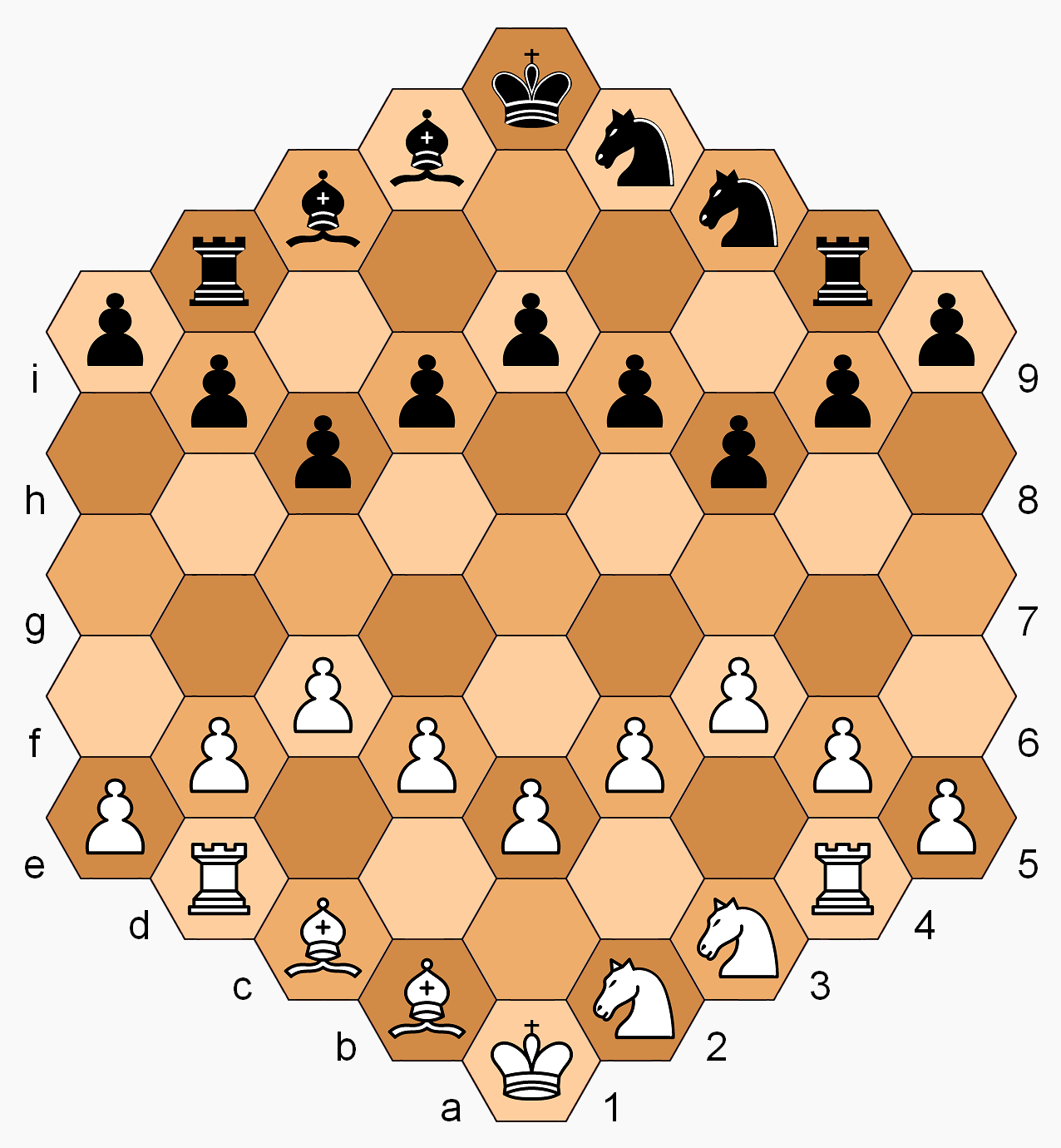
Dragonfly hex
Dragonfly on the hex board is played the same as Dragonfly 7×7, except that pieces move and capture as in Gliński's hexagonal chess (with the exceptions that pawns have no initial double-step option, and castling is permitted).
References
Bibliography
- {{cite book
- {{cite book |editor-last=Beasley |editor-first=John
References
- Pritchard (1994), p. 362
- Pritchard (1994), p. 96
- Pritchard (2007), p. 159
- (April–September 1994). "Dragonfly". [[British Chess Variants Society]].
This article was imported from Wikipedia and is available under the Creative Commons Attribution-ShareAlike 4.0 License. Content has been adapted to SurfDoc format. Original contributors can be found on the article history page.
Ask Mako anything about Dragonfly (chess variant) — get instant answers, deeper analysis, and related topics.
Research with MakoFree with your Surf account
Create a free account to save articles, ask Mako questions, and organize your research.
Sign up freeThis content may have been generated or modified by AI. CloudSurf Software LLC is not responsible for the accuracy, completeness, or reliability of AI-generated content. Always verify important information from primary sources.
Report