From Surf Wiki (app.surf) — the open knowledge base
Dowsing
Pseudoscientific attempts to locate underground objects
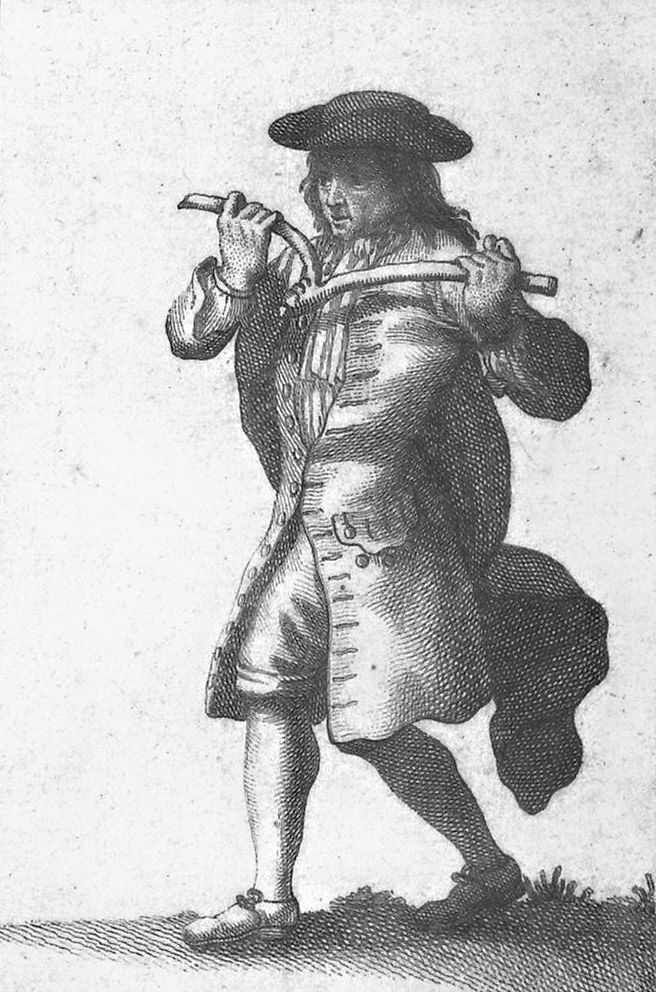
Pseudoscientific attempts to locate underground objects
the divination method
Dowsing is a type of divination employed in attempts to locate ground water, buried metals or ores, gemstones, oil, claimed radiations (radiesthesia), gravesites, malign "earth vibrations" and many other objects and materials without the use of a scientific apparatus. It is also known as divining (especially in water divining), doodlebugging (particularly in the United States, in searching for petroleum or treasure) or water finding, or water witching (in the United States).
A Y-shaped twig or rod, or two L-shaped ones, called dowsing rods or divining rods are normally used, and the motion of these are said to reveal the location of the target material. The motion of such dowsing devices is generally attributed to random movement, or to the ideomotor phenomenon, a psychological response where a subject makes motions unconsciously.
The scientific evidence shows that dowsing is no more effective than random chance. It is therefore regarded as a pseudoscience.
History
Early divination and religion


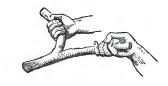
Dowsing originated in ancient times, when it was treated as a form of divination. The Catholic Church banned the practice completely.
Protestant Reformer Martin Luther perpetuated the Catholic ban, in 1518 listing divining for metals as an act that broke the first commandment (i.e., as occultism).
Old texts about searching for water do not mention using the divining twig, and the first account of this practice was in 1568. Sir William F. Barrett wrote in his 1911 book Psychical Research that:
In 1662, divining with rods was declared to be "superstitious, or rather satanic" by a Jesuit, Gaspar Schott, though he later noted that he was not sure that the devil was always responsible for the movement of the rod. In southern France in the 17th century, it was used to track criminals and heretics. Its abuse led to a decree of the inquisition in 1701, forbidding its employment for purposes of justice.
An epigram by Samuel Sheppard, from Epigrams theological, philosophical, and romantick (1651) runs thus:
|Some Sorcerers do boast they have a Rod, Gather'd with Vowes and Sacrifice, And (borne about) will strangely nod To hidden Treasure where it lies; Mankind is (sure) that Rod divine, For to the Wealthiest (ever) they incline.}}
Modern dowsing
Dowsing practices used in an attempt to locate metals are still performed much like they were during the 16th century. The 1550 edition of Sebastian Münster's Cosmographia contains a woodcut of a dowser with forked rod in hand walking over a cutaway image of a mining operation. The rod is labeled in Latin and German; "Virgula Divina – Glück-Rüt" ('Rod Divine, Luck-Rod'), but there is no text accompanying the woodcut. By 1556, Georgius Agricola's treatment of mining and smelting of ore, De Re Metallica, included a detailed description of dowsing for metal ore.
In the 16th century, German deep mining technology was in enormous demand all over Europe. German miners were licensed to live and work in England, particularly in the Stannaries (tin mines) of Devon and Cornwall and in Cumbria. In other parts of England, the technique was used in the royal mines for calamine. By 1638 German miners were recorded using the technique in silver mines in Wales.
The Middle Low German name for a forked stick (Y-rod) was Schlag-Ruthe ('striking rod'). This was translated in the sixteenth century Cornish dialect to duschen (duschan according to William Barrett) (Middle English, 'to strike, fall'). By the seventeenth century the English term dowsing was coming into common use.
In the lead-mining area of the Mendip Hills in Somerset, England in the 17th century the natural philosopher Robert Boyle, inspired by the writings of Agricola, watched a practitioner try to find "latent veins of metals". Boyle saw the hazel divining rod (virgula divinatoria) stoop in the hands of the diviner, who protested that he was not applying any force to the twig; Boyle accepted the man's genuine belief but himself remained unconvinced. Towards the end of the century, in 1691 the philosopher John Locke, who was born in the English West Country, used the term deusing-rod for the Old Latin name virgula divina. So, dowse is synonymous with strike, hence the phrases: to dowse/strike a light, to dowse/strike a sail.
Dowsing was conducted in South Dakota in the late 19th and early 20th centuries to help homesteaders, farmers and ranchers locate water wells on their property.
The military have occasionally resorted to dowsing techniques. In the First World War Gallipoli campaign, sapper Stephen Kelly, of the 3rd Light Horse Brigade, Australian Expeditionary Force, became well known for finding water for the British troops. In the late 1960s during the Vietnam War, some United States Marines used dowsing when locating weapons and tunnels. As late as in 1986, when 31 soldiers were taken by an avalanche during an operation in the NATO drill Anchor Express in Vassdalen, Norway, the Norwegian army attempted to locate soldiers buried in the avalanche using dowsing as a search method.
Dowsing is still used by some farmers and water engineers in Britain; however, many of the country's utilities have distanced themselves from the practice.
Postulated mechanisms
Early attempts at an explanation of dowsing were based on the notion that the divining rod was physically affected by emanations from substances of interest. The following explanation is from William Pryce's 1778 Mineralogia Cornubiensis:
A study towards the end of the 19th century concluded that the phenomenon was attributed to cryptesthesia, where the practitioner makes unconscious observations of the terrain and involuntarily influences the movement of the rod. Early investigations by members of the Society for Psychical Research endorsed this view.
Committed parapsychologist G. N. M. Tyrrell also believed that the action of the rod was caused by involuntary muscular movements and debunked the theory of external influences.
Dowsing over maps, prior to visiting the site, was also believed to work, hence some kind of clairvoyance was proposed. This was believed to act on the nervous system, rather than on the muscles directly. These various mechanisms remain in contention among dowsers.
Fraudulent security devices

In the late twentieth and early twenty-first centuries, a number of dowsing-like devices were marketed for modern police and military use, primarily as explosive detectors, such as the ADE 651, Sniffex, and the GT200. In consequence of these frauds, in 1999 the United States National Institute of Justice issued advice against buying equipment based on dowsing.
Equipment
The device used by a dowser is typically referred to as a dowsing or divining rod, even though it may not be rod-shaped.
Dowsing twig

Traditionally, the most common method used is the dowsing twig, a forked (Y-shaped) branch from a tree or bush. Some dowsers prefer branches from particular trees, and some prefer the branches to be freshly cut. Hazel twigs in Europe and witch-hazel in the United States are traditionally commonly chosen, as are branches from willow or peach trees. The two ends on the forked side are held one in each hand with the third (the stem of the Y) pointing straight ahead. The dowser then walks slowly over the places where the target (for example, minerals or water) may be, and the dowsing rod is expected to dip, incline or twitch when a discovery is made. This method is sometimes known as "willow witching." Some dowsers would hang a golden ring on the edge of the dowsing rod, or split the tip to slide in a silver coin.
Pair of rods

Many modern dowsers use a pair of L-shaped metal rods. One rod is held in each hand, with the short arm of the L held upright, and the long arm pointing forward. The upright arm is often free to rotate inside a tube. When something is "found," the rods move in synchrony. Depending on the dowser, they may cross over or swing apart. If the object is long and straight, such as a water pipe, the rods may point in opposite directions, showing its orientation. The rods may be fashioned from wire coat hangers or wire flags used for locating utilities. Glass or plastic rods have also been accepted. Straight rods are also sometimes used for the same purposes, and were common in early 19th century New England.
Pendulum
A pendulum weight on a short cord or thread is the tool of choice for many modern dowsers. An article in Live to Plant lists it as one of three common methods (the other two being Y-shaped rods and L rods). The dowser holds the cord in one hand and allows the pendulum to swing freely. The dowser then observes how the pendulum is swinging and interprets the motion to offer insights.
Studies
- Dowsing studies from the early twentieth century were examined by geologist John Walter Gregory in a report for the Smithsonian Institution. Gregory concluded that the results were a matter of chance or explained by observations from ground surface clues.
- Geologist W. A. MacFadyen tested three dowsers during 1943–1944 in Algeria. The results were entirely negative.
- A 1948 study in New Zealand by P. A. Ongley tested 75 dowsers' ability to detect water. None of them was more reliable than chance. According to Ongley "not one showed the slightest accuracy."
- Archaeometrist Martin Aitken tested British dowser P. A. Raine in 1959. Raine failed to dowse the location of a buried kiln that had been identified by a magnetometer.
- In 1971, dowsing experiments were organized by British engineer R. A. Foulkes on behalf of the Ministry of Defence. The results were "no more reliable than a series of guesses".
- Physicists John Taylor and Eduardo Balanovski reported in 1978 a series of experiments they conducted that searched for unusual electromagnetic fields emitted by dowsing subjects; they did not detect any.
- A 1979 review by Evon Z. Vogt and Ray Hyman examined many controlled studies of dowsing for water, and found that none of them showed better than chance results.
- British academics Richard N. Bailey, Eric Cambridge, and H. Denis Briggs, carried out dowsing experiments at the grounds of various churches. They reported successful results in their book Dowsing and Church Archaeology (1988). Their experiments were critically examined by archaeologist Martijn Van Leusen who suggested they were badly designed and the authors had redefined the test parameters on what was classified as a "hit" or "miss" to obtain positive results.
- A 2006 study of grave dowsing in Iowa reviewed 14 published studies and determined that none of them correctly predicted the location of human burials, and simple scientific experiments demonstrated that the fundamental principles commonly used to explain grave dowsing were incorrect.
- A randomized double-blind trial in 2012 was carried out to determine whether homeopaths were able to distinguish between Bryonia and placebo by use of a dowsing method. The results were negative.
Kassel 1991 study
A 1990 double-blind study was undertaken in Kassel, Germany, under the direction of the Gesellschaft zur Wissenschaftlichen Untersuchung von Parawissenschaften (Society for the Scientific Investigation of the Parasciences). James Randi offered a US$10,000 prize to any successful dowser. The three-day test of some thirty dowsers involved plastic pipes through which water flow could be controlled and directed. The pipes were buried 50 cm under a level field, the position of each marked on the surface with a colored strip. The dowsers had to tell whether water was running through each pipe. All the dowsers signed a statement agreeing this was a fair test of their abilities and that they expected a 100% success rate. However, the results were no better than chance, and no one was awarded the prize.
Betz 1990 study
In a 1987–88 study in Munich by Hans-Dieter Betz and other scientists, 500 dowsers were initially tested for their skill, and the experimenters selected the best 43 among them for further tests. Water was pumped through a pipe on the ground floor of a two-story barn. Before each test, the pipe was moved in a direction perpendicular to the water flow. On the upper floor, each dowser was asked to determine the position of the pipe. Over two years, the dowsers performed 843 such tests and, of the 43 pre-selected and extensively tested candidates, at least 37 showed no dowsing ability. The results from the remaining 6 were said to be better than chance, resulting in the experimenters' conclusion that some dowsers "in particular tasks, showed an extraordinarily high rate of success, which can scarcely if at all be explained as due to chance … a real core of dowser-phenomena can be regarded as empirically proven."
Five years after the Munich study was published, Jim T. Enright, a professor of physiology who emphasized correct data analysis procedure, contended that the study's results are merely consistent with statistical fluctuations and not significant. He believed the experiments provided "the most convincing disproof imaginable that dowsers can do what they claim", stating that the data analysis was "special, unconventional and customized". Replacing it with "more ordinary analyses", he noted that the best dowser was on average 4 mm out of 10 m closer to a mid-line guess, an advantage of 0.04%, and that the five other "good" dowsers were on average farther than a mid-line guess. Enright emphasized that the experimenters should have decided beforehand how to statistically analyze the results; if they only afterward chose the statistical analysis that showed the greatest success, then their conclusions would not be valid until replicated by another test analyzed by the same method. He further pointed out that the six "good" dowsers did not perform any better than chance in separate tests. Another study published in Pathophysiology hypothesized that such experiments as this one that were carried out in the twentieth century could have been interfered with by man-made radio frequency radiation, as test subjects' bodies absorbed the radio waves and unconscious hand movement reactions took place following the standing waves or intensity variations.
Scientific reception
Ideomotor phenomenon
Science writers such as William Benjamin Carpenter (1877), Millais Culpin (1920), and Martin Gardner (1957) accept the view of some dowsers that the movement of dowsing rods is the result of unconscious muscular action. This view is widely accepted amongst the scientific community. The dowsing apparatus is known to amplify slight movements of the hands caused by a phenomenon known as the ideomotor response: people's subconscious minds may influence their bodies without consciously deciding to take action. This would make the dowsing rod susceptible to the dowsers' subconscious knowledge or perception; and also to confirmation bias.
Pseudoscience
Dowsing is considered to be a pseudoscience.
Psychologist David Marks in a 1986 article in Nature included dowsing in a list of "effects which until recently were claimed to be paranormal but which can now be explained from within orthodox science." Specifically, dowsing could be explained in terms of sensory cues, expectancy effects, and probability.
Science writer Peter Daempfle has noted that when dowsing is subjected to scientific testing, it fails. Daempfle has written that although some dowsers claim success, this can be attributed to the underground water table being distributed relatively uniformly in certain areas.
According to archaeologist Kenneth Feder, "the vast majority of archaeologists don't use dowsing, because they don't believe it works."
Psychologist Chris French has noted that "dowsing does not work when it is tested under properly controlled conditions that rule out the use of other cues to indicate target location."
Water dowsers often achieve good results because random chance has a high probability of finding water in favorable terrain.
In pop culture
Dowsing rods have appeared in many forms of popular media, such as Coraline and Pokémon. It is often associated with ghostly or creepy themes and stories with superstitious elements. Other elements of popular media that reference dowsing rods include use of a dowsing pendulum by Professor Calculus in Tintin*,* appearing as a card in Magic: The Gathering*,* and appearing as a plot device multiple times in The Smurfs (1981).
Notable dowsers

Notable dowsers include:
- Jacques Aymar-Vernay
- Moritz Benedikt
- Theodore Besterman
- Christopher Bird
- Manfred Curry
- Leicester Gataker
- Uri Geller
- A. Frank Glahn
- Otto Edler von Graeve
- Henry Gross
- Ernst Hartmann
- Christopher Hills
- T. C. Lethbridge
- J. Cecil Maby
- Faye Marlowe
- Larry R. Marshall
- Michel Moine
- Nils-Axel Mörner
- James Scott-Elliot
- Joseph Smith (in his early life)
- Oliver Cowdery
- Karl Spiesberger
- Ludwig Straniak
- Solco Walle Tromp
- Ralph Whitlock
- Professor Calculus
References
Bibliography
References
- As translated from one preface of the Kassel experiments, "roughly 10,000 active dowsers in Germany ''alone'' can generate a conservatively-estimated annual revenue of more than 100 million DM (US$50 million)". [http://www.gwup.org/psitest/ ''GWUP-Psi-Tests 2004: Keine Million Dollar für PSI-Fähigkeiten''] {{webarchive. link. (April 10, 2005 (in German) and [http://www.phact.org/e/z/kassel.htm English version] {{webarchive). link. (August 14, 2007.)
- (May 19, 2022). "What Is Dowsing? - The Ancient Practice For Treasure Hunting".
- (2015-08-20). "Bad vibrations: what's the evidence for geopathic stress?".
- Inglis (1986), pp. 245–246
- "Dowsing, Doodlebugging, and Water Witching". Association of Independent Readers and Rootworkers Wiki.
- Lyman, Thomas G.. (1967). "Water Dowsing as a Surviving Folk Tradition". Keystone Folklore Quarterly.
- Zusne, Leonard; Jones, Warren H. (1989). ''Anomalistic Psychology: A Study of Magical Thinking''. Lawrence Erlbaum Associates, Inc. pp. 105–110. {{ISBN. 978-0-805-80507-9
- Novella, Steve; Deangelis, Perry. (2002). ''Dowsing''. In [[Michael Shermer]]. ''The Skeptic Encyclopedia of Pseudoscience''. ABC-CLIO. pp. 93–94. {{ISBN. 1-57607-654-7 "Despite widespread belief, careful investigation has demonstrated that the technique of dowsing simply does not work. No researcher has been able to prove under controlled conditions that dowsing has any genuine divining power... A more likely explanation for the movement of a dowser's focus is the ideomotor effect, which entails involuntary and unconscious motor behavior."
- Lawson, T. J; Crane, L. L. (2014). ''Dowsing Rods Designed to Sharpen Critical Thinking and Understanding of Ideomotor Action''. ''[[Teaching of Psychology (journal). Teaching of Psychology]]'' 41 (1): 52–56.
- Vogt, Evon Z.. (1979). "Water Witching U.S.A.". Chicago University Press.
- [[Brian Regal. Regal, Brian]]. (2009). ''Pseudoscience: A Critical Encyclopedia''. Greenwood Press. pp. 55–57. {{ISBN. 978-0-313-35507-3
- Inglis (1986) pp. 246–247.
- ''Decem praecepta Wittenbergensi populo praedicta'', Martin Luther
- Hill, Sharon A.. (19 March 2017). "Witching for water".
- (2017-03-26). "15 Credibility Street #13".
- (1911). "Psychical Research". Henry Holt & Co. (N.Y.), Williams and Norgate (London).
- (1573). "The book of the foundations of S. Teresa of Jesus of the Order of our Lady of Carmel, with the visitation of nunneries, the rule and constitutions". London, Baker.
- link. (2023-09-05 on [[Google Books]])
- {{EB1911
- Baring-Gould, S. (Sabine). (May 26, 1876). "Curious myths of the Middle Ages". London, Rivingtons.
- William Barrett and [[Theodore Besterman]]. ''The Divining Rod: An Experimental and Psychological Investigation.'' (1926) Kessinger Publishing, 2004: p. 7
- (1556). "De Re Metallica".
- "Cornwall and West Devon Mining Landscape".
- (1930). "The Mines of Mendip". Oxford University Press.
- "Wiktionary entry for schlag".
- "Wiktionary entry for ruthe".
- (1911). "Psychical Research". Henry Holt & Co. (N.Y.), Williams and Norgate (London).
- (1891). "A Middle-English Dictionary". Oxford University Press.
- {{cite EB1911
- (1661). "Works". [[Thomas Birch]].
- (1824). "Some considerations of the consequences of lowering the interest, and raising the value of money. In a letter sent to a Member of Parliament, in the year 1691".
- (2005). "An Etymological Dictionary of the English Language". Dover Publications, Inc..
- (1911). "Psychical Research". Henry Holt & Co. (N.Y.), Williams and Norgate (London).
- Grace Fairchild and Walker D. Wyman, Frontier Woman: The Life of a Woman Homesteader on the Dakota Frontier (River Falls: University of Wisconsin-River Falls Press, 1972), 50; Robert Amerson, From the Hidewood: Memories of a Dakota Neighborhood (St. Paul: Minnesota Historical Society Press, 1996), 290–298.
- Inglis (1986), p.248
- Claudia Sandlin. (1989-11-30). "Divining Ways; Dowsers Use Ancient Art in Many Kinds of Searches". Washington Post.
- Rolf Manne. (2005). "Ønskekvist i snøskred – psevdovitenskap i praksis?". Pseudovitenskap og Etikk, published at Norwegian University of Science and Technology.
- [https://abcnews.go.com/US/wireStory/california-farmers-hire-dowsers-find-water-22737878 California Farmers Hire Dowsers to Find Water] {{Webarchive. link. (2014-03-02, ABC news)
- Marks, Ben. "Our Dad, the Water Witch of Wyoming".
- [https://www.bbc.co.uk/news/uk-england-oxfordshire-42070719 Scientist finds UK water companies use 'magic' to find leaks] {{Webarchive. link. (2018-06-14 , BBC Oxford, 21 November 2017. (retrieved 21 November 2017))
- Matthew Weaver, [https://www.theguardian.com/business/2017/nov/21/uk-water-firms-admit-using-divining-rods-to-find-leaks-and-pipes UK water firms admit using divining rods to find leaks and pipes] {{Webarchive. link. (2017-11-21 , ''The Guardian'', 21 November 2017.)
- Camila Domonoske, [https://www.npr.org/sections/thetwo-way/2017/11/21/565746002/u-k-water-companies-sometimes-use-dowsing-rods-to-find-pipes U.K. Water Companies Sometimes Use Dowsing Rods To Find Pipes] {{Webarchive. link. (2017-11-22 , The Two-Way, NPR, 21 November 2017.)
- (1876). "The divining rod". [[Bristol Naturalists' Society]].
- Inglis (1986), pp.254-5.
- Tyrrell, G. N. M. (1938). ''Science and Psychical Phenomena'', Methuen, London.
- [http://www.justnet.org/Lists/JUSTNET%20Resources/Attachments/440/moleeval_apr02.pdf Double-Blind Field Evaluation of the MOLE Programmable Detection System], [[Sandia National Laboratories]] {{webarchive. link. (November 4, 2009)
- Nordland, Rod. (November 4, 2009). "Iraq Swears by Bomb Detector U.S. Sees as Useless". The New York Times.
- (September 1999). "Guide for the Selection of Commercial Explosives Detection Systems for Law Enforcement Applications (NIJ Guide 100-99), Chapter 7. Warning: Do Not Buy Bogus Explosives Detection Equipment".
- Inglis (1986)
- Randolph, Vance. (2012). "Ozark Magic and Folklore.". Dover Publications.
- "The Science Behind Dowsing: Fact or Fiction".
- William Bown; "[https://www.newscientist.com/article/mg12817373-200-science-the-physics-of-a-dowsing-pendulum/ Science: The physics of a dowsing pendulum] {{Webarchive. link. (2022-02-23 ", ''New Scientist'', 6 October 1990.)
- Gregory, J. W. (1928). [https://archive.org/stream/annualreportofbo1928smit#page/n381/mode/2up ''Water Divining'']. Annual Report of the Smithsonian Institution. United States Government Printing Office. pp. 325–348.
- [[Hugh Robert Mill. Mill, Hugh Robert]]. (1927) ''Belief and Evidence in Water Divining''. ''[[Nature (journal). Nature]]'' 120: 882–884.
- MacFadyen, W. A. (1946). ''Some Water Divining in Algeria''. ''[[Nature (journal). Nature]]'' 157: 304–305.
- Ongley, P.. (1948). "New Zealand Diviners". Prometheus Books.
- Aitken, M. J. (1959). ''Test for Correlation Between Dowsing Response and Magnetic Disturbance''. Archaeometry 2: 58–59.
- [[Kenneth Feder. Feder, Kenneth L]]. (2010). ''Encyclopedia of Dubious Archaeology: From Atlantis to Walam Olum''. Greenwood Publishing Group. p. 93. {{ISBN. 978-0-313-37918-5
- Foulkes, R. A. (1971). ''Dowsing Experiments''. ''[[Nature (journal). Nature]]'' 229: 163–168.
- (1978). "Can electromagnetism account for extra-sensory phenomena?". Nature.
- Leusen, Martijn Van. (1998). ''Dowsing and Archaeology''. Archaeological Prospection 5: 123–138.
- Whittaker, William E.. "Grave Dowsing Reconsidered". Office of the State Archaeologist, University of Iowa.
- McCarney R, Fisher P, Spink F, Flint G, van Haselen R. (2002). [https://www.ncbi.nlm.nih.gov/pmc/articles/PMC1279512/ ''Can homeopaths detect homeopathic medicines by dowsing? A randomized, double-blind, placebo-controlled trial''] {{Webarchive. link. (2018-05-03 . Journal of the Royal Society of Medicine 95: 189–191.)
- [http://www.gwup.org/psitest/ GWUP-Psi-Tests 2004: Keine Million Dollar für PSI-Fähigkeiten] {{webarchive. link. (April 10, 2005 (in German) and [http://www.phact.org/e/z/kassel.htm English version] {{webarchive). link. (August 14, 2007.)
- (January 1991). "Kassel Dowsing Test - Part 1". Skeptiker.
- (January 1991). "Kassel Dowsing Test - Part 2". Skeptiker.
- Wagner, H., H.-D. Betz, and H. L. König, 1990. Schlußbericht 01 KB8602, Bundesministerium für Forschung und Technologie. [http://www.csicop.org/si/show/testing_dowsing_the_failure_of_the_munich_experiments/ As quoted by Jim T. Enright] {{Webarchive. link. (2014-03-29 in the ''[[Skeptical Inquirer]]''.)
- Enright, Jim T.. (January–February 1999). "The Failure of the Munich Experiments". CSICOP.
- (1995). "Water dowsing: The Scheunen experiments". Naturwissenschaften.
- Enright, J. T.. (June 1996). "Dowsers lost in a Barn". Springer Berlin / Heidelberg.
- (2012). "Dowsing can be interfered with by radio frequency radiation". Pathophysiology.
- (1999). "Anyone Can Dowse For Better Health". Quantum, an imprint of W Foulsham & Co Ltd.
- [[William Benjamin Carpenter. Carpenter, William Benjamin]]. (1877). ''Mesmerism, Spiritualism, &c. Historically & Scientifically Considered.'' New York: D. Appleton and Company. pp. 47–53
- [[Millais Culpin. Culpin, Millais]]. (1920). ''Spiritualism and the New Psychology: An Explanation of Spiritualist Phenomena and Beliefs in Terms of Modern Knowledge''. London: Edward Arnold. pp. 34–43
- [[Martin Gardner. Gardner, Martin]]. (1957). ''[[Fads and Fallacies in the Name of Science]]''. Dover Publications. pp. 101–115. {{ISBN. 0-486-20394-8
- [[Ray Hyman. Hyman, Ray]]. (2003). [https://quackwatch.org/01QuackeryRelatedTopics/ideomotor.html "How People Are Fooled by Ideomotor Action"] {{Webarchive. link. (2017-05-11 . Quackwatch.)
- [[Chris French. French, Chris]]. (2013). [https://www.theguardian.com/science/2013/apr/27/ouija-boards-dowsing-rods-bomb-detectors "The unseen force that drives Ouija Boards and fake bomb detectors"] {{Webarchive. link. (2017-06-20 . The Guardian.)
- Hyman, R; Vogt, E. Z. (1968). ''Psychologists examine the secrets of water witching''. ''[[Science Digest]]'' 63 (1): 39–45.
- [[Terence Hines. Hines, Terence]]. (2003). ''Pseudoscience and the Paranormal''. Prometheus Books. pp. 418–421. {{ISBN. 1-57392-979-4
- [[Ray Hyman. Hyman, Ray]]. (2007). ''Ouija, Dowsing, and Other Selections of Ideomotor Action''. In. S. Della Sala. ''Tall Tales About the Mind & Brain: Separating Fact From Fiction''. Oxford University Press. pp. 411–424
- [http://skepdic.com/dowsing.html "Dowsing (a.k.a. water witching)"] {{Webarchive. link. (2012-06-19 . The Skeptic's Dictionary.)
- [[Brian Regal. Regal, Brian]]. (2009). ''Pseudoscience: A Critical Encyclopedia''. Greenwood. pp. 56–57. {{ISBN. 978-1591020868
- [[Massimo Pigliucci. Pigliucci, Massimo]]; [[Maarten Boudry. Boudry, Maarten]]. (2013). ''Philosophy of Pseudoscience: Reconsidering the Demarcation Problem''. University Of Chicago Press p. 38. {{ISBN. 978-0-226-05196-3
- [[Benjamin Radford. Radford, Benjamin]]. (2013). [https://web.archive.org/web/20130703010233/http://www.livescience.com/34486-dowsing-water-witching.html "Dowsing: The Pseudoscience of Water Witching"]. Live Science.
- Marks, David F.. (March 13, 1986). "Investigating the paranormal". Nature Publishing Group.
- [[Peter Daempfle. Daempfle, Peter]]. (2013). ''Good Science, Bad Science, Pseudoscience, and Just Plain Bunk: How to Tell the Difference''. Rowman & Littlefield Publishers. p. 115. {{ISBN. 978-1-4422-1728-7
- "Teach the Controversy: Dowsing".
- Selick, Henry. "Coraline".
- "Dowsing Machine".
- "Professor Calculus — Tintin.com".
- "Dowsing Device MTG - The Lost Caverns of Ixalan #146 (English) {{!}} Magic: The Gathering".
- (1981-12-05). "Fuzzle Trouble/Smurfette's Dancing Shoes". The Smurfs.
- (January 28, 1914). "His Rod to Find Radium". [[The New York Times]].
- "06 the Gift and Power of God".
This article was imported from Wikipedia and is available under the Creative Commons Attribution-ShareAlike 4.0 License. Content has been adapted to SurfDoc format. Original contributors can be found on the article history page.
Ask Mako anything about Dowsing — get instant answers, deeper analysis, and related topics.
Research with MakoFree with your Surf account
Create a free account to save articles, ask Mako questions, and organize your research.
Sign up freeThis content may have been generated or modified by AI. CloudSurf Software LLC is not responsible for the accuracy, completeness, or reliability of AI-generated content. Always verify important information from primary sources.
Report