From Surf Wiki (app.surf) — the open knowledge base
Douro
River in Portugal and Spain

River in Portugal and Spain
| Field | Value |
|---|---|
| name | Douro |
| name_other | es |
| mwl | |
| image | Rio Douro - Portugal (32615481975) (cropped).jpg |
| image_size | 255 |
| image_caption | The river flowing through the Portuguese wine region, designated as a World Heritage Site. |
| map | Douro (fleuve).png |
| map_size | 255 |
| pushpin_map_size | 255 |
| mapframe | yes |
| mapframe-zoom | 5 |
| subdivision_type1 | Country |
| subdivision_name1 | Spain, Portugal |
| length | 897 km |
| discharge1_location | Porto |
| discharge1_avg | 700 m3/s |
| discharge1_max | 17000 m3/s |
| discharge2_location | Pocinho |
| discharge2_avg | 442 m3/s |
| source1 | Picos de Urbión |
| source1_location | Sistema Ibérico, Duruelo de la Sierra, Soria, Castile and León, Spain |
| source1_coordinates | |
| source1_elevation | 2157 m |
| mouth | Foz do Douro |
| mouth_location | Atlantic Ocean, Porto, Greater Porto, Norte, Portugal |
| mouth_coordinates | |
| mouth_elevation | 0 m |
| basin_size | 98400 km2 |
| tributaries_left | , , , Duratón, Cega, Adaja, Tormes, Huebra, Águeda, Côa, , Távora, , , , Arda, |
| tributaries_right | Pisuerga, Valderaduey, Esla, , Tua, Corgo, Tâmega, Sousa |
the river
mwl | mapframe-zoom = 5
The Douro (, , , ; ; ) is the largest river of the Iberian Peninsula by discharge. It rises near Duruelo de la Sierra in the Spanish province of Soria, meanders briefly south, then flows generally west through the northern part of the Meseta Central in Castile and León into northern Portugal. Its largest tributary (carrying more water than the Douro at their confluence) is the right-bank Esla. The Douro flows into the Atlantic Ocean at Porto, the second largest city of Portugal.
The scenic Douro railway line runs close to the river. Adjacent areas produce port (a mildly fortified wine) and other agricultural produce. A small tributary of the river has the Côa Valley Paleolithic Art site which is considered important to the archaeological pre-historic patrimony, designated a UNESCO World Heritage Site. Within Spain, it flows through the middle of the autonomous community of Castile and León, with the basin spanning through the northern half of the Meseta Central. The latter includes wine producing areas such as the Ribera del Duero DOP.
Name
The Latin name Durius might have been a Celtic name before the overwhelming Romanization of Iberia. If so, the Celtic root could have been *dubro- (in that family of languages the final vowel sound often changes with context, as in Latin). However, were that the case, the -b-, of which there remains no trace, would not have disappeared, as evidenced by place-names derived from Gaulish *dubron (plural dubra), such as French Douvres and English Dover (3rd/4th-century Dubris; Douvres in French), Spanish Dobra, German Tauber (Dubra-gave 807), and Gaelic/Old Irish dobur "water" and river name Dobhar in Ireland and Scotland. Modern Welsh dŵr "water" is cognate with modern Breton dour and Cornish dur "water" and results from a later typical Brittonic evolution of **dubro-*, unknown in the Continental Celtic languages.
The possible origin is the hydronymic root **dur-, which is Pre-Indo-European or Pre-Celtic. Albert Dauzat linked this river name to a Pre-Celtic hydronymic root **dor-, which is well attested in Western Europe: in France Doire, Doron, Douron, etc. and in Italy Dora, etc. The meaning of this element is, however, unknown.
A folk-etymological derivation suggests that the name comes from the Portuguese or Spanish term for "golden".
History
In Roman times, the river was personified as the god Durius.
Part of the drainage basin might have been severely depopulated in the 8th century. According to Claudio Sánchez-Albornoz this was a deliberate act by Alfonso I of Asturias for the defence of his Kingdom, which led the area to be named Repoblación.
The Douro vinhateiro ("vine-land") of the Douro Valley in Portugal, long devoted to vineyards, has been designated by UNESCO as a World Heritage Site. The wine was taken downriver in flat-bottom boats called rabelos, to be stored in barrels in cellars in Vila Nova de Gaia, just across the river from Porto. Nowadays port wine is transported there in tanker trucks.
In the 1960s and 1970s, dams with locks were built along the river, allowing river traffic into the upper regions in Spain and along the border.
In 1998, Portugal and Spain signed the Albufeira Convention, an agreement on the sharing of trans-boundary rivers to include the Douro, Tagus and Guadiana. The convention superseded an agreement on the Douro, signed in 1927, that was expanded in 1964 and 1968 to include tributaries.
Geography


It is the third-longest river in the Iberian Peninsula after the Tagus and Ebro. Its total length is 897 km,
In its Spanish section, the Douro crosses the great Castilian meseta and meanders through five provinces of the autonomous community of Castile and León: Soria, Burgos, Valladolid, Zamora, and Salamanca, passing through the towns of Soria, Almazán, Aranda de Duero, Tordesillas, and Zamora.
The most important tributaries in this region are the Pisuerga, passing through Valladolid, and the Esla, which passes through Zamora. This region is generally semi-arid plains, with wheat and in some places, especially near Aranda de Duero, with vineyards, in the Ribera del Duero wine region. Sheep rearing is also important.
The drainage basin borders those of Miño to the north, Ebro to the east, and Tajo to the south.
For 112 km, the river forms part of the border between Spain and Portugal, in a region of narrow canyons. It formed a historical barrier to invasions, creating a cultural/linguistic divide. In these isolated areas, in which the Aldeadávila Dam impounds the river, there are protected areas: the International Douro Natural Park (on the Portuguese side) and the Arribes del Duero Natural Park (on the Zamoran margin).
The Douro fully enters Portuguese territory just after the confluence with the Águeda River; once the Douro enters Portugal, major population centres are less frequent along the river. Except for Porto and Vila Nova de Gaia at the river mouth, the only population centres of any note are Foz do Tua, Pinhão and Peso da Régua. Tributaries here are small, merging into the Douro along the canyons; the most important are Côa, Tua, Sabor, Corgo, Tavora, Paiva, Tâmega, and Sousa. None of these small, fast-flowing rivers is navigable.
Human geography
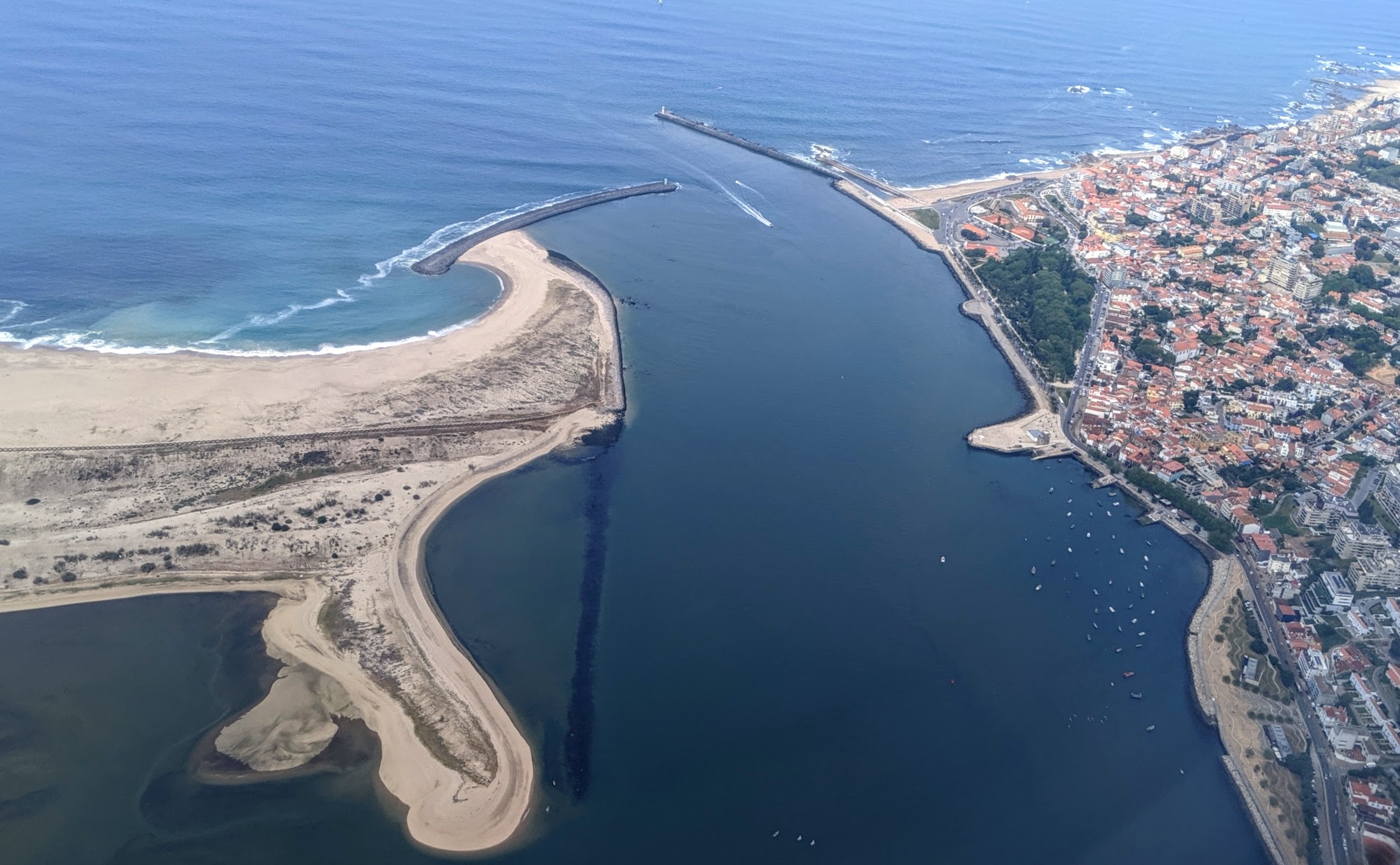
Major Spanish riverside towns include Soria, Almazán, Aranda de Duero, Tordesillas, Zamora and major Portuguese towns include Miranda do Douro, Foz Côa, Peso da Régua, Lamego, Vila Nova de Gaia, and Porto. The most populous cities along the Douro River are Valladolid and Zamora in Spain, and Porto and Vila Nova de Gaia in Portugal. The latter two are located at the mouth of the Douro at the Atlantic Ocean.
In Portugal, the Douro flows through the districts of Bragança, Guarda, Viseu, Vila Real, Aveiro and Porto. Porto is the main hub city in northern Portugal. Its historic centre has been designated as a UNESCO World Heritage Site because of its significant architecture and history.
Economy

These reaches of the Douro have a mesoclimate allowing for cultivation of olives, almonds, and especially grapes, which are important for making port. The region around Pinhão and São João da Pesqueira is considered to be the centre of port, with its quintas (or farms/estates) that extend along the steep slopes of the river valleys. In the 21st century, many of these are owned by multinational, reputed wine companies.
Recently, a prosperous tourist industry has developed based on river excursions from Porto to points along the Upper Douro valley.
The Douro railway line (Linha do Douro) was completed in 1887; it connects Porto, Rio Tinto, Ermesinde, Valongo, Paredes, Penafiel, Livração, Marco de Canaveses, Régua, Tua and Pocinho.
Pocinho is near the very small city of Foz Côa, which is close to Côa Valley Paleolithic Art site. This is considered important to the archaeological pre-historic patrimony, and it has been designated as a UNESCO World Heritage Site.
Dams
Fifteen dams have been built on the Douro to regulate the water flow, generate hydroelectric power, and allow navigation through locks. Beginning at the headwaters, the first five dams are in Spain: Cuerda del Pozo, Los Rábanos, San José, Villalcampo and Castro Dams. The next five downstream are along the Portuguese-Spanish border; the first three are owned and operated by Portugal: (Miranda, Picote and Bemposta Dams), while the next two belong to Spain: (Aldeadávila and Saucelle Dams).
The Douro's last five dams are in Portugal, and allow for navigation: Pocinho, Valeira, Régua, Carrapatelo, and Crestuma–Lever dams. Vessels with a maximum length of 83 m and width of 11.4 m can pass through the five locks. The highest lock, at Carrapatelo Dam, has a maximum lift of 35 m. The waters of Pocinho lake reach 125 m above sea level. Unannounced releases of water from upstream Spanish dams occasionally causes navigation issues in these locks.
Gallery
File:Zamora (9223963842).jpg|The Douro in Zamora (Spain) File:Valladolid rio pisuerga puente mayor playa.jpg|The Pisuerga River (tributary to the Duero) in Valladolid File:The Douro Valley (10185403284).jpg|The Upper Douro valley where Port wine grapes grow File:Rabelo Douro en–Porto.jpg|The typical rabelo boat and Porto historical district in background File:Dom Luis 1 bridge Porto Portugal.JPG|Port wine signs by the Douro River File:Porto Panorama 2004.jpg|Panoramic view of Porto File:Douro2flat1070.jpg|The river between Porto and Vila Nova de Gaia File:Douro Valley Regua.jpg|The river near Régua, Portugal File:Arribes del Duero - Miranda edited.jpg|Douro Internacional near Miranda do Douro File:Arribes del Duero vistos desde Aldeadávila.JPG|Arribes del Duero near Aldeadávila File:Wharfs at the Douro in Porto.jpg|The river mouth in Porto File:Rio Douro (9498681956).jpg|Over Porto File:Estuário do Douro I.jpg|Douro Estuary File:Porto Gaia Foz do Douro.jpg|Looking across the river mouth from Foz do Douro to Vila Nova de Gaia (Atlantic Ocean on the right) File:Urueña almendro1 lou.jpg|Typical almond tree, mostly seen along the river in Portugal File:Terraced vineyards along the Douro river.jpg|Terraced vineyards near Régua are scattered across the rolling hills, reflecting the river.
References
References
- {{Cite American Heritage Dictionary. Douro
- "Douro". [[HarperCollins]].
- "Douro". [[Oxford University Press]].
- {{Cite Merriam-Webster. Douro
- (1992). "The Esla River Basin: From the Cantabrian Mountain to the Duero". Limnetica.
- Ferguson, Robert. (1862). "The River-names of Europe". Williams & Norgate.
- (1978). "Dictionnaire étymologique des noms de rivières et de montagnes en France". [[Klincksieck]].
- Timmons, Nick. (1994). "Portugal".
- (2016). "DK Eyewitness Travel Guide Portugal".
- "Spanish-Portuguese Albufeira Convention". United Nations.
- (May 2010). "Hydrological response of Mediterranean headwaters to climate oscillations and land-cover changes: The mountains of Duero River basin (Central Spain)". [[Global and Planetary Change]].
- "Rivers in Spain". iberianature.com.
- "Guide to Spain CO-CU". iberianature.com.
This article was imported from Wikipedia and is available under the Creative Commons Attribution-ShareAlike 4.0 License. Content has been adapted to SurfDoc format. Original contributors can be found on the article history page.
Ask Mako anything about Douro — get instant answers, deeper analysis, and related topics.
Research with MakoFree with your Surf account
Create a free account to save articles, ask Mako questions, and organize your research.
Sign up freeThis content may have been generated or modified by AI. CloudSurf Software LLC is not responsible for the accuracy, completeness, or reliability of AI-generated content. Always verify important information from primary sources.
Report