From Surf Wiki (app.surf) — the open knowledge base
Dough
Paste used in cooking

Paste used in cooking
the cooking ingredient
Dough is a malleable, sometimes elastic paste made from flour (which itself is made from grains or from leguminous or chestnut crops). Dough is typically made by mixing flour with a small amount of water or other liquid and sometimes includes yeast or other leavening agents, as well as ingredients such as fats or flavourings.
Making and shaping dough begins the preparation of a wide variety of foodstuffs, particularly breads and bread-based items, but also including biscuits, cakes, cookies, dumplings, flatbreads, noodles, pasta, pastry, pizza, piecrusts, scones and similar items. Dough can be made from a wide variety of flour, commonly wheat and rye but also maize, rice, legumes, almonds, and other cereals or crops.
Types of dough

There is no formal definition of what makes dough, though most doughs have viscoelastic properties.
Yeast-leavened doughs are used to make various types of bread, including bread rolls, loaves and some types of flatbread. Not all yeast doughs require kneading. High-hydration doughs like ciabatta and focaccia may be folded to develop gluten or not kneaded at all. Commercial bread dough may also include dough conditioners, which help make the dough and the final product more consistent.
The addition of milk, salt, fats, eggs, sugar or other ingredients will produce bread products of varying texture. Enriched doughs include Viennoiserie, and some old-fashioned holiday breads made with brioche doughs like babka, panettone and king cake. Quick breads use leavening agents other than yeast (such as baking powder or baking soda), and include soda bread, scones and biscuits.
Unleavened bread is made not only from wheat but in many cultures has been made from locally available starchy ingredients like corn, oats and cassava since the earliest times.
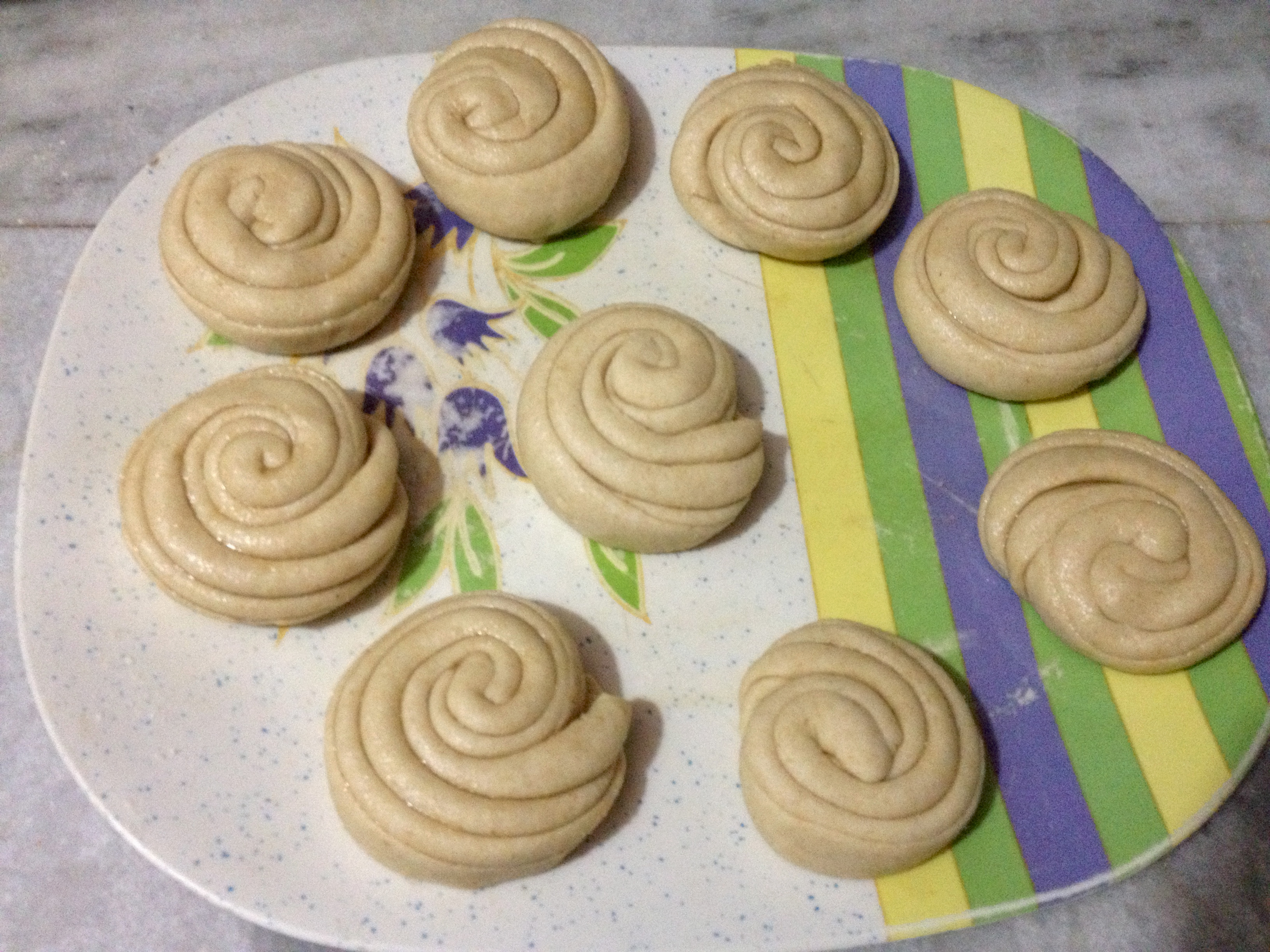
Laminated dough such as mille-feuille and puff pastry are flour-based doughs folded over fat to create layers and rolled out. The folding and rolling process can be repeated to create very thin layers of dough and butter to create the puff pastry. There are many different techniques to create laminated doughs; some, like paratha, are relatively simple, while others, like mille-feuille, are more laborious. Most laminated doughs are leavened only by the steam created by the folding process. Croissants, however, are made with yeast.
Choux pastry is a steam-leavened dough used for some types of sweet pastries, notably cream puffs, eclairs, some homemade funnel cakes, tulumba and churros. Unlike most other pastry doughs, the ingredients for the dough are cooked on the stove top before the dough is baked until achieving the consistency of a thick paste. Choux means 'cabbage' in French. It is thought that the name comes from the shape of the cream puffs made with choux paste.
Gluten gives dough structure and texture. Gluten-free or low-gluten doughs may need additional considerations. Gluten-free doughs like rice noodles and Japanese harusame noodles depend on the gelatinization of starch for structure.
Doughs with higher fat content develop less gluten and are, therefore, generally less elastic than most bread doughs. They tend to become tough when they are kneaded. These doughs are often called "short" by bakers. Examples include many cookie and pie doughs such as shortcrust pastry.
Some dumpling and pasta doughs are similar enough that experts have difficulty distinguishing them, although dumpling is a very general category that overlaps with others like yeasted breads and batter biscuits. Varying the ratio of liquid and flour in a basic pasta dough may create a softer dough like that used for the German soup noodle spaetzle. Eggs are a very common addition to make the dough moist and easier to roll out. The dough can be filled or shaped various ways and boiled, baked, steamed or fried.
Sometimes meringue is considered a dough.
Techniques
Techniques used in dough production depend on the type of dough and final product.
For yeast-based and sponge (such as sourdough) breads, a common production technique is the dough is mixed, kneaded, and then left to rise. Many bread doughs call for a second stage, where the dough is kneaded again, shaped into the final form, and left to rise a final time (or proofed) before baking. Kneading is the process of working a dough to produce a smooth, elastic dough by developing gluten. This process is both temperature and time-dependent; temperatures that are either too hot or too cold will cause the yeast to not develop, and rising times that are either too short or too long will affect the final product.
Pasta is typically made from a dry dough that is kneaded and shaped, either through extrusion, rolling out in a pasta machine, or stretched or shaped by hand (as for gnocchi or dumplings). Pasta may be cooked directly after production (so-called "fresh pasta") or dried, which renders it shelf-stable.
Doughs for biscuits and many flatbreads which are not leavened with yeast are typically mixed but not kneaded or left to rise; these doughs are shaped and cooked directly after mixing.
While breads and other products made from doughs are often baked, some types of dough-based foods are cooked over direct heat, such as tortillas, which are cooked directly on a griddle. Fried dough foods are also common in many cultures.
Pancakes, waffles, some kinds of bar cookies such as brownies, and many cakes and quick breads (including muffins and the like) are often made with a semi-liquid batter of flour and liquid that is poured into the final shape, rather than a solid dough. Unlike bread dough, these batters are not stabilized by the formation of a gluten network.
File:Cirdingis36.gif|Dough being kneaded File:Breaddough1.jpg|Yeast bread dough after kneading, before rising File:Breaddough2.jpg|Yeast bread dough after rising (proofing), for 40 minutes File:Pasta machine.jpg|Dough being cut into noodles with a pasta machine
References
References
- (1997). "Handbook of Food Engineering Process".
- Tylor, Edward Burnett. (1881). "Anthropology: an introduction to the study of man and civilization".
- Cooking through History: A Worldwide Encyclopedia of Food with Menus and Recipes. 2020. ABC-CLIO.
- Goldstein Darra. 2015. The Oxford Companion to Sugar and Sweets. Oxford: Oxford University Press.
- Carter, Noelle. "How to make your own delicious funnel cake". Austin American-Statesman.
- Alan Davidson. National & Regional Styles of Cookery: Proceedings: Oxford Symposium. 1981.
- McGee Harold. 2004. On Food and Cooking : The Science and Lore of the Kitchen Completely rev. and updated ed. New York: Scribner.
- "This is how to make perfect shortcrust pastry". Good Housekeeping.
- Heinzelmann Ursula. 2008. Food Culture in Germany. Westport Conn: Greenwood Press.
- Culinary Institute of America. 2011. The Professional Chef. 9th ed. Hoboken N.J: John Wiley & Sons.
- Thaker Aruna and Arlene Barton. 2012. Multicultural Handbook of Food Nutrition and Dietetics. Chichester West Sussex UK: Wiley-Blackwell.
- The English recipe for "Satin Biscuit" dates to 1677, and earlier recipes are known by different names. Some included flour like a 1604 recipe for "white bisket bread".Day Ivan. 2009. Cooking in Europe 1650-1850. Westport Conn: Greenwood Press.
- Rathod, Anurag. (2023-02-09). "From Antiquated to Advanced: The History of Pizza Dough Rollers".
- (1997). "Joy of Cooking". Scribner.
- Stanley P. Cauvain. (2012) Chapter 12: Baking. in ''Food Processing Handbook.'' 2 ed. Wiley. p. 422 {{ISBN. 9783527324682. This reference is specifically about cake batter.
This article was imported from Wikipedia and is available under the Creative Commons Attribution-ShareAlike 4.0 License. Content has been adapted to SurfDoc format. Original contributors can be found on the article history page.
Ask Mako anything about Dough — get instant answers, deeper analysis, and related topics.
Research with MakoFree with your Surf account
Create a free account to save articles, ask Mako questions, and organize your research.
Sign up freeThis content may have been generated or modified by AI. CloudSurf Software LLC is not responsible for the accuracy, completeness, or reliability of AI-generated content. Always verify important information from primary sources.
Report