From Surf Wiki (app.surf) — the open knowledge base
Double-stack rail transport
Railroad cars carrying two layers of intermodal containers

Railroad cars carrying two layers of intermodal containers
Double-stack rail transport is a form of intermodal freight transport in which railroad cars carry two layers of intermodal containers. Invented in the United States in 1984, it is now being used for nearly 70% of United States intermodal shipments. Using double stack technology, a freight train of a given length can carry roughly twice as many containers, sharply reducing transport costs per container. On United States railroads, special well cars are used for double-stack shipment to reduce the needed vertical clearance and to lower the center of gravity of a loaded car. In addition, the well car design reduces damage in transit and provides greater cargo security by cradling the lower containers so their doors cannot be opened. A succession of larger container sizes have been introduced to further increase shipping productivity in the United States.
Double-stack rail operations are growing in other parts of the world, but are often constrained by clearance and other infrastructure limitations.
History
Southern Pacific Railroad (SP), and Robert Ingram, of SeaLand, debuted the double-stack intermodal car in 1977. SP and Ingram jointly designed the first car with ACF Industries in 1976. At first it was slow to become an industry standard, then in 1984 American President Lines, started working with the Union Pacific Railroad and that same year, the first all double-stack train left Los Angeles, California for South Kearny, New Jersey, under the name of "Stacktrain" rail service. Along the way the train transferred from the UP to the Chicago and North Western Railway and then to Conrail.
Sizes and clearances

Double-stack cars come in a number of sizes, related to the standard sizes of the containers they are designed to carry. Well lengths of 12.19 m, 14.63 m and 16.15 m are most common. Heights range from 2.44 m to 2.908 m ("high cube").
Double stack requires a higher clearance above the tracks, or structure gauge, than do other forms of rail freight. Double-stack cars are most common in North America where intermodal traffic is heavy and electrification is less widespread; thus overhead clearances are typically more manageable. Nonetheless, North American railroads have invested large sums to raise bridges and tunnel clearances along their routes and remove other obstacles to allow greater use of double stack trains and to give them more direct routes. Outside North America some rail routes have been built or upgraded to such standards as to allow both electrification with overhead wires and double stacking.{{cite web |url=https://rdso.indianrailways.gov.in/works/uploads/File/Railway%20_Gazette_Double_Stack%20Container(1).pdf |title= Double-stack under the wires
CSX lists three clearance heights above top of rail for double stack service:
- Doublestack 1 — 18 ft
- Doublestack 2 — 19 ft
- Doublestack 3 — 20 ft
- Doublestack 4 — 20 ft
The last two clearances offer the most flexibility, allowing two high cube containers to be stacked.
Stacking containers
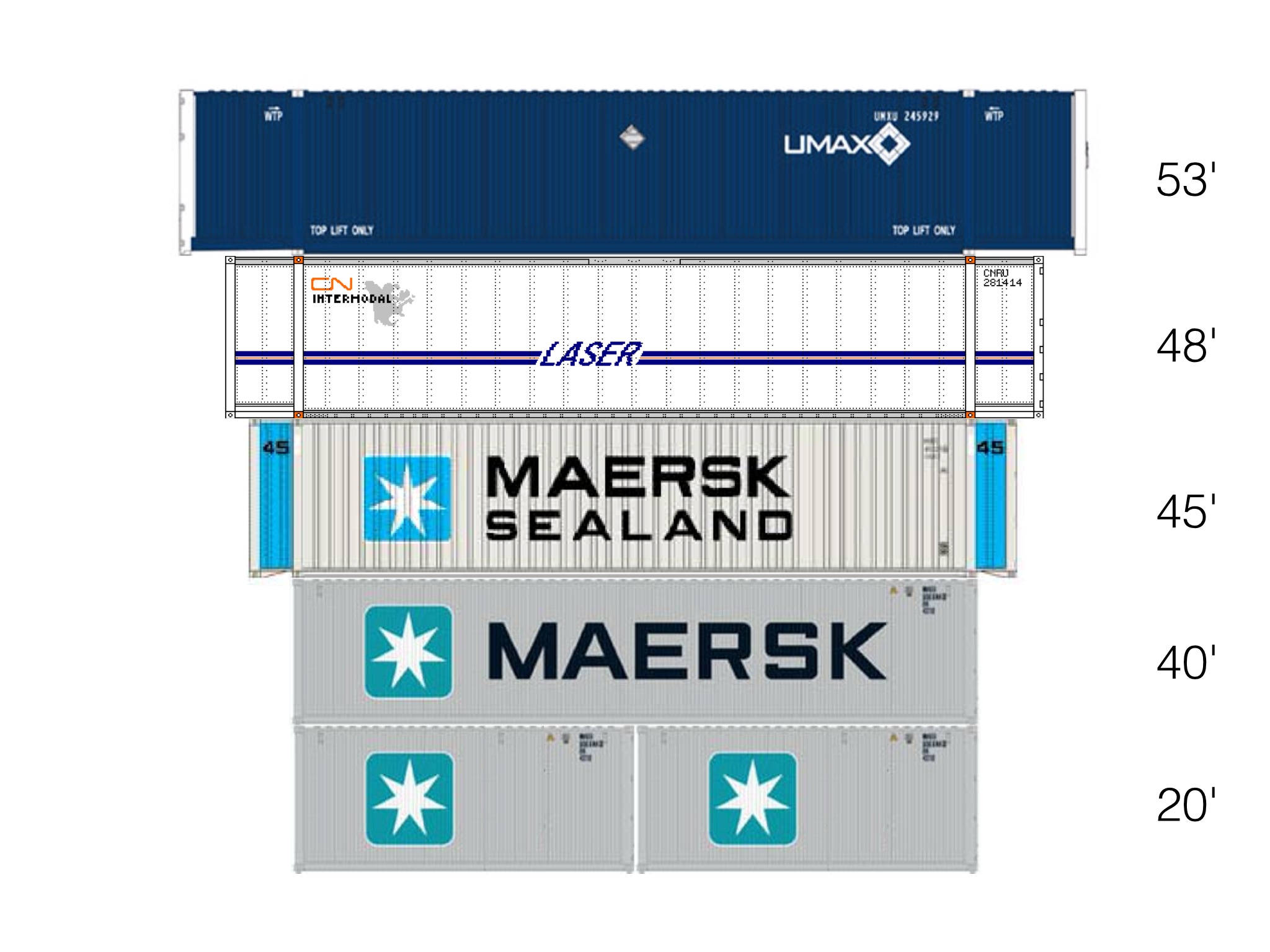
Forty-foot containers are the standard unit length and load bearing points are at the ends of such containers. Longer containers, such as 45, 48 and 53 feet long, still have the load bearing points 40 feet apart, with the excess protruding equally outside this length. Therefore, 40-foot containers, or larger, can be stacked on 20-foot containers if there are two 20-foot containers in a row; however, 20-foot containers cannot be stacked on top of 40-foot or longer containers. The possible double-stacking patterns are:
- Two 20 ft in lower and one 40 ft (or longer) in upper stack (allowed in India, China, US)
- One 40 ft in lower and another 40 ft (or longer) in upper stack (allowed in India, US)
- Two 20 ft in lower and another set of two 20 ft in upper stack.
The container coupling holes are all female and double male twistlocks are required to securely mate container stacks together.
Dwarf containers
China had started to experiment using reduced-size containers to be stacked on to normal containers to allow transport under 25 kV overhead line electrification.
India has started to build a series of dwarf container for domestic transport to be run under 25 kV electrification. With a height of 6 ft they are 662 mm shorter than ISO shipping containers but 162 mm wider while still allowing for 67% more capacity when double stacked as compared to single stack ISO container. The width is comparable to that of North American 53-foot containers.
Weights
Containers have weight limits designed to allow their transport by road trucks, which have lower weight limits than trains. Outside the U.S., a common limit for railways is 8 t/m train length and 22.5 t per axle. A four axle container car can take 90 t. Since a container is limited to 30.5 t, even including the empty weight of the rail car, single stacking uses only part of the load capacity of the railway. A 20 ft container is limited to 24 t and two such can fit into a car for a 40 ft container, or even three if double-stacking, but not four unless very high axle load is permitted. The North American railways permit two 53 ft containers as shown in the images on this page.
Another consideration is the maximum weight of a train. A maximum length train in Europe, 750 m long can have 50 container cars with a total weight of 2250 t, and more if 20 ft containers are included. This is not far from the limit using standard European (freight) couplers.
Operations
North America
Intermodal containers shipped by rail within North America are primarily 53 ft long, with trailer-on-flat-car (TOFC) units used as well. The 53-foot length reflects a common maximum length for highway semi-trailers, which varies by state. Major domestic intermodal carriers include:
- J. B. Hunt
- Swift
- Schneider National
- Hub Group Containers shipped between North America and other continents consist of mostly 40 ft and some 45 ft and 20 ft containers. Container ships only take 40's, 20's and also 45's above deck. 90% of the containers that these ships carry are 40-footers and 90% of the world's freight moves on container ships; so 81% of the world's freight moves by 40-foot containers. Most of these 40-foot containers are owned by non-U.S. companies like Maersk, MSC, and CMA CGM. The only U.S. 40-foot container companies are leasing companies like Textainer, Triton International, and CAI Leasing.
Low bridges and narrow tunnels in various locations prevent the operation of double-stack trains until costly upgrades are made. Some Class I railroad companies in the U.S., often in partnership with government agencies, have implemented improvement programs to remove obstructions to double-stack trains. Double-stack projects include:
- Heartland Corridor (Norfolk Southern Railway) — $320 million
- Norfolk Southern Crescent Corridor — $2.5 billion (estimate)
- National Gateway (CSX Transportation) — $700 million
- Commonwealth Railway — $69 million
- Chicago Region Environmental and Transportation Efficiency Program — $3 billion (estimate)
- Cross-Harbor Rail Tunnel proposed to connect rail freight lines in New Jersey with Long Island, New York. — $10–14 billion (estimate)
- Continental Rail Gateway (Canadian Pacific Railway), proposed tunnel between Detroit, Michigan and Windsor, Ontario to replace the existing Michigan Central Railway Tunnel. — $400 million
File:DTTX 724681 20050529 IL Rochelle.jpg|Part of a double-stack train, with 53-foot containers File:APM Terminals WJ Grimes.JPG|Double-stack train loaded at APM Terminals in Portsmouth, Virginia File:Intermodal shipping containers on a railway flat car.jpg|Transportación marítima mexicana (TMM) containers on a double stack train car, 2008 File:Cajon Intermodal.jpg|A BNSF double-stack train passing through Cajon Pass in California, with a mix of 20-foot and 40-foot containers
Outside North America

On the vast majority of its network, Europe has more restricted loading gauge and train weight limits as well as axle load limits. In other words, many bridges and tunnels are too low for double-stacking. In addition, since European electrification standards generally predated double stacking and were not designed to accommodate for larger clearances than those permitted by existing bridges and tunnels, the overhead catenary in Europe is also too low to accommodate double stacking. Only a few newly built routes make accommodation for possible double stacking in the future such as the Betuweroute in the Netherlands which however links to no other railway line allowing double stacking.
Standard gauge railways in North America and China must use special well cars to lower the center of gravity, fit within the loading gauge and in China allow double stack trains to run under specially heightened overhead lines. broad gauge used in India enables trains to carry standard shipping containers double-stacked on standard flat wagons. Flat wagons, in addition to being much less expensive than well wagons, can carry more containers in a given length of train. Indian Railways is able to carry containers double-stacked on standard flat wagons at 100 km/h. Experiments with triple-stacked operation using lower, 1,981 mm containers, were done unsuccessfully in 2006. Experiments in India for double stacking using flatcars under 25 kV AC overhead lines set 7.45 m above rail have begun with funds given by Japan.
- Australia Australia - double-stacked trains operate between Perth, Adelaide, Darwin and Parkes, New South Wales 6.5 m clearances. , the Inland Railway between Melbourne and Brisbane was being built for operation of double stacked trains.
- BRA Brazil - Double Stacked trains in Brazil already operates between the intermodal terminal of Sumaré-SP and Rondonópolis-MT (around 1000 km). The operation started in June 2019 by Brado Logística. Besides that, a brand new railroad called "Ferrovia Norte - Sul" will also operate with Double Stack container trains. The operation will start in 2021.
- CHN China - A number of select Class I trunk railway lines in China were constructed or upgraded with 25 kV AC overhead lines high enough to operate double-stacked container trains but currently do not see any double-stack service, such as the Nanjing–Qidong railway, Nantong–Shanghai railway, Guangzhou–Zhuhai railway and sections of the Beijing–Kowloon railway and Longhai railway. Since 2018, China Railway started operating double-stacked standard containers in well-wagons hauled by electric locomotives under overhead lines from Port of Ningbo-Zhoushan along the Xiaoshan–Ningbo railway and Chuanshan Port branch line to Shaoxing. Another railway in the area capable of operating double stack containers under overhead lines, the Ningbo–Jinhua railway connecting Port of Ningbo-Zhoushan to Yiwu and Jinhua, is under construction. Other under construction railways capable of operating double stack containers under overhead lines are the Liuzhou-Guangzhou Railway between Guangdong and Guangxi, Lanzhou-Chongqing Railway and a line from Guiyang via Nanning to the port city of Qinzhou. China's National Transportation Outline envisions a network of electric double stack container services connecting all major cities and ports.
- IND India - Mundra Port and Pipavav Port operate double-stacked diesel and electric trains on gauge using flat wagons. India is building the Dedicated Freight Corridor an electric traction freight railway network which can transport double-stack international standard containers. The tracks are entirely grade-separated and have a generous loading gauge of 3660 mm width and 7,100 mm maximum height allowing for the double-stacked shipping container on flatcars to be transported, in contrast to wellcars used in other countries for double-stack rail transport. This allows for single trains to have a 400-container capacity.
- KEN Kenya - The Mombasa-Nairobi standard gauge railway has been built for the operation of double-stacked trains, the first such trains being launched on October 1, 2018. All future extensions will be built to similar standards.
- NED Netherlands - The Betuweroute, a freight rail line between Rotterdam and the German border built in 2007 is prepared for double-stacking insofar as tunnels and bridges have been built to accommodate double stack trains to reduce the cost and time of any future upgrade to the network. The current catenary wire is too low for double stack rail transport (meaning the catenary would have to be raised to allow double stacking) and the upgrade is dependent on the German section of the railway connection as there are no accommodations for future double stack transport on any line connecting to the Betuweroute on the German side.
- PAN Panama - The rebuilt Panama Canal Railway operates double-stack container trains 47.6 miles (76.6 km) across the Isthmus of Panama from Colón on the Atlantic Ocean, to Balboa on the Pacific, near Panama City.
- SAU Saudi Arabia - Saudi Railways Organization line to Dammam.
References
References
- Kaminski, Edward S.. (1999). "American Car & Foundry Company: A Centennial History, 1899–1999". Signature Press.
- "Railroad Operational Panel". Transportation Law Journal, Vol. 28 (2000).
- (September 1, 1990). "A new fleet shapes up. (High-Tech Railroading)". Railway Age.
- "AAR Open Top Loading Rules Manual (August 2020) - Appendix A".
- "Guide to Railcars".
- (3 December 2020). "Commentary: Electrify California's Trains Now".
- "CSX System Clearance Map— Doublestack Routes".
- "AAR Open Top Loading Rules Manual (August 2020) - Appendix A".
- "CAIN-NSC-HDWELL_16.jpg".
- Vishwas Kothari. (2018-07-10). "Indian railways introduces first double stack dwarf containers". Times of India.
- "Table 3-6: Semitrailer Length Limitations on National Truck Network by State".
- [https://finance.yahoo.com/quote/TRTN-PA/profile?ltr=1 Triton]
- [https://finance.yahoo.com/quote/CAI/profile?ltr=1 CAI]
- (September 9, 2010). "Norfolk Southern opens Heartland Corridor".
- (May 1, 2008). "CSX Announces National Gateway to Improve Flow of Freight". CSX.
- (July 2017). "New Commonwealth Railway line set to open".
- Battagello, Dave. (November 1, 2011). "Rail tunnel awaiting government funds".
- [https://www.maritime-database.com/company.php?cid=244388 Transportación marítima mexicana (TMM)]
- "Low center of gravity".
- Das, Mamuni. (October 15, 2007). "Spotlight on double-stack container movement". The Hindu Business Line.
- Das, Mamuni. (October 29, 2007). "Green signal for triple-stacks on diesel routes". The Hindu Business Line.
- Rao, Raghvendra. (October 10, 2006). "Rlys to operate triple-stack container trains".
- "Photo Gallery: IRJ".
- Dayal, Raghu. (May 2009). "Preparing to handle double-stack containers". Railway Gazette International.
- (August 2009). "Reaching up". Railway Gazette International.
- (July 28, 2008). "Double stacked to Perth". Parkes Champion Post.
- (June 30, 2008). "2008-2024 Interstate and Hunter Valley Rail Infrastructure Strategy".
- "Service offering {{!}} Inland Rail".
- "Brado anuncia investimentos de R$30 milhões em vagões double stack na Intermodal South America".
- (28 March 2019). "Rumo vence trecho de 1,5 mil quilômetros da Ferrovia Norte-Sul".
- "Aerodynamic Effects Caused by Trains Entering Tunnels".
- "非人狂想屋 {{!}} 你的火车发源地 » X2K双层集装箱行驶在京沪线".
- "宁启铁路复线电气化工程开工仪式在江苏泰州举行".
- sina_mobile. (2017-01-21). "中国跨度最大公铁两用钢拱桥合龙(图)".
- "「通沪铁路7月运营,宁启-通沪路增开动车组38对」- 南通房产超市".
- "上海铁路局:宁启铁路4月11日起进行动态检测".
- "广珠铁路首趟货运列车从珠海高栏港站首发(图)-搜狐新闻".
- "京九铁路(南昌局段)电气化改造工程完成挂网架线".
- "京九铁路将可开行双层集装箱列车_滚动新闻_新浪财经_新浪网".
- "图文:京九北线电气化铁路进行重载货车试运行-搜狐新闻".
- "东陇海铁路可走双层集装箱列车_新闻中心_新浪网".
- "穿山港铁路支线开建 可跑双层集装箱火车_中国宁波网_民生·城事".
- "运能提高38%,国内首趟双层集装箱海铁联运班列舟山港首发".
- "非人狂想屋 {{!}} 你的火车发源地 » HXD1B牵引双层集装箱列车".
- "甬金铁路全线开工!可开行双层集装箱列车".
- "重大进展!金甬铁路全线迈入架梁施工阶段".
- "兰渝铁路岷县至广元段正式开通运营".
- "兰渝铁路广元至重庆段今起开行动车 运行时间压缩1.5小时-新华网".
- "贵阳经南宁至钦州拟建双层集装箱铁路-新华网".
- "未来15年高铁建设强度仍将高于普速铁路 着力发展高铁快递快运-中经实时报-中国经营网".
- "新筑车站更名,请叫我"西安国际港站"!_腾讯新闻".
- "铁道部将加快东北地区铁路建设".
- ""双层高箱"开启铁路运输新模式".
- "Salient features".
- UIC – International union of railways. (2015-11-18). "DFCCIL – Dedicated Freight Corridors Corporation of India Limited".
- "Mombasa-Nairobi Standard Gauge Railway Project".
- Sanga, Benard. "SGR launches double-stack freight trains".
- (April 1, 2004). "The Betuweroute solution".
- "SRO president urges acceleration of rail projects".


This article was imported from Wikipedia and is available under the Creative Commons Attribution-ShareAlike 4.0 License. Content has been adapted to SurfDoc format. Original contributors can be found on the article history page.
Ask Mako anything about Double-stack rail transport — get instant answers, deeper analysis, and related topics.
Research with MakoFree with your Surf account
Create a free account to save articles, ask Mako questions, and organize your research.
Sign up freeThis content may have been generated or modified by AI. CloudSurf Software LLC is not responsible for the accuracy, completeness, or reliability of AI-generated content. Always verify important information from primary sources.
Report