From Surf Wiki (app.surf) — the open knowledge base
Double fertilization
Complex fertilization mechanism of flowering plants

Complex fertilization mechanism of flowering plants
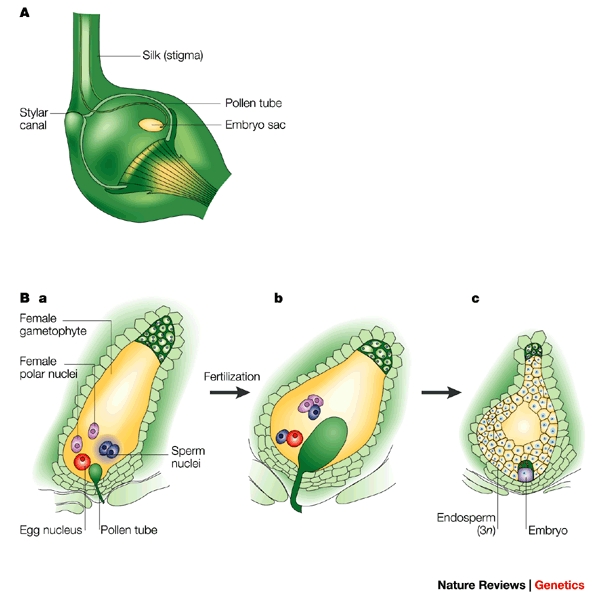
Double fertilization or double fertilisation (see spelling differences) is a complex fertilization mechanism of angiosperms. This process involves the fusion of a female gametophyte or megagametophyte, also called the embryonic sac, with two male gametes (sperm). It begins when a pollen grain adheres to the stigmatic surface of the carpel, the female reproductive structure of angiosperm flowers. The pollen grain begins to germinate (unless a type of self-incompatibility that acts in the stigma occurs in that particular species and is activated), forming a pollen tube that penetrates and extends down through the style toward the ovary as it follows chemical signals released by the egg. The tip of the pollen tube then enters the ovary by penetrating the micropyle opening in the ovule, and releases two sperm into the embryonic sac (megagametophyte).
The mature embryonic sac of an unfertilized ovule is 7-cellular and 8-nucleate. It is arranged in the form of 3+1+3 (from top to bottom) i.e. 3 antipodal cells, 1 central cell (binucleate), 2 synergids & 1 egg cell. One sperm fertilizes the egg cell and the other sperm fuses with the two polar nuclei of the large central cell of the megagametophyte. The haploid sperm and haploid egg fuse to form a diploid zygote, the process being called syngamy, while the other sperm and the diploid central cell fuse to form a triploid primary endosperm cell (triple fusion). Some plants may form polyploid nuclei. The large cell of the gametophyte will then develop into the endosperm, a nutrient-rich tissue which nourishes the developing embryo. The ovary, surrounding the ovules, develops into the fruit, which protects the seeds and may function to disperse them.
The two central cell maternal nuclei (polar nuclei) that contribute to the endosperm, arise by mitosis from the same single meiotic product that gave rise to the egg. The maternal contribution to the genetic constitution of the triploid endosperm is double that of the sperm.
In a study conducted in 2008 of the plant Arabidopsis thaliana, the migration of male nuclei inside the female gamete, in fusion with the female nuclei, has been documented for the first time using in vivo imaging. Some of the genes involved in the migration and fusion process have also been determined.
Evidence of double fertilization in Gnetales, which are non-flowering seed plants, has been reported. | doi-access =
Brief history
Double fertilization was discovered more than a century ago by Sergei Nawaschin in Kyiv
--,{{cite journal |author=Kordium EL |title=Double fertilization in flowering plants: 1898-20&&&--
Double fertilization in gymnosperms
A far more rudimentary form of double fertilization occurs in the sexual reproduction of an order of gymnosperms commonly known as Gnetales. Specifically, this event has been documented in both [Ephedra and Gnetum, a subset of gnetophytes. In Ephedra nevadensis, a single binucleate sperm cell is deposited into the egg cell. Following the initial fertilization event, the second sperm nucleus is diverted to fertilize an additional egg nucleus found in the egg cytoplasm. In most other seed plants, this second 'ventral canal nucleus' is normally found to be functionally useless. In Gnetum gnemon, numerous free egg nuclei exist in female cytoplasm inside the female gametophyte. Succeeding the penetration of the mature female gametophyte by the pollen tube, female cytoplasm and free nuclei move to surround the pollen tube. Released from the binucleate sperm cell are two sperm nuclei which then fuse with free egg nuclei to produce two viable zygotes, a homologous characteristic between families Ephedra and Gnetum. In both families, the second fertilization event produces an additional diploid embryo. This supernumerary embryo is later aborted, leading to the synthesis of only one mature embryo. The additional fertilization product in Ephedra does not nourish the primary embryo, as the female gametophyte is responsible for nutrient provision. The more primitive process of double fertilization in gymnosperms results in two diploid nuclei enclosed in the same egg cell. This differs from the angiosperm condition, which results in the separation of the egg cell and endosperm. Comparative molecular research on the genome of G. gnemon has revealed that gnetophytes are more closely related to conifers than they are to angiosperms. The rejection of the anthophyte hypothesis, which identifies gnetales and angiosperms are sister taxa, leads to speculation that the process of double fertilization is a product of convergent evolution and arose independently among gnetophytes and angiosperms.
In vitro double fertilization
In vitro double fertilization is often used to study the molecular interactions as well as other aspects of gamete fusion in flowering plants. One of the major obstacles in developing an in vitro double fertilization between male and female gametes is the confinement of the sperm in the pollen tube and the egg in the embryonic sac. A controlled fusion of the egg and sperm has already been achieved with poppy plants. Pollen germination, pollen tube entry, and double fertilization processes have all been observed to proceed normally. In fact, this technique has already been used to obtain seeds in various flowering plants and was named “test-tube fertilization”.
References
References
- Berger, F.. (January 2008). "Double-fertilization, from myths to reality". Sexual Plant Reproduction.
- (August 2008). ["Double fertilization – Caught In The Act"](http://scholarbank.nus.edu.sg/handle/10635/129674 }}<!--). [[Trends in Plant Science]].
- Jensen, W. A.. (February 1998). "Double Fertilization: A Personal View". [[Sexual Plant Reproduction]].
- (August 2008). "Fertilization and Early Seed Formation". [[Comptes Rendus Biologies]].
- (1995-12-01). "Double Fertilization in Gnetum gnemon: The Relationship between the Cell Cycle and Sexual Reproduction.". The Plant Cell.
- Friedman, William E.. (1990). "Sexual Reproduction in Ephedra nevadensis (Ephedraceae): Further Evidence of Double Fertilization in a Nonflowering Seed Plant". American Journal of Botany.
- (1996). "Double Fertilization in Gnetum gnemon (Gnetaceae): Its Bearing on the Evolution of Sexual Reproduction within the Gnetales and the Anthophyte Clade". American Journal of Botany.
- Friedman, W. E.. (1995-04-25). "Organismal duplication, inclusive fitness theory, and altruism: understanding the evolution of endosperm and the angiosperm reproductive syndrome.". Proceedings of the National Academy of Sciences.
- Friedman, William E.. (1994). "The Evolution of Embryogeny in Seed Plants and the Developmental Origin and Early History of Endosperm". American Journal of Botany.
- (2000-04-11). "Phylogeny of seed plants based on all three genomic compartments: Extant gymnosperms are monophyletic and Gnetales' closest relatives are conifers". Proceedings of the National Academy of Sciences.
- (1999-06-22). "MADS-box genes reveal that gnetophytes are more closely related to conifers than to flowering plants". Proceedings of the National Academy of Sciences.
- (2002-12-01). "Relationships among seed plants inferred from highly conserved genes: sorting conflicting phylogenetic signals among ancient lineages". American Journal of Botany.
- (2000-04-11). "Seed plant phylogeny inferred from all three plant genomes: Monophyly of extant gymnosperms and origin of Gnetales from conifers". Proceedings of the National Academy of Sciences.
- Zenkteler, M.. (1990). "In vitro fertilization and wide hybridization in higher plants". Crit Rev Plant Sci.
This article was imported from Wikipedia and is available under the Creative Commons Attribution-ShareAlike 4.0 License. Content has been adapted to SurfDoc format. Original contributors can be found on the article history page.
Ask Mako anything about Double fertilization — get instant answers, deeper analysis, and related topics.
Research with MakoFree with your Surf account
Create a free account to save articles, ask Mako questions, and organize your research.
Sign up freeThis content may have been generated or modified by AI. CloudSurf Software LLC is not responsible for the accuracy, completeness, or reliability of AI-generated content. Always verify important information from primary sources.
Report