From Surf Wiki (app.surf) — the open knowledge base
Douady rabbit
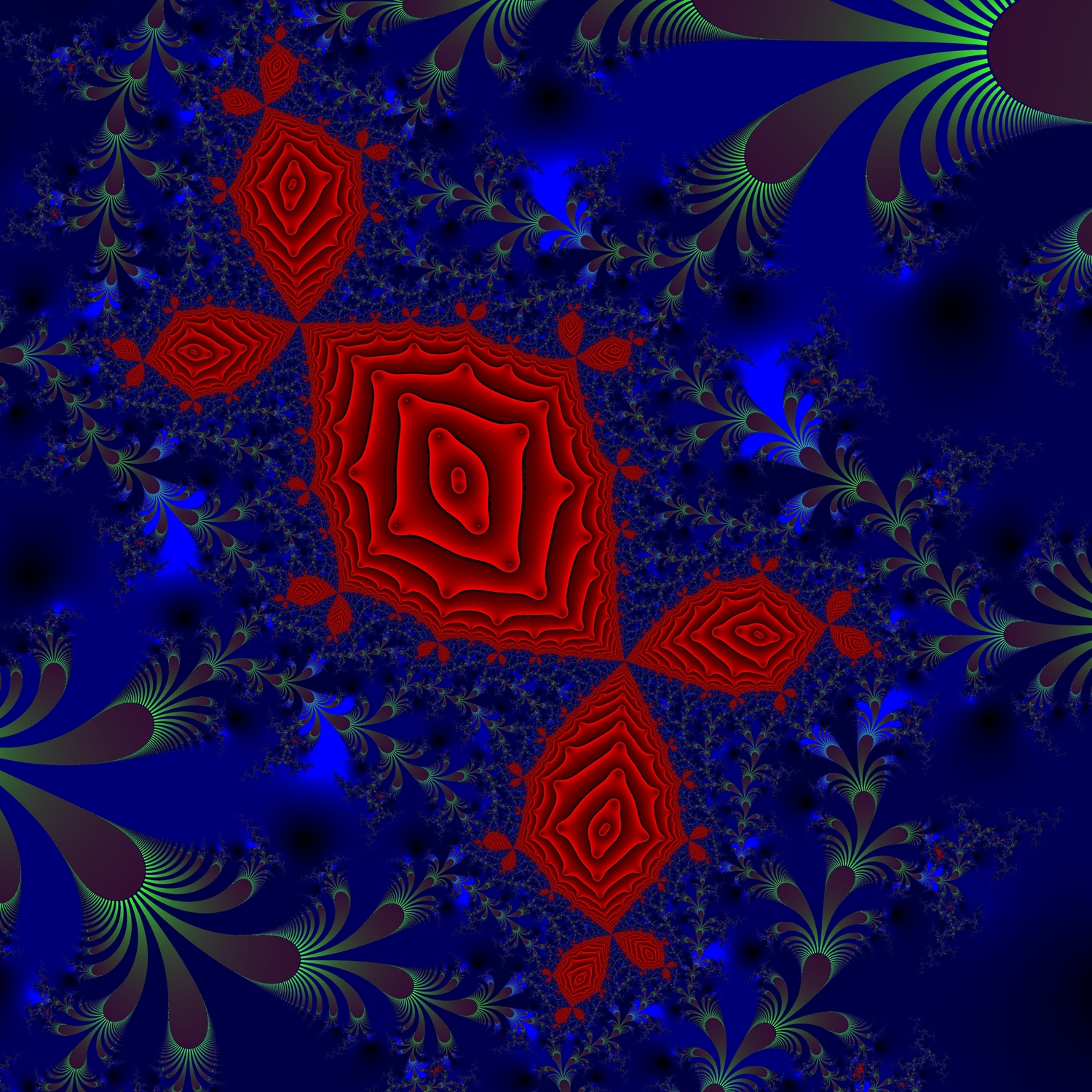
Fractal related to the mandelbrot set

Fractal related to the mandelbrot set
It is named after French mathematician Adrien Douady.
Background
The Douady rabbit is generated by iterating the Mandelbrot set map z_{n+1}=z_n^2+c on the complex plane, where parameter c is fixed to lie in one of the two period three bulb off the main cardioid and z ranging over the plane. The resulting image can be colored by corresponding each pixel with a starting value z_0 and calculating the amount of iterations required before the value of z_n escapes a bounded region, after which it will diverge toward infinity.
It can also be described using the logistic map form of the complex quadratic map, specifically
:z_{n+1} = \mathcal M z_n := \gamma z_n \left(1 - z_n\right).
which is equivalent to
w_{n+1}=w_n^2+c.
Irrespective of the specific iteration used, the filled Julia set associated with a given value of \gamma (or \mu) consists of all starting points z_0 (or w_0) for which the iteration remains bounded. Then, the Mandelbrot set consists of those values of \gamma (or \mu) for which the associated filled Julia set is connected. The Mandelbrot set can be viewed with respect to either \gamma or \mu.
Noting that \mu is invariant under the substitution \gamma \to 2 - \gamma, the Mandelbrot set with respect to \gamma has additional horizontal symmetry. Since z and w are affine transformations of one another, or more specifically a similarity transformation, consisting of only scaling, rotation and translation, the filled Julia sets look similar for either form of the iteration given above.
Detailed description


You can also describe the Douady rabbit utilising the Mandelbrot set with respect to \gamma as shown in the graph above. In this figure, the Mandelbrot set superficially appears as two back-to-back unit disks with sprouts or buds, such as the sprouts at the one- and five-o'clock positions on the right disk or the sprouts at the seven- and eleven-o'clock positions on the left disk. When \gamma is within one of these four sprouts, the associated filled Julia set in the mapping plane is said to be a Douady rabbit. For these values of \gamma, it can be shown that \mathcal M has z=0 and one other point as unstable (repelling) fixed points, and z=\infty as an attracting fixed point. Moreover, the map {\mathcal{M}}^3 has three attracting fixed points. A Douady rabbit consists of the three attracting fixed points z_1, z_2, and z_3 and their basins of attraction.
For example, Figure 4 shows the Douady rabbit in the z plane when \gamma=\gamma_D=2.55268-0.959456i, a point in the five-o'clock sprout of the right disk. For this value of \gamma, the map \mathcal M has the repelling fixed points z=0 and z=.656747-.129015i. The three attracting fixed points of {\mathcal M}^3 (also called period-three fixed points) have the locations
:\begin{align} z_1 &= 0.499997032420304 - (1.221880225696050\times10^{-6})i{;}{;}{\mathrm {(red)}},\ z_2 &= 0.638169999974373 - (0.239864000011495)i{;}{;}{\mathrm {(green)}},\ z_3 &= 0.799901291393262 - (0.107547238170383)i{;}{;}{\mathrm {(yellow)}}. \end{align}
The red, green, and yellow points lie in the basins B(z_1), B(z_2), and B(z_3) of {\mathcal M}^3, respectively. The white points lie in the basin B(\infty) of \mathcal M.
The action of \mathcal M on these fixed points is given by the relations {\mathcal M}z_1=z_2, {\mathcal M}z_2=z_3, and {\mathcal M}z_3=z_1.
Corresponding to these relations there are the results
:\begin{align} {\mathcal M}B(z_1)&=B(z_2) {;} {\mathrm {or}} {;} {\mathcal M}{;}{\mathrm {red}}\subseteq{\mathrm {green}},\ {\mathcal M}B(z_2)&=B(z_3) {;} {\mathrm {or}} {;} {\mathcal M}{;}{\mathrm {green}}\subseteq{\mathrm {yellow}},\ {\mathcal M}B(z_3)&=B(z_1) {;} {\mathrm {or}} {;} {\mathcal M}{;}{\mathrm {yellow}}\subseteq{\mathrm {red}}. \end{align}

As a second example, Figure 5 shows a Douady rabbit when \gamma=2-\gamma_D=-.55268+.959456i, a point in the eleven-o'clock sprout on the left disk (\mu is invariant under this transformation). This rabbit is more symmetrical in the plane. The period-three fixed points then are located at
:\begin{align} z_1&= 0.500003730675024 + (6.968273875812428 \times 10^{-6})i {;}{;} ({\mathrm {red}}),\ z_2&=-0.138169999969259 + (0.239864000061970)i {;}{;} ({\mathrm {green}}),\ z_3&= -0.238618870661709 - (0.264884797354373)i {;}{;} ({\mathrm {yellow}}). \end{align}
The repelling fixed points of \mathcal M itself are located at z=0 and z=1.450795 + 0.7825835i. The three major lobes on the left, which contain the period-three fixed points z_1,z_2, and z_3, meet at the fixed point z=0, and their counterparts on the right meet at the point z=1. It can be shown that the effect of \mathcal M on points near the origin consists of a counterclockwise rotation about the origin of \arg(\gamma), or very nearly 120^\circ, followed by scaling (dilation) by a factor of |\gamma|=1.1072538.

Variants
A twisted rabbit is the composition of a rabbit polynomial with n powers of Dehn twists about its ears.
The corabbit is the symmetrical image of the rabbit. Here parameter c \approx -0.1226 -0.7449i. It is one of 2 other polynomials inducing the same permutation of their post-critical set are the rabbit.
3D
The Julia set has no direct analog in three dimensions.
4D
A quaternion Julia set with parameters c = -0.123 + 0.745i and a cross-section in the xy plane. The Douady rabbit is visible in the cross-section.
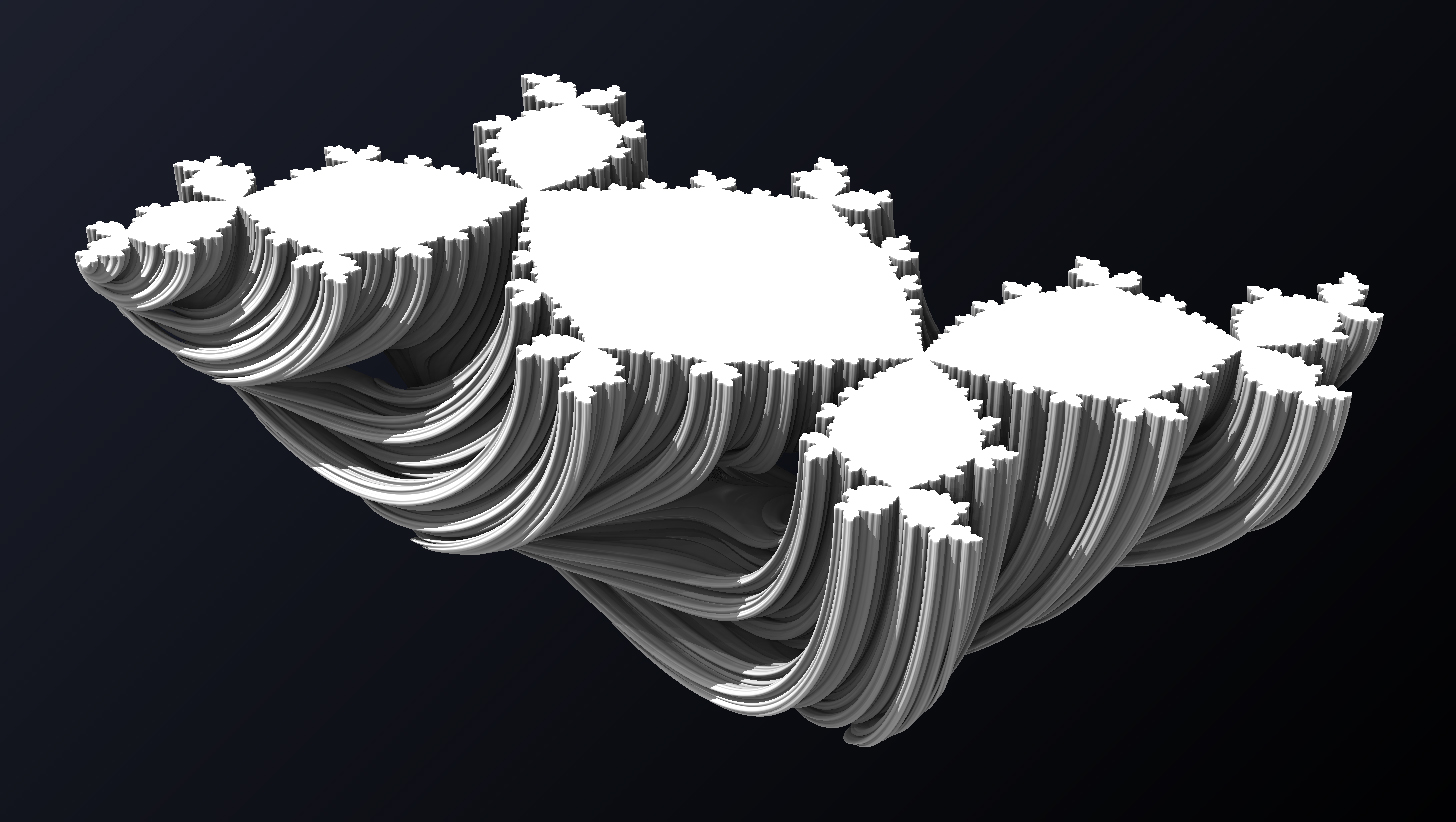
Embedded

A small embedded homeomorphic copy of rabbit in the center of a Julia set
Fat
The fat rabbit or chubby rabbit has c at the root of the 1/3-limb of the Mandelbrot set. It has a parabolic fixed point with 3 petals. Parabolic Julia set for internal angle 1 over 3.png|Fat rabbit Parabolic chessboard for internal angle 1 over 3.png|Parabolic chessboard
n-th eared
In general, the rabbit for the period-(n+1)th bulb of the main cardioid will have n ears For example, a period four bulb rabbit has three ears.
Perturbed
Perturbed rabbit Perturbated Rabbit Julia set.png|Perturbed rabbit PerturbatedRabbitJuliaSetZoom.png|Perturbed rabbit zoom
Twisted rabbit problem
In the early 1980s, Hubbard posed the so-called twisted rabbit problem, a polynomial classification problem. The goal is to determine Thurston equivalence types of functions of complex numbers that usually are not given by a formula (these are called topological polynomials):
- given a topological quadratic whose branch point is periodic with period three, determining which quadratic polynomial it is Thurston equivalent to
- determining the equivalence class of twisted rabbits, i.e. composite of the rabbit polynomial with nth powers of Dehn twists about its ears.
The problem was originally solved by Laurent Bartholdi and Volodymyr Nekrashevych using iterated monodromic groups. The generalization of the problem to the case where the number of post-critical points is arbitrarily large has been solved as well.
Gallery
File:Lapin de Douady 01.png|Gray levels indicate the speed of convergence to infinity or to the attractive cycle File:LCMJ rabbit.png|Boundaries of level sets File:Douady Rabbit Julia set with modified binary decomposition.png|Binary decomposition File:Douady Rabbit Julia set with modified binary decomposition LCM.png File:Rabbit Julia set with spine.svg|With spine File:Julia set with 3 external rays.svg|With external rays File:Fr253 rabbit4.jpg|Multibrot-4 Douady rabbit File:Fr158.jpg|A Douady rabbit on a red background File:Fr249.jpg|A chain of Douady rabbits
References
References
- "A Geometric Solution to the Twisted Rabbit Problem by Jim Belk, University of St Andrews".
- Laurent Bartholdi. (2006). "Thurston equivalence of topological polynomials". Acta Mathematica.
- "Period-n Rabbit Renormalization. 'Rabbit's show' by Evgeny Demidov".
- [http://www.math.nagoya-u.ac.jp/~kawahira/works/rims0402.pdf Note on dynamically stable perturbations of parabolics by Tomoki Kawahira] {{webarchive. link. (October 2, 2006)
- "Twisted Three-Eared Rabbits: Identifying Topological Quadratics Up To Thurston Equivalence by Adam Chodof".
- "Recent Research Papers (Only since 1999) Robert L. Devaney: Rabbits, Basilicas, and Other Julia Sets Wrapped in Sierpinski Carpets".
- "Polynomials, dynamics, and trees by Becca Winarski".
- Laurent Bartholdi. (2005). "Thurston equivalence of topological polynomials".
- (2019). "Recognizing Topological Polynomials by Lifting Trees".
This article was imported from Wikipedia and is available under the Creative Commons Attribution-ShareAlike 4.0 License. Content has been adapted to SurfDoc format. Original contributors can be found on the article history page.
Ask Mako anything about Douady rabbit — get instant answers, deeper analysis, and related topics.
Research with MakoFree with your Surf account
Create a free account to save articles, ask Mako questions, and organize your research.
Sign up freeThis content may have been generated or modified by AI. CloudSurf Software LLC is not responsible for the accuracy, completeness, or reliability of AI-generated content. Always verify important information from primary sources.
Report